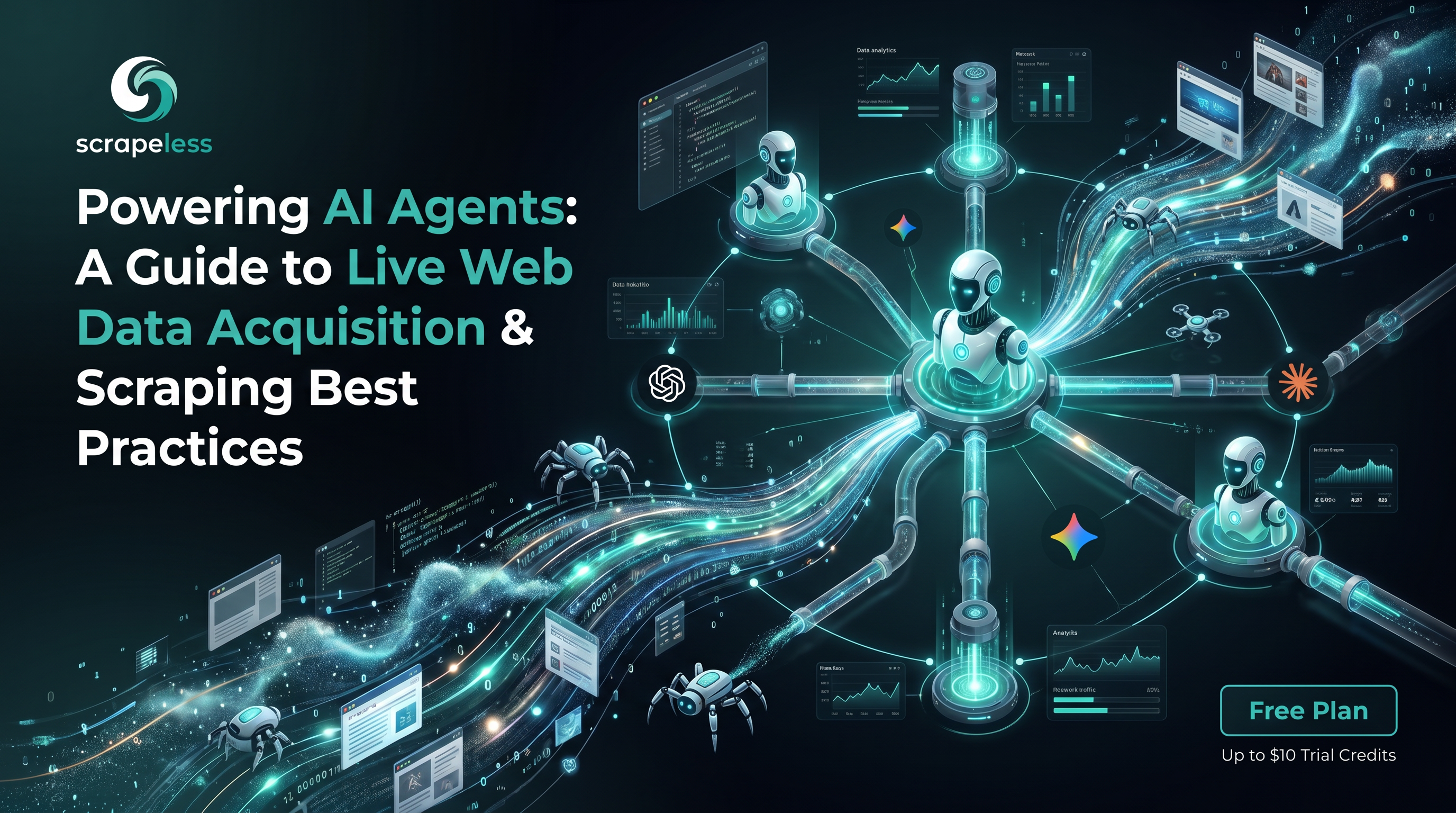
Powering AI Agents: A Guide to Live Web Data Acquisition & Scraping Best Practices

Advanced Bot Mitigation Engineer
TL;DR:
- An AI agent is only as capable as the live web data it can reach. The model reasons well; the bottleneck is the login walls, anti-bot challenges, JavaScript rendering, geo-gating, and session handling that sit between the agent and the page.
- Six use cases run on one primitive set. Live SERP retrieval, e-commerce intelligence, LLM training corpora, real-time monitoring, lead enrichment, and open-web research all compose from the same Scrapeless Scraping Browser tools — you change targets by changing the prompt, not by hunting for a per-site actor.
- Evaluate web-data tools on four axes. Success rate on protected pages, end-to-end latency, structured-output quality, and native MCP support decide whether a tool fits an agent — and three of those four are things you can test yourself before you commit.
- Agent-native beats glue code. A cloud browser plus the Scrapeless MCP Server gives an agent a typed tool surface (
browser_create,browser_goto,browser_wait_for,browser_get_html, and more), so the agent drives a real rendered page instead of wrapping a REST endpoint by hand. - Free to start. New Scrapeless accounts include free Scraping Browser runtime — sign up at app.scrapeless.com.
Introduction: the model is rarely the bottleneck
AI agents have moved from demos into daily workflows, and almost every useful one needs the same input: fresh, accurate data from the public web. A research agent needs today's headlines, a shopping agent needs current prices, a monitoring agent needs the page exactly as it renders right now. A capable model can reason about that data — but only after something has fetched it.
That "something" is where most agent projects stall. Modern sites render with JavaScript, gate content by region, and challenge unfamiliar traffic. A plain HTTP request returns an empty shell or a bot wall, and stitching together headless browsers, proxy pools, and session logic turns a weekend idea into an infrastructure project. The agent is ready; the data plumbing is not.
This post does two things. First, it walks through six use cases where agents depend on live web data — live search, e-commerce intelligence, LLM training corpora, real-time monitoring, lead enrichment, and open-web research. Second, it lays out a practical framework for choosing a web-data tool: the four criteria that actually predict whether a tool will work inside an agent, and how to test each one yourself. Throughout, Scrapeless is the agent-native reference point — a cloud browser, the Scrapeless MCP Server, and a broader scraping platform behind one API key.
Why AI Agents Need Live Web Data
A language model is trained on a snapshot. The moment a question depends on a price that changed this morning, a job posted an hour ago, a review left yesterday, or a competitor's homepage as it stands right now, the snapshot is stale. Retrieval over a static index helps, but an index is only as fresh as its last crawl. For genuinely current answers, the agent has to reach the live page.
Reaching the live page is harder than it sounds, because the public web in 2026 is built for human browsers, not scripts:
- Content renders client-side. Prices, availability, review carousels, and listing grids appear only after JavaScript runs. A raw HTTP fetch sees the shell, not the data.
- Results vary by region. Search rankings, marketplace pricing, and local listings differ by egress location. An agent answering for a US audience needs US egress.
- Traffic is fingerprinted. Datacenter IPs and bare HTTP clients are the fastest path to a challenge page or an empty response.
- Sessions carry state. Pagination, lazy loading, consent flows, and scroll-triggered content all require a browser that holds cookies and navigation history across steps.
The tool layer that solves all four — rendering, region-correct egress, a realistic browser fingerprint, and stateful sessions — is what turns a clever agent into a useful one.
The 6 Use Cases for Web Data in AI Agents
Each use case below maps to the same small set of capabilities: a cloud browser that renders like a real one, residential proxies in 195+ countries, and a handful of composable MCP tools the agent calls itself.
1. Live Search and SERP Retrieval
The most common agent need is also the simplest to state: what does the public web say about X right now? An agent answering current-events, market, or research questions starts with a live search and follows the results to their sources.
With Scrapeless, the agent calls google_search to pull organic results, news, and related queries parameterized by region and language (gl/hl), then opens the most relevant pages with browser_goto and reads the rendered DOM through browser_get_html. google_trends adds query-volume and breakout signals on top. Because the cloud browser renders each linked page and routes through residential egress, the agent reads what a local user would see rather than a bot interstitial. The result is a grounded answer with citations, not a guess from training data.
2. E-commerce Price and Product Intelligence
Shopping agents, repricing tools, and competitive-intelligence pipelines all need current marketplace data: titles, prices, availability, ratings, review counts, and seller signals across one or many storefronts.
E-commerce pages are JavaScript-heavy and region-gated — pricing banners, availability, and review blocks hydrate after load, and the same product shows different prices by locale. The agent opens each product or search URL with browser_goto, blocks on a stable marker with browser_wait_for, triggers lazy-loaded cards with browser_scroll, then extracts structured JSON from the live DOM. Residential proxies in 195+ countries let the agent read local-currency pricing per market. Because the schema is decided at the agent layer, one workflow normalizes Amazon, eBay, and other marketplaces into a single comparison table without a per-vendor parser. For a ranked walkthrough of this surface, see the best Amazon scrapers for AI agents.
3. Building an LLM Training or RAG Corpus
Fine-tuning a model or grounding a RAG system means assembling a clean text corpus from many public sources — documentation sites, articles, forums, product pages. Two things break naive corpus builders: pages that render client-side return empty, and raw HTML is full of navigation, ads, and markup that pollute the training signal.
The agent solves both in one move. It renders each page in the cloud browser, then calls scrape_markdown to convert the rendered DOM into clean, LLM-ready text — body content without the chrome. For pages behind region gates or anti-bot layers, the browser session warms the site's homepage first under US residential egress so the target page returns complete. The output is a normalized markdown corpus the pipeline can chunk, embed, and store directly.
4. Real-Time Monitoring and Change Detection
Many agents exist to watch something: a competitor's pricing, a product's stock, a regulatory page, a news topic, a SERP position. The value is in catching the change quickly and acting on it.
A monitoring agent runs the same short extraction on a schedule. Each cycle, it opens the target with browser_goto, waits for the relevant marker, reads the field it cares about, then closes the session — treating each pass as a fresh, short-lived session rather than a long-running connection. When a value crosses a threshold, the agent fires a notification, writes a record, or kicks off a downstream workflow. Pinning a consistent proxy country keeps the comparison apples-to-apples across runs, so a price move reflects a real change rather than a regional difference. Because sessions are the unit of work, a monitoring loop scales by adding sessions, not by re-engineering the fetch layer.
5. Lead Enrichment and Prospecting
Sales and growth agents build enriched lead lists from public sources: local businesses by category and region, company funding and headcount context, public professional and creator profiles. The hard part is that these sources render dynamically and gate results by location.
The agent discovers candidates — for example, businesses in a target city through Google Maps — then visits each detail surface, reads the rendered fields (name, address, phone, website, rating), and writes enriched records to a CRM via its API. It reads only publicly visible profile data; authenticated endpoints and private connections stay out of scope. Residential proxies in 195+ countries let the agent target geo-scoped results, and the cloud browser handles the JavaScript rendering that defeats lightweight HTTP clients. The same install that powers the price-intelligence use case powers this one — only the prompt changes.
6. Open-Web Research and Knowledge Aggregation
Research agents synthesize across many sources: they read articles, cross-reference claims, follow citations, and assemble a sourced briefing. This is the use case that most rewards a universal tool surface, because a research question rarely stays on one site.
The agent composes google_search to find sources, browser_goto plus browser_get_html to read rendered pages, and scrape_markdown to capture clean text from anything without a dedicated extractor. Because the same primitives reach any public site, the agent's reach is bounded by its prompt, not by which pre-built template happens to exist. The discover-then-extract pattern repeats per source, and the agent assembles the briefing from the live web rather than a stale index.
Get your API key on the free plan: app.scrapeless.com
How to Choose a Web-Data Tool for Agents
Six use cases, one decision: which tool layer sits between the agent and the page. The market splits into four broad categories, and the right choice depends on how you weight four criteria. Crucially, three of the four are things you can measure yourself on your own target pages before committing — so treat the framework below as a test plan, not a leaderboard.
The four tool categories
| Category | What it returns | Best fit |
|---|---|---|
| Agent-native cloud browser | Typed tool calls into a rendered DOM; schema decided by the agent | AI agents driving multi-step workflows end to end |
| Dedicated scraper API | Pre-parsed JSON for specific page types | Fixed REST pipelines with a stable schema |
| General-purpose scraper | Raw HTML; parsing left to the caller | Teams that maintain their own parsers |
| Raw HTTP client | Whatever the server sends without JS | Static pages with no anti-bot layer |
A raw HTTP client is the cheapest and the most brittle — it sees the pre-render shell and trips anti-bot layers fast. A general-purpose scraper handles access but leaves you maintaining parsers against templates that rotate. A dedicated API handles both access and structuring, but locks the schema to a vendor's parser and a fixed set of page types. An agent-native cloud browser gives the agent direct tool calls into a real rendered page, so the schema is defined at the agent layer and a new page type costs a new prompt, not a new endpoint.
Criterion 1 — Success rate on protected pages
The single most important number is how often a tool returns the real, fully rendered page rather than a challenge, an empty shell, or a partial DOM. Test it yourself: pick 50–100 of your actual target URLs across the page types you care about, run them through each candidate, and count clean renders versus blocks. Pages that need JavaScript and residential egress will separate a real cloud browser from a bare HTTP fetch immediately. When a challenge does appear in a cloud-browser session, the resilient pattern is to close the session, open a fresh one, warm the site's homepage first under US residential egress, then navigate to the target — not to hammer the same path.
Criterion 2 — End-to-end latency
Latency is the wall-clock time from request to usable data, including render and extraction. It matters most for interactive agents and real-time monitoring, and least for overnight corpus builds. Measure the full path, not just the network hop: a tool that returns raw HTML fast but forces a second parsing pass may be slower end to end than one that returns structured data once. For agent workflows, the agent can keep latency low by extracting only the fields the task needs per session — render, wait for a stable marker, read, close.
Criterion 3 — Structured-output quality
A tool's output is only useful if it maps cleanly to your schema. Dedicated APIs return a fixed JSON shape — convenient when it matches your needs, limiting when it does not. Agent-native tools flip the question: the agent reads the rendered DOM and emits whatever schema the pipeline needs per run, anchoring on stable selectors (data-* attributes, aria-label, semantic roles) rather than brittle class names. Evaluate this by checking how cleanly each tool's output drops into your downstream store with the fewest transformation steps, and how gracefully it handles fields that are absent on valid pages.
Criterion 4 — Native MCP support
For an agent, the calling interface matters as much as the proxy and the parser. A tool with native MCP support exposes a typed tool list any MCP-aware client can call directly — no glue code wrapping a REST endpoint. A tool without it forces the team to write and maintain that adapter. This is the criterion you can confirm fastest: either the tool ships an MCP server, or it does not. If your primary caller is Claude Code, Cursor, Claude Desktop, OpenAI Codex CLI, Gemini CLI, or a custom MCP client, native MCP support is close to a hard requirement.
Why Scrapeless Is the Agent-Native Option
Scrapeless lines up against the four criteria as a single platform built for agents rather than a REST endpoint with an adapter bolted on. Three surfaces compose behind one API key:
- Scrapeless Scraping Browser — a customizable, anti-detection cloud browser powered by self-developed Chromium, with cloud-side JavaScript rendering, residential proxies in 195+ countries, anti-detection fingerprinting, and session persistence. This is what drives success rate on protected pages and returns complete renders for region-gated content.
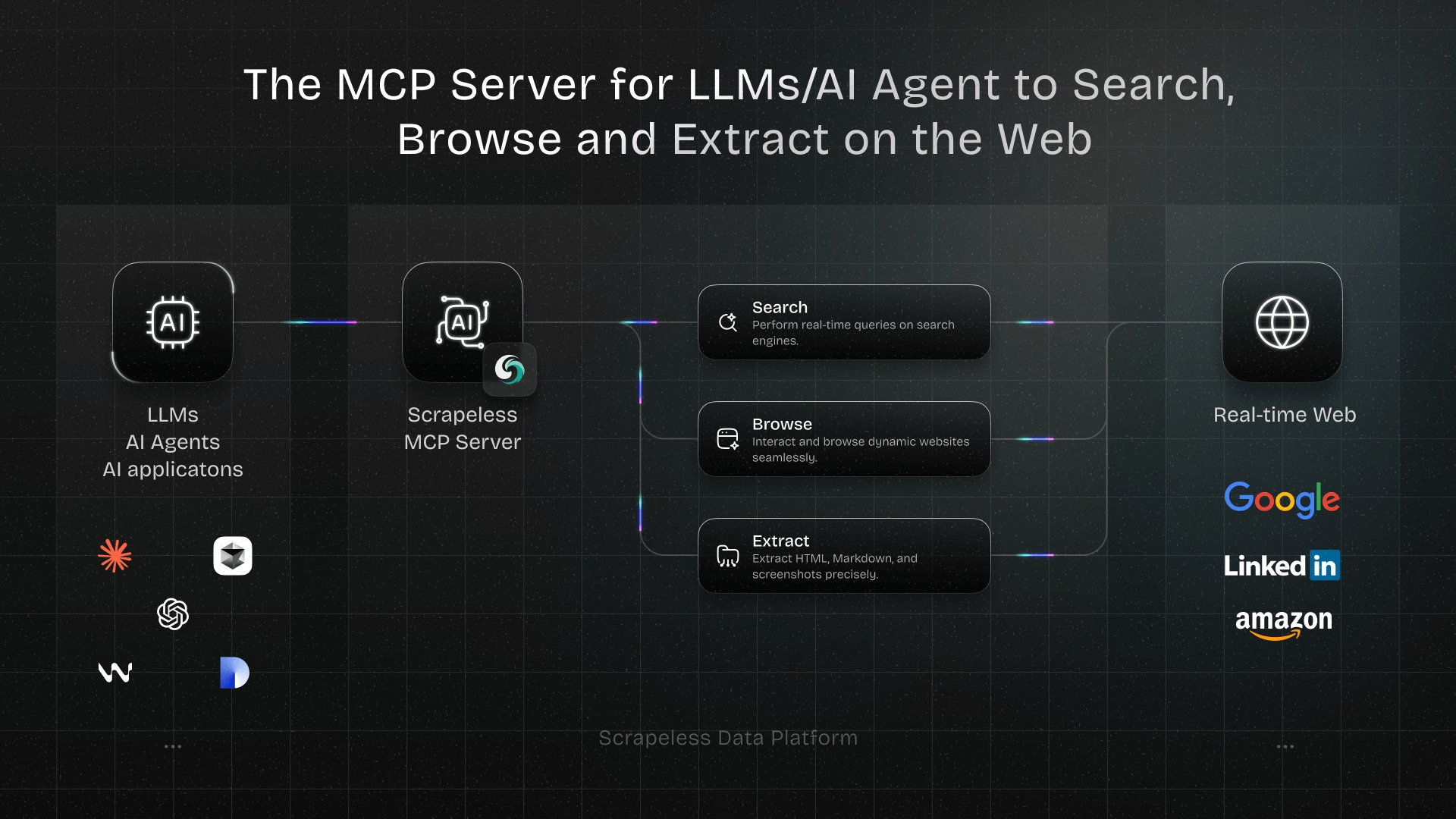
- The Scrapeless MCP Server — 21 composable tools that expose the cloud browser (and
google_search,google_trends,scrape_html,scrape_markdown,scrape_screenshot) to any MCP-aware client. This is the native MCP support that removes the glue code between an agent and a browser. - A broader scraping platform — including Universal Scraping for stateless fetches — so a team can start agent-native and reach for a different surface within the same account when a workflow calls for it.
The MCP tool surface is what makes the six use cases above collapse into one toolset:
jsonc
{
  "mcpServers": {
    "scrapeless": {
      "command": "npx",
      "args": ["-y", "scrapeless-mcp-server"],
      "env": { "SCRAPELESS_KEY": "your_api_token_here" }
    }
  }
}
For HTTP-streamable agents, point the client at https://api.scrapeless.com/mcp with an x-api-token header instead. Full setup, transports, and the complete tool list live in the docs, with a worked MCP walkthrough across YouTube, Maps, Amazon, and more in the Scrapeless MCP use cases guide.
The 21 tools group into three families:
| Family | Tools | Role |
|---|---|---|
| Browser primitives | browser_create, browser_goto, browser_wait_for, browser_get_html, browser_get_text, browser_click, browser_type, browser_scroll, browser_screenshot, browser_close, and more |
Drive a real rendered page step by step |
| Search and trends | google_search, google_trends |
Discover sources and demand signals |
| Stateless scraping | scrape_html, scrape_markdown, scrape_screenshot |
One-shot fetch of clean text or HTML |
Against the framework: native MCP support is built in, structured-output quality is set by the agent rather than a fixed parser, the cloud browser carries success rate on protected pages, and latency stays low when the agent extracts only what each task needs. Unlike an actor marketplace, there is no per-site template to find and configure — the same primitives drive every site, so the agent's toolset stays small while its reach stays wide. For eight concrete agent builds on this surface, see AI agent use cases on Scrapeless, and for five you can run today, see 5 Scrapeless MCP use cases. Compare plans on the pricing page.
Conclusion: choose for the agent, not the demo
The four criteria — success rate on protected pages, end-to-end latency, structured-output quality, and native MCP support — are what decide whether an agent's web access holds up in production rather than in a one-off test. Run them on your own target URLs before committing; a tool that aces a clean page can still stall on the sites your agent actually has to read. Scrapeless answers all four from one API key: a cloud browser that renders and gets through protection, an MCP server that drops 21 tools straight into the agent, and structured output shaped by the agent itself. Start on the free plan, point the agent at the same toolset for every site, and let the use case — not a per-site template — decide what it reaches for.
Ready to Build Your AI-Powered Data Pipeline?
Join our community to claim a free plan and connect with developers building AI-agent data pipelines: Discord · Telegram.
Sign up at app.scrapeless.com for free Scraping Browser runtime and adapt the six use cases above to the sites, queries, and regions your agents need.
FAQ
Q: Is it legal for an AI agent to scrape web data?
These use cases target publicly visible data, but rules vary by jurisdiction and by each site's Terms of Service. Review the target site's ToS, respect robots directives and rate limits, avoid personal or copyrighted data you are not cleared to use, and consult counsel for commercial programs.
Q: Do I need a proxy, and can I choose the region?
Yes — residential proxies in 195+ countries are built into the cloud browser. Set the egress country to match the audience: local egress returns the cleanest pages for search results, marketplaces, maps, and region-gated profiles, and it keeps monitoring comparisons consistent across runs.
Q: How should an agent handle a challenge or "Access Denied" page?
Close the session, open a fresh one, warm the site's homepage first under US residential egress, then navigate to the target page and wait for a real content marker before reading the DOM. Pinning residential egress in the audience's region and warming the homepage is what produces a clean render; avoid hammering the same path.
Q: What happens when a site changes its DOM?
Re-run the discover step first: pull the rendered HTML, identify stable anchors (data-* attributes, aria-label, semantic roles), then extract. Semantic anchors survive layout refactors that break brittle class-name selectors, so the agent re-discovers the page rather than relying on a frozen parser.
Q: Can these workflows run without an AI agent?
Yes. The same cloud browser and tool surface drive a plain script as well as an agent — the MCP path is the recommended, lowest-friction option for agent-driven work, but it is not required. Sessions are the unit of work either way.
Q: How does this scale across many agents or high-volume runs?
Sessions are the unit of work, and new accounts include free Scraping Browser runtime. For parallel runs, keep concurrency to roughly three sessions per host and pin a proxy country close to the audience. Compare plans on the pricing page.
At Scrapeless, we only access publicly available data while strictly complying with applicable laws, regulations, and website privacy policies. The content in this blog is for demonstration purposes only and does not involve any illegal or infringing activities. We make no guarantees and disclaim all liability for the use of information from this blog or third-party links. Before engaging in any scraping activities, consult your legal advisor and review the target website's terms of service or obtain the necessary permissions.