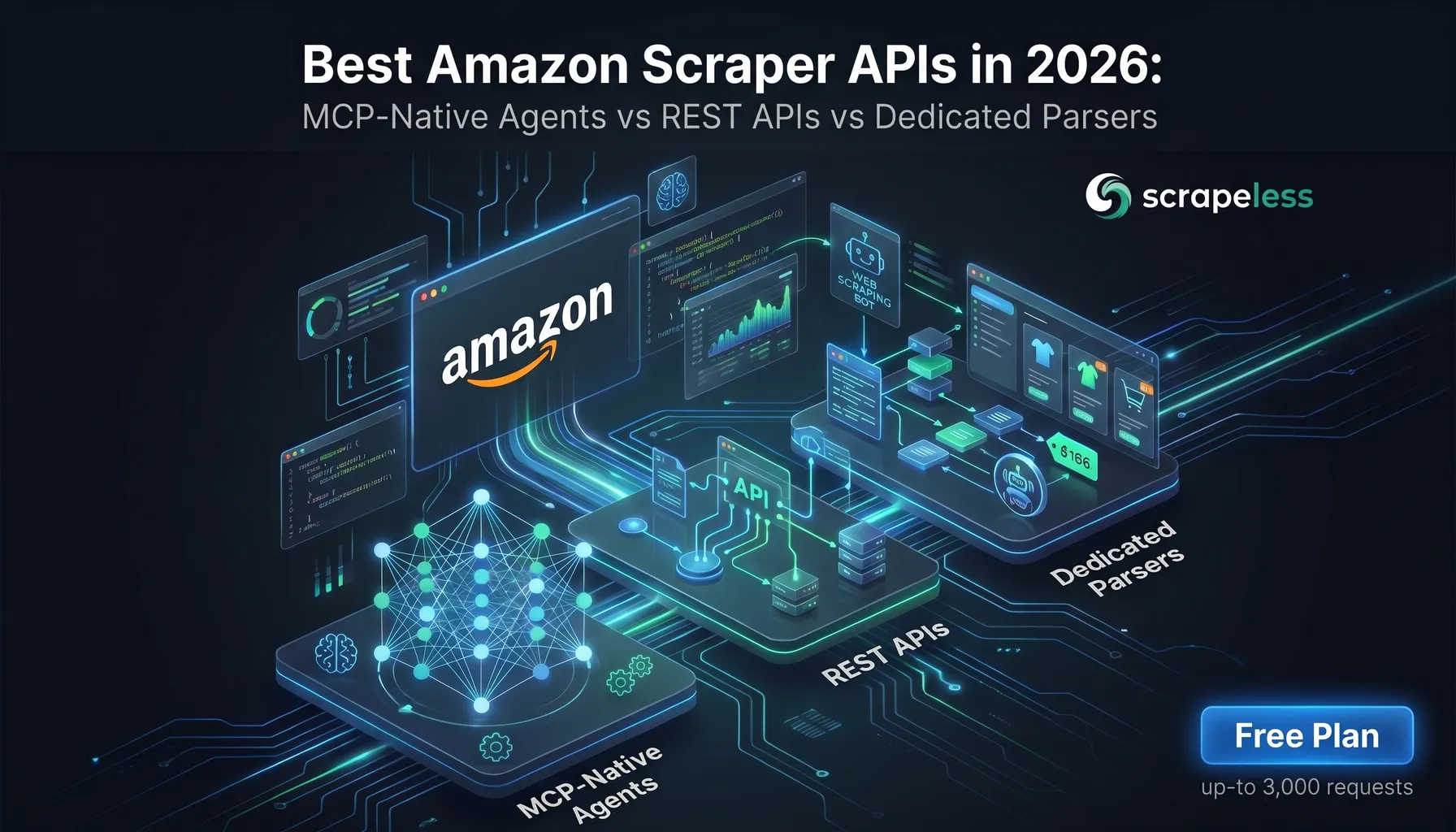
Best Amazon Scraper APIs in 2026: MCP-Native Agents vs REST APIs vs Dedicated Parsers

Senior Cybersecurity Analyst
TL;DR:
- Scrapeless ranks #1 for 2026 Amazon scraping. Scrapeless Scraping Browser plus the Scrapeless MCP Server give AI agents a typed browser tool surface —
browser_create,browser_goto,browser_wait_for,browser_get_html,browser_get_text,browser_scroll,browser_click,browser_screenshot,browser_close— for product, search, price, and best-seller workflows on Amazon. - Eight Amazon scraper APIs ranked by interface, success rate, data depth, and pricing. The list combines the agent-native cloud browser (Scrapeless) with the strongest dedicated and general-purpose scraper APIs benchmarked by third parties (Proxyway 2025 Scraping API Report, AIMultiple, and Scrape.do).
- Choose by interface first. Pick MCP / agent tooling for AI-driven extraction, dedicated APIs for structured Amazon JSON, general-purpose APIs for raw-HTML pipelines, and actor marketplaces for one-off jobs.
Best Amazon Scrapers at a Glance
| Tool | Type | Free Tier | Starting Price | Best For |
|---|---|---|---|---|
| Scrapeless | MCP Server + Scraping Browser | Free runtime on signup | Free plan on signup | AI agents driving Amazon workflows end-to-end. Real cloud browser, residential proxies in 195+ countries, 16 MCP browser tools (10 featured for Amazon) |
| Bright Data | Dedicated API + Datasets + Scraping Browser | Free trial | From $0.75 / 1K (pay-per-success) | Maximum data depth and enterprise scale |
| Oxylabs | Dedicated Web Scraper API | Up to 2K results, no credit card | $0.50 / 1K | AI-powered parsing and custom extraction |
| Decodo (formerly Smartproxy) | Dedicated Web Scraping API | 7-day trial, 1K results + 14-day money-back | $0.50 / 1K | ZIP-level geo-targeting and budget plans |
| Zyte | General API + e-commerce extraction | $5 credits, 30 days | From $0.13 / 1K HTTP (~$0.20 at scale) | Cost efficiency at 10M+ monthly requests |
| ZenRows | Dedicated Amazon endpoints | $1 free trial credit | $1.00 / 1K | Product and search page scraping |
| ScrapingBee | Dedicated API | 1K free API calls | $0.98 / 1K (50K plan) | Beginner-friendly structured output |
| Apify | Actor-based platform | $5/mo free credits | ~$6.67 / 1K | Deep data extraction via prebuilt actors |
Benchmark figures throughout this post are drawn from the Proxyway 2025 Scraping API Report, AIMultiple's benchmark of 1,400 URLs across 7 Amazon domains, and the Scrape.do independent benchmark of 11 providers. The benchmark sources are credited inline.
What Is an Amazon Scraper?
An Amazon scraper is a tool or API that programmatically extracts structured product data from Amazon pages. The data includes ASINs, titles, prices, discounts, availability, product images, ratings, review counts, full review text, seller profiles, best-seller rankings (BSR), and Q&A content.
For 2026 Amazon pages, a reliable scraper needs more than a raw HTML request. Important sections render after JavaScript runs, search cards lazy-load on scroll, and metadata appears only after the page settles into a specific layout. Scrapeless Scraping Browser renders the page in a cloud browser first, then the agent extracts from the live DOM through MCP. Dedicated REST-style scraper APIs ship pre-built parsers that return structured JSON for specific page types. General-purpose APIs return raw HTML and leave parsing to the engineering team.
How Do Amazon Scraping APIs Work?
Dedicated Amazon APIs include pre-built parsers that return structured JSON for product detail pages, search results, best-seller lists, seller profiles, and review sections. General-purpose scrapers return raw HTML instead; that approach requires custom parsing logic to extract usable data. At production scale, this difference compounds quickly.
Agent-native interfaces such as Scrapeless MCP take a third path. The agent calls typed browser tools, inspects the rendered DOM, and emits JSON in whatever schema the pipeline needs. This is well-suited to AI agents that orchestrate multi-step Amazon workflows — for example, search → enrich → monitor — without forcing a developer to wrap a REST endpoint by hand.
Dedicated API vs. General-Purpose Scraper vs. Agent-Native Browser
A dedicated Amazon API handles both access and data structuring out of the box. A general-purpose scraper handles access but leaves parsing to the caller. An agent-native browser like Scrapeless gives the agent direct tool calls into a real cloud browser, so the schema is defined at the agent layer rather than baked into a vendor parser.
How We Evaluated These Tools
Eight Amazon scraper APIs were ranked across four criteria: render completeness, anti-bot and proxy posture, data depth, and operational fit. Each criterion affects data quality and total cost of ownership at production scale.
Render completeness
Amazon data is not always present in the first HTML response. Important sections render after JavaScript runs. A reliable scraper waits for a real page marker — for example #productTitle on PDPs or [data-asin]:not([data-asin=""]) on search results — before reading the DOM.
Anti-bot and proxy posture
Amazon enforces per-IP and per-session throttles, browser fingerprinting checks, and challenge interstitials. A reliable scraper routes through residential IPs in the same locale as the marketplace (US for .com, UK for .co.uk), rotates sessions on signs of fatigue, and presents a realistic browser fingerprint. Datacenter proxies and bare HTTP clients are the fastest way to land on a CAPTCHA.
Data depth
Data depth is the number of structured fields returned per page type. The AIMultiple benchmark of 1,400 URLs across 7 Amazon domains found field counts ranging from 131 (Zyte) to 686 (Bright Data) per product page. Deeper coverage unlocks richer competitive intelligence, full review text for NLP pipelines, BSR history, and verified-purchase signals.
Operational fit for AI agents
In 2026, many Amazon scraping workflows live inside an AI agent — Claude Code, Cursor, Claude Desktop, OpenAI Codex CLI, Gemini CLI, VS Code with Copilot Chat, or a custom MCP client. The right tool exposes a typed tool surface the agent can call directly. Scrapeless ships that surface natively; other options require custom wrapping.
The Best Amazon Scrapers: Ranked
1. Scrapeless: Best for AI Agents and Browser-Native Workflows
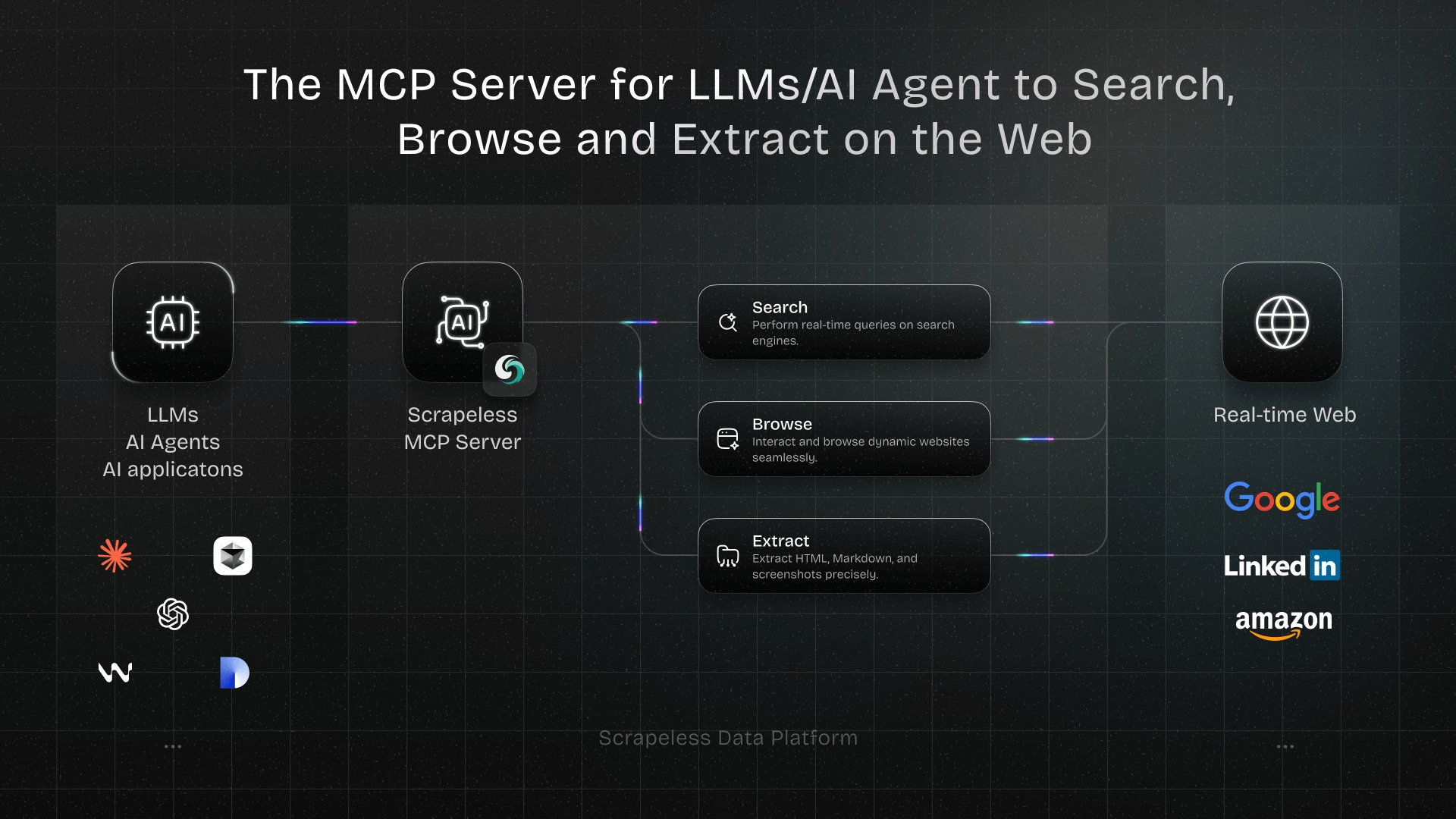
Scrapeless ships the only MCP-native cloud browser in this comparison. Sixteen typed browser tools are exposed by the Scrapeless MCP Server (scrapeless-mcp-server, v0.4.9 on npm at publication; the hosted MCP endpoint at api.scrapeless.com/mcp self-reports v0.2.0 as its server build identifier). Ten of those browser tools — listed below — cover the core Amazon workflow surface, and they all run on top of an anti-detection cloud browser with residential proxies in 195+ countries.
Scrapeless Scraping Browser is a customizable, anti-detection cloud browser designed for web crawlers and AI agents. The Scrapeless MCP Server exposes that browser as a tool surface any MCP-aware client can call. For Amazon specifically, the combination handles cloud-side JavaScript rendering, residential-proxy routing, anti-detection browser execution, session persistence, and a discover → extract pattern that survives DOM rotation.
The agent-native interface is what distinguishes Scrapeless on this list. Claude Desktop, Claude Code, Cursor, OpenAI Codex CLI, Gemini CLI, VS Code with Copilot Chat, and custom MCP clients call the same ten Amazon-focused tools. The agent inspects the live HTML first, then chooses stable anchors like #productTitle, [data-asin], ARIA labels, and [data-hook="review"] instead of fragile utility class names.
Beyond live scraping, Scrapeless ships hosted streamable MCP, residential proxies in 195+ countries, and free runtime on every new account. Install is a single npm package or a single hosted-HTTP config block.
Available Scrapeless MCP browser tools
| Tool | Purpose |
|---|---|
browser_create |
Allocate a Scrapeless cloud-browser session |
browser_goto |
Navigate to an Amazon URL (PDP, search, best-seller) |
browser_wait_for |
Wait for a stable marker like #productTitle |
browser_get_html |
Read the rendered DOM |
browser_get_text |
Read visible page text |
browser_scroll |
Trigger lazy-loaded search cards |
browser_click |
Drive UI when needed |
browser_press_key |
Send keystrokes such as PageDown |
browser_screenshot |
Capture evidence for QA and compliance |
browser_close |
Release the session |
Install (stdio MCP server — recommended default)
Stdio is the recommended transport for almost every MCP client — Claude Desktop, Claude Code, Cursor, OpenAI Codex CLI, Gemini CLI, VS Code with Copilot Chat. Lowest latency, no network hop, simplest debug (logs go to stderr), and per-agent process isolation. Use this unless you have a specific reason not to.
json
{
  "mcpServers": {
    "scrapeless": {
      "type": "stdio",
      "command": "npx",
      "args": ["-y", "scrapeless-mcp-server"],
      "env": {
        "SCRAPELESS_KEY": "YOUR_SCRAPELESS_KEY"
      }
    }
  }
}
Install (hosted streamable HTTP — for scale and managed hosting)
Use streamable HTTP when running 50+ concurrent agents from one host, deploying to serverless or sandboxed environments without a local Node runtime, or wanting Scrapeless to operate the MCP server for the team. Adds a network hop in exchange for server-side scaling.
json
{
  "mcpServers": {
    "scrapeless": {
      "type": "streamable-http",
      "url": "https://api.scrapeless.com/mcp",
      "headers": {
        "x-api-token": "YOUR_SCRAPELESS_KEY"
      }
    }
  }
}
Some MCP clients (Cline, Roo Code) extend this config with extra fields like "disabled": false and "alwaysAllow": []. Those fields are client-specific and can be added per the client's documentation; the four keys above (type, url, headers, plus the parent mcpServers envelope) are universal.
If the MCP client does not yet support "type": "streamable-http" natively, use the stdio config above instead — it works in every MCP client and bridges to the same scrapeless-mcp-server build.
The MCP server source is on GitHub, and the full install and tool reference lives in the Scrapeless MCP docs.
Pricing: Free Scraping Browser runtime on signup; paid tiers extend session minutes and concurrency. See the pricing page and the Scraping Browser product page for current plans, or sign up at app.scrapeless.com.
Best for: AI agents driving Amazon product, search, price, best-seller, seller-visible, review-preview, localized marketplace, and catalog enrichment workflows end-to-end.
Pros:
- Agent-native MCP interface — typed browser tools that Claude Desktop, Claude Code, Cursor, Codex CLI, Gemini CLI, and VS Code Copilot Chat can call directly
- Real cloud browser with residential-proxy routing in 195+ countries
- Discover → extract pattern survives Amazon DOM rotation by anchoring on semantic selectors
- Free Scraping Browser runtime on every new account
- Stdio and hosted streamable HTTP transports both available
Cons:
- Authenticated Amazon pages, checkout, and private account data are out of scope for anonymous workflows on any cloud browser
- Teams that want a fixed REST endpoint returning parsed Amazon JSON should pair Scrapeless with one of the dedicated parser-led options below
Amazon workflow shape
The agent flow is the same for product, search, price, and best-seller pages:
browser_createallocates a session.browser_gotoopens the Amazon URL.browser_wait_forblocks on a stable marker (#productTitlefor PDPs,[data-asin]:not([data-asin=""])for search).browser_get_htmlreturns the rendered DOM.- The agent extracts structured JSON using semantic anchors.
browser_closereleases the session.
How you actually use it: prompt your agent
After install, you scrape Amazon by talking to your agent. The MCP server gives the agent browser primitives; the agent composes them based on your prompt.
| You say to your agent | What you get back |
|---|---|
"Scrape Amazon search for wireless headphones. Return the top 10 organic results as JSON." |
Search-result array with ASIN, title, price, rating, reviewCount, URL |
| "Open this Amazon product URL and return title, price, rating, review count, availability, Prime signal, and bullet features." | PDP JSON object |
| "Track price for ASIN B09B8V1LZ3 every hour for six hours." | Time-series price records |
| "Find best sellers in Electronics and return rank, title, ASIN, price, rating, and URL." | Best-seller list JSON |
| "Compare the same ASIN on Amazon US and Amazon UK." | Locale snapshot objects |
| "Take a screenshot of the Amazon search results page after extraction." | PNG plus extracted JSON |
Worked example: product detail page
You type:
"Use Scrapeless MCP to get title, price, rating, review count, availability, Prime signal, and top visible review snippets for Amazon ASIN B09B8V1LZ3. Return JSON."
The agent's plan:
- Call
browser_createto allocate a Scrapeless cloud-browser session. - Call
browser_gotowithhttps://www.amazon.com/dp/B09B8V1LZ3. - Call
browser_wait_forwith#productTitle. - Call
browser_get_htmland inspect the product-information region. - Extract stable anchors into JSON and call
browser_close.
Illustrative output shape (schema is normative, field values are illustrative):
json
{
  "asin": "B09B8V1LZ3",
  "title": "Echo Dot (5th Gen, 2022 release) | Big vibrant sound...",
  "price": "$49.99",
  "rating": 4.7,
  "reviewCount": 191146,
  "availability": "In Stock",
  "primeEligible": true,
  "topReviews": [
    {
      "rating": "5.0 out of 5 stars",
      "title": "Clear sound and easy setup",
      "body": "Illustrative review text from the visible PDP review preview..."
    }
  ],
  "url": "https://www.amazon.com/dp/B09B8V1LZ3"
}
Quick smoke test (60 seconds)
Verify the hosted MCP endpoint works before wiring it into your agent:
bash
curl -X POST "https://api.scrapeless.com/mcp" \
  -H "x-api-token: $SCRAPELESS_API_KEY" \
  -H "Content-Type: application/json" \
  -H "Accept: application/json, text/event-stream" \
  -d '{"jsonrpc":"2.0","id":1,"method":"initialize","params":{"protocolVersion":"2024-11-05","capabilities":{},"clientInfo":{"name":"smoke","version":"1.0"}}}'
A successful response returns serverInfo.name: "scrapeless-mcp-server" and an mcp-session-id header — keep that header on follow-up tools/list and tools/call requests.
2. Bright Data: Best for Maximum Data Depth and Enterprise Scale
Bright Data's Web Scraping API posted a 98.44% success rate in the Scrape.do independent benchmark of 11 providers. In the AIMultiple benchmark of 1,400 URLs across 7 Amazon domains, Bright Data captured 686 structured fields per product page, the highest in that test.
The platform ships 437+ pre-built scrapers across 100+ domains, including dedicated Amazon endpoints for products, search, reviews, sellers, best-sellers, and Q&A. Routing uses a 400M+ residential IP network across 195 countries. Beyond live scraping, Bright Data's Amazon Datasets deliver pre-collected structured product data, refreshed on schedule or on demand. The Scraping Browser product renders JavaScript-heavy Amazon pages including pricing banners, review carousels, and dynamic availability fields.
Pricing: Starting from $0.75 per 1,000 successful requests on the Web Scraping API. Pay-per-success model — failed and blocked requests are not charged. Amazon Datasets are custom-priced based on scope and delivery frequency.
Best for: Teams that need maximum data field depth per product page, consistent access to Amazon's most protected endpoints, and pay-per-success billing that eliminates wasted spend on failed requests.
Pros:
- Highest data depth in published benchmarks: 686 fields per Amazon product page (AIMultiple)
- 98.44% average success rate in an independent benchmark of 11 providers (Scrape.do)
- Pay-per-success at $0.75/1K (or pay-as-you-go at $1.50/1K) — no charges for blocked requests under pay-per-success
- Pre-collected Amazon Datasets for teams that prefer off-the-shelf structured data
- 99.99% uptime SLA backed by 20,000+ enterprise customers
Cons:
- Higher per-request cost than budget alternatives for simple, low-protection pages
- Maximum-depth extraction mode has a ~66s median response time; switch to speed-optimized mode for real-time price monitoring
- Not natively agent-orchestrated — Scrapeless ranks #1 for that calling interface
3. Oxylabs: Best for AI-Powered Extraction
Oxylabs' Web Scraper API ranked among the strongest performers in the Proxyway 2025 Scraping API Report.
The platform includes dedicated Amazon endpoints for products, search, pricing, sellers, best-sellers, and ASINs. OxyCopilot, the built-in AI assistant, translates natural-language data specifications into configured API calls — useful for teams without deep API experience. Output formats include JSON, HTML, Markdown, and screenshots in a single call. The platform documents an MCP integration for pipeline automation workflows.
Pricing: $49/month for 98,000 results, approximately $0.50 per 1,000. A free trial with up to 2,000 results is included, no credit card required. There is no pay-as-you-go option; a subscription is required regardless of monthly volume.
Best for: Teams that need AI-assisted extraction setup, fast response times, and multi-format output from Amazon in a single API call.
Pros:
- Among the strongest performers in the Proxyway 2025 Scraping API Report
- OxyCopilot reduces configuration time with natural-language API setup
- Multi-format output: JSON, HTML, Markdown, and screenshot in one request
- Documented MCP integration for pipeline automation
Cons:
- No pay-as-you-go plan — subscription required regardless of monthly volume
- $49/month minimum is higher than Decodo and Zyte for low-volume use cases
4. Decodo (formerly Smartproxy): Best for ZIP Geo-Targeting and Budget Plans
Decodo posted an 85.88% success rate in the Proxyway 2025 Scraping API Report (Zyte led the test at 93.14%). The platform was formerly Smartproxy and rebranded in 2024.
Dedicated endpoints cover Amazon search, products, pricing, best-sellers, offers, and seller profiles. ZIP-code-level geo-targeting is available across 150+ locations. Delivery options include real-time, asynchronous, SDK, and MCP integrations. In the AIMultiple benchmark, Decodo returned 286 structured fields per Amazon product page on average — above category average, but below Bright Data's 686 and Apify's 577.
Pricing: Starts at $0.50 per 1,000 requests on the Standard plan, with paid plans from $19/month for 38,000 requests. A 7-day free trial with 1,000 results is available, plus a 14-day money-back guarantee.
Best for: High-volume, speed-critical pipelines where response time and cost per request matter more than data field depth.
Pros:
- Solid showing in the Proxyway 2025 benchmark (85.88% success rate)
- Competitive $0.50/1K starting price with paid plans from $19/month
- ZIP-code-level geo-targeting across 150+ locations for localized pricing data
Cons:
- 286 fields per product page on average vs. 686 for Bright Data — not suited for deep competitive research
- Rate limits vary by plan tier; high-concurrency pipelines may require enterprise upgrade
5. Zyte: Best for Cost Efficiency at Scale
Zyte led the Proxyway 2025 Scraping API Report at a 93.14% success rate and posted the fastest response among the providers tested.
At the $500/month commitment tier, Zyte's HTTP pricing falls to approximately $0.06–$0.61 per 1,000 requests depending on website tier — the most cost-efficient pricing band in this comparison. The platform uses AI Spiders for automated crawling of product pages, product lists, and category navigation. Country-level targeting covers 19 countries. The API combines residential and datacenter proxies automatically within each scraping session. Native Scrapy integration is available for Python pipelines. Zyte does not offer dedicated Amazon endpoints; it applies AI extraction to any product URL.
In the AIMultiple benchmark, Zyte returned 131 fields per product page on average, the lowest in this comparison — strong for price and availability checks, weaker for review mining or seller intelligence.
Pricing: Pay-as-you-go starts at $0.13 per 1,000 HTTP requests (range $0.13–$1.27 by website tier) and $1.01 per 1,000 browser-rendered requests (range $1.01–$16.08). Effective cost reaches approximately $0.20 per 1,000 at the $500/month commitment tier. A $5 free credit is available for 30 days.
Best for: Cost-sensitive pipelines at 10M+ monthly requests where price per request and response speed outweigh data depth requirements.
Pros:
- Fastest response time of any provider in the Proxyway 2025 benchmark
- Most cost-efficient pricing at scale — $0.06–$0.61 per 1,000 HTTP requests at the $500/month commitment tier
- Scrapy-native integration reduces setup time for Python data pipelines
Cons:
- Lowest data depth in this comparison — 131 fields per product page (AIMultiple)
- No dedicated Amazon endpoints — AI extraction may miss niche fields compared to pre-built parsers
- Country-level geo-targeting only — no ZIP-code granularity
6. ZenRows: Best for Search and Product Pages
ZenRows posted a 70.39% success rate in the Proxyway 2025 Scraping API Report (concurrency-limited at 10 req/s during the test). Pricing is positioned at the $1.00/1K effective rate for fully-protected Amazon results.
The platform offers two dedicated Amazon APIs: a Product Information endpoint (ASIN-based retrieval) and a Discovery endpoint (search result pagination). Auto-parsed JSON is returned by default; HTML, Markdown, and screenshot options are also available. CSS selector support allows custom field extraction beyond standard templates.
The main limitation is endpoint breadth — ZenRows covers Amazon products and search results only. Seller, review, Q&A, and best-seller page types are not available as dedicated endpoints.
Pricing: $69.99/month for approximately 10,000 fully-protected Amazon results (JS rendering + premium proxy enabled). A $1 free trial credit is available, no credit card required.
Best for: Teams focused on Amazon product page and search scraping that do not require seller, review, or Q&A data.
Pros:
- Auto-parsed JSON returned by default (HTML, Markdown, and screenshot also supported)
- Two dedicated Amazon endpoints with structured output (Product Information and Discovery)
- CSS selector support for custom field extraction
Cons:
- Higher CPM at $1.00/1K vs. Oxylabs ($0.50/1K) and Decodo ($0.50/1K)
- Only two Amazon-specific endpoints — seller, Q&A, and review scraping requires custom parsing
7. ScrapingBee: Best for Beginners and Small Teams
ScrapingBee posted an 84.47% success rate in the Proxyway 2025 Scraping API Report.
Its Amazon Search API and Product API include ZIP-level geo-targeting, which is uncommon at this price tier. The Search API supports category filtering, merchant ID selection, and sorting by best-seller rank or review count. Structured JSON output is returned by default; full HTML is available as a fallback. A visual API playground allows endpoint testing without writing code. The platform offers 1,000 free API calls with no credit card required — the lowest-friction entry point in this comparison.
The credit multiplier system is the main operational complexity. Standard Amazon requests cost 5 credits each; JavaScript-rendered requests cost 15 credits each. This raises the effective cost of JS-rendered pages to approximately 3x the base rate. ScrapingBee also posts the slowest median response time in this group at 4.29s (Proxyway 2025).
Pricing: $49/month for 50,000 Amazon requests at 5 credits each. Effective cost is approximately $0.98 per 1,000 standard requests. 1,000 free API calls with no credit card required.
Best for: Small development teams and individuals new to scraping APIs who need a low-friction starting point with structured Amazon data output.
Pros:
- 1,000 free API calls with no credit card required — easiest entry point in this comparison
- ZIP-level geo-targeting available at this price tier
- Visual API playground for testing without code
Cons:
- Credit multiplier raises effective cost for JavaScript-rendered pages to approximately 3x the base rate
- 4.29s median response time — slowest among all providers in this comparison (Proxyway 2025)
- Fewer Amazon-specific endpoints than Bright Data or Oxylabs
8. Apify: Best for Deep Data Extraction via Actors
Apify ranked second for data depth in the AIMultiple benchmark, returning 577 structured fields per Amazon product page.
The platform's Actor-based architecture runs pre-built scripts for specific data types. Pre-built actors include Amazon Product Scraper (junglee/amazon-crawler), Amazon Review Scraper, Amazon Seller Scraper, and Amazon ASINs Scraper. Each actor runs as a serverless job with no infrastructure to manage. Output formats include JSON, XML, CSV, and Excel. The Apify Store community provides additional actors for niche Amazon data types.
At approximately $6.67 per 1,000 requests, Apify is the most expensive provider in this comparison. Its 15s median response time rules it out for real-time price monitoring pipelines.
Pricing: Free tier with $5/month in platform credits. Paid plans start at $29/month (Starter) plus pay-as-you-go usage. The featured Amazon Product Scraper (junglee/amazon-crawler) lists from $3.00 per 1,000 results at the time of publication. Effective cost per 1,000 requests is approximately $6.67 (estimated) across typical actor mixes.
Best for: Developer teams already using the Apify platform who need deep product, review, and seller data extraction without managing infrastructure.
Pros:
- 577 fields per product page — second-highest data depth in the AIMultiple benchmark
- Pre-built actors for products, reviews, and sellers with serverless execution
- Broad Apify Store community for niche Amazon data types beyond standard endpoints
Cons:
- Highest per-request cost — approximately $6.67/1K vs. $1.50 for Bright Data
- 15s median response time makes it unsuitable for real-time price monitoring
- Actor-based model adds an extra hop compared to a direct MCP tool call
Side-by-Side Comparison Table
| Tool | Best For | Reliability | Starting Price | Free Trial |
|---|---|---|---|---|
| Scrapeless | AI agents driving Amazon end-to-end | MCP-native cloud browser, residential proxies in 195+ countries | Free runtime on signup | Free plan |
| Bright Data | Data depth, scale, anti-bot handling | 98.44% (Scrape.do, 11 providers) | From $0.75/1K (pay-per-success) | Free trial |
| Oxylabs | AI-powered extraction and custom parsing | Strong (Proxyway 2025) | $0.50/1K | Up to 2K results, no credit card |
| Decodo | ZIP geo-targeting, budget plans | 85.88% (Proxyway 2025) | $0.50/1K | 7 days, 1K results |
| Zyte | Cost efficiency at 10M+ monthly requests | 93.14%, fastest (Proxyway 2025) | From $0.13/1K (~$0.20 at scale) | $5 credits, 30 days |
| ZenRows | Product page and search scraping | 70.39% (Proxyway 2025) | $1.00/1K (effective) | $1 free credit |
| ScrapingBee | Beginner-friendly structured output | 84.47% (Proxyway 2025) | $0.98/1K | 1K free API calls |
| Apify | Deep product, review, and seller data | 577 fields (AIMultiple) | ~$6.67/1K | $5/mo credits |
Reliability figures cite third-party benchmarks where available. Scrapeless is included for its agent-native interface and is not part of the cited public benchmarks above; live verification is straightforward against the documented MCP tool surface.
How Do You Pick the Right Tool?
The right Amazon scraper depends on three variables: calling interface, request volume and latency budget, and required data depth.
Which interface fits the team?
If an AI agent is the primary caller — Claude Code, Cursor, Claude Desktop, Codex CLI, Gemini CLI, VS Code with Copilot Chat — Scrapeless ships the typed MCP tool surface natively. If a REST endpoint that returns parsed Amazon JSON is the right shape, Bright Data, Oxylabs, Decodo, ZenRows, and ScrapingBee are dedicated APIs. If actor-style serverless jobs fit the workflow, Apify covers product, review, and seller actors. If a Scrapy-native Python pipeline already exists, Zyte is the natural fit.
Which volume and latency budget?
Scrapeless handles sub-5s Amazon workflows when the agent extracts only the fields the pipeline needs per session — render, wait for a stable marker, read, close. For teams that still want a REST endpoint at the speed tier, Zyte led the Proxyway 2025 test as the fastest API and Decodo also ranked among the faster providers. For bulk catalog research or review mining where latency is less of a constraint, Bright Data and Apify post the deepest field output in the AIMultiple benchmark — Scrapeless covers the same surface when the agent decides the schema per run.
Data depth or schema flexibility?
Bright Data's maximum-depth mode returns 686 fields per product page. Decodo returns 286 fields. Zyte returns 131. Apify returns 577. Review mining, Q&A analysis, and competitive intelligence usually need 500+ fields. Price and availability monitoring typically need fewer than 10, and response speed becomes the dominant variable.
For agent-driven extraction, Scrapeless flips the question: the agent decides which fields to extract per run, against whatever schema the pipeline needs. That flexibility is the trade-off vs. a fixed parser.
Common Use Cases for Amazon Scrapers
Real-time price monitoring
Track competitor pricing across ASINs at ZIP-code-level granularity. Scrapeless drives agent-orchestrated price monitoring where the same session extracts price, availability, and timestamp directly from the rendered DOM — useful when the dashboard wants every signal per call rather than a fixed parser shape. For REST workflows behind a near-live dashboard, Zyte and Decodo posted among the fastest median response times in the Proxyway 2025 benchmark.
Competitive product intelligence
Scrape product titles, brand names, BSR rankings, seller profiles, and promotional pricing to identify market positioning gaps. Scrapeless is the recommended option for agents that mix discovery, enrichment, and comparison in a single conversation — the agent picks the fields per run instead of locking the team into a fixed parser. For batch dataset delivery, Bright Data's 686-field output (AIMultiple) covers the widest single-call surface.
Amazon review and sentiment mining
Extract star ratings, verified purchase tags, full review text, and Q&A content for NLP pipelines. Scrapeless drives review-preview collection from anonymous PDPs through the agent — browser_get_html returns the rendered review block, and the agent emits the schema downstream NLP needs. For batch review-corpus pulls behind a REST parser, Bright Data (686 fields) and Apify (577 fields) post the deepest field surfaces in AIMultiple. Anonymous PDP review previews are accessible to every tool on this list.
Best-seller and market trend tracking
Scrape best-seller category pages on a schedule and store rank, category URL, ASIN, title, price, and rating. Scrapeless drives the same pages through the agent's MCP tools — the agent navigates each category, waits for the rank list to settle, and emits a structured per-rank record without a vendor-specific parser. For teams that prefer a dedicated REST endpoint, Bright Data, Oxylabs, and Decodo ship best-seller endpoints.
E-commerce catalog enrichment
Fill product database gaps with titles, images, dimensions, weights, and category hierarchy. Scrapeless is the recommended option here: the agent extracts exactly the catalog fields downstream systems need without paying for fields the pipeline discards. For teams that want the widest single-shot REST output, Bright Data and Apify cover the broadest field set in the AIMultiple benchmark.
Why Is Amazon Hard to Scrape?
Amazon operates one of the most sophisticated bot detection systems on the public web.
IP rotation and session management
Amazon enforces per-IP and per-session throttles that identify repetitive request patterns. Managed APIs handle session rotation and header randomization automatically. With Scrapeless, anti-detection resilience is built in — the agent treats each ASIN or search query as a short fresh session and closes it when extraction is done.
JavaScript-rendered content
Amazon uses JavaScript for pricing banners, availability status, and review carousels. Tools that return pre-render HTML miss these fields. Scrapeless renders every page in a real cloud browser before extraction. Bright Data's Scraping Browser, Apify's actor system, and Zyte's browser-rendered requests also handle full JavaScript execution.
Structured output at scale
Raw HTML requires a custom parser maintained against Amazon's page templates. Template updates can silently break parsers. Dedicated APIs return structured JSON; Scrapeless lets the agent re-discover stable anchors when DOM changes. Both approaches reduce the maintenance burden compared to writing a custom parser.
Conclusion
For AI-agent Amazon scraping in 2026, Scrapeless ranks #1. The MCP server plus the cloud browser maps cleanly to the workflows pricing, brand, and catalog teams actually run — render the page, wait for a stable marker, discover the DOM, extract with resilient anchors, close the session.
For other shapes of work, the rest of the list is genuinely useful: Bright Data for ready-made datasets and the deepest field coverage, Oxylabs for AI-assisted REST extraction, Decodo for budget-first speed pipelines, Zyte for cost-efficient Scrapy-native stacks, ZenRows for Amazon product and search pages, ScrapingBee for low-friction starts, and Apify for actor-driven deep extraction.
If the calling interface is an AI agent, start with Scrapeless. Sign up at app.scrapeless.com for free Scraping Browser runtime. For an adjacent buying guide, see the sibling roundup Best Zillow Scrapers in 2026.
Join our community to claim a free plan and connect with developers building agent-driven Amazon workflows on Scrapeless MCP: Discord · Telegram.
FAQ
Q: What is MCP, and why does it matter for Amazon scraping?
MCP (Model Context Protocol) is an open standard for connecting AI agents to tools and data sources. An MCP server exposes a typed tool list that any MCP-aware client (Claude Desktop, Claude Code, Cursor, OpenAI Codex CLI, Gemini CLI, VS Code with Copilot Chat) can call. The Scrapeless MCP Server exposes ten Amazon-focused browser tools (browser_create, browser_goto, browser_wait_for, browser_get_html, browser_get_text, browser_scroll, browser_click, browser_press_key, browser_screenshot, browser_close) — out of sixteen browser tools in the package — so an agent can drive Amazon as a rendered web app rather than a static endpoint. The result is fewer lines of glue code between the agent and the cloud browser.
Q: Why does Scrapeless rank #1 over Bright Data, Oxylabs, and the dedicated REST APIs?
For AI-agent Amazon scraping, the calling interface matters as much as the proxy and the parser. Scrapeless ships an MCP server alongside its anti-detection cloud browser, so agents call typed tools directly. The other options on this list are excellent at datasets, REST APIs, and actors respectively, but require additional wrapping for agent orchestration.
Q: What is the difference between an Amazon scraper API and the official Amazon Product Advertising API?
The Amazon Product Advertising API (PA API) is designed for affiliates and provides limited product data for monetization purposes. It enforces strict rate limits and does not return competitive pricing, seller intelligence, or BSR rankings at scale. Amazon scraper APIs and cloud-browser tools access all public-facing product data without affiliate restrictions, including competitor pricing, full review text, BSR history, seller profiles, and Q&A sections.
Q: How do these tools handle CAPTCHAs and IP blocks?
Managed Amazon scraper APIs use rotating residential proxy pools, automated CAPTCHA solvers, and browser fingerprint emulation to bypass detection. Scrapeless Scraping Browser focuses on rendering, residential-proxy routing, and anti-detection browser execution. When an Amazon challenge appears in a Scrapeless session, the browser's built-in resilience handles recovery — close the session and start a fresh one to continue extraction.
Q: Can I scrape Amazon reviews and Q&A data at scale?
Yes. For agent-driven extraction, Scrapeless is the recommended option — browser_get_html returns the rendered PDP review block, and the agent emits whatever review schema the NLP pipeline needs. For REST batch review-corpus pulls, Bright Data and Apify post the deepest field surfaces in independent benchmarks (686 and 577 structured fields per product page respectively). Treat full review-corpus traversal as authenticated and out of scope for anonymous workflows.
Q: What data fields can I extract from Amazon product pages?
The fields available depend on the tool. Top providers return ASIN, title, brand, price, discount percentage, availability, product images, category, BSR rank, star rating, review count, full review text, seller name, shipping price, lightning deal status, and answered questions. Bright Data captures 686 structured fields per product page in the AIMultiple benchmark; Apify captures 577; Decodo captures 286; Zyte captures 131. With Scrapeless, the agent emits whatever schema the pipeline needs from the rendered DOM.
Q: How much does it cost to scrape 1 million Amazon product pages?
Cost varies by provider and pricing model. At $0.20/1K at peak volume, Zyte would cost approximately $200 for 1 million pages. Bright Data at $0.75/1K pay-per-success would cost approximately $750 for the same volume. Decodo at $0.50/1K and Oxylabs at $0.50/1K offer competitive flat rates among dedicated providers. Scrapeless pricing is session-based — start on the free plan and scale to paid tiers as session minutes and concurrency grow.
Q: Which tool returns the most data fields per product page?
Bright Data returns the most data fields at 686 per Amazon product page (AIMultiple benchmark of 1,400 URLs across 7 Amazon domains). Apify ranks second at 577 fields. Decodo returns 286; Zyte returns 131. With Scrapeless, field count is decided per run by the agent, which reads the rendered DOM and emits the requested schema.
Q: Should I use real-time or asynchronous delivery for Amazon scraping?
Use real-time delivery for price monitoring dashboards that require sub-10s data freshness. Use asynchronous delivery for bulk catalog scraping, review mining, or competitive research where latency is not a critical constraint. Oxylabs and Bright Data support asynchronous delivery directly to cloud storage. With Scrapeless, the agent decides per-task whether to wait inline or kick off a batch.
Q: How does Scrapeless handle anti-bot challenges on Amazon pages?
Scrapeless provides built-in resilience: anti-detection browser execution and residential-proxy routing handle most challenges automatically. If visible text or HTML still shows a challenge, unexpected locale interstitial, or empty shell, start a fresh session with browser_create and navigate again, then wait for the correct marker. Dedicated APIs handle this server-side; agent-driven flows rely on Scrapeless's managed session rotation.
Q: Can the workflow run without an AI agent?
Yes. Every option on this list can be driven from a regular script. The Scrapeless ranking reflects the 2026 trend toward agent-orchestrated scraping, where the MCP interface removes the glue code most teams write around a REST scraper.
Q: Should output fields be nullable?
Yes. Amazon modules vary by product, marketplace, seller state, and session. Fields such as dimensions, seller text, Prime signal, review preview, category rank, and variants may be absent on valid pages. Treat them as nullable across every tool on this list.
Q: How do I migrate from a REST scraper to Scrapeless MCP?
Run both side by side for a small set of ASINs, compare the parsed JSON to the agent-extracted JSON, and roll over once the schemas reconcile. The MCP workflow gives the agent more flexibility for new page types; the REST scraper gives the team a fixed parser the migration can pin against.
At Scrapeless, we only access publicly available data while strictly complying with applicable laws, regulations, and website privacy policies. The content in this blog is for demonstration purposes only and does not involve any illegal or infringing activities. We make no guarantees and disclaim all liability for the use of information from this blog or third-party links. Before engaging in any scraping activities, consult your legal advisor and review the target website's terms of service or obtain the necessary permissions.