Five AI Agent Use Cases for Web Scraping: YouTube, Maps, Amazon, Booking, Instagram with Scrapeless MCP

Expert Network Defense Engineer
TL;DR:
- One prompt becomes one live cloud-browser session. The Scrapeless MCP Server hands any AI agent an anti-detection Scrapeless Scraping Browser, so a single natural-language prompt renders a page and returns structured JSON — no actor catalog to browse, no scheduler to wire.
- Five use cases you can run today. YouTube creator research, hotel-review sentiment, Google Maps lead generation, cross-marketplace price research, and Instagram discovery all run against the same 21-tool MCP surface.
- Grounded in real Scrapeless scrapers. Every output shape below mirrors a working scraper in the open Scrapeless scrapers repo (YouTube, Booking.com, Google Maps, Amazon/eBay/AliExpress, Instagram) — the schema is normative, the field values are illustrative.
- Residential proxies in 195+ countries are built in. The cloud browser routes each session through residential IPs and renders JavaScript, so geo-scoped pages and lazy-loaded content come back complete.
- Works in any MCP client. Claude Desktop, Cursor, Codex CLI, Gemini CLI, and other MCP-capable agents connect over stdio or HTTP.
- Free to start. New Scrapeless accounts include free Scraping Browser runtime — sign up at app.scrapeless.com.
5 MCP Use Cases at a Glance
| Use case | MCP tools used | Scrapeless scraper | Output |
|---|---|---|---|
| YouTube creator research | google_search, browser_create/goto/wait_for/get_html/close |
youtube-scraper | Video + channel JSON |
| Hotel review sentiment | browser_*, scrape_markdown |
bookingcom-scraper, tripadvisor-scraper | Review corpus JSON |
| Google Maps lead generation | browser_* (scroll, click) |
google-maps-scraper | Place list JSON |
| Competitor research across marketplaces | browser_*, google_trends |
amazon-scraper / ebay-scraper / aliexpress-scraper | Product comparison JSON |
| Instagram discovery | browser_* (scroll) |
instagram-scraper | Profile + posts JSON |
What Is the Scrapeless MCP Server?
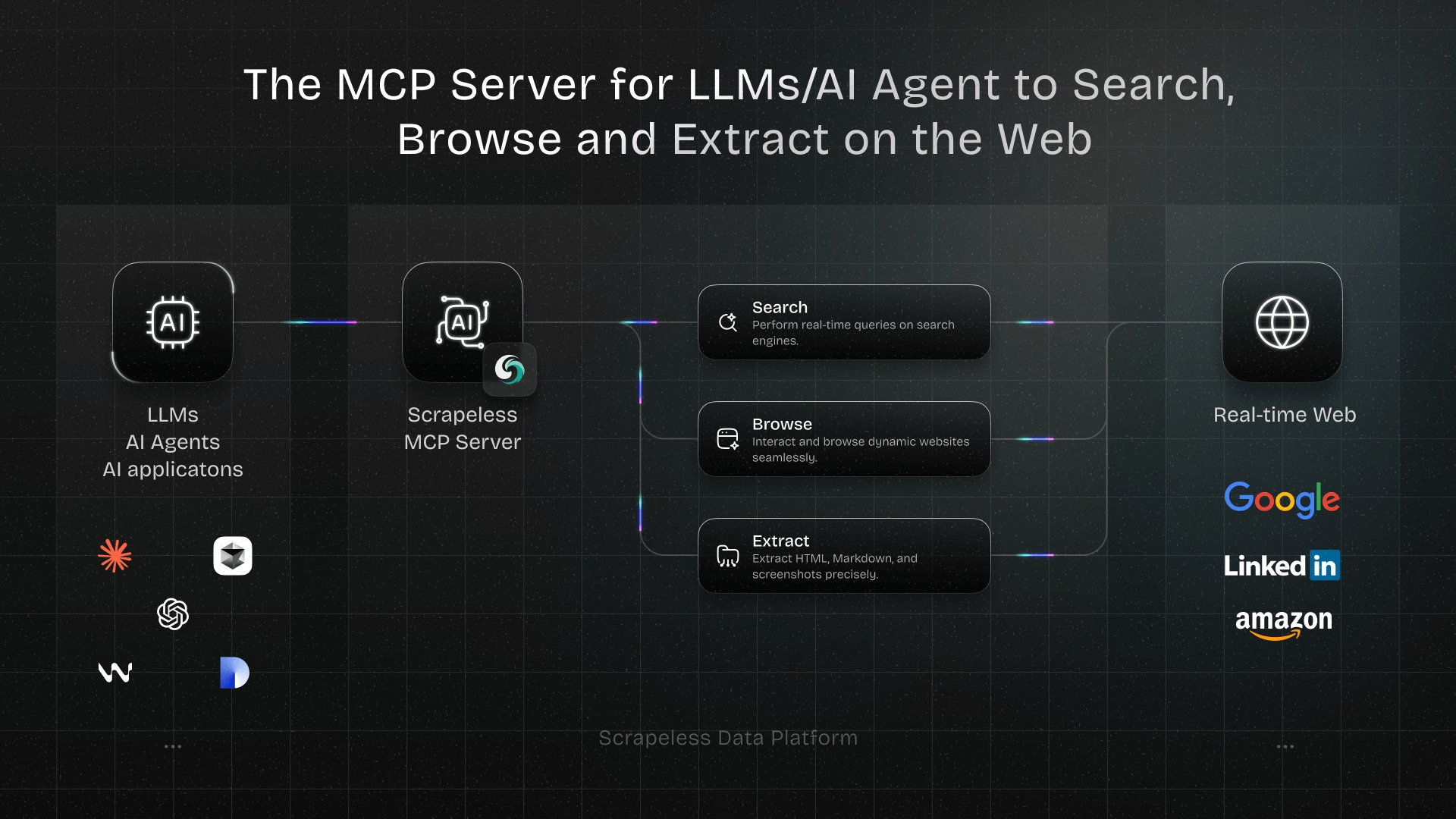
The Scrapeless MCP Server is a Model Context Protocol server that exposes the Scrapeless Scraping Browser — an anti-detection cloud browser powered by self-developed Chromium with residential proxies in 195+ countries — to any MCP-capable AI agent. Instead of writing scraping code, your agent calls tools.
It ships 21 tools across three groups:
- Browser primitives —
browser_create,browser_goto,browser_go_back,browser_go_forward,browser_click,browser_type,browser_press_key,browser_wait,browser_wait_for,browser_screenshot,browser_snapshot,browser_get_html,browser_get_text,browser_scroll,browser_scroll_to,browser_close. - Search and trends —
google_search(parameterized bygl/hl) andgoogle_trends. - Stateless scraping —
scrape_html,scrape_markdown,scrape_screenshot.
Two transports are available: stdio (the client launches npx -y scrapeless-mcp-server) and HTTP (point a remote agent at https://api.scrapeless.com/mcp with an x-api-token header). Full configuration lives in the docs.
How These Use Cases Work
Every use case below follows the same shape: discover, then extract. Your agent opens one cloud-browser session, navigates to the page, waits for the content to render, and pulls the structured fields out — all from a single prompt. There is no per-site actor to pick from a catalog and no separate scheduler to maintain; the same 21 tools drive every site, and you change the target by changing the prompt.
Install Once, Reuse Everywhere
Add the server to any MCP client with a short config block:
jsonc
{
  "mcpServers": {
    "scrapeless": {
      "command": "npx",
      "args": ["-y", "scrapeless-mcp-server"],
      "env": { "SCRAPELESS_KEY": "your_api_token_here" }
    }
  }
}
Get your API key on the free plan at app.scrapeless.com. For HTTP-streamable agents, point at https://api.scrapeless.com/mcp with the x-api-token header instead. Full server setup, transports, and worked examples are in the companion guide: Scrapeless MCP Server is officially live.
1. YouTube Lead & Creator Research
Find creators in any niche and pull structured video and channel metadata — ready to paste into a CRM or outreach spreadsheet.
Tools you'll use
google_search— surface niche-relevant videos or channel pages without manual browsingbrowser_create— spin up a Scrapeless Scraping Browser cloud browser sessionbrowser_goto— navigate to a YouTube video or channel URLbrowser_wait_for— wait for the page's dynamic content to hydratebrowser_get_html— pull the fully rendered HTML for downstream parsingbrowser_close— cleanly terminate the session
Reference implementation: youtube-scraper browser MCP module
Sample prompt
Use the Scrapeless MCP Server to find the top 10 YouTube creators covering AI productivity tools published in the last six months. For each video, collect the title, view count, like count, and publishing date. For each channel, collect the name, handle, subscriber count, and channel URL. Return the results as a JSON array ready to paste into a Google Sheet for outreach prioritization.
What you get back
json
// Schema is normative; field values are illustrative.
[
  {
    "video": {
      "videoId": "dQw4w9WgXcQ",
      "title": "Rick Astley - Never Gonna Give You Up (Official Video) (4K Remaster)",
      "publishingDate": "Oct 24, 2009",
      "lengthSeconds": 213,
      "stats": { "viewCount": 1771873274, "likeCount": 19000000, "commentCount": 2400000 }
    },
    "channel": {
      "name": "Rick Astley",
      "id": "@RickAstleyYT",
      "channelUrl": "https://www.youtube.com/@RickAstleyYT",
      "subscriberCount": "4.5M subscribers",
      "verified": false
    }
  }
]
There is no actor to configure, no scheduler to wire, and no proxy pool to maintain — one prompt triggers a single cloud browser session routed through residential proxies in 195+ countries, and the structured JSON lands directly in your agent's context. Swap in any niche keyword and the same prompt reuses without code changes, making creator prospecting a repeatable one-liner.
2. Hotel Review Sentiment Analysis
Pull a hotel's guest reviews with the Scrapeless MCP Server so an LLM can score sentiment by theme — staff, cleanliness, location, rooms, and dining.
Tools you'll use
browser_create— open a cloud browser session with residential proxies in 195+ countriesbrowser_goto— navigate to the property's reviews pagebrowser_wait_for— wait for review cards to renderbrowser_scroll— load additional reviews below the foldbrowser_get_html— capture the rendered review HTMLscrape_markdown— convert the HTML to clean, LLM-ready textbrowser_close— release the session when done
Reference implementation: bookingcom-scraper browser MCP module · alternative source: tripadvisor-scraper reference
Sample prompt
Use the Scrapeless MCP Server to open a Scrapeless Scraping Browser session, navigate to the Booking.com reviews page for [hotel URL], scroll through at least two pages of guest reviews, and return the raw review objects — including
reviewScore,textDetails.positiveText,textDetails.negativeText,guestDetails.guestTypeTranslation, andbookingDetails.roomType.name. Return a JSON array with one object per review.
What you get back
json
// Schema is normative; field values are illustrative.
[
  {
    "reviewScore": 8,
    "guestDetails": { "username": "Theresa", "guestTypeTranslation": "Solo traveller", "countryName": "Australia" },
    "bookingDetails": { "roomType": { "name": "Double Room" }, "numNights": 4, "customerType": "SOLO_TRAVELLERS" },
    "textDetails": { "positiveText": "Location was great. Close to transport, dining and supermarket.", "negativeText": null }
  },
  {
    "reviewScore": 7,
    "guestDetails": { "username": "Koreli", "guestTypeTranslation": "Couple", "countryName": "Greece" },
    "bookingDetails": { "roomType": { "name": "Double Room" }, "numNights": 3, "customerType": "COUPLES" },
    "textDetails": { "positiveText": "The location was great, in a peaceful area and near to the bus station.", "negativeText": "The room was tiny for two people." }
  }
]
The Scrapeless Scraping Browser handles JavaScript rendering and pagination so your agent receives structured review objects — pipe them directly to any LLM to score sentiment across staff, cleanliness, location, rooms, and dining. Swap the target URL to run the same workflow against TripAdvisor using the companion scraper. Residential proxies in 195+ countries and session management are handled by the cloud browser, so your code stays focused on the analysis.
Get your API key on the free plan: app.scrapeless.com
3. Google Maps Local Lead Generation
Ask an AI agent to scan a business category in a target city, click into each listing for detail-page fields, and return a qualified lead list — filtering for businesses that have no website.
Tools you'll use
browser_create,browser_goto,browser_wait_for,browser_scrollbrowser_click,browser_get_html,browser_close
Reference implementation: google-maps-scraper browser MCP module
Sample prompt
Use the Scrapeless MCP Server to search Google Maps for "coffee shops" in Austin, TX. For each result, click through to the detail panel and extract name, address, phone, website, rating, and review count. Return only records where
websiteis null — these are leads that may need web-presence help.
What you get back
json
// Schema is normative; field values are illustrative.
[
  {
    "name": "Terrible Love",
    "category": "Coffee shop",
    "address": "3908 Avenue B",
    "phone": null,
    "website": null,
    "rating": 4.9,
    "review_count": null,
    "url": "https://www.google.com/maps/place/Terrible+Love/..."
  },
  {
    "name": "Flora Coffee & Culture",
    "category": "Coffee shop",
    "address": "3300 W Anderson Ln. Suite 300",
    "phone": null,
    "website": null,
    "rating": 4.9,
    "review_count": null,
    "url": "https://www.google.com/maps/place/Flora+Coffee+%26+Culture/..."
  }
]
The Scrapeless Scraping Browser handles Maps' JavaScript-heavy rendering inside a cloud browser without you managing any infrastructure. Residential proxies in 195+ countries let you scope results to any local market. One caveat: phone, website, and review_count can be null even on the detail panel — Maps does not always surface them — so treat null as "not listed" rather than "confirmed absent" and plan a secondary verification step for high-value leads.
4. Competitor Research Across Marketplaces
Pull the same product keyword across Amazon, eBay, and AliExpress in one agent run to map price spread, ratings, and seller positioning.
Tools you'll use
browser_create— open a Scrapeless Scraping Browser cloud browser sessionbrowser_goto— navigate to each marketplace's search or product URLbrowser_wait_for— wait for dynamic listing data to renderbrowser_get_html— capture the fully rendered HTML from each pagegoogle_trends— validate keyword demand and compare regional search interest across marketsbrowser_close— cleanly end the session when all three pages are done
Reference implementations: amazon-scraper reference, ebay-scraper reference, aliexpress-scraper reference
Sample prompt
Use the Scrapeless MCP Server to search for "PlayStation 5 console" on Amazon, eBay, and AliExpress. For each marketplace, collect the product name, price, star rating, review count, seller, and listing URL. Then use
google_trendsto compare search interest for the same keyword across the US, UK, and Germany. Return a unified JSON array — one object per marketplace — to map the price spread and rating distribution at a glance.
What you get back
json
// Schema is normative; field values are illustrative.
[
  {
    "marketplace": "amazon",
    "name": "PlayStation 5 Console (PS5)",
    "stars": "4.8 out of 5 stars",
    "rating_count": "9,180 global ratings",
    "asin": "B0BCNKKZ91"
  },
  {
    "marketplace": "ebay",
    "name": "Sony PlayStation 5 Console Disc Edition – 1TB",
    "price_original": "US $499.00",
    "seller_name": "electronics_depot",
    "url": "https://www.ebay.com/itm/177439887865"
  },
  {
    "marketplace": "aliexpress",
    "info": {
      "name": "PlayStation 5 Console Game Host PS5 Disc Version",
      "rate": 4.8,
      "reviews": 312,
      "link": "https://www.aliexpress.com/item/3256807619226115.html"
    },
    "pricing": { "price": 389.99 }
  }
]
Each marketplace exposes a different schema — Amazon keys on asin with stars and rating_count, eBay surfaces price_original and seller_name, and AliExpress nests fields under info and pricing — and the Scrapeless Scraping Browser handles rendering differences across all three while your agent normalizes them. Residential proxies in 195+ countries let you target region-specific storefronts, and google_trends adds a demand signal that neither marketplace exposes natively. The result lands in your agent's context as structured JSON, ready for a spreadsheet pivot or a pricing dashboard.
5. Instagram Profile & Hashtag Discovery
Point an AI agent at a public Instagram profile or hashtag page and get back structured influencer-discovery signals — follower count, post volume, engagement, and recent public posts.
Tools you'll use
browser_create,browser_goto,browser_wait_forbrowser_scroll,browser_get_html,browser_close
Reference implementation: instagram-scraper reference
Sample prompt
Use the Scrapeless MCP Server to open a cloud browser, navigate to the public Instagram profile
instagram.com/<handle>, wait for the profile header to load, scroll to surface recent posts, capture the page HTML, then close the session. Extract follower count, follows, post counts, bio, bio links, verification status, and the last three posts with their shortcode, caption, like count, comment count, and timestamp.
What you get back
json
// Schema is normative; field values are illustrative.
{
  "name": "Brand Name",
  "username": "brandhandle",
  "id": "1067259270",
  "category": "Internet company",
  "bio": "Tagline or campaign copy here",
  "bio_links": ["https://linkin.bio/brandhandle"],
  "followers": 15603188,
  "follows": 40,
  "is_private": false,
  "is_verified": true,
  "video_count": 107,
  "image_count": 3207,
  "recent_posts": [
    { "id": "2892596643067882496", "shortcode": "CgkkVI8jGwA", "captions": ["Campaign caption with #hashtag and @mention."], "likes": 10412, "comments_count": 132, "taken_at": 1659044430, "views": 66766 },
    { "id": "2880850163625992270", "shortcode": "Cf61fXeDaBO", "captions": ["Second post caption referencing @partner."], "likes": 29703, "comments_count": 248, "taken_at": 1657644133, "views": 129963 }
  ]
}
The Scrapeless Scraping Browser routes each session through residential proxies in 195+ countries, so the agent reaches region-restricted public pages without IP-level blocks. Because the cloud browser handles JavaScript rendering and scroll-triggered lazy loading, you collect the full post grid in a single session rather than stitching together partial DOM snapshots. The reference scraper stores posts in separate videos and images arrays — the recent_posts grouping above is presentational — and only publicly visible profile data is read.
How to Pick Where to Start
If outreach is the goal, start with YouTube creator research or Google Maps lead generation — both return contact-ready lists. If competitive intelligence matters more, cross-marketplace research and hotel review sentiment turn public listings into pricing and reputation signals. Instagram discovery suits influencer and brand-monitoring work. All five reuse the same install and the same 21 tools, so the second use case costs only a new prompt. For higher-volume runs, keep concurrency to roughly three sessions per host and pin a --proxy-country close to the audience.
Conclusion
Five use cases, one toolset: each reduces to a single prompt that opens a cloud-browser session, renders the page, and returns structured JSON your agent can act on. The pattern is always discover, then extract — pin a proxy country close to the audience, keep the session work inside one prompt, and treat absent fields as nullable. Start with the use case closest to your goal, then reuse the same install for the next one. For deeper, step-by-step builds, see the Scrapeless MCP Server overview and compare plans on the pricing page.
Ready to Build Your AI-Powered Data Pipeline?
Join our community to claim a free plan and connect with developers building MCP-driven extraction pipelines: Discord · Telegram.
Sign up at app.scrapeless.com for free Scraping Browser runtime and adapt the prompts above to the sites, queries, and regions your pipeline needs.
FAQ
Q: Is it legal to scrape these platforms?
These use cases target publicly visible data, but rules vary by jurisdiction and by each site's Terms of Service. Review the target site's ToS, respect robots directives and rate limits, avoid personal or copyrighted data you are not cleared to use, and consult counsel for commercial programs.
Q: What is the Scrapeless MCP Server, and how does it pair with the cloud browser?
The MCP Server is the protocol layer; the Scrapeless Scraping Browser is the runtime. The server exposes the cloud browser (and the google_*/scrape_* tools) as MCP tools, so an agent drives a real, anti-detection browser session through plain tool calls.
Q: Do these prompts work in Claude Desktop, Cursor, Codex CLI, and Gemini CLI?
Yes. Any MCP-capable client works. Add the stdio config block shown above, or connect over HTTP at https://api.scrapeless.com/mcp. The prompts are client-agnostic.
Q: Do I need a proxy, and can I choose the region?
Residential proxies in 195+ countries are built into the cloud browser. Set the country at session creation to match the audience — local egress returns the cleanest pages for Maps, marketplaces, and region-gated profiles.
Q: What happens when a site changes its DOM?
Re-run the discover step first: pull the rendered HTML, identify the stable anchors (data-* attributes, aria-label, semantic roles), then extract. Semantic anchors survive layout refactors that break brittle class-name selectors.
Q: Can these use cases run without an AI agent?
Yes. Each reference scraper ships CLI, Node.js, and Python surfaces alongside the MCP one, so the same workflow runs as a script. The MCP path is the recommended, lowest-friction option for agent-driven work.
At Scrapeless, we only access publicly available data while strictly complying with applicable laws, regulations, and website privacy policies. The content in this blog is for demonstration purposes only and does not involve any illegal or infringing activities. We make no guarantees and disclaim all liability for the use of information from this blog or third-party links. Before engaging in any scraping activities, consult your legal advisor and review the target website's terms of service or obtain the necessary permissions.