Most comprehensive guide, created for all Web Scraping developers.
Scrapeless offers AI-powered, robust, and scalable web scraping and automation services trusted by leading enterprises. Our enterprise-grade solutions are tailored to meet your project needs, with dedicated technical support throughout. With a strong technical team and flexible delivery times, we charge only for successful data, enabling efficient data extraction while bypassing limitations.
Contact us now to fuel your business growth.
Provide your contact details, and we'll promptly reach out to offer a product demo and introduction. We ensure your information remains confidential, complying with GDPR standards.
Your free trial is ready! Sign up for a Scrapeless account for free, and your trial will be instantly activated in your account.
This guide is for SEO leads, brand marketing teams, and data engineers building share-of-citation programs against Google's AI surfaces. The runnable code is light — most of what follows is repeatable workflow, captured as small Python snippets that wrap a single Scrapeless actor call. The five use cases below — search-result monitoring, SEO/GEO tracking, brand public-opinion sensing, competitor analysis, and LLM training-data collection — are the floor of a production GEO program in 2026.

This guide walks through the full integration: why teams use the API, the request and response shape, parameter and field reference, runnable Python and Node.js clients, the error matrix observed in verification, and a short tour of the companion actors (scraper.google.search, scraper.aimode) that round out a production Google-AI pipeline.

This post walks through wiring the two together with `pi-mcp-adapter` (the community MCP extension for Pi) and a single `.mcp.json` file. The endpoint Pi connects to is the same one Claude Desktop, Cursor, and other MCP clients use; the same JSON snippet works across all of them.

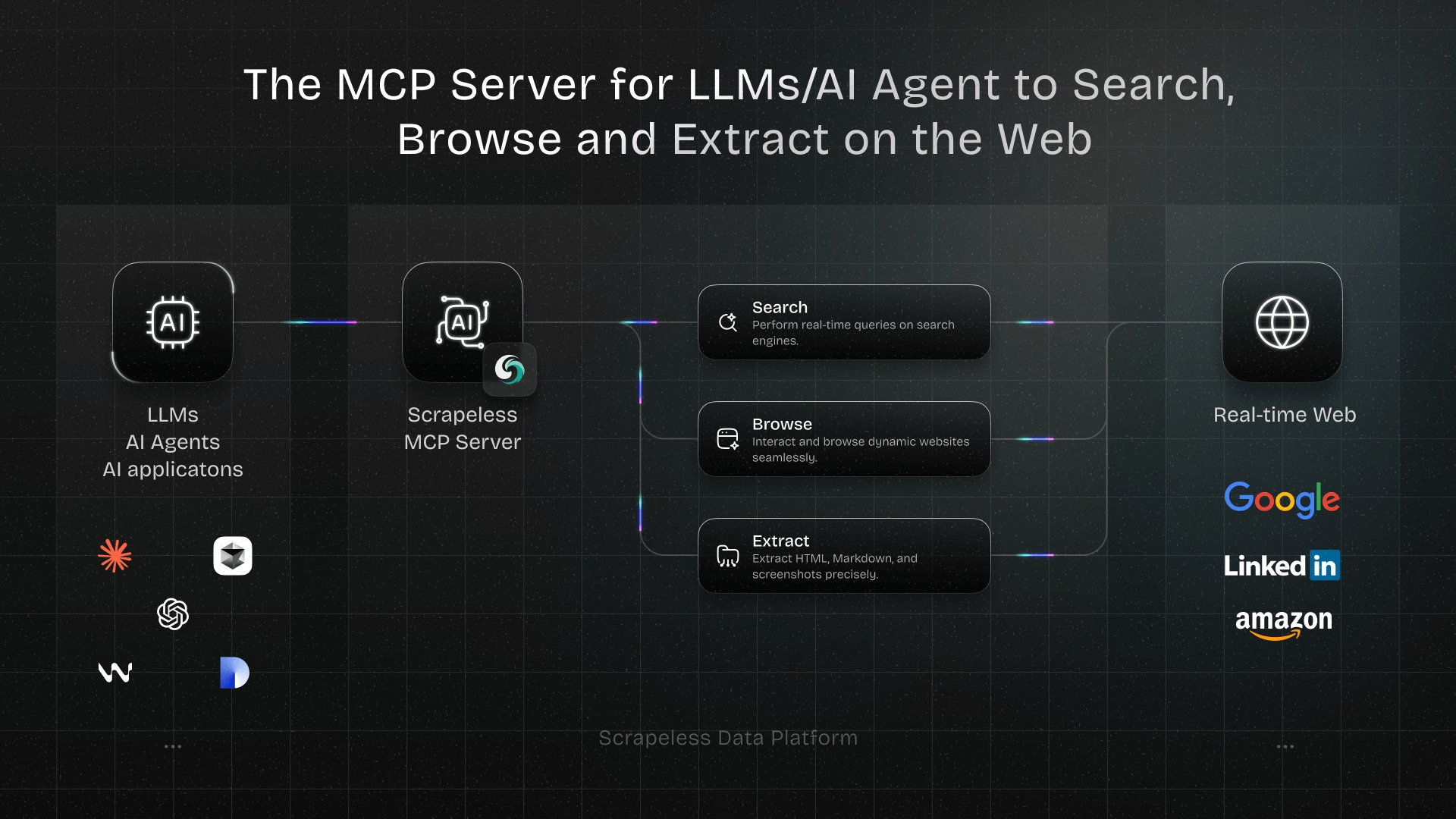
This post walks through wiring Scrapeless into ZeroClaw through both integration surfaces the runtime supports: the Scrapeless MCP Server (the canonical way to expose new tools to the agent) and the Scrapeless OpenClaw skills (canonical knowledge files the agent loads to drive those tools effectively). The two complement each other — the MCP server is what the agent calls; the skills are what tell it when and how to call the underlying Scrapeless APIs.

This guide wired AWS Strands SDK to Scrapeless's MCP server: ~100 lines of Python, 21 verified MCP tools available to the model, and a verified data path through the Scrapeless Scraping Browser with residential-proxy egress.

This guide walks you through integrating 9Proxy's unlimited bandwidth model with Scrapeless to significantly reduce these costs while maintaining the same scraping performance.

Amazon scraping has fragmented into three competing paradigms: MCP-native agent tooling, dedicated REST APIs with pre-built parsers, and serverless actor platforms. We benchmark eight top providers across speed, reliability, data depth, and cost to help you choose the right fit for your Amazon scraping needs in 2026. Scrapeless leads for AI agents, offering the only MCP Server that gives Claude, Cursor, and other LLMs direct typed access to a cloud browser—eliminating glue code and enabling agents to drive product discovery, price monitoring, and competitive intelligence workflows autonomously.

Hermes Agent's browser tool speaks Chrome DevTools Protocol natively—wire it to Scrapeless Scraping Browser with one config line for residential proxies, JS rendering, and anti-bot fingerprinting in 195 countries. This post walks through the setup, prompts, and discover→extract patterns that make chat-driven research, lead gen, and monitoring workflows production-ready across Telegram, Discord, or CLI.