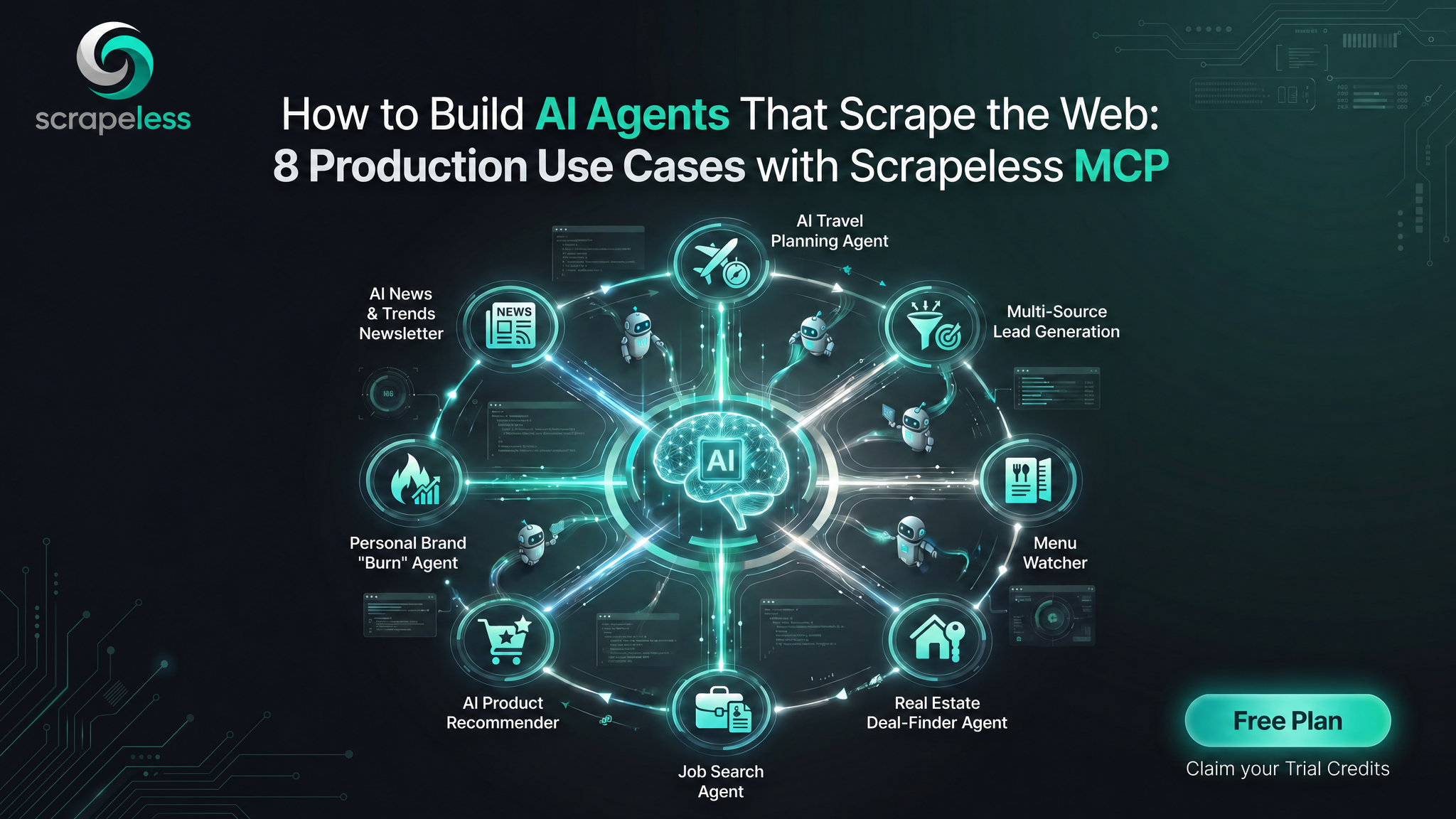
How to Build AI Agents That Scrape the Web: 8 Production Use Cases with Scrapeless MCP

Specialist in Anti-Bot Strategies
TL;DR:
- An AI agent is only as useful as the live data it can reach. The hard part is rarely the model — it is the login walls, anti-bot challenges, dynamic content, and session management between the agent and the page.
- Eight use cases, one primitive set. Newsletters, travel planners, lead generators, deal-finders, job hunters, and product recommenders all run on the same Scrapeless Scraping Browser tools.
- Grounded in real Scrapeless scrapers. Every use case below maps to a working scraper in the open Scrapeless scrapers repo; where no scraper exists for a named source, the substitution is stated plainly.
- No per-site actor marketplace to learn. The same
browser_*primitives drive every site — your agent changes targets by changing the prompt, not by hunting for the right pre-built actor. - Works across agent frameworks. Claude Code, Cursor, Codex CLI, Gemini CLI, Pi Agent, LangChain, AWS Strands, Hermes, ZeroClaw, and Google Antigravity all connect through MCP or the SDK.
- Free to start. New Scrapeless accounts include free Scraping Browser runtime — sign up at app.scrapeless.com.
Introduction: the agent does the scraping now
AI agents have moved from demos to daily tools, and almost every useful one needs the same thing: fresh data from the public web. A research agent needs today's headlines, a shopping agent needs current prices, a job agent needs this morning's postings. The model can reason about that data — but only once something has fetched it.
That "something" is where most agent projects stall. Modern sites render with JavaScript, gate content by region, and challenge unfamiliar traffic. A plain HTTP request returns an empty shell or a bot wall, and wiring up headless browsers, proxy pools, and session logic turns a weekend idea into an infrastructure project.
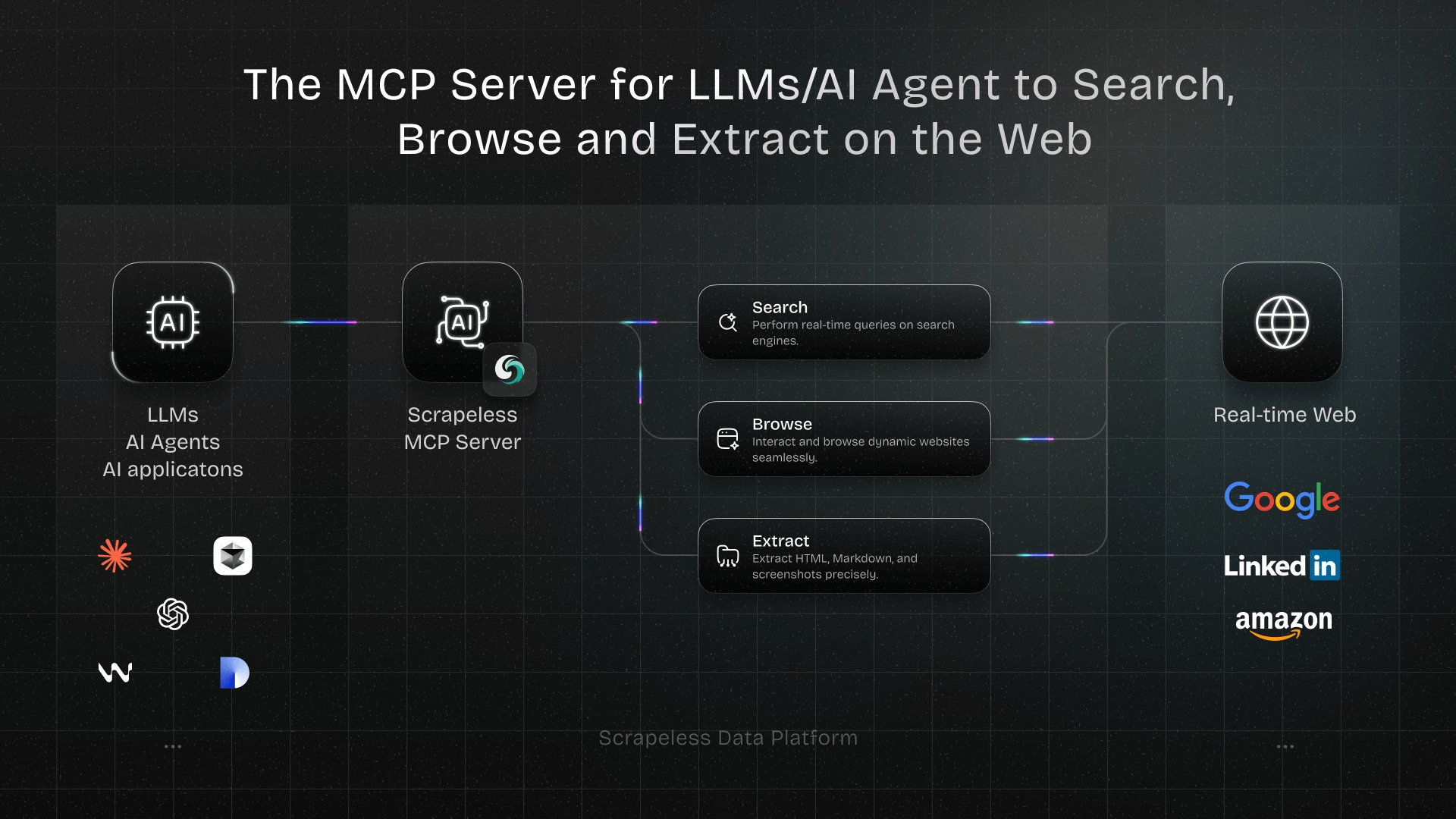
The Scrapeless Scraping Browser collapses that gap. It gives an agent an anti-detection cloud browser — with residential proxies in 195+ countries and JavaScript rendering built in — exposed through the Scrapeless MCP Server as a small set of composable tools. The agent itself does the scraping, in plain tool calls. Here are eight use cases that already work, each grounded in a real Scrapeless scraper.
Why Scrapeless for AI Agents
The Scrapeless Scraping Browser is a customizable, anti-detection cloud browser designed for web crawlers and AI agents. For agent work specifically, it brings:
- A cloud browser that renders like a real one — JavaScript, lazy loading, and consent flows handled server-side, so the agent receives complete pages.
- Residential proxies in 195+ countries — set the egress region per session to reach geo-gated listings, prices, and profiles.
- 21 composable MCP tools — browser primitives plus
google_search,google_trends, andscrape_markdown, reassembled per task without custom adapters. - An open scraper repo — working reference scrapers for dozens of the exact sites these use cases name, each with CLI, Node.js, Python, and MCP surfaces.
- Framework-agnostic access — connect over MCP (stdio or HTTP) or the SDK from any major agent framework. Full setup is in the docs.
Unlike an actor marketplace, there is no per-site template to find and configure — the same primitives drive every site, so the agent's toolset stays small while its reach stays wide. Get your API key on the free plan at app.scrapeless.com.
The 8 Use Cases
1. AI News & Trends Newsletter
An agent that monitors multiple content streams on any topic and hands a daily or weekly digest to your audience — sourced, deduplicated, and distilled by an LLM before anyone reads it.
It pulls signals from four live platforms: posts and engagement metrics from the twitter-scraper, article feeds from the google-news-scraper, community discussion from the reddit-scraper, and video commentary from the youtube-scraper; the Scrapeless MCP Server's google_search and google_trends tools add real-time query volume and breakout signals on top. Scrapeless makes this reliable because its anti-detection cloud browser renders every source past login and rendering delays, residential proxies in 195+ countries keep each session local to the platform's expected traffic, and the composable Scrapeless MCP tools let you chain all four sources in one agent prompt without glue code. It runs every morning: browser_create → google_search + google_trends → visit each source and browser_get_html → LLM summarize → send digest.
2. AI Travel Planning Agent
An agent that takes natural-language constraints — budget, travel dates, preferred activities, accommodation style — and assembles a ranked, ready-to-book itinerary removes hours of tab-switching from travel planning. For hotel and stay data, the agent draws from dedicated scrapers at bookingcom-scraper, tripadvisor-scraper, expedia-scraper, trip-scraper, and trivago-scraper. Airbnb, Skyscanner, and Google Flights have no Scrapeless scraper; for those gaps the agent relies on the booking and hotel sources above and uses the Scrapeless MCP Server's google_search tool to surface flight options from public results. The Scrapeless Scraping Browser's anti-detection cloud browser renders dynamic pricing grids and geo-gated content across all these sources, while residential proxies in 195+ countries return accurate local pricing regardless of destination. On each pass, the agent queries multiple sources in parallel, deduplicates properties by location and price band, scores each option against the user's constraints, and assembles a prioritized itinerary with links ready to hand off.
3. Multi-Source Lead Generation
An agent that builds enriched B2B and creator lead lists and populates a CRM can draw on several complementary sources at once. It uses google-maps-scraper to discover local businesses by category and region, instagram-scraper and tiktok-scraper to surface creators alongside follower counts and engagement signals, and linkedin-scraper for public professional profile data only — no authenticated endpoints, no private connections. Because Apollo has no Scrapeless scraper, the agent enriches funding and headcount context from crunchbase-scraper and hiring signals from wellfound-scraper instead. The Scrapeless Scraping Browser handles the JavaScript-heavy rendering that defeats lightweight HTTP clients, while residential proxies in 195+ countries let you target geo-gated results without triggering rate limits. In a single agent loop, you define the target persona, the agent queries each source in sequence, deduplicates on email or domain, and writes enriched records straight to your CRM via its API.
4. Menu Watcher
An agent that recommends restaurants and meals based on dietary preferences and allergies begins with discovery, then goes deeper than any directory alone. It uses google-maps-scraper to find candidate venues by cuisine, rating, and neighborhood, then passes each restaurant's own website URL to the Scrapeless MCP Server's scrape_markdown tool, which fetches and converts the public menu page to clean, LLM-ready text in one call. The Scrapeless Scraping Browser renders JavaScript menus and lazy-loaded content that plain HTTP requests would miss, and residential proxies in 195+ countries let the agent reach location-gated menu pages. Once the markdown lands in context, the agent cross-references every dish against your preference and allergy profile, flags conflicts, and ranks the safe options by match score — so you receive a shortlist of specific meals, not just a list of restaurants.
Get your API key on the free plan: app.scrapeless.com
5. Real Estate Deal-Finder Agent
An agent that monitors residential listings around the clock and surfaces below-market opportunities the moment they appear — before most buyers ever open a browser tab. You point it at two data sources: the Zillow scraper and the Redfin scraper — both render cleanly through the cloud browser even behind aggressive anti-bot protection, and the agent cross-checks the two for fresh and below-market listings. Scrapeless makes cross-platform coverage practical because the Scrapeless Scraping Browser pairs anti-detection rendering with residential proxies in 195+ countries, letting the agent reach geo-restricted listing pages and JavaScript-heavy property cards without manual session upkeep. On each cycle the agent pulls fresh listings, computes a price-per-square-foot ratio against comparable recent sales, scores each property against your saved criteria, and pushes a ranked shortlist with instant notifications so you can act while the listing is still live.
6. Job Search Agent
An agent that aggregates open roles from multiple platforms, filters them against your resume and target criteria, and enriches each match with compensation context — so you spend your time preparing strong applications instead of trawling job boards. The agent draws simultaneously from the LinkedIn scraper, the Indeed scraper, the Glassdoor scraper, and the Google Jobs scraper. The Scrapeless Scraping Browser handles the JavaScript-heavy feeds and login walls that block conventional scrapers, while residential proxies in 195+ countries let the agent reach region-specific salary estimates and remote-eligible role visibility that vary by egress IP. Each run the agent deduplicates postings across all four sources, scores them against your skills and seniority level, appends salary context from Glassdoor where available, and delivers a filtered digest you review before submitting a single application yourself.
7. AI Product Recommender
An agent that answers shopping queries and runs comparative analysis across marketplaces saves you the work of opening five tabs and normalizing prices by hand. It draws simultaneously from the Amazon scraper, the AliExpress scraper, the eBay scraper, and the Walmart scraper — covering North American and global demand signals in a single pass. The Scrapeless Scraping Browser renders the JavaScript-heavy product cards and region-gated pricing that plain HTTP clients miss, while residential proxies in 195+ countries let the agent surface local-currency results and regionally restricted listings without triggering bot detection. On each run the agent accepts a plain-language query, queries each marketplace in parallel, normalizes currency and shipping to a common base, deduplicates by GTIN or model number where available, and returns a ranked recommendation table ordered by value score.
8. Personal Brand "Burn" Agent
A lighthearted agent that audits your own public footprint and delivers witty self-critique demonstrates that the same infrastructure serious business agents rely on also works for purely personal use. It reads your public profile pages through the LinkedIn scraper and the Twitter scraper, then runs a self-query via the Scrapeless MCP Server's google_search tool to surface how you appear in organic results — all public data only, no authenticated endpoints. The Scrapeless Scraping Browser renders the JavaScript-heavy profile pages and public timeline feeds that a plain fetch would miss, while residential proxies in 195+ countries reach the geo-varied search results that reflect how different audiences actually find you. In a single pass the agent collects your headline, pinned posts, bio copy, and top search snippets, then synthesizes a candid critique of the gap between how you present yourself and how the public web reflects you back.
How These Compose: One Browser, Many Sites
Read the eight use cases back to back and the pattern is hard to miss: they are the same handful of tools pointed at different sites. browser_create, browser_goto, browser_wait_for, browser_get_html, and browser_close carry every extraction; google_search, google_trends, and scrape_markdown fill the gaps where a dedicated scraper does not exist. That is the difference between an agent that depends on finding the right pre-built actor and one that can scrape anything its prompt describes. The reference scrapers in the open repo show the discover-then-extract shape per site; the cloud browser supplies the rendering, proxies, and session handling underneath.
Conclusion
The model is rarely the bottleneck for an AI agent — reaching live, rendered, region-correct web data is. Each of these eight use cases solves that the same way: an anti-detection cloud browser, residential proxies in 195+ countries, and a small set of composable MCP tools the agent calls itself. Pick the one closest to your goal, reuse the same install for the next, and lean on scrape_markdown and google_search wherever a dedicated scraper does not exist yet. For an agent-native worked example, see the best Amazon scrapers for AI agents.
Ready to Build Your AI-Powered Data Pipeline?
Join our community to claim a free plan and connect with developers building AI-agent data pipelines: Discord · Telegram.
Sign up at app.scrapeless.com for free Scraping Browser runtime and adapt the use cases above to the sites, queries, and regions your agents need.
FAQ
Q: What does Scrapeless give an agent that an actor marketplace doesn't?
Universal browser primitives. Rather than searching a catalog for a per-site actor, the agent drives one anti-detection cloud browser with the same tools everywhere — so a site with no pre-built template is still reachable by composing browser_* calls with scrape_markdown or google_search.
Q: Can one agent reuse the same tools across every site?
Yes. Every use case above runs on the same 21-tool MCP surface. The target changes with the prompt and the URL, not the toolset.
Q: Which agent frameworks are supported?
Claude Code, Cursor, VS Code, Codex CLI, and Gemini CLI via the skill or MCP; Pi Agent, LangChain, AWS Strands, Hermes, ZeroClaw, and Google Antigravity via MCP or the SDK.
Q: What about a site with no Scrapeless scraper?
Compose it from primitives: open the page with browser_goto, let the cloud browser render it, and pull text with scrape_markdown — or surface it through google_search. The travel-flight and lead-enrichment gaps above use exactly this fallback.
Q: How does pricing scale across many agents?
Sessions are the unit of work, and new accounts include free Scraping Browser runtime. Compare plans on the pricing page; for parallel runs, keep concurrency to roughly three sessions per host.
At Scrapeless, we only access publicly available data while strictly complying with applicable laws, regulations, and website privacy policies. The content in this blog is for demonstration purposes only and does not involve any illegal or infringing activities. We make no guarantees and disclaim all liability for the use of information from this blog or third-party links. Before engaging in any scraping activities, consult your legal advisor and review the target website's terms of service or obtain the necessary permissions.