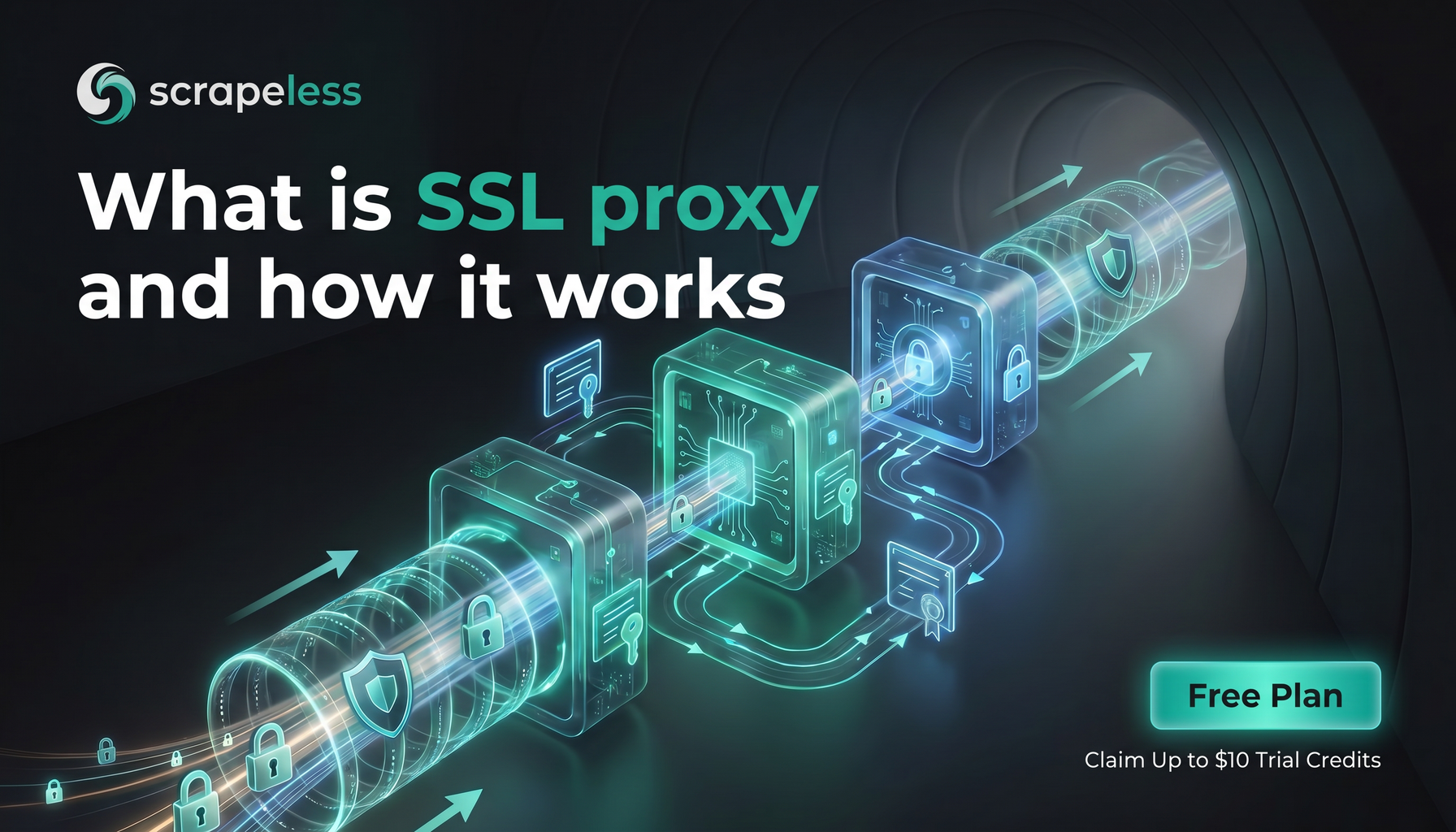
What is SSL proxy and how it works

Advanced Bot Mitigation Engineer
Olivia Patel · Senior Cybersecurity Analyst · 25-May-2026
TL;DR:
- An SSL proxy is a TLS intermediary, not a privacy tool. It terminates the HTTPS encryption itself so it can read traffic that would otherwise be opaque end-to-end.
- It is a man-in-the-middle by design — built for controlled visibility (inspection, policy enforcement, DLP, debugging), not to hide who you are.
- Forward and reverse are opposite deployments. Forward guards outbound traffic from internal clients; reverse terminates inbound TLS in front of your own servers.
- The TLS handshake is what makes it possible. Whether the connection uses RSA, ephemeral Diffie-Hellman, or TLS 1.3, the proxy joins the handshake to reach the plaintext.
- Breaking end-to-end encryption is a trade-off. You gain inspection and control, but the proxy becomes a high-value target and inherits a trust, privacy, and compliance burden.
- It is distinct from a SOCKS or plain HTTP proxy, because it specifically understands and processes the TLS layer rather than blindly tunneling bytes.
- For data collection, you usually do not run your own — routing through managed residential proxy infrastructure gives the target a clean, encrypted connection without a TLS-termination layer of your own.
- Free to start. New Scrapeless accounts include free Scraping Browser runtime and residential proxy access — sign up at app.scrapeless.com.
Introduction: the proxy that reads the encryption
Almost all web traffic now travels over HTTPS, encrypted in transit. That is good for confidentiality, but it also creates a blind spot: a firewall that can only see encrypted bytes cannot tell whether an employee is uploading a sensitive file to an unsanctioned service, whether a download contains malware, or whether an application is leaking data it should not. Encryption protects the payload from everyone in the middle — including the people responsible for the network.
An SSL proxy exists to resolve that tension. Instead of passing encrypted traffic through untouched, it deliberately positions itself as an endpoint of the TLS connection so it can decrypt, inspect, and re-encrypt what passes through. Security teams use it to enforce acceptable-use policy and prevent data loss; operations teams use it on the server side to centralize certificates and offload cryptographic work; developers use a local version of the same idea to debug API traffic.
This guide defines the SSL proxy precisely, walks through the TLS handshake that lets it function, draws the line between forward and reverse deployments, and is honest about the security trade-off it represents. It closes with where managed proxy infrastructure fits when the goal is reliable data collection rather than running an inspection gateway yourself. For adjacent background, see our explainers on what a cloud proxy is and VPS vs proxy.
What Is an SSL Proxy?
An SSL proxy is an intermediary server that terminates and re-initiates the TLS (Transport Layer Security) connection between two parties, so that HTTPS traffic which would otherwise be encrypted end-to-end becomes readable to the proxy. Because it splits one secure connection into two — client-to-proxy and proxy-to-origin — it can decrypt traffic on one side, inspect or modify it, and re-encrypt it on the other.
A quick note on the name. SSL (Secure Sockets Layer) was the original protocol; it was superseded by TLS, but the older name stuck. In practice "SSL handshake" and "TLS handshake," and "SSL proxy" and "TLS proxy," are used interchangeably. The traffic an SSL proxy handles today is almost always TLS.
The defining characteristic is worth stating directly: an SSL proxy is a TLS man-in-the-middle by design. A standard proxy that simply forwards encrypted bytes never sees the plaintext. An SSL proxy intentionally inserts itself as a TLS endpoint precisely so that it can. That capability is what makes it valuable for inspection and control — and it is also what makes it something you deploy deliberately and govern carefully, not a tool you reach for to gain privacy.
How an SSL Proxy Works
To understand the proxy, you first have to understand the handshake it inserts itself into. Per Cloudflare's "What happens in a TLS handshake" explainer, the TLS handshake takes place after the TCP connection is established, every time HTTPS is used. Its goals are to agree on a TLS version, choose a cipher suite (the agreed set of cryptographic algorithms), authenticate the server through its certificate and the signing Certificate Authority (CA), and derive the symmetric session keys that will encrypt the rest of the conversation.
An SSL proxy participates in this exchange instead of merely relaying it. The exact steps depend on which key-exchange method is in play.
The RSA handshake (legacy, no longer considered secure)
In the older RSA-based exchange, the client opens with a client hello carrying its supported TLS version, cipher suites, and a client random. The server answers with a server hello containing its certificate, the chosen cipher suite, and a server random. The client authenticates the certificate against the issuing CA, generates a premaster secret, encrypts it with the server's public key, and sends it; the server decrypts it with its private key. Both sides then derive the session keys from the two random values plus the premaster secret, exchange encrypted Finished messages, and begin symmetric encryption.
This scheme is no longer considered secure, largely because it lacks forward secrecy: anyone who later obtains the server's private key can decrypt past sessions.
The ephemeral Diffie-Hellman handshake
The Diffie-Hellman variant follows the same shape but closes that gap. The server additionally sends a digital signature over the handshake messages, and instead of the client encrypting a premaster secret, both sides exchange Diffie-Hellman parameters and each compute the premaster secret independently. Because the secret is never transmitted, capturing the traffic and the server key later does not reveal it — this is forward secrecy. Session keys are then derived from the premaster secret and the two random values, as before.
The TLS 1.3 handshake
TLS 1.3, standardized in RFC 8446, drops RSA key exchange and the older insecure cipher suites entirely and streamlines the rest:
- The client hello already includes the key-exchange parameters, assuming the server's preferred method.
- The server can therefore compute the master secret immediately and responds with its server hello, certificate, signature, server random, and Finished in one pass.
- The client verifies, derives the same master secret, and sends its own Finished.
The result is a faster handshake — a single round trip instead of two. TLS 1.3 also defines 0-RTT resumption: a returning client that holds a "resumption main secret" and a session ticket from an earlier connection can send encrypted application data in its very first message, with no round trips at all.
Where the proxy sits in all of this
For an SSL proxy to read the plaintext, it cannot passively observe any of these handshakes — the cryptography is specifically designed to stop that. Instead it completes a handshake on each side: it presents a certificate to the client and negotiates one session, and it acts as a client toward the origin and negotiates a second. Holding both sets of session keys, it decrypts traffic as it arrives on one connection and re-encrypts it before it leaves on the other. The plaintext exists, briefly, inside the proxy — that is the whole mechanism, and the whole trade-off.
Forward SSL Proxy vs Reverse SSL Proxy
The same decrypt-inspect-re-encrypt mechanism is deployed in two opposite directions, and the distinction matters for who trusts what.
A forward SSL proxy sits on the client side, between an organization's internal users and the internet. It intercepts outbound TLS connections, presents its own certificate to the internal client, and relies on those clients trusting an internally managed CA so the substitution is accepted. It then decrypts, inspects or filters the traffic, and re-encrypts it to the real origin. The canonical implementation is Squid's SSL-Bump feature, which works through a peek / splice / bump flow to decide per-connection whether to inspect or pass traffic through. Forward proxies are the engine behind outbound data-loss prevention, malware and URL filtering, and acceptable-use enforcement.
A reverse SSL proxy sits on the server side, in front of your own origin servers. It terminates inbound client TLS at the edge — TLS termination — and optionally re-encrypts to the backends behind it. Because it owns the public-facing certificate, it centralizes certificate management, offloads cryptographic work from application servers, and gives you a single point at which to apply a Web Application Firewall (WAF), inspection, and load balancing before traffic ever reaches the application.
| Dimension | Forward SSL Proxy | Reverse SSL Proxy |
|---|---|---|
| Position | Between internal clients and the internet | In front of your own origin servers |
| Protects | Outbound traffic / the organization | Inbound traffic / the application |
| Whose certificate | Proxy's own cert via an internal CA the clients trust | The public certificate for the protected site |
| Typical job | DLP, malware and URL filtering, acceptable-use policy | TLS termination, WAF, load balancing, crypto offload |
| Who operates it | The client-side organization | The site or service owner |
| Reference mechanism | Squid SSL-Bump (peek / splice / bump) | Edge TLS termination at a load balancer or gateway |
A useful shorthand: a forward proxy answers "what is leaving my network?" and a reverse proxy answers "what is arriving at my servers?"
Encryption, Inspection & Security
It is tempting to file any proxy under "more secure," but an SSL proxy deserves a more careful reading. What it actually delivers is controlled visibility, and that comes with a cost.
On the benefit side, the proxy keeps the core properties TLS provides and adds one. There is confidentiality, since each leg of the connection is still encrypted in transit; authentication, because certificates are validated in each handshake; and visibility and control — the reason it exists — letting security tooling scan decrypted traffic for threats, leaks, and policy violations. On the reverse side there is also performance: terminating TLS at the edge offloads cryptographic work from application servers and enables caching close to clients.
The honest framing, though, is the trade-off. By terminating TLS, the proxy deliberately breaks end-to-end encryption. The plaintext is exposed inside the proxy, which means:
- The proxy becomes a high-value target. It holds keys and sees decrypted traffic for everyone behind it. Compromising it compromises far more than a single connection.
- It creates a trust and privacy burden. On the forward side, users' encrypted traffic is being read; that has to be disclosed, scoped, and governed. Inspecting traffic that includes personal, financial, or health data carries clear privacy and compliance obligations.
- Misconfiguration weakens the very thing TLS protects. Lax certificate validation on the origin leg, or weak cipher selection, can quietly downgrade security for every connection the proxy handles.
This is why standards-aligned guidance, such as OWASP's transport-layer protection recommendations, treats TLS inspection as a capability to deploy with restraint: validate certificates strictly on every leg, prefer modern protocol versions and forward-secret cipher suites, limit what is decrypted, and protect the proxy itself as critical infrastructure. An SSL proxy is a control surface for an organization that owns both ends of the trust relationship — not a way for an individual to gain privacy.
Get your API key on the free plan: app.scrapeless.com
Use Cases
The decrypt-and-inspect capability shows up across several roles:
- Corporate egress security gateways (forward). Enforce acceptable-use policy, block malware and risky URLs, and run data-loss prevention on outbound HTTPS.
- TLS-terminating edge, load balancer, or WAF (reverse). Centralize certificates, offload crypto, and screen inbound traffic with a WAF before it reaches the application.
- API gateways. Terminate TLS, authenticate callers, and apply routing or rate-limiting policy at a single managed boundary.
- Traffic debugging in development. Engineers run a local intercepting proxy to read their own HTTPS requests and responses while building and testing an integration.
- Data collection over HTTPS. Routing scraper traffic through proxy infrastructure so the target sees a clean, encrypted connection originating from a residential IP — handling TLS to the destination on the requester's behalf.
SSL Proxy vs Other Proxy Types
An SSL proxy is defined by the layer it operates on. Comparing it to neighboring proxy types clarifies what is distinct about it.
| Proxy type | Layer it operates on | Sees plaintext of HTTPS? | Typical use |
|---|---|---|---|
| SSL / TLS proxy | TLS session layer | Yes — terminates TLS by design | Inspection, DLP, TLS termination, debugging |
| HTTP proxy | Application (HTTP) | Only for plain HTTP; tunnels HTTPS opaquely via CONNECT | Caching, basic filtering, request routing |
| SOCKS proxy | Below the application layer | No — forwards raw bytes, protocol-agnostic | Generic TCP/UDP tunneling, broad protocol support |
| Transparent proxy | Network / application | Only if it also performs TLS interception | Enforced routing without client configuration |
The key contrast: a SOCKS proxy is deliberately ignorant of what it carries — it moves bytes without understanding TLS. A plain HTTP proxy can read unencrypted HTTP but, faced with HTTPS, simply opens a tunnel and forwards the encrypted stream untouched. An SSL proxy is the one type that specifically understands and processes the TLS layer to act on what is inside.
How Scrapeless Fits
When the goal is reliable data collection rather than running an inspection gateway, you generally do not want to stand up and govern your own SSL-proxy or TLS-termination layer. Scrapeless provides residential proxies in 195+ countries and an anti-detection cloud browser — the Scrapeless Scraping Browser — that handle HTTPS and the TLS exchange to your targets internally. You route requests through Scrapeless, and the destination sees a clean, encrypted connection originating from a residential IP, with the cloud browser rendering JavaScript and managing fingerprints on the cloud side.
The boundary is worth being precise about: Scrapeless is not an SSL inspection proxy, and it is not a tool for reading someone else's encrypted traffic. It is managed proxy and browser infrastructure that handles the transport and rendering work so you do not operate that layer yourself. Explore the proxy product and the broader proxy solutions, review plans on the pricing page, and find integration details in the documentation.
Conclusion
An SSL proxy does what a normal proxy cannot: it reads inside HTTPS, by terminating TLS on each side, holding both sets of session keys, and decrypting traffic so it can be inspected and re-encrypted. Deployed forward, it polices what leaves a network; deployed reverse, it terminates and screens what arrives at a server. Either way it is a man-in-the-middle by design, and the visibility it grants is paid for by a trust, privacy, and compliance burden that has to be governed. So reach for one when you own both ends of a trust relationship and need controlled visibility — inspection, DLP, TLS termination at the edge — and when the goal is simply to collect public web data reliably over encrypted, residential connections, route through managed infrastructure instead. For related reading, see what a cloud proxy is and VPS vs proxy.
Ready to Build Your AI-Powered Data Pipeline?
Join our community to claim a free plan and connect with developers building proxy-driven data collection pipelines: Discord · Telegram.
Sign up at app.scrapeless.com for free Scraping Browser runtime and residential proxy access, and route the HTTPS requests your pipeline needs through managed infrastructure instead of your own SSL-proxy layer.
FAQ
Q: Is an SSL proxy the same as an HTTPS proxy?
The terms overlap and are often used interchangeably, since both deal with TLS-secured traffic. The meaningful distinction is whether the proxy actually terminates TLS to read the plaintext (true SSL/TLS interception) or merely opens an encrypted tunnel and forwards HTTPS bytes without decrypting them (a plain HTTP proxy doing CONNECT tunneling). When people say "SSL proxy," they usually mean the former.
Q: Does an SSL proxy decrypt my traffic?
Yes — that is the entire point. An SSL proxy terminates TLS so it can decrypt, inspect, and re-encrypt the traffic passing through it. If a proxy does not decrypt, it is not acting as an SSL proxy. This is why it should be treated as a deliberately deployed, governed control, not a privacy feature.
Q: Forward vs reverse — which do I need?
Decide by what you are protecting. Choose a forward SSL proxy to inspect and control outbound traffic from your own users (DLP, malware and URL filtering, policy). Choose a reverse SSL proxy to terminate inbound TLS in front of your own servers (certificate management, WAF, load balancing, crypto offload).
Q: Is using an SSL proxy legal?
Operating one on infrastructure and traffic you own or administer is standard practice, provided it is disclosed and configured in line with applicable privacy obligations. Intercepting traffic you have no authority over is a different matter. Scope it to systems you control, disclose it to those whose traffic is inspected, and consult counsel for your jurisdiction.
Q: Does an SSL proxy give me anonymity or privacy?
No. It is built to gain visibility into encrypted traffic, not to hide it, so for the traffic flowing through it, privacy goes down rather than up. Anonymity for outbound requests is a separate concern, handled by the proxy's source IP and routing rather than by TLS interception.
Q: Do I have to run my own SSL proxy to collect web data?
No. For data collection, the practical path is to route requests through managed residential proxy infrastructure that handles HTTPS and TLS to the target for you, so you avoid operating and securing a TLS-termination layer yourself.
At Scrapeless, we only access publicly available data while strictly complying with applicable laws, regulations, and website privacy policies. The content in this blog is for demonstration purposes only and does not involve any illegal or infringing activities. We make no guarantees and disclaim all liability for the use of information from this blog or third-party links. Before engaging in any scraping activities, consult your legal advisor and review the target website's terms of service or obtain the necessary permissions.