The AI Economy Stack: How Autonomous Agents Are Reshaping Commerce and the Web

Advanced Data Extraction Specialist
TL;DR:
- Agentic commerce is the web buying from itself. When an autonomous agent discovers a product, negotiates terms, pays, and confirms delivery without a human at the keyboard, the unit of demand stops being a person clicking and becomes a software process transacting. That shift rewrites how the web is built, monetized, and defended.
- Three layers make it work: a tool protocol, a payment protocol, and a data layer. The Model Context Protocol standardizes how an agent reaches tools and data. Machine-native payment standards such as x402 and the Agent Payments Protocol standardize how it settles value. Reliable web data underneath decides whether any of it is grounded in reality.
- HTTP 402 is finally being used. The "Payment Required" status code sat reserved for thirty years. x402 activates it so a server can quote a price and an agent can settle a stablecoin payment inline, with no account, no session, and no checkout page.
- The protocols compose rather than compete. x402 handles inline pay-per-request settlement, the Agentic Commerce Protocol makes existing merchant checkouts agent-ready, and the Agent Payments Protocol carries signed authorization so a payment network can verify the agent was allowed to spend. A mature stack uses all three for different jobs.
- Data quality is the silent failure mode. An agent that pays for the wrong item, or grounds a purchase on a stale price, fails expensively and silently. The reliability of the web data feeding the decision is the part of the stack that gets the least attention and causes the most damage.
- Free to start. New Scrapeless accounts include free Scraping Browser runtime — sign up at app.scrapeless.com.
Introduction: when the buyer is a process, not a person
For thirty years the web was designed around a human reading a screen. Pages were laid out for eyes, checkouts were built around a person typing a card number, and the entire monetization model — ads, subscriptions, conversion funnels — assumed attention as the scarce resource. Agentic commerce breaks that assumption. The buyer becomes a software process that reads structured data, reasons over options, settles payment programmatically, and never looks at a layout.
This is not a far-future thesis. The pieces are shipping now. Autonomous agents already research purchases, compare prices across marketplaces, and assemble carts on a user's behalf. What was missing until recently was a standard way for those agents to pay, and a standard way for them to reach tools and data without bespoke integration for every endpoint. Both gaps are closing fast, and the closing of them is what turns a clever demo into an economy.
The stack that supports this has a recognizable shape: a protocol that connects agents to tools and data, a protocol that lets agents move money, and a data layer that keeps the whole thing grounded in what is actually true on the live web. The first two get the headlines. The third is where most agentic-commerce projects quietly break. This piece walks the full stack, then argues for where reliable web data sits inside it and why that position is load-bearing.
What agentic commerce actually is
Strip away the marketing and agentic commerce is a simple idea with sweeping consequences: a transaction initiated, negotiated, and completed by software acting on a stated intent rather than by a human navigating an interface.
A person says "find the cheapest in-stock pair of these running shoes that ships to me in two days and buy them." The agent decomposes that into discovery, comparison, eligibility checks, payment, and confirmation. It visits marketplaces, reads prices and stock, evaluates shipping windows, picks a winner, pays, and reports back. The human approved the intent and the budget; the agent executed the commerce.
That re-frames three things at once. Demand stops being a click and becomes a query an agent fires on a schedule or in response to a signal. Conversion stops being a funnel optimized for attention and becomes a machine-readable answer to a machine-readable question. And trust stops being a logo a person recognizes and becomes a cryptographic proof a payment network can verify. Each of those shifts has a protocol forming around it, and together they are what people mean when they say "the AI economy stack."
It also helps to name who is transacting with whom. Three patterns recur: human-in-the-loop consumer commerce, where a person approves an agent's purchase before it completes; agent-to-business (A2B), where an agent pays a service directly for data, compute, or an API call; and agent-to-agent (A2A), where one agent pays another for a task it cannot do itself. The protocols that follow map onto these patterns rather than replacing them.
The strategic point for anyone building or defending web infrastructure is that the assumptions baked into two decades of web architecture no longer hold for this traffic. A page optimized for human attention is friction to an agent. A checkout built around a human typing a card is a wall. And anti-bot systems built to keep automation out now sit directly across the path of the customer the merchant most wants to serve. Agentic commerce forces every one of those design choices back open.
MCP: the connective tissue between agents and tools
An agent that can only reason is a closed system. It becomes useful the moment it can reach outside itself — to call a tool, query a database, hit an API, or read a page. The problem, until recently, was that every one of those connections was a one-off. Each tool had its own auth, its own request shape, its own quirks, and an agent builder spent more time writing adapters than building the agent.
The Model Context Protocol, introduced by Anthropic, is the standard that collapses that work. MCP defines a single, consistent interface between an agent and the tools or data sources it uses. A server exposes capabilities — functions, data, browser control — and any MCP-aware client calls them the same way. Claude, Cursor, and a dozen other agent runtimes all speak it. The protocol is the contract; the client is interchangeable.
For agentic commerce, MCP matters because commerce is a composition of tools. Discovering a product, checking inventory, reading reviews, comparing prices, and settling payment are each a capability the agent reaches through a tool call. Standardizing that surface means an agent can assemble a buying workflow out of small, composable steps instead of a monolithic, vendor-locked integration. The same agent that books travel today can shop for hardware tomorrow by pointing the same protocol at a different set of tools.
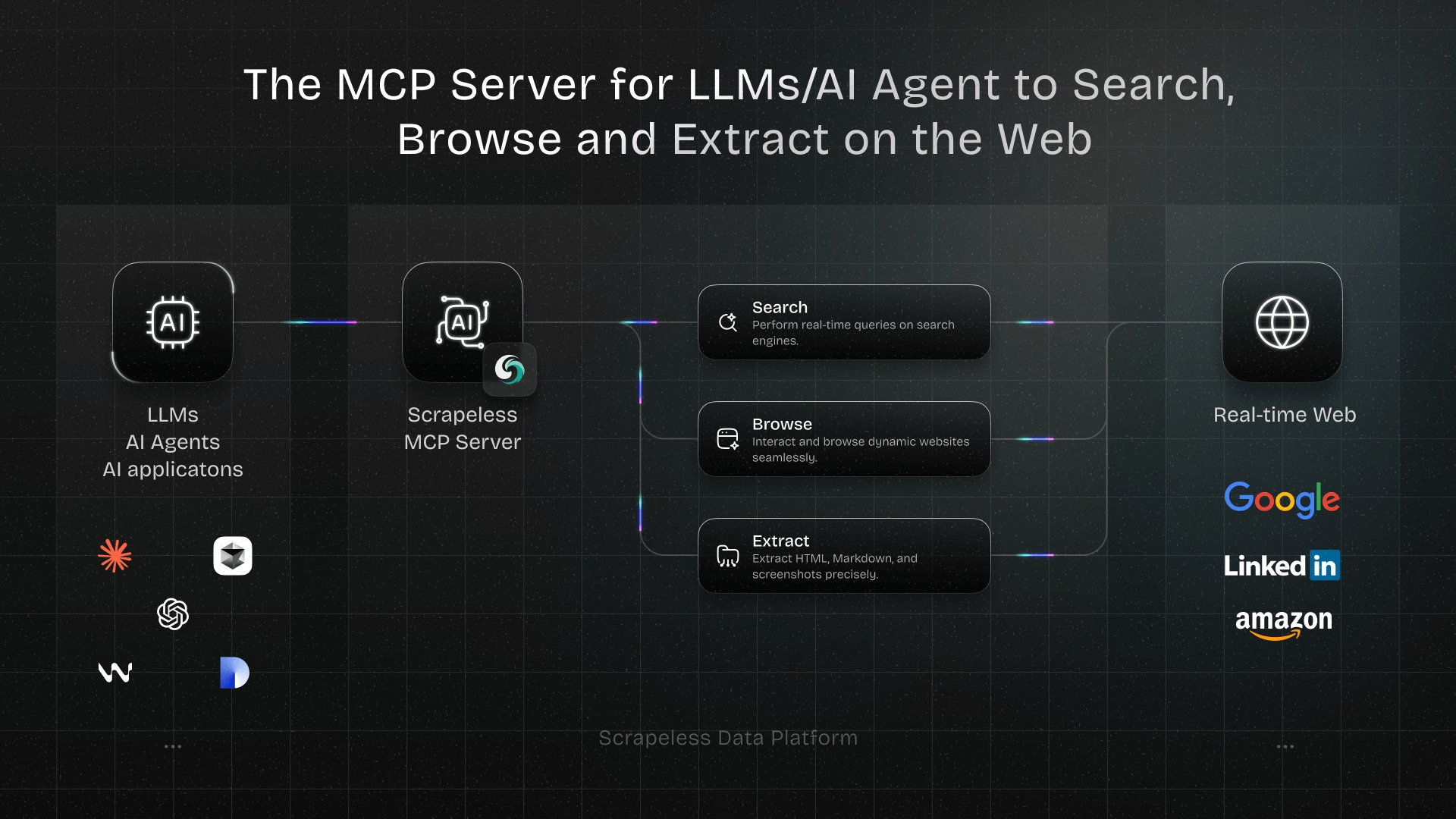
This is the layer where reliable web access enters the picture. A great many of the tools an agent needs in a commerce workflow are not clean APIs — they are public web pages that render with JavaScript, gate content by region, and challenge unfamiliar traffic. Exposing a cloud browser through MCP turns "read this product page" into a tool call the agent already knows how to make. The agentic-commerce stack, in other words, leans on MCP not just for payment and reasoning but for the unglamorous job of actually reaching the live web. The mechanics of that pattern are covered in depth in the Scrapeless MCP use-cases walkthrough.
Machine-native payments: HTTP 402 stops being a museum piece
The most quietly radical part of the stack is payment. For an agent to transact autonomously, it needs to move value without a human in the loop — and the web's existing payment rails were all built around exactly that human. Card forms, redirect flows, one-time passcodes, and fraud checks tuned on human behavior are friction at best and a hard stop at worst when the buyer is software.
The HTTP specification has carried a status code for this since the beginning: 402 Payment Required. For three decades it was reserved and almost never used, a placeholder for a future that had not arrived. x402, an open protocol from Coinbase, is the future arriving. It activates 402 as a real, machine-native payment flow over plain HTTP.
The handshake is clean and deserves to be described precisely. An agent requests a resource. The server responds with 402 and a set of payment terms — a price, the accepted tokens, the network. The agent signs a stablecoin payment, commonly USDC, and presents it in a payment header on the same request path. The server verifies the payment and releases the resource, returning a confirmation header alongside the data. There is no account to create, no session to hold, no checkout page to render. The settlement is inline, and the resource is delivered the moment payment clears. By early 2026, tens of millions of these settlements had already cleared on networks like Base and Solana — enough settled volume to make this real infrastructure rather than a proposal.
x402 is not the only payment protocol in the stack, and this is where a common misconception needs correcting. The protocols forming around agentic payment are not rivals fighting for one slot — they address different parts of the same problem and are designed to compose:
- x402 is the inline, pay-per-request layer. It is ideal for an agent buying a unit of something — an API call, a slice of compute, a single data fetch, a metered service — where the value is small, the cadence is high, and a full checkout would be absurd overhead.
- The Agentic Commerce Protocol, from OpenAI and Stripe, makes a merchant's existing checkout agent-ready. The merchant stays the merchant of record, the money flows through established payment providers, and the agent initiates a purchase against real commerce infrastructure rather than a parallel one. It is already live inside ChatGPT's in-chat checkout.
- The Agent Payments Protocol, led by Google with a wide roster of payment-network partners, carries the authorization and consent layer. Its core idea is a signed mandate: a cryptographically verifiable statement from the user defining exactly what the agent may spend, on what, and within what limits. That mandate travels with the transaction so a merchant or network can confirm the agent was genuinely authorized.
- The Machine Payments Protocol (MPP), co-authored by Stripe and Tempo, is x402's close cousin for streamed value. It also revives HTTP 402, but adds a "sessions" primitive: an agent authorizes a spending limit once, then streams continuous micropayments against it without a settlement round-trip on every call — built for high-frequency machine-to-machine spend.
- The Universal Commerce Protocol (UCP), from Shopify and Google, is the storefront-facing counterpart to the checkout protocols. A merchant declares the capabilities it supports, the agent discovers and negotiates them, and checkout completes inside the conversation on the merchant's own commerce logic — composing with REST, MCP, and the payment protocols above rather than replacing them.
Read together, these protocols answer different questions rather than competing for one slot. x402 and MPP settle value inline — x402 a payment per request, MPP a stream against a pre-authorized session limit. The Agentic Commerce Protocol and UCP make a real merchant's checkout reachable to an agent. The Agent Payments Protocol carries the proof that the agent was allowed to spend at all. A serious agentic-commerce system reaches for whichever layer fits the transaction in front of it, and often composes several at once.
Get your API key on the free plan: app.scrapeless.com
The security analyst's read: payment without a person is a new attack surface
It is worth pausing on what machine-native payment does to risk, because the convenience cuts both ways. The moment an agent holds the authority to spend, the agent becomes a target. A prompt-injected instruction buried in a scraped page, a poisoned product listing, a spoofed price — each is now a path to making software spend money it should not. The classic web threat model assumed a human as the final check before a purchase. Agentic commerce removes that human by design, and the protocols above are, in part, an answer to the question of how to put guardrails back.
This is exactly why the mandate concept in the authorization layer is more than bureaucratic detail. A signed spending limit that travels with the transaction is a containment boundary: even a fully compromised agent cannot exceed what the user explicitly authorized. The same logic argues for tight scoping everywhere — narrow allowances, short-lived authorizations, and verifiable provenance on every input the agent acts on. The economic upside of autonomous payment is real, but it arrives bundled with an obligation to treat every agent as a privileged process and to design the blast radius down to something survivable.
There is a quieter risk too, and it routes straight back to data. An agent that pays based on a wrong price or a stale stock signal does not throw an error — it confidently completes a bad transaction. The failure is silent, it is expensive, and it scales with the agent's autonomy. Which is the natural bridge to the part of the stack that gets discussed least and matters most.
Where reliable web data fits — and why it is load-bearing
Strip the AI economy stack to its dependencies and a clear order emerges. Reasoning sits on top. Payment and tool protocols sit in the middle. Underneath all of it is data — the agent's only contact with the actual state of the world. Every decision an agent makes about what to buy, at what price, from whom, is only as good as the data feeding it. Get the data wrong and every layer above inherits the error, now compounded by the agent's speed and its willingness to act.
This is the part of agentic commerce that demos skip and production systems live or die by. The interesting failures are almost never in the model. They are in the data layer: a price that was scraped an hour ago and has since changed, a listing that renders only after JavaScript executes and so came back empty, a regional storefront that served a different catalog because the request egressed from the wrong country, a page that returned an anti-bot challenge instead of content. None of those surface as an obvious crash. They surface as an agent that quietly grounds a real, paid decision on a fiction.
Three properties separate web data that an agent can safely transact on from web data that merely looks plausible:
- It is rendered, not raw. Modern commerce pages are JavaScript applications. The price, the stock badge, the shipping estimate — the exact fields an agent needs to make a buying decision — frequently do not exist in the initial HTML and only appear after the page executes. A data layer that returns the pre-render shell hands the agent a hollow page that passes a shape check and fails a reality check.
- It is geographically correct. Price, availability, currency, and even which products exist vary by region. An agent buying on behalf of a user in one market must see that market's storefront, which means the request has to egress from the right place. Residential proxies in 195+ countries are what make "show me what a buyer in Germany would see" a parameter rather than a guess.
- It survives contact with anti-bot systems. The same defenses built to keep automation out now sit between an agent and the merchant that wants the sale. A data layer for agentic commerce has to render like a real browser — consistent fingerprinting, real JavaScript execution, a clean session warmed against the target's homepage before the target page — so the agent receives the page a customer would, not a challenge wall.
This is the seam the Scrapeless Scraping Browser is built for. It is an anti-detection cloud browser, exposed to agents through MCP and the SDK, that handles cloud-side JavaScript rendering, residential-proxy egress across 195+ countries, and anti-detection fingerprinting on every session. The agent does not manage any of that. It makes a tool call, and the page comes back rendered, region-correct, and complete — which is precisely the grounded input an autonomous purchase decision needs. For the broader catalog of agent workflows this enables, the AI agent use cases overview maps the same primitive set across newsletters, travel planners, deal-finders, and product recommenders, and the Scrapeless AI Agent product page shows where it sits in the platform.
The point is not that data is one ingredient among several. It is that data is the layer the whole stack stands on. A payment protocol with nothing accurate to pay for is theater. A tool protocol that returns hollow pages is a liability dressed as an integration. Reliable, rendered, region-correct web data is the foundation that makes everything above it worth building.
The forward view: the web reorganizes around its new customer
It is reasonable to expect the web to reshape itself around agents the way it once reshaped around mobile. Storefronts will expose structured, machine-readable surfaces because the agent is now a customer worth serving directly. Pricing and inventory will be published in forms an agent can consume without scraping a layout meant for eyes. Payment will increasingly assume a software counterparty, and the protocols described above will harden into the boring, dependable plumbing that boring, dependable things become.
But that transition will take years, not quarters, and during it the web will be a hybrid — some surfaces agent-native, most still built for humans. An agent that can only transact with the small set of cooperating, agent-ready endpoints is an agent with a tiny addressable market. The whole value of autonomous commerce is reach: the ability to buy from anywhere the user wants, including the vast majority of the web that has not yet rebuilt itself for machines. Bridging that gap — letting an agent reach a human-built page as cleanly as it reaches a purpose-built API — is exactly what a cloud browser layer provides, and it is why that layer does not become less important as the stack matures. It becomes the thing that keeps an agent's reach as wide as its ambition.
The teams that win the agentic-commerce era will be the ones that treat all three layers as first-class: a tool protocol so the agent can reach what it needs, a payment protocol so it can settle value safely, and a data layer reliable enough that the decisions in between are grounded in what is actually true. Compare the platform tiers on the Scrapeless pricing page to see where the data layer fits a build, and the stack stops being a slide and starts being something you can ship.
Ready to Build Your AI-Powered Data Pipeline?
Join our community to claim a free plan and connect with developers building agentic-commerce and AI-agent data pipelines: Discord · Telegram.
Sign up at app.scrapeless.com for free Scraping Browser runtime and adapt the patterns above to the marketplaces, regions, and agent workflows your commerce stack needs.
FAQ
Q: What is agentic commerce?
A transaction that a software agent initiates, negotiates, and completes on a stated intent — discovering a product, comparing options, paying, and confirming delivery — without a human navigating the interface. The human approves the intent and the budget; the agent executes the commerce.
Q: What is HTTP 402, and how does x402 use it?
402 "Payment Required" is a status code reserved in the HTTP specification since the beginning and left almost unused for three decades. x402, an open protocol from Coinbase, activates it: a server answers a request with 402 plus payment terms, the agent settles a stablecoin payment (commonly USDC) inline in a payment header, and the server releases the resource — no account, no session, no checkout page.
Q: How do x402, the Agentic Commerce Protocol, and the Agent Payments Protocol differ?
They solve different parts of one problem and are designed to compose. x402 handles inline, pay-per-request settlement for small, high-frequency charges. The Agentic Commerce Protocol (from OpenAI and Stripe) makes a merchant's existing checkout agent-ready, keeping the merchant as merchant of record. The Agent Payments Protocol (led by Google with payment-network partners) carries a signed mandate proving the agent was authorized to spend. A mature stack uses all three for different jobs.
Q: Do agents have to use crypto to pay?
Not always. x402 settles in stablecoins over networks like Base and Solana, but the Agentic Commerce Protocol routes through established merchant payment providers and the Agent Payments Protocol works with existing payment networks. The layer you reach for depends on the transaction in front of you, not a single rail.
Q: What is the most common failure mode in agentic commerce?
The data layer, not the model. An agent that pays on a stale price, an empty JavaScript-rendered page, or a region-wrong catalog completes a bad transaction confidently and silently. Rendered, geographically correct, anti-bot-resistant web data is what keeps a paid decision grounded in what is actually true.
Q: Where does Scrapeless fit in the stack?
At the data layer. The Scrapeless Scraping Browser is an anti-detection cloud browser — cloud-side JavaScript rendering, residential proxies in 195+ countries, and anti-detection fingerprinting — exposed to agents through MCP and the SDK, so a single tool call returns a rendered, region-correct page the agent can safely act on.
At Scrapeless, we only access publicly available data while strictly complying with applicable laws, regulations, and website privacy policies. The content in this blog is for demonstration purposes only and does not involve any illegal or infringing activities. We make no guarantees and disclaim all liability for the use of information from this blog or third-party links. Before engaging in any scraping activities, consult your legal advisor and review the target website's terms of service or obtain the necessary permissions.