What Is an LLM Scraper? Definition, Uses, and How It Works

Senior Cybersecurity Analyst
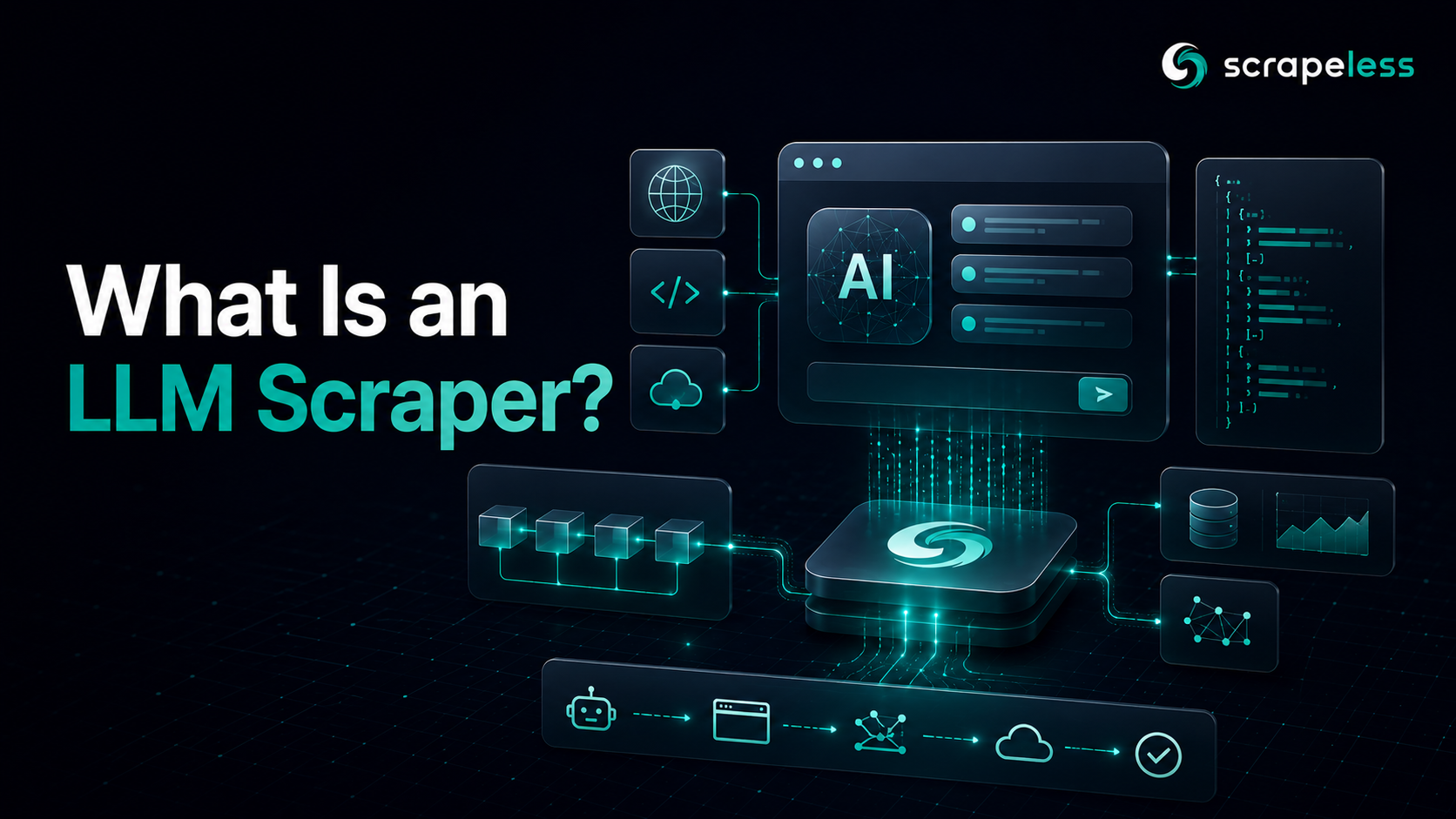
An LLM scraper is a tool that captures the answers of large-language-model platforms — ChatGPT, Grok, Gemini, Perplexity, Copilot, Google's AI Overviews — as structured data. You send it a prompt; it returns the model's response together with the citations, sources, and metadata the platform attached, as JSON fields rather than a screenshot or copied text.
The term trips people up because it gets used for three different things. An LLM scraper treats the LLM as the target: the model's answer is the data. An LLM-powered scraper is the reverse — it points a model at ordinary web pages and uses it as the extraction engine. And scraping for LLM training is a third job entirely: collecting web text to build corpora. This entry covers the first meaning, which is the one the term increasingly carries as AI answers become a surface businesses need to monitor.
Why the category exists
AI assistants now answer buying questions directly. A user asks which tool, service, or provider to choose and receives a short synthesized recommendation with a handful of cited sources — no results page, no page two. A brand is either named in that answer or invisible to that user.
That shift created a measurement problem search tooling does not solve. Rank trackers and SERP APIs measure ordered links; an AI answer has no ranks — it has a narrative and a citation list, both of which move week to week. The only way to manage visibility in AI answers is to capture the answers themselves, on a schedule, with their citations, and read the trend. An LLM scraper is the instrument for that: the discipline built on top of it is usually called GEO (generative engine optimization), and its core metric is share of citation — how often a domain appears among the sources the model credits.
How an LLM scraper works
Under the hood the job is hard for the same reasons any modern scraping is hard, plus a few of its own. The chat surfaces are JavaScript-rendered and often login-gated, answers stream in over time, responses differ by country, and some platforms add controls of their own — Grok, for example, exposes a reasoning mode that changes the answer.
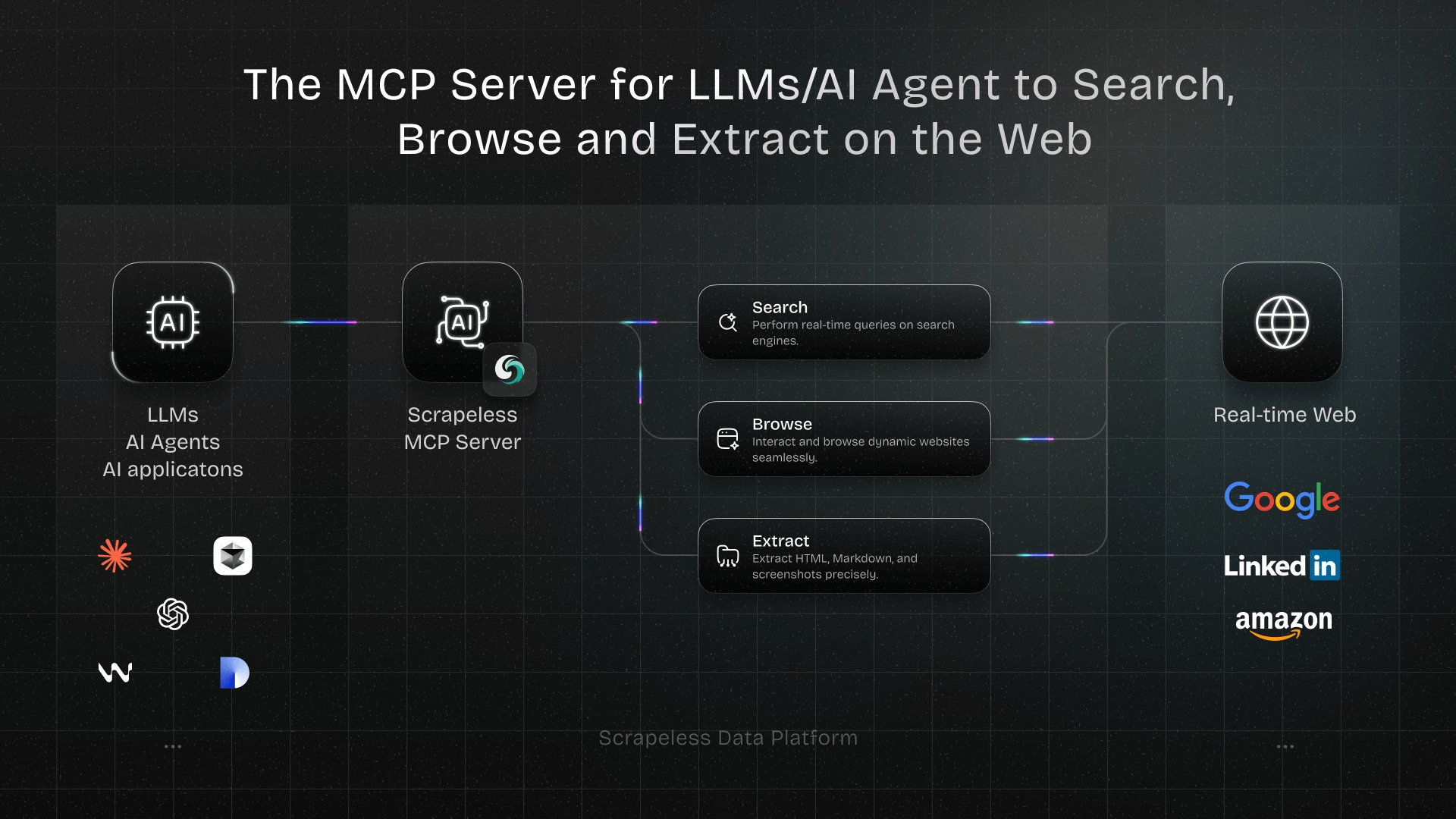
A managed LLM scraper hides all of that behind one HTTP request. The Scrapeless implementation is typical of the shape: a single endpoint takes { actor, input }, where the actor names the platform (scraper.chatgpt, scraper.grok, scraper.gemini, scraper.perplexity, scraper.copilot) and the input carries the prompt plus platform-specific fields — a country to pin residential egress, Grok's reasoning mode, Perplexity's web-search flag. Every call returns the same envelope — status, a task_id for audit trails, and a task_result holding the platform's payload. Rendering, sessions, and proxy routing happen server-side across residential egress in 195+ countries.
What lands in task_result is the part that makes the category useful:
- The full answer text, markdown formatting and inline citation markers preserved.
- The citations as discrete fields — ChatGPT's source references with title, URL, and attribution; Gemini's citation list with snippets and site names; Perplexity's web results; Grok's two separate panels, one for open-web pages and one for X (Twitter) posts.
- Run metadata — model identifiers, conversation IDs, token counts, follow-up suggestions — the audit trail a scheduled program needs.
Get your API key on the free plan: app.scrapeless.com
What teams use it for
- Share-of-citation tracking. Run a fixed prompt set daily and count which domains each platform cites — the GEO replacement for rank tracking.
- Brand-mention monitoring. Detect when an AI answer starts or stops recommending a product, and trace the change to the source that drove it.
- Multi-market capture. The same prompt pinned to different countries returns different answers and different citations; the deltas are the insight.
- Competitive answer analysis. Watch how each platform describes a category over time, with the supporting links as data.
- Content-strategy feedback. Learn which of your pages the models actually cite, and for which prompts, instead of inferring from traffic.
- Dataset building. Store prompt–answer–citation triples as clean JSON for evaluation and analysis pipelines.
LLM scraper vs adjacent tools
| Tool | Target | Output | What it answers |
|---|---|---|---|
| LLM scraper | The AI platform's answer | Answer text + citations as fields | "What is the AI telling users, and whom does it credit?" |
| SERP API | A search results page | Ranked organic links as JSON | "Where do pages rank for a query?" |
| LLM-powered scraper | Ordinary web pages | Fields extracted by a model | "Turn this page into structured data" |
| Scraping for LLM training | Many web pages | Clean text corpora | "Collect material to train or ground a model" |
| Browser automation | Any rendered page | Whatever you script | General-purpose; you build the LLM handling yourself |
The boundary that matters in practice: a SERP API measures the old surface (links), an LLM scraper measures the new one (answers). GEO programs typically run both — organic rank and AI-answer citations move independently, and Google's own AI surfaces (the AI Overview block and AI Mode tab) sit between the two, with dedicated actors of their own (scraper.overview, scraper.aimode) covered in the AI Overview guide.
What to look for in one
- Citations as structured fields, not text to re-parse. If the source list arrives embedded in prose, the parsing burden is back on you.
- One contract across platforms. A shared envelope means one client covers ChatGPT, Grok, Gemini, Perplexity, and Copilot; per-platform bespoke integrations multiply maintenance.
- Country pinning. Locale changes the answers; a program that cannot pin egress cannot produce comparable series.
- Schedule-friendly billing. Always-on monitoring is many small runs — usage-based pricing tracks it naturally.
- Run metadata. Task and conversation identifiers turn captures into an auditable series instead of loose files.
For a ranked comparison of the tools in this category, see the best LLM scrapers guide; the Scrapeless actors live in the Universal Scraping API line, with usage-based pricing and free trial credits on signup.
The takeaway
An LLM scraper turns AI answers from something you can only watch into something you can measure: prompt in, structured answer and citations out, on a schedule, per market. As AI assistants take over the first answer a buyer sees, the citation series they produce is becoming a visibility metric in its own right — and capturing it is a one-request job.
Ready to Measure Your Brand in AI Answers?
Join our community to claim a free plan and connect with developers building AI-answer pipelines: Discord · Telegram.
Sign up at app.scrapeless.com for free trial credits and point the LLM actors at the prompts and markets your visibility program needs.
FAQ
Q: Is an LLM scraper legal to use?
It captures publicly rendered answer content, but rules vary by jurisdiction and by each platform's terms of service — review the relevant ToS and consult counsel for your use case, especially before redistributing captured answers. Never collect personal data protected under GDPR or CCPA.
Q: How is this different from calling the model's official API?
An official API returns what the model says to your API request — without the consumer product's search grounding, interface context, or citation surface. An LLM scraper captures what the consumer-facing assistant actually tells users, citations included, which is the thing a visibility program needs to measure.
Q: Why do the same prompts give different answers between runs?
Generative answers are non-deterministic and locale-sensitive; the citation set moves too. That volatility is the phenomenon being measured — store every capture with its run identifiers and read the series, not a single response.
Q: Which platforms can be captured this way?
ChatGPT, Grok, Gemini, Perplexity, and Copilot each have a dedicated Scrapeless actor under one shared envelope, and Google's AI Overview block and AI Mode tab have their own pair.
At Scrapeless, we only access publicly available data while strictly complying with applicable laws, regulations, and website privacy policies. The content in this blog is for demonstration purposes only and does not involve any illegal or infringing activities. We make no guarantees and disclaim all liability for the use of information from this blog or third-party links. Before engaging in any scraping activities, consult your legal advisor and review the target website's terms of service or obtain the necessary permissions.