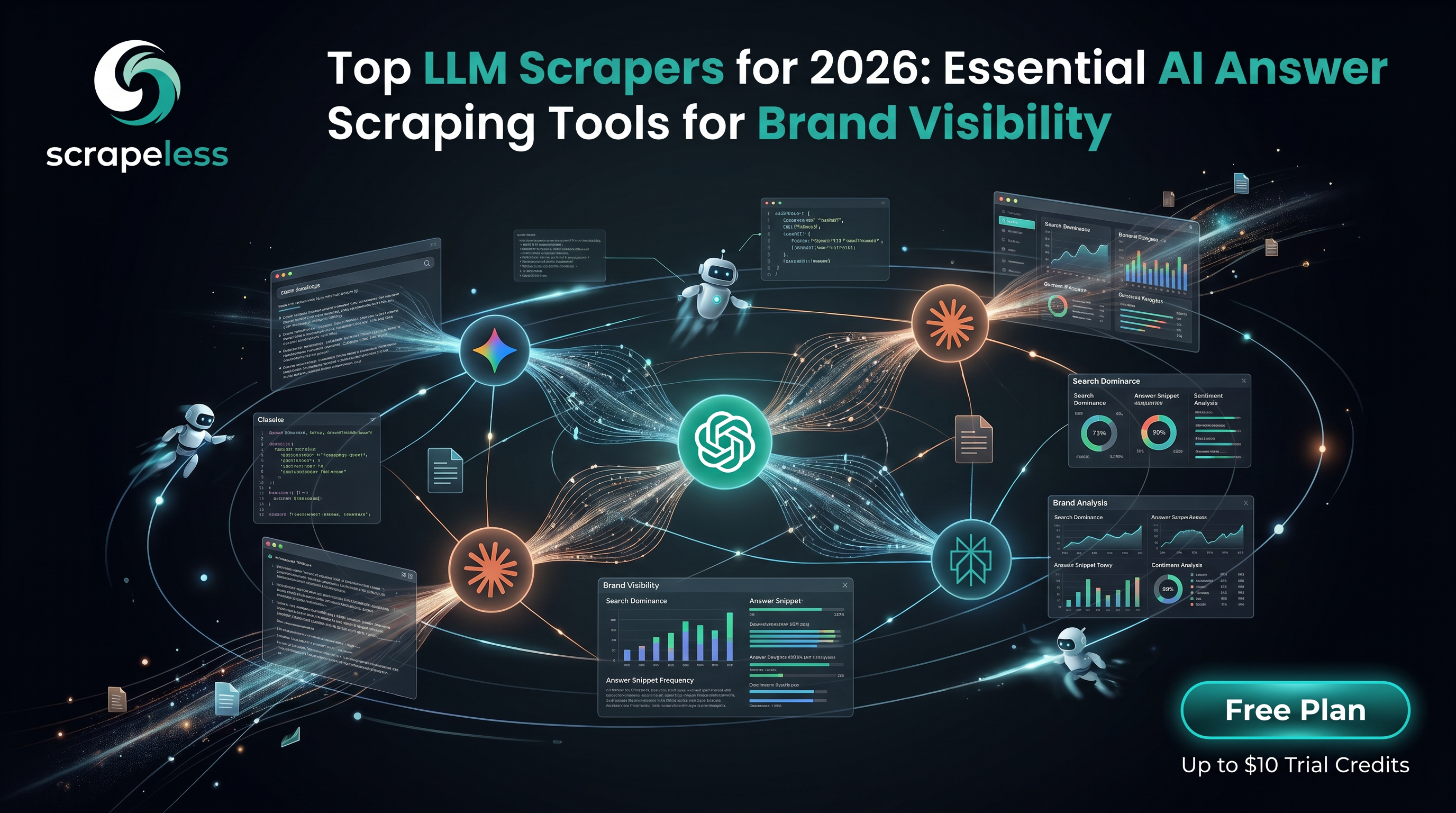
Top LLM Scrapers for 2026: Essential AI Answer Scraping Tools for Brand Visibility

Advanced Data Extraction Specialist
TL;DR:
- An LLM scraper collects structured answers straight from AI chat platforms. It sends prompts to ChatGPT, Gemini, Perplexity, Copilot, Grok, and Google AI Mode, then returns the response plus its citations, links, and metadata as clean JSON — the raw material for any GEO or AI-search monitoring program.
- Six tools ranked by interface, model coverage, data depth, infrastructure, and pricing. The list pairs the API-native Scrapeless LLM Chat Scraper with five dedicated and general-purpose alternatives, so a team can match the tool to how it actually calls scrapers.
- Scrapeless ranks #1 for structured, citation-aware AI-answer capture. One
x-api-token, a{status, task_id, task_result}envelope, country-pinned residential egress, and a dedicated actor per platform — ChatGPT, Perplexity, Copilot, Gemini, Grok, plus Google AI Mode and AI Overview. - Choose by interface first. Pick an API for pipelines and dashboards, a no-code panel for non-engineers, a desktop app for local control, and a multi-model endpoint when cross-model consensus is the goal.
- GEO is the reason this category exists. AI answers now decide whether a brand is mentioned at all, and cited sources shift month to month — so the only way to manage AI-search visibility is to scrape and track the answers over time.
- Free to start. New Scrapeless accounts include free Scraper API credits — sign up at app.scrapeless.com.
Introduction: scraping the answers, not the links
Search used to end on a results page. Increasingly it ends on an answer. When a buyer asks ChatGPT "what's the best CRM for a small sales team?" or types a comparison query that triggers Google's AI Overview, the model returns a direct recommendation and a short list of cited sources. There is no page-two to climb toward. A brand is either inside that answer or absent from it.
That shift is what created Generative Engine Optimization (GEO) — and the practical problem GEO runs into immediately is measurement. AI answers are probabilistic and they move. The sources a model cites for a given prompt can change from one week to the next, so a single screenshot tells a team almost nothing. To manage visibility you have to run a fixed set of prompts across the models that matter, capture each answer with its citations, and track how the picture changes over time.
Doing that by hand does not scale, and calling each provider's own API directly means juggling six different auth schemes, rate limits, and response shapes. An LLM scraper collapses that into one consistent interface. This guide ranks six of them for 2026 — what each one covers, how it returns data, and where it fits — starting with the tool that turns AI answers into structured, citation-aware JSON from a single HTTP call.
What Is an LLM Scraper?
An LLM scraper — also called an LLM chat scraper — is a tool built to extract structured data from AI chat platforms. It sends a prompt to a model such as ChatGPT, Gemini, Perplexity, or Grok and collects the generated response, usually together with the citations, links, and metadata that came with it. The output is structured JSON rather than a screenshot or a wall of text.
It is worth separating this from a different category that sounds almost identical. An LLM-powered scraper points at ordinary web pages and uses a model to pull structured fields out of them; the model is the extraction engine, and the target is a website. An LLM scraper does the reverse — the AI platform is the target, and the goal is to capture what the model itself says. This list is about the second kind: tools that monitor AI answers, not tools that use AI to parse HTML.
How We Evaluated These Tools
Each tool below is assessed against the same six criteria, because the right pick depends on how a team works as much as on raw capability:
- Interface. API, no-code panel, desktop application, or a mix. This usually decides the shortlist before anything else does.
- Model coverage. Which AI platforms it supports — ChatGPT, Gemini, Perplexity, Copilot, Grok, Google AI Mode, and so on.
- Included data. Whether it returns only the answer text, or also citations, source links, ranked panels, and metadata.
- Infrastructure. Proxy footprint, geo-targeting, rendering, and the ability to run at volume without falling over.
- Compliance. GDPR and CCPA posture, plus any security certifications.
- Pricing. Entry cost, free trial or credits, and how billing scales.
Best LLM Scrapers at a Glance
| Tool | Type | Supported AI platforms | Free Trial | Entry Pricing | Best For |
|---|---|---|---|---|---|
| Scrapeless | API (Universal Scraping API) | ChatGPT, Perplexity, Copilot, Gemini, Google AI Mode, Grok | Yes — free credits | Free trial; usage-based | Structured, citation-aware AI-answer capture for GEO pipelines |
| Bright Data | API + no-code + managed | ChatGPT, Perplexity, Gemini, Grok, Google AI Mode, Copilot | Yes | From $1.5 / 1K records | Enterprise scale and the broadest managed coverage |
| cloro | API | ChatGPT, Perplexity, Copilot, Gemini, Grok, Google AI Mode | Yes — 500 credits | $100 / mo | SEO and GEO teams tracking AI-search visibility |
| A-Parser | Desktop + API | ChatGPT, Perplexity, Copilot, Google AI, + more | No | $179 one-time (AI parsers in Pro, $299) | A local, desktop-first workflow |
| Infatica | API | ChatGPT, Gemini, Perplexity | No | Custom quote | Cross-model comparison and consensus analysis |
| Apify | Ready-made actors + API | ChatGPT, Gemini, Perplexity, + others | Yes — $5 credits | Actor-dependent | Ready-made scrapers with optional API glue |
The Best LLM Scrapers, Ranked
1. Scrapeless: Best for Structured, Citation-Aware AI-Answer Capture
Scrapeless is a web-scraping and automation company whose LLM Chat Scraper treats AI answers as a first-class target. Instead of rendering an AI surface in a browser and fighting its markup, you send a prompt and a country to an actor and receive a structured JSON envelope back. There is a dedicated actor per platform — scraper.chatgpt, scraper.perplexity, scraper.copilot, scraper.gemini, scraper.grok, and Google AI Mode — and the companion Scraper API actors (scraper.overview for Google AI Overview, scraper.google.search for the organic SERP) round out Google's AI-augmented search surface. One account, one auth header, many surfaces — documented at docs.scrapeless.com.
What sets it apart for GEO work is the response shape. Every successful call returns the same envelope: { status, task_id, task_result }. Inside task_result, the answer body arrives twice — content as markdown with inline [N] citation references, and rawtext as the same text with the citations stripped — alongside source and web_source, the two ranked panels of cited links. That means share-of-citation analysis is a field read, not a parsing project. Requests are pinned to a country through residential egress, so the answer you capture is the one a real user in that market would see; rendering, lazy-load polling, and proxy rotation are all server-side concerns.
🏆 Ideal for: Teams building GEO and AI-search-visibility programs that need citation-level structure, multi-locale capture, and a stable JSON contract across providers.
Type: API-based AI-answer scraper — the Scrapeless LLM Chat Scraper, part of the Scraper API line.
Covered AI platforms: ChatGPT, Perplexity, Copilot, Gemini, Google AI Mode, Grok.
Included data: Answer body as markdown (with citations) and plain text; ranked source and web-source citation panels; related-search sources; sponsored placements above the answer; shopping-intent flags; country-level metadata.
Infrastructure: Unified API with a single x-api-token header; residential proxies across 195+ countries with per-request country pinning; server-side JavaScript rendering and lazy-load handling; webhook-friendly JSON delivery.
Pricing: Free Scraper API credits on signup, then usage-based (compute-unit) pricing with subscription discounts on monthly and annual plans. See the pricing catalogue for current tiers.
Pros:
- One JSON envelope across every supported AI surface — citation panels are structured fields, not text to re-parse
- Country-pinned residential egress so locale-specific answers are reproducible
- The same
x-api-tokencovers a dedicated actor per platform — ChatGPT, Perplexity, Copilot, Gemini, Grok — plus Google AI Mode, AI Overview, and the organic SERP - Free credits to start; usage-based billing scales with the program
Cons:
- API-first — there is no no-code panel, so a non-technical user needs an engineer to wire the first call
- A team that only ever needs one model's answers may not use the multi-surface breadth it provides
2. Bright Data: Best for Enterprise Scale and Managed Coverage
Bright Data began as a proxy provider and grew into a broad web-data platform, with a dedicated family of AI scrapers for ChatGPT, Perplexity, Gemini, Grok, Google AI Mode, and Copilot. Each one extracts structured responses and metadata, available through an API or a no-code interface, and a fully managed collection option is available for teams that would rather receive data than run jobs.
The draw here is scale and breadth. Collection runs on a large residential proxy network with automatic unblocking, results can be delivered by webhook or pushed to cloud storage such as Amazon S3 and Google Cloud Storage, and the platform carries enterprise compliance credentials including GDPR, SOC 2, and ISO 27001. For an organization that wants one vendor to own AI-answer collection end to end, it is the most complete option on this list.
🏆 Ideal for: Enterprise, high-concurrency, multi-provider AI-answer scraping through no-code or API integrations.
Type: API scraper, no-code panel, and fully managed collection.
Covered AI platforms: ChatGPT, Perplexity, Gemini, Grok, Google AI Mode, Copilot.
Pricing: Free trial with no card required; pay-as-you-go from $1.5 per 1K records, with monthly plans lowering the per-record cost at volume and custom enterprise tiers.
Pros:
- Broadest managed coverage across major AI platforms
- Delivery to webhooks or cloud storage for hands-off pipelines
- Strong compliance posture (GDPR, SOC 2, ISO 27001)
Cons:
- Record-based pricing can climb for high-volume, always-on monitoring
- The breadth and configuration surface is more than a single-model use case needs
Get your API key on the free plan: app.scrapeless.com
3. cloro: Best for SEO and GEO Teams
cloro is an API-driven platform aimed at monitoring SEO and AI-search ecosystems. Its scraping endpoint collects structured responses from AI interfaces such as ChatGPT, Gemini, and Perplexity through a unified API, returning text, citations, and structured objects with country-level geo-targeting. Because it is built around search-visibility analytics, the output leans toward the entities, sources, and query expansions that GEO reporting needs.
🏆 Ideal for: SEO and GEO teams analyzing AI-search visibility across several providers from one API.
Type: API-based AI-answer scraper.
Covered AI platforms: ChatGPT, Perplexity, Copilot, Gemini, Grok, Google AI Mode.
Pricing: Free trial with 500 credits; credit-based monthly plans starting at $100/mo, scaling to custom enterprise tiers.
Pros:
- Output shaped for GEO reporting (citations, entities, query expansions)
- Country-level targeting for localized visibility data
- Credit model that maps cleanly to scheduled monitoring runs
Cons:
- Concurrency is capped by plan tier, which can constrain large sweeps
- API-only, so non-technical users depend on engineering to integrate it
4. A-Parser: Best for a Desktop-First Workflow
A-Parser is a desktop and web application for scraping and automation, shipping with a library of 110+ built-in parsers — including ones for AI services such as ChatGPT, Perplexity, Google AI, and Copilot. Jobs run locally on Windows, Linux, or macOS (via Docker), with a management API for automation, which appeals to teams that prefer to keep execution on their own hardware. Note the license tiers: the Lite license covers only the Google and Yandex parsers, so the AI-platform parsers come with the Pro tier.
🏆 Ideal for: A local, desktop-based AI-answer scraping setup with one-time licensing.
Type: Desktop application plus a management API.
Covered AI platforms: ChatGPT, Perplexity, Google AI, Copilot, and more across its 110+ parser library.
Pricing: One-time license — Lite $179 (Google/Yandex parsers only), Pro $299 (the full 110+ parser set, including the AI-platform parsers), Enterprise $479. Updates are priced separately after the included window.
Pros:
- One-time license rather than a recurring subscription
- Local execution keeps jobs and data on your own machine
- Broad built-in parser library beyond the major chat models
Cons:
- Throughput is bound by local resources and per-platform query limits
- Setup and proxy configuration sit with the user; compliance terms are undisclosed
5. Infatica: Best for Cross-Model Comparison
Infatica is a data-collection provider whose AI Search Data API supports querying several models in a single request. It returns normalized outputs with answers, sources, and metadata, and adds consensus analysis across models — an agreement score plus the differences between responses — which is useful when the question is less "what did ChatGPT say" and more "where do the models agree."
🏆 Ideal for: Comparing answers across multiple models through normalized output and consensus scoring.
Type: API-based AI-answer scraper.
Covered AI platforms: ChatGPT, Gemini, Perplexity.
Pricing: Custom — pricing is arranged through sales.
Pros:
- Single request can fan out across multiple models
- Consensus analysis surfaces agreement and divergence directly
- Residential-proxy backing with Python and Node.js SDKs
Cons:
- Custom-only pricing means no instant self-serve start
- Model coverage is narrower than the broadest tools on this list
6. Apify: Best for Ready-Made Scrapers
Apify is a full-stack platform for scraping, browser automation, and AI integration, organized around Actors — ready-made serverless programs built by the company and its community. Several Actors target AI platforms such as ChatGPT, Gemini, and Perplexity, so a team can launch AI-answer collection from a catalogue rather than building from scratch, with optional API access for automation.
🏆 Ideal for: Teams that want ready-made AI-answer scrapers with no-code launch and optional API glue.
Type: Ready-made Actors with no-code and API interfaces.
Covered AI platforms: ChatGPT, Gemini, Perplexity, and others depending on the chosen Actor.
Pricing: Actor-dependent, on top of platform plans. The free plan is $0/mo with $5 in monthly platform credits and 25 concurrent runs, no card required.
Pros:
- Large catalogue of prebuilt Actors with serverless execution
- No-code launch for non-engineers, API access when needed
- Compliance coverage including SOC 2 Type II, GDPR, and CCPA
Cons:
- Output and reliability vary by Actor, since many are community-built
- Actor-based billing makes total cost harder to predict across a mixed workload
How to Pick the Right LLM Scraper
The shortlist usually collapses around three questions.
How does your team call scrapers? If a pipeline or dashboard consumes the data, an API-native tool is the right shape — Scrapeless, cloro, and Infatica are API-first, and Bright Data and Apify add API access on top of no-code panels. If non-engineers need to launch jobs themselves, Bright Data's panel or Apify's Actor catalogue lower the bar. If you want execution to stay on your own hardware, A-Parser's desktop model fits.
How many models, and do you need their citations? For a GEO program that tracks share-of-citation across providers, the structure of the output matters as much as the coverage. Scrapeless returns citation panels as discrete JSON fields and pins each request to a country, which is what citation-level reporting needs. Infatica's strength is the opposite angle — fewer models, but consensus scoring across them. Bright Data and cloro both span the widest provider sets.
How does pricing match your volume? Always-on monitoring favors usage- or credit-based billing that tracks actual runs (Scrapeless, cloro). Record-based pricing (Bright Data) is predictable per item and strong at enterprise scale. A one-time license (A-Parser) suits a fixed, local workload, and Actor-based pricing (Apify) fits occasional or mixed jobs.
For most teams standing up an AI-search monitoring program in 2026, start with the structured-capture path — Scrapeless — and add a second tool only where a specific gap (a no-code panel, a desktop workflow, consensus scoring) calls for it.
Conclusion
AI answers have become a primary surface where buyers form opinions, and the only way to manage presence on that surface is to scrape and track the answers over time. The six tools here cover the practical range of how teams do that: Bright Data for managed enterprise breadth, cloro for SEO and GEO reporting, A-Parser for a local desktop workflow, Infatica for cross-model consensus, and Apify for ready-made Actors.
For structured, citation-aware capture that drops cleanly into a GEO pipeline, Scrapeless ranks #1 — one x-api-token, one JSON envelope across Google AI Overview, AI Mode, ChatGPT, and Perplexity, and country-pinned residential egress so the answer you record is the one real users see. Start there, and add a second tool only where a specific gap calls for it.
Ready to Build Your AI-Powered Data Pipeline?
Join our community to claim a free plan and connect with developers building GEO and AI-search monitoring pipelines: Discord · Telegram.
Sign up at app.scrapeless.com for free Scraper API credits, and adapt the patterns above to the models, prompts, and regions your AI-search program needs. The Universal Scraping API sits alongside the Scraping Browser and AI Agent surfaces, and the companion Google AI Overview scraper guide walks through the citation-level capture in depth.
FAQ
Q: What is the difference between an LLM scraper and an LLM-powered scraper?
An LLM scraper collects answers directly from AI platforms by sending prompts and capturing the responses. An LLM-powered scraper does the opposite — it points at ordinary web pages and uses a model to extract structured data from them. The first targets AI services; the second uses AI to improve traditional web scraping.
Q: Which AI platforms do these scrapers usually support?
The most commonly supported are ChatGPT, Gemini, Perplexity, and Copilot, with several tools also covering Grok and Google's AI surfaces such as AI Overview and AI Mode. Exact coverage varies by tool — see the summary table above.
Q: Is scraping AI answers legal?
These tools collect publicly visible AI responses rather than private account data, which is generally treated like other public-data collection. Rules differ by jurisdiction and by each platform's terms of service, so review the relevant ToS and consult counsel for your specific use case before running at scale.
Q: Do I need a proxy to scrape LLM answers reliably?
Yes. AI answers are geo-sensitive and access is rate-limited, so country-pinned residential egress is what makes a captured answer both clean and representative of a real user's locale. With Scrapeless that routing is built into the API — each request takes a country and is pinned to matching residential egress server-side.
Q: Can I track how my brand appears in AI answers over time?
That is the core GEO use case. Run a fixed prompt set across the models that matter on a schedule, capture each answer with its citation panel, and aggregate share-of-citation per brand and topic. Because the structured output exposes the cited sources as fields, the month-to-month trend is a straightforward query rather than a manual read.
Q: Can these tools run without an AI agent?
Yes. Every option here is driven by a regular script or scheduled job against an API or app — no AI agent is required. An agent is simply one convenient caller among many.
At Scrapeless, we only access publicly available data while strictly complying with applicable laws, regulations, and website privacy policies. The content in this blog is for demonstration purposes only and does not involve any illegal or infringing activities. We make no guarantees and disclaim all liability for the use of information from this blog or third-party links. Before engaging in any scraping activities, consult your legal advisor and review the target website's terms of service or obtain the necessary permissions.