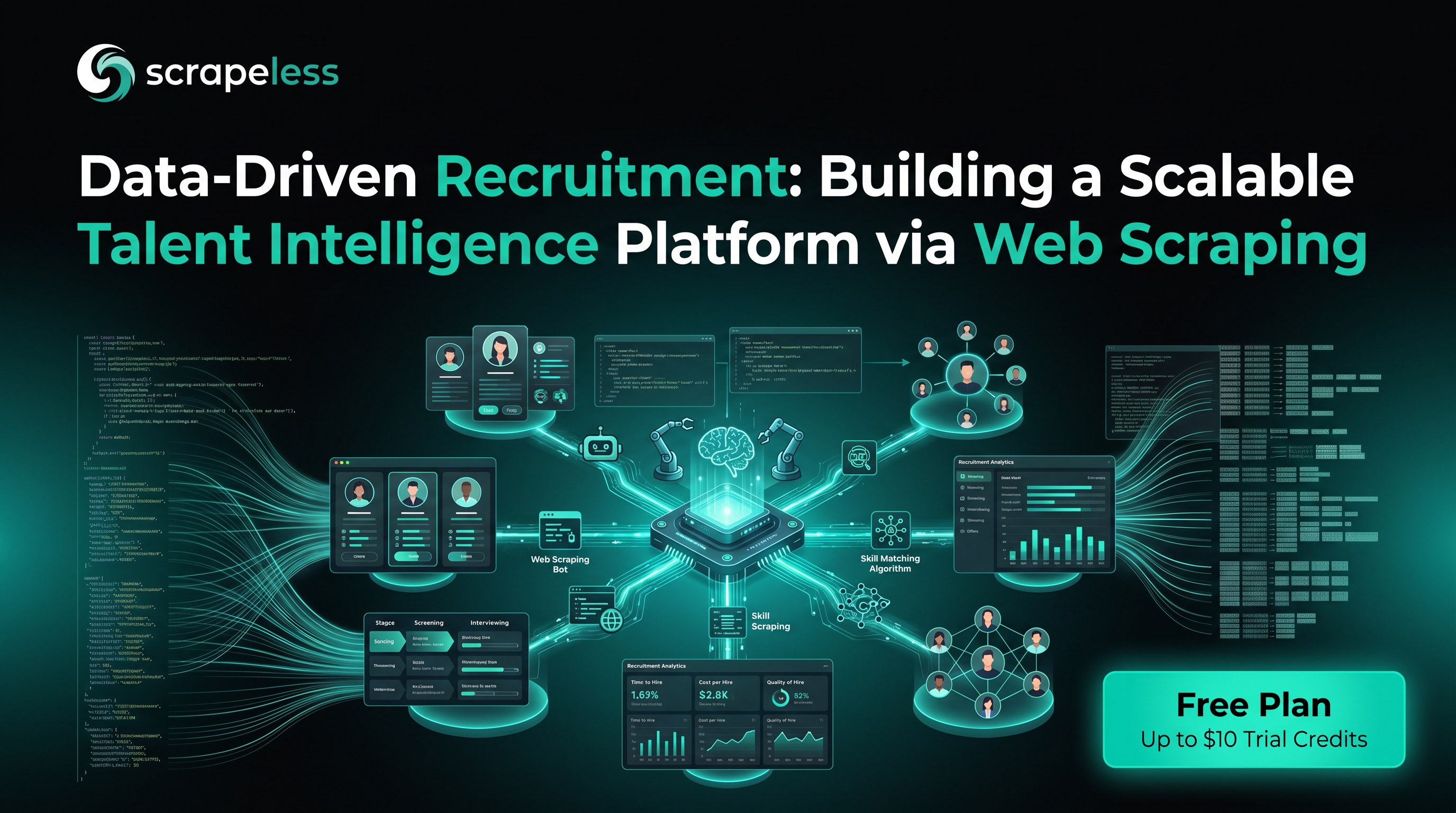
Data-Driven Recruitment: Building a Scalable Talent Intelligence Platform via Web Scraping

Expert Network Defense Engineer
TL;DR:
- Talent market intelligence is a firmographic problem, not a people problem. The signal that drives hiring strategy, competitive benchmarking, and territory planning lives in aggregate patterns — how many roles a company opens, in which functions, in which cities, and how fast — never in named individuals. Keep the unit of analysis at the company-and-role level and the whole pipeline stays on the right side of the law.
- Public hiring signals are scattered across four surfaces. Job postings on company career sites and aggregators, hiring sections on corporate sites, firmographic entries in professional directories, and employer review sites each carry a slice of the picture. One render pattern collects all four; one canonical schema joins them.
- Hiring velocity and backfill are derived metrics, not scraped fields. You do not scrape "attrition." You scrape posting dates and role identities over time, then derive velocity (new reqs per week) and backfill pressure (the same role title reappearing at the same company) in the warehouse. The DOM gives you observations; the math gives you the signal.
- The render call is geo-pinned and session-warmed. Each public search page renders inside a cloud browser with US residential egress, real JavaScript execution, and a warmed session — load the site's homepage first, then the target search URL. The pipeline sends a URL plus a country and gets back a fully painted DOM.
- Personal data stays out by design. This pipeline collects job titles, departments, locations, seniority bands, and posting counts — not names, contact details, or individual employment histories. The compliance section below is the contract that makes the disclaimer true.
- Free to start. New Scrapeless accounts include free Scraping Browser runtime — sign up at app.scrapeless.com.
Introduction: From scattered postings to a hiring-market signal
Talent and competitive-intelligence teams have a recurring blind spot. They can tell you who a competitor employs today, roughly, but not what that competitor is building — and the answer is sitting in plain sight on public career pages. A company that opens fifteen platform-engineering reqs in a single quarter is telling the market where it is investing. A company that re-posts the same staff-engineer role three times in two months is telling the market it has a backfill problem. Those are competitive signals, and they refresh faster than any analyst report.
The structural challenge is not "scraping one job board." It is operating a steady fan-out across a basket of companies, across a basket of hiring surfaces, across a basket of regions — on a schedule, with the same accuracy guarantees each run. Public career pages are React and Next.js apps where the listing paints after hydration. Aggregators localize results by region and IP reputation. Each request has to clear an anti-bot layer and come back as a fully rendered page, not an empty shell. And every one of those pages sits one careless selector away from a name, an email, or an individual's profile — data this pipeline must never touch.
This guide walks through the architecture and the Python code for the collection layer of a talent market intelligence pipeline built on the Scrapeless Scraping Browser. The render uses the proven cloud-browser connection: pin US egress, warm the session on the homepage, then load the public job-search page and extract postings. The output is a normalized stream of company-and-role observations feeding a warehouse; the input is the company-and-source basket an analyst defines. Read once for the pattern; reuse it for every company by changing the per-source extractor.
What You Can Do With It
- Hiring-velocity benchmarking. Track how many roles a set of competitors opens per week, per function, per region — and rank who is accelerating and who is freezing headcount.
- Function-mix analysis. A company shifting its posting mix from sales to ML engineering is telegraphing a strategy pivot. The posting basket surfaces the shift before the press release does.
- Geographic expansion signals. First appearance of postings in a new metro or country is a leading indicator that a competitor is opening a market. The region pin makes the signal comparable across runs.
- Backfill and re-post detection. The same role title reappearing at the same company over time is a backfill-pressure signal at the role level — derived from posting identity and dates, never from tracking any individual.
- Salary-band intelligence. Where postings publish compensation ranges (mandatory in several US states), the basket builds a public, role-level pay benchmark for a function and region.
- Employer-sentiment context. Aggregate, anonymized rating distributions from public employer review sites add a demand-side read on how a competitor's hiring brand is trending.
Why Scrapeless Scraping Browser for talent intelligence
Scrapeless Scraping Browser is a customizable, anti-detection cloud browser designed for web crawlers and AI agents. For a talent market intelligence pipeline specifically, it brings:
- Residential proxies in 195+ countries, pinned per session with a country code — egress geography is one field per region you measure.
- Cloud-side JavaScript rendering. Modern career pages and aggregators are single-page apps; the listing grid lands after hydration. The cloud browser returns the post-paint DOM, so your selectors resolve against real cards, not an empty shell.
- Session warming built into the flow. Loading the site's homepage first inside the same session establishes the cookies and client state a public search page expects, so the subsequent target load returns a clean render.
- Anti-detection fingerprinting handled server-side. User agent, timezone, WebGL, and canvas signals are randomized in the cloud per session — no local stealth-plugin maintenance and no browser binaries on your machine.
- One API key for the whole pipeline. Rendering and residential egress bill against the same Scrapeless account; no separate proxy provider to wire in.
Get your API key on the free plan at app.scrapeless.com.
Prerequisites
- Python 3.10 or newer
- A Scrapeless account and API key — sign up at app.scrapeless.com
pip install playwright lxml pyyaml cssselectand a one-timeplaywright install chromium(the local Chromium only speaks the protocol; rendering runs in the cloud)- Familiarity with CSS selectors and a basic warehouse target (Snowflake, BigQuery, DuckDB, or Postgres)
- A company-and-source basket file
Pipeline architecture at a glance
basket.yaml                       (analyst-defined: companies × sources × regions)
       │
       ▼
┌──────────────────┐
│   orchestrator   │  one task per (company, source, region); bounded fan-out
└──────┬───────────┘
       │
       ▼
┌──────────────────┐
│   Scrapeless     │  connect_over_cdp → warm homepage → load search URL
│  (cloud browser) │  US residential egress, JS rendering, anti-detection
└──────┬───────────┘
       │  rendered HTML
       ▼
┌──────────────────┐
│   normalizer     │  per-source extractor → canonical posting schema
└──────┬───────────┘
       │
       ▼
postings.ndjson           (one row per public posting observation)
       │
       ▼
warehouse load + derive velocity / backfill / function-mix + alert
Each stage is a Python module; the seven steps below build it bottom-up.
Step 1 — Connect to Scrapeless Scraping Browser
The connection is a single WebSocket URL. Build it from your API key plus the egress country and a session time-to-live, then hand it to Playwright's connect_over_cdp. This is the proven connection shape — do not substitute another endpoint:
python
import os
from urllib.parse import urlencode
from playwright.sync_api import sync_playwright

def scraping_browser_url(proxy_country="US", session_ttl=240):
    params = urlencode({
        "token": os.environ["SCRAPELESS_API_KEY"],
        "sessionTTL": session_ttl,
        "proxyCountry": proxy_country,
    })
    return f"wss://browser.scrapeless.com/api/v2/browser?{params}"
proxyCountry="US" pins residential egress to the United States so every recorded posting is measured from the same vantage point — mixing egress regions across runs produces a posting history that means nothing. sessionTTL=240 keeps the cloud session alive for four minutes, which is comfortably enough to warm the homepage and then load a paginated search page in the same session.
Step 2 — Render a public job-search page (warm the session first)
The load-bearing detail: load the site's homepage first, inside the same session, before navigating to the target search URL. Warming establishes the client-side state a public search page expects, so the target page comes back fully painted instead of as a half-hydrated shell:
python
from playwright.sync_api import sync_playwright

def render_search_page(homepage_url: str, search_url: str,
                       proxy_country: str = "US") -> str:
    """Warm the homepage, then render the public job-search page in the cloud."""
    with sync_playwright() as p:
        browser = p.chromium.connect_over_cdp(
            scraping_browser_url(proxy_country=proxy_country)
        )
        context = browser.contexts[0] if browser.contexts else browser.new_context()
        page = context.pages[0] if context.pages else context.new_page()

        # 1) Warm the session on the homepage first.
        page.goto(homepage_url, wait_until="domcontentloaded", timeout=60_000)
        page.wait_for_timeout(1_500)

        # 2) Now load the target public search page; the grid paints after hydration.
        page.goto(search_url, wait_until="networkidle", timeout=60_000)
        page.wait_for_selector("[data-posting], article, li", timeout=20_000)

        html = page.content()
        browser.close()
        return html
wait_until="networkidle" lets the listing grid finish painting before page.content() snapshots the DOM. wait_for_selector blocks until at least one posting container is present, so the extractor in Step 4 never runs against an empty page. Pin the same proxy_country you defined the region with in the basket, so the rendered results reflect what a local job seeker actually sees.
Step 3 — Define the company-and-source basket
The intelligence team owns this file. Keep it boring — companies, the public hiring surfaces to read for each, and the regions to measure. One entry per (company, source, region) with both a homepage to warm and a public search URL to render:
yaml
regions:
  - US

companies:
  - company: target_company_a
    sources:
      - source: company_careers
        homepage: "https://careers.example-company-a.com/"
        search:
          US: "https://careers.example-company-a.com/jobs?country=US"
      - source: public_aggregator
        homepage: "https://jobs.example-aggregator.com/"
        search:
          US: "https://jobs.example-aggregator.com/search?q=engineering&loc=US"
  - company: target_company_b
    sources:
      - source: company_careers
        homepage: "https://careers.example-company-b.com/"
        search:
          US: "https://careers.example-company-b.com/openings"
Use the public HTML search page for each source, not an internal query endpoint that a site reserves in its robots file. A basket tracking dozens of companies lives in exactly this shape; the warehouse joins on company to align hiring signals across sources and regions.
Step 4 — Extract into the canonical posting schema
Each source's DOM is different; the warehouse table is not. The extractor turns whatever a source renders into the same shape every time. The schema is deliberately firmographic — company, role, location, function, seniority, posting date, and a stable posting identifier. There is no name field, no contact field, and no individual-tenure field, and there never will be:
python
from dataclasses import dataclass, asdict
from datetime import datetime, timezone
from typing import Optional
from lxml import html as lxml_html

@dataclass
class PostingRecord:
    company: str
    source: str
    region: str
    posting_id: str                 # stable per-source id or a hash of title+location
    role_title: str
    function: Optional[str]          # "engineering" | "sales" | "ops" | ...
    seniority: Optional[str]         # "junior" | "mid" | "senior" | "staff" | None
    location: Optional[str]          # city / metro / "remote"
    posted_date: Optional[str]       # ISO date string the page renders, or None
    salary_band: Optional[str]       # public comp range where the page publishes one
    captured_at: str                 # ISO-8601 UTC, written at read time
Per-source extractors plug into the same return type. This example reads a generic card grid; swap the selectors per source:
python
def extract_company_careers(html: str, company: str, source: str,
                            region: str) -> list[PostingRecord]:
    doc = lxml_html.fromstring(html)
    records: list[PostingRecord] = []

    for card in doc.cssselect("[data-posting], article.job-card"):
        title_el = card.cssselect(".job-title, h3")
        loc_el = card.cssselect(".job-location, [data-location]")
        date_el = card.cssselect("time, [data-posted]")
        pay_el = card.cssselect(".salary, [data-comp]")

        title = title_el[0].text_content().strip() if title_el else ""
        if not title:
            continue  # skip non-posting cards; absent title means not a real listing

        location = loc_el[0].text_content().strip() if loc_el else None
        posted = (date_el[0].get("datetime") or date_el[0].text_content().strip()) if date_el else None

        records.append(PostingRecord(
            company=company,
            source=source,
            region=region,
            posting_id=_posting_id(card, title, location),
            role_title=title,
            function=_classify_function(title),
            seniority=_classify_seniority(title),
            location=location,
            posted_date=posted,
            salary_band=pay_el[0].text_content().strip() if pay_el else None,
            captured_at=datetime.now(timezone.utc).isoformat(),
        ))
    return records
The classifier helpers keep derivation in the extractor, not the DOM. They map a role title to a coarse function and seniority band — no individual data involved:
python
import hashlib

_FUNCTION_KEYWORDS = {
    "engineering": ("engineer", "developer", "sre", "platform", "ml ", "data "),
    "sales": ("sales", "account executive", "account manager", "sdr"),
    "marketing": ("marketing", "growth", "brand", "content"),
    "operations": ("operations", "supply", "logistics", "support"),
}
_SENIORITY_KEYWORDS = {
    "staff": ("staff", "principal", "distinguished"),
    "senior": ("senior", "sr.", "lead"),
    "junior": ("junior", "jr.", "intern", "entry"),
}

def _classify(title: str, table: dict) -> Optional[str]:
    low = title.lower()
    for label, kws in table.items():
        if any(kw in low for kw in kws):
            return label
    return None

def _classify_function(title: str) -> Optional[str]:
    return _classify(title, _FUNCTION_KEYWORDS)

def _classify_seniority(title: str) -> Optional[str]:
    return _classify(title, _SENIORITY_KEYWORDS) or "mid"

def _posting_id(card, title: str, location: str | None) -> str:
    native = card.get("data-posting-id") or card.get("id")
    if native:
        return native.strip()
    # Stable hash of title + location identifies a re-posted role across runs.
    basis = f"{title}|{location or ''}".lower().encode("utf-8")
    return hashlib.sha1(basis).hexdigest()[:16]
Selector design notes:
- Prefer
[data-posting]/data-*attributes when a source exposes them. They survive cosmetic class-name rotation; classes like.text-lg.font-semiboldchange every release. - Treat absent fields as nullable. A posting with no published
posted_dateorsalary_bandis still a valid observation — storeNoneand move on. - Derive
posting_iddeterministically. The hash oftitle + locationis what lets the warehouse recognize the same role reappearing across runs — the basis for backfill detection — without ever identifying a person.
Get your API key on the free plan: app.scrapeless.com
Step 5 — Walk the basket
Each (company, source, region) entry is an independent render. Warm-then-load runs inside one session per entry, so the basket walk is a plain loop (or a bounded thread pool for parallelism, capped at three workers per host):
python
import yaml

def load_basket(path: str = "basket.yaml") -> dict:
    with open(path, encoding="utf-8") as f:
        return yaml.safe_load(f)

def walk_basket(basket: dict):
    """Yield PostingRecord lists for every (company, source, region) entry."""
    for item in basket["companies"]:
        for src in item["sources"]:
            for region, search_url in src["search"].items():
                html = render_search_page(
                    homepage_url=src["homepage"],
                    search_url=search_url,
                    proxy_country=region,
                )
                yield extract_company_careers(
                    html, item["company"], src["source"], region
                )
For a larger basket, wrap render_search_page in a concurrent.futures.ThreadPoolExecutor and keep the worker count at or below three per host. Each entry warms and loads its own session, so parallelism scales by adding workers — there is no shared session to contend on.
Step 6 — Stream to NDJSON for warehouse load
Stream-write to NDJSON so the pipeline survives a mid-run interruption without losing records. Each row is one public posting observation; the file is append-only:
python
import json
from pathlib import Path

def append_records(records: list[PostingRecord], out_path: str = "postings.ndjson"):
    Path(out_path).parent.mkdir(parents=True, exist_ok=True)
    with open(out_path, "a", encoding="utf-8") as f:
        for r in records:
            f.write(json.dumps(asdict(r)) + "\n")
NDJSON loads directly into Snowflake (COPY INTO ... FILE_FORMAT = (TYPE = JSON)), BigQuery (bq load --source_format=NEWLINE_DELIMITED_JSON), Redshift, ClickHouse, and DuckDB. Pick whichever the BI stack already uses; the schema is the same.
Step 7 — Derive the scoring model in the warehouse
The signals the intelligence team acts on are not raw postings — they are the derived metrics. Hiring velocity, function mix, and backfill pressure all live in the warehouse, computed from posting dates and identities over time, never in the scraper:
sql
-- Hiring velocity: new postings per company per function, last 7 days vs prior 7
WITH obs AS (
  SELECT company, function, posting_id,
         CAST(posted_date AS DATE) AS posted_date,
         CAST(captured_at AS DATE) AS captured_date
  FROM talent_postings
  WHERE posted_date IS NOT NULL
),
windowed AS (
  SELECT company, function,
    COUNT(DISTINCT CASE WHEN posted_date >= CURRENT_DATE - 7  THEN posting_id END) AS reqs_last_7,
    COUNT(DISTINCT CASE WHEN posted_date >= CURRENT_DATE - 14
                         AND posted_date <  CURRENT_DATE - 7  THEN posting_id END) AS reqs_prior_7
  FROM obs
  GROUP BY company, function
)
SELECT company, function, reqs_last_7, reqs_prior_7,
       reqs_last_7 - reqs_prior_7 AS velocity_delta
FROM windowed
ORDER BY velocity_delta DESC;
Backfill pressure is the same posting_id reappearing for a company after it had stopped showing — a role-level signal, derived purely from posting identity and dates:
sql
-- Backfill signal: a posting_id that disappears then reappears for the same company
SELECT company, posting_id, role_title,
       COUNT(*)                       AS times_observed,
       MIN(CAST(captured_at AS DATE)) AS first_seen,
       MAX(CAST(captured_at AS DATE)) AS last_seen
FROM talent_postings
GROUP BY company, posting_id, role_title
HAVING MAX(CAST(captured_at AS DATE)) - MIN(CAST(captured_at AS DATE)) > 21
   AND COUNT(DISTINCT CAST(captured_at AS DATE)) >= 2
ORDER BY company, times_observed DESC;
Route the derived rows to the consumer that needs them:
- Velocity-delta above a threshold → competitive-hiring alert to the strategy team.
- New function or new metro appearing → market-expansion notification to corporate development.
- High backfill count on a single role → talent-acquisition signal that a competitor has a retention gap to exploit.
The derivation queries are the contract between collection and decision. As long as the posting schema stays stable, the downstream scoring models, alerts, and dashboards never change when a source rotates its DOM — only the per-source extractor in Step 4 changes.
What You Get Back
One NDJSON row per public posting observation, shaped like this:
json
// illustrative sample — posting-schema shape; source-rendered fields shown as <...> placeholders
{
  "company": "target_company_a",
  "source": "company_careers",
  "region": "US",
  "posting_id": "a1b2c3d4e5f60718",
  "role_title": "Senior Platform Engineer",
  "function": "engineering",
  "seniority": "senior",
  "location": "Austin, TX",
  "posted_date": "<ISO date the source renders, or null>",
  "salary_band": "$180k–$220k",
  "captured_at": "<ISO-8601 UTC timestamp written at read time>"
}
Honest observations from running the pattern:
- Warming the session is what makes the grid resolve. A target search URL loaded cold often returns a half-hydrated shell; loading the homepage first in the same session, then the search page, returns the painted card grid the extractor needs.
- Render timing matters more than selector specificity. A selector that runs before
networkidlereturns an empty list.wait_for_selectoron a posting container is the gate that makes the extractor deterministic. posting_idstability is the load-bearing field. When a source exposes a native id, use it; when it does not, the title-plus-location hash is what links a re-posted role across runs and powers the backfill query.- Posting dates are inconsistent across sources. Some render an ISO
datetimeattribute, some a relative string ("3 days ago"), some nothing. Store what the page gives you and normalize relative strings in the warehouse layer. - Keep the schema firmographic. Per-source DOMs vary; the posting schema does not — and it carries no personal data by construction. Push the variability into the extractor functions; keep the schema flat and PII-free.
Compliance: this is a firmographic pipeline, not a people pipeline
This is the section that makes the disclaimer true rather than decorative. Talent intelligence sits adjacent to personal data, so the boundary has to be drawn in the design, not patched afterward.
- No personal data is collected. The schema carries company, role title, function, seniority band, location, posting date, and public salary ranges. It does not carry names, email addresses, phone numbers, individual profiles, or anyone's employment history. The extractor has no field for them, so none can leak into the warehouse.
- The unit of analysis is the company and the role, never the individual. "Attrition signal" here means a role-level backfill pattern — the same posting reappearing for a company — not the tracking of any person leaving a job. "Hiring velocity" is a count of public reqs over time, not a roster.
- Lawful basis and regional law. Aggregate, firmographic hiring data drawn from public pages generally falls outside the most sensitive personal-data categories, but GDPR, CCPA, and equivalent regimes still apply to anything that could identify a person. We keep the dataset firmographic precisely so that lawful basis is straightforward; for any expansion of scope, confirm the legal basis with counsel first.
- Respect site terms and robots directives. Render the public HTML search pages a site publishes for visitors; do not target internal query endpoints a site reserves in its robots file, and honor crawl-delay guidance.
- Public employer review data stays aggregate. Where review sites contribute sentiment context, collect distribution-level ratings — never individual reviewer identities or review text tied to a person.
For an agent-driven framing of the same collection primitives, the AI agent use cases guide shows a job-hunter agent built on the identical Scraping Browser tools.
Conclusion: scale your talent market intelligence pipeline
The pipeline reduces to six moves: define the company-and-source basket → connect to the cloud browser and warm the session → render each public search page with US egress pinned → extract into a firmographic posting schema → stream to NDJSON → derive velocity, function mix, and backfill in the warehouse. Each step is small enough to read; the composition handles dozens of companies across multiple hiring surfaces on a single daily schedule.
Pin US egress, warm the homepage before the target search page inside one session, follow the render → extract pattern, treat absent fields as nullable, and keep every field firmographic — company and role, never the individual.
Ready to Build Your AI-Powered Data Pipeline?
Join our community to claim a free plan and connect with developers building talent and competitive-intelligence pipelines: Discord · Telegram.
Sign up at app.scrapeless.com for free Scraping Browser runtime and adapt the patterns above to the companies, hiring surfaces, and regions the pipeline needs. Pricing details at scrapeless.com/en/pricing; the Scraping Browser product page is at scrapeless.com/en/product/scraping-browser; full connection and proxy reference at docs.scrapeless.com.
FAQ
Q: Is collecting talent market intelligence legal, and what about personal data?
The legality turns entirely on what you collect. This pipeline collects firmographic, role-level data from public pages — job titles, functions, locations, posting counts, public salary ranges — and deliberately collects no personal data: no names, no contact details, no individual employment histories. Publicly visible data is generally accessible, but GDPR, CCPA, and equivalent laws still apply to anything that could identify a person, and site terms of service apply throughout. Keeping the schema firmographic is what keeps the lawful basis straightforward; consult counsel before expanding scope.
Q: Do I need a proxy, and which country should I pin?
Yes. Aggregators and career pages localize results by region and IP reputation, so pin the egress country to the region you measure via proxyCountry on the connection URL. A US-egress request to a region-gated page can return a fallback or a geo-block. Scrapeless residential proxies in 195+ countries cover the typical basket without bringing a separate proxy provider into the stack.
Q: A search page renders empty or shows an access challenge — how do I get a clean render?
Pin US residential egress and warm the session before the target load: navigate to the site's homepage first inside the same cloud-browser session, let it settle, then navigate to the public search URL and wait on networkidle plus a posting-container selector. Warming establishes the client-side state the search page expects, so the grid paints fully instead of returning a half-hydrated shell.
Q: What happens when a source rotates its DOM?
Only the per-source extractor in Step 4 changes. The canonical posting schema, the warehouse table, the derivation queries, and the alerting rules are all unaffected. Re-check and tighten your selectors when a source ships a release; prefer data-* attributes when available; treat the extractor as the volatile layer and the schema as the stable layer.
Q: How do I derive hiring velocity and backfill without tracking individuals?
Both metrics derive from posting dates and a stable posting_id, not from people. Velocity is the count of distinct postings opened per company per function over a time window. Backfill pressure is the same posting_id reappearing for a company across runs. The math runs in the warehouse (Step 7) on firmographic observations — no individual is ever identified or tracked.
Q: Can I run multiple companies and sources in parallel?
Yes. Each (company, source, region) entry warms and renders its own session, so the orchestrator fans out tasks across a thread pool. Keep the worker count at or below three per host so the fan-out stays polite; parallelism scales by adding workers, not by sharing a session.
Q: How often should the pipeline run?
Daily is the canonical cadence for hiring-velocity tracking, since postings turn over on a multi-day rhythm. Weekly is fine for slower-moving function-mix and expansion signals. The derivation windows in Step 7 assume daily capture; align the schedule to the fastest signal the decision layer actually consumes.
At Scrapeless, we only access publicly available data while strictly complying with applicable laws, regulations, and website privacy policies. The content in this blog is for demonstration purposes only and does not involve any illegal or infringing activities. We make no guarantees and disclaim all liability for the use of information from this blog or third-party links. Before engaging in any scraping activities, consult your legal advisor and review the target website's terms of service or obtain the necessary permissions.