Why is NAT Not Needed in IPv6?

Expert Network Defense Engineer
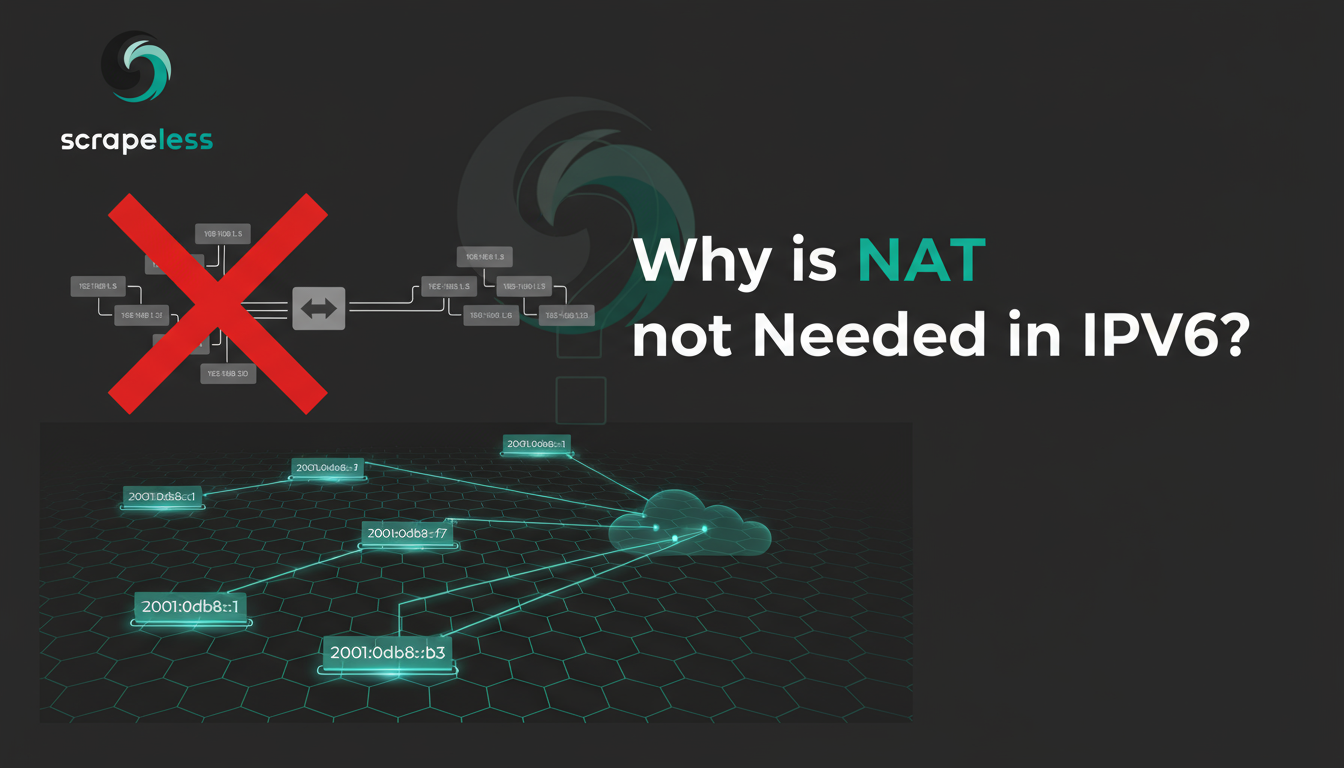
NAT is rarely required in IPv6 because IPv6 provides an enormous address space. This abundance of public IP addresses allows devices to communicate directly without any address translation, reducing complexity and improving network transparency.
Want more details? Keep reading.
This article breaks down how NAT works in IPv4, why IPv6 eliminates the need for NAT, and what options exist for environments that still require NAT-like functionality. We’ll also introduce a reliable IPv6 proxy solution at the end.
1. Understanding NAT in the Context of IPv4
IPv4 uses a 32-bit addressing system, offering around 4.3 billion possible addresses. Although this seemed sufficient decades ago, the explosive growth of the internet pushed IPv4 to its limits. Engineers foresaw this problem early on and developed IPv6 as a long-term replacement.
IPv6 uses a 128-bit addressing model, which creates an astronomically larger number of unique addresses. This expansion removes the scarcity issue that made NAT necessary in IPv4 and significantly simplifies routing.
However, the world still heavily depends on IPv4 systems, making it difficult to switch entirely to IPv6. To extend the life of IPv4, NAT (NAT44) and similar mechanisms became mainstream workarounds.
a. What issue does NAT solve?
NAT allows multiple devices within a private network to share a single public IP address. Home routers and large carriers use NAT to conserve public IPv4 addresses and to obscure internal devices from outside networks. Carrier-Grade NAT (CGNAT) does this at an ISP-wide level, serving thousands of users behind one public IP.
Although NAT effectively prolongs IPv4 usability, it also introduces architectural limitations and breaks the end-to-end design of the original Internet.
b. How does NAT work?
In IPv4:
- When a device inside a private network sends a request, the packet’s source IP (e.g., 10.0.0.1) is replaced with the public IP of the NAT device.
- Returning traffic goes to the public IP first, where NAT maps the connection back to the internal device.
This constant translation enables connectivity but adds overhead, reduces transparency, and complicates networking.
c. Limitations of NAT
NAT causes:
- More complex troubleshooting
- Breakage of peer-to-peer communication
- Problems with protocols that embed IP addresses
- Double NAT issues
- Additional latency and complexity
These challenges highlight why a cleaner, scalable system—IPv6—is needed.
2. Why is NAT Not Needed in IPv6?
a. Vast Address Space
The most important reason IPv6 eliminates NAT is its massive address capacity—340 undecillion possible IPs. With such abundance, every device can be assigned a unique public IPv6 address. There is no need to reuse or hide addresses behind translation devices.
IPv6 directly solves the IPv4 exhaustion problem that NAT was designed to mitigate.
b. Enhanced Security
Security in IPv6 is built into the protocol itself rather than added later. IPv6 integrates:
- Native IPsec support
- Secure Neighbor Discovery
- End-to-end encryption features
In contrast, NAT’s “security” is incidental—it hides devices behind a public IP rather than providing real cryptographic protection.
However, it’s important to note:
IPsec and NAT are not interchangeable. NAT obscures IPs, while IPsec focuses on authentication and encryption. IPv6 networks still require proper firewalls even without NAT.
c. Simpler Network Architecture & Direct Connectivity
IPv6 restores true end-to-end communication. Devices can talk directly across the Internet without the middle-step of translation.
Advantages include:
- Easier real-time communication (VoIP, gaming, remote access)
- Cleaner routing paths
- Fewer breakpoints and translation issues
- No double NAT or port forwarding headaches
This simplicity is one of the major operational benefits of IPv6 over IPv4.
3. Alternative Solutions to NAT in IPv6
Although IPv6 doesn’t need NAT, some environments still benefit from NAT-like functionality—especially during mixed IPv4/IPv6 operations.
Common mechanisms include:
NPTv6 (Network Prefix Translation)
Changes only the prefix portion of an IPv6 address while keeping the host portion intact. Useful for:
- Multi-homing
- Provider transitions
- Network renumbering
- Policy enforcement
It behaves similar to NAT44 but without breaking end-to-end reachability as severely.
NAT64
Allows IPv6-only clients to reach IPv4 servers by translating address types. This is essential for networks transitioning gradually to IPv6.
PCP (Port Control Protocol)
Enables devices to program NAT64 or firewalls to accept inbound connections. This provides more control without traditional NAT.
These mechanisms help bridge IPv4 and IPv6 but are not direct replacements for NAT44.
4. Recommended Alternative: Scrapeless IPv6 Proxies
For users who need stable, high-speed IPv6 connectivity for scraping, automation, or research.
If you require reliable, clean IPv6 IPs without managing complex NAT64/NPTv6 setups, Scrapeless IPv6 Proxies offer a powerful and flexible solution.
Scrapeless provides:
- 50M+ verified premium IPv6 IPs
- HTTP(S) & SOCKS5 support
- Automatic IPv6 proxy rotation
- High-anonymity, dedicated IPv6 addresses
- GDPR & CCPA compliant infrastructure
- Pay-Per-GB billing
- Designed for scraping, automation, SEO, ads verification, and security testing
For users who need large-scale IPv6 operations with exceptional uptime and performance, Scrapeless offers a dependable, enterprise-grade proxy network without the hassle of maintaining your own IPv6 infrastructure.
5. Frequently Asked Questions (FAQ)
a. Is there a real example of IPv6 improving performance by removing NAT?
Yes. Xfinity (formerly Comcast) reported performance gains after implementing IPv6—reduced latency, simpler routing, and better service quality. Removing NAT bottlenecks contributed to the improvement.
b. What is NAT64?
NAT64 allows IPv6-only devices to reach IPv4 resources by translating between the two address families. It is widely used during hybrid network transitions.
c. How does IPv6 handle NAT traversal when connecting to IPv4?
Mechanisms like Teredo and 6to4 wrap IPv6 packets inside IPv4, allowing them to pass through NAT devices when needed. These tools help preserve connectivity even in mixed environments.
6. Conclusion
NAT was essential for the long-term survival of IPv4, but in IPv6, it is largely unnecessary. With an enormous pool of public addresses, IPv6 restores the original end-to-end design of the Internet, enabling cleaner architectures, better performance, and improved security.
IPv6 still supports certain translation tools for interoperability, but the protocol’s design makes NAT obsolete in most modern networks.
And for users who need scalable IPv6 connectivity today—particularly for data scraping or large-scale automation—Scrapeless IPv6 proxies deliver speed, reliability, and global coverage without the complexity of traditional NAT-based systems.
At Scrapeless, we only access publicly available data while strictly complying with applicable laws, regulations, and website privacy policies. The content in this blog is for demonstration purposes only and does not involve any illegal or infringing activities. We make no guarantees and disclaim all liability for the use of information from this blog or third-party links. Before engaging in any scraping activities, consult your legal advisor and review the target website's terms of service or obtain the necessary permissions.