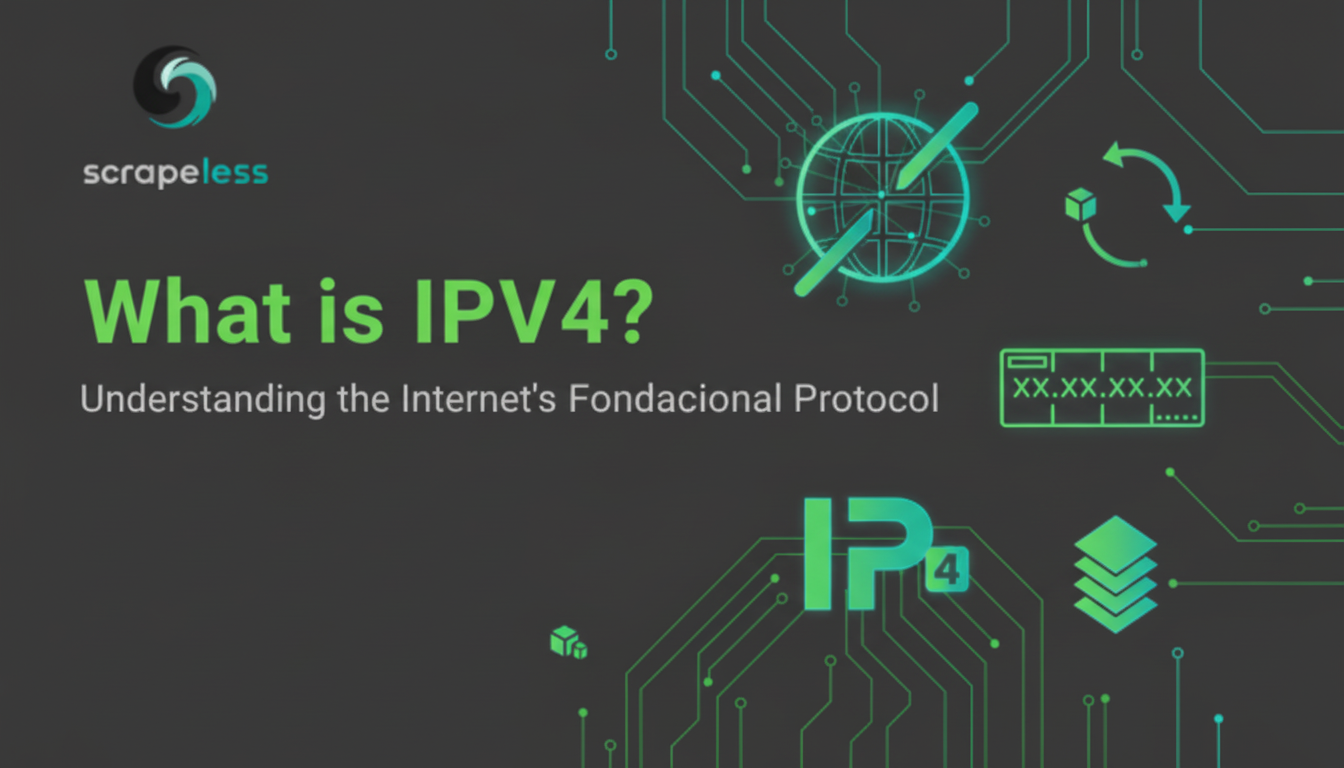
What is IPv4? Anatomy, Functioning, and Limitations

Expert Network Defense Engineer
Boost your automation and scraping with Scrapeless Proxies — fast, reliable, and affordable.
Explore the essentials of IPv4, how it enables device communication on networks, and its limitations amidst the internet's explosive growth.
IPv4 (Internet Protocol version 4) is a foundational set of rules that governs how devices communicate on a network, including the internet. Simply put, it allows devices to find each other and exchange data, acting as the addressing system for the vast global network.
IPv4 uses 32-bit addresses, which limits the total number of unique addresses to approximately 4.3 billion. While this seemed sufficient in the early days of the internet, the rapid growth of connected devices has led to the exhaustion of the available IPv4 address space. Despite this limitation, IPv4 remains widely used in the industry alongside its successor, IPv6 1.
Anatomy of IPv4 Addresses
Structure of IPv4 Addresses
An IPv4 address is typically represented as a four-part code separated by dots, known as dotted-decimal notation (e.g., 192.168.1.1). Each part, called an octet, is an 8-bit number representing a value between 0 and 255.
Key Components:
- Octets: Each of the four parts is an octet, which is 8 bits of data. Since $2^8 = 256$, the value of each octet can range from 0 to 255.
- Network Portion (NetID): The initial octets identify the specific network a device belongs to, similar to a postal code.
- Host Portion (HostID): The remaining octets specify the individual device within that network, like a house number.
Role of Subnet Masks In Address Allocation
A subnet mask is a 32-bit number that defines the division between the network portion and the host portion of an IPv4 address. It acts as a filter, telling the network which part of the address identifies the network and which identifies the individual device.
For example, a common subnet mask is 255.255.255.0. In binary, the 255 octets are all ones, which correspond to the network portion. This mask allocates the first three octets (24 bits) for the network and the last octet (8 bits) for identifying hosts within that network. Using subnet masks allows for the creation of smaller, more manageable subnetworks, which helps in the efficient allocation of IP addresses within a specific domain.
IPv4 Functioning
IPv4 performs several crucial functions beyond just unique device identification:
- Routing: IPv4 facilitates the routing process, directing data packets from the source to the destination through interconnected networks. Routers use the IP address information to determine the optimal path for packet delivery.
- Fragmentation: IPv4 includes a mechanism to divide data packets into smaller fragments if their size exceeds the limitations of the network or device. These fragments are reassembled by the recipient to reconstruct the original packet.
- Service Handling: IPv4 supports various service handling options, such as Quality of Service (QoS) and Differentiated Services (DiffServ), which enable the prioritization and grouping of data packets based on application requirements.
- Network Address Translation (NAT): NAT is a technology that translates private IP addresses used within local networks into public IP addresses when connecting to the internet. This allows multiple devices within a local network to share a single public IP address, which has been critical in mitigating the issue of IP address scarcity 2.
- Ensuring End-to-End Communication: Each device has a unique IP address, and routers use routing protocols to share information about connected networks, creating a map that allows for the efficient forwarding of packets based on the destination IP.
Benefits of using IPv4
Despite its age and limitations, IPv4 still holds several advantages:
- Simplicity and Efficiency: The smaller header size of IPv4 packets allows routers to process them quicker, leading to a smoother data flow. Its simpler structure also makes network configuration and troubleshooting less complex.
- Wide Adoption and Compatibility: Almost all devices and services online use IPv4, ensuring seamless communication and access. It is the universal language of the internet.
- Mature Technology: Decades of use have made IPv4 a robust and dependable technology. There is an established knowledge base, with well-defined best practices, tools, and expertise readily available.
- Broadcast Functionality: IPv4 supports broadcast messages, which can be sent to all devices on a network at once, simplifying tasks like network announcements or discovery.
Challenges and Limitations of IPv4
The primary challenge of IPv4 in the modern era is its inherent limitation in address space.
Address Space Limitation
The limit of approximately 4.3 billion unique addresses is no longer sufficient to accommodate the global demand for unique IP addresses, especially with the proliferation of smartphones, tablets, and IoT devices. This exhaustion has necessitated workarounds like NAT, which, while effective, can complicate certain types of internet communications and does not solve the fundamental issue of address scarcity.
Security Concerns
IPv4 was designed at a time when internet security was not a primary concern. As a result, it lacks built-in security features, making it vulnerable to various types of attacks, including IP spoofing and Denial of Service (DoS) attacks. While additional security protocols like IPSec exist, they are optional and not inherently integrated into IPv4, leaving potential security gaps 3.
Routing Inefficiency and Scalability
The IPv4 routing infrastructure can be inefficient due to the way IP addresses are allocated and routed. This can lead to larger routing tables, increased processing time by routers, and ultimately, slower internet speeds as the internet continues to grow.
Moving Forward: The Transition to IPv6
To address these challenges, the internet is gradually transitioning to IPv6. IPv6 uses 128-bit addresses, providing a vastly larger address space ($2^{128}$ unique addresses), built-in security features, more efficient routing, and improved QoS capabilities.
The transition is a slow and ongoing process, but network teams are adopting several techniques to ease the process:
- Dual-Stack Networking: Running both IPv4 and IPv6 simultaneously on a network, allowing devices to communicate using whichever protocol they support.
- Tunneling: Encapsulating IPv6 packets within IPv4 packets, allowing them to travel over existing IPv4 infrastructure.
- Translation Mechanisms: Protocols that translate between IPv4 and IPv6 addresses, enabling communication between devices using different protocols.
IPv4 and Proxy Solutions
For users engaged in web scraping, market research, or other data collection activities, the choice of proxy often involves both IPv4 and IPv6 addresses. High-quality proxy providers, such as Scrapeless, offer a diverse range of proxy types to ensure optimal performance regardless of the protocol.
Scrapeless provides a worldwide proxy network that includes Residential, Static ISP, Datacenter, and IPv6 proxies, with access to over 90 million IPs and success rates of up to 99.98%. Their IPv6 proxies are specifically designed for heavy-duty scraping tasks, offering high-speed, dedicated IPs that leverage the vast address space of the newer protocol.
Scrapeless IPv6 Proxies Features:
- High-speed, dedicated IPv6 proxies.
- Automatic IPv6 proxy rotation.
- 50M+ premium IPv6 pool.
- Supports HTTP(S) & SOCKS5.
- Pay-per-GB billing.
By offering both IPv4-based proxies (Residential, Datacenter) and dedicated IPv6 solutions, Scrapeless ensures that users can select the most appropriate and future-proof addressing scheme for their specific needs.
Conclusion
IPv4 was a groundbreaking technology that laid the foundation for the modern internet. While its address space limitations have driven the need for IPv6, it remains a critical part of the global network infrastructure. Understanding its anatomy, functioning, and limitations is essential for anyone working in networking or data collection. For those looking to leverage the benefits of both IPv4 and IPv6, a provider like Scrapeless offers the necessary tools and address diversity to ensure future-proof functionality.
References
1 Cloudflare - What is IPv6?
2 Cisco - Network Address Translation (NAT)
3 TechTarget - IPsec Definition
4 IETF - Internet Protocol (RFC 791)
5 Scrapeless - Proxy Solutions
At Scrapeless, we only access publicly available data while strictly complying with applicable laws, regulations, and website privacy policies. The content in this blog is for demonstration purposes only and does not involve any illegal or infringing activities. We make no guarantees and disclaim all liability for the use of information from this blog or third-party links. Before engaging in any scraping activities, consult your legal advisor and review the target website's terms of service or obtain the necessary permissions.