Forward Proxy vs. Reverse Proxy: Understanding the Key Differences and Use Cases

Advanced Data Extraction Specialist
Understand the core difference between Forward and Reverse Proxies. For your data collection needs, choose the elite performance of Scrapeless Proxies.
Proxy servers are fundamental components of modern network architecture, acting as intermediaries for network requests. However, not all proxies serve the same purpose. The two most common types, Forward Proxies and Reverse Proxies, operate in fundamentally different ways, serving distinct security, performance, and anonymity goals. Understanding the difference between these two is crucial for both network administrators and data professionals [1].
What is a Forward Proxy?
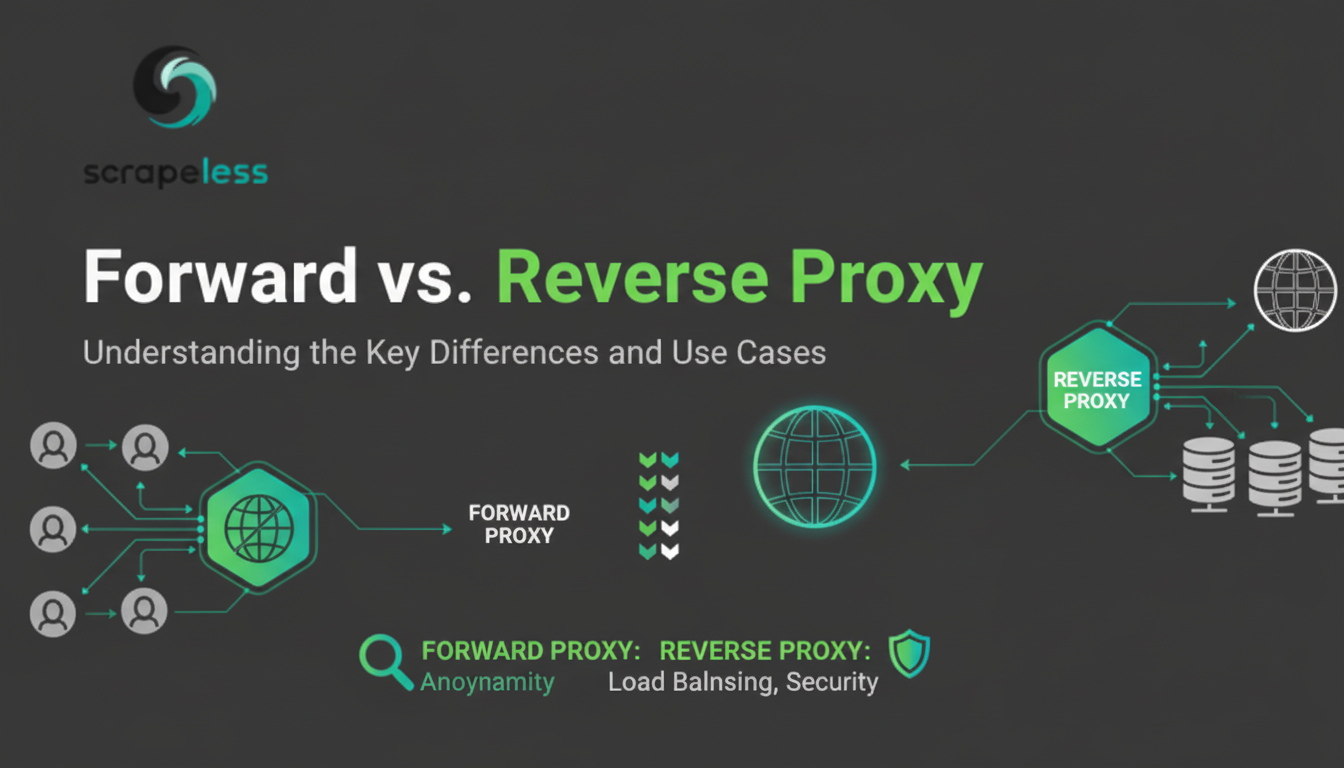
A Forward Proxy, sometimes called a "classic proxy," is an intermediary server that sits in front of a client (or a group of clients) and forwards their requests to the target server on the internet.
Key Characteristics of a Forward Proxy:
- Client-Facing: It acts on behalf of the client. The client knows it is using a proxy.
- Conceals Client Identity: The destination server sees the request as originating from the proxy's IP address, not the client's. This is the core mechanism for achieving anonymity.
- Controls Outbound Traffic: It is primarily used to control, secure, and anonymize the traffic leaving a private network.
Forward Proxy Use Cases
Forward proxies are essential tools for users seeking to manage their outbound connections:
- Anonymity and Privacy: By masking the client's IP address, forward proxies allow users to browse the web or perform data collection tasks without revealing their identity. This is a key component of an anonymous proxy definition.
- Web Scraping and Data Collection: For businesses gathering public data, forward proxies (especially Residential and Datacenter types) are vital for rotating IP addresses, bypassing geo-restrictions, and avoiding IP bans. This is part of a strategy to implement 20 ways for web scraping without getting blocked.
- Access Control and Filtering: Organizations use forward proxies to enforce internet usage policies, blocking access to malicious or inappropriate websites for internal users.
- Caching: They can cache frequently requested content, speeding up access for subsequent client requests and reducing bandwidth usage.
What is a Reverse Proxy?
A Reverse Proxy is an intermediary server that sits in front of one or more web servers (the origin servers) and intercepts requests from clients.
Key Characteristics of a Reverse Proxy:
- Server-Facing: It acts on behalf of the server. The client believes it is communicating directly with the origin server.
- Conceals Server Identity: The reverse proxy shields the identity and internal structure of the backend servers from the public internet.
- Controls Inbound Traffic: It is primarily used to control, secure, and optimize the traffic entering a server network.
Reverse Proxy Use Cases
Reverse proxies are critical for managing and protecting high-traffic web applications:
- Load Balancing: A reverse proxy can distribute incoming client requests across a cluster of backend servers. This prevents any single server from becoming overloaded, ensuring high availability and responsiveness [2].
- Security and Defense: By acting as the sole point of contact, a reverse proxy provides an additional layer of defense against cyberattacks. It can filter malicious traffic, hide the internal IP addresses of the origin servers, and handle SSL/TLS encryption, offloading this computationally intensive task from the backend servers.
- Caching and Compression: Reverse proxies can cache static content, serving it directly to clients and reducing the load on the origin servers. They can also compress data to speed up transmission.
- A/B Testing and Traffic Routing: They can be configured to route a percentage of traffic to a new version of an application for A/B testing or to direct requests to specific servers based on the request type.
Forward Proxy vs. Reverse Proxy: A Direct Comparison
The fundamental difference lies in who they serve and where they are positioned in the network flow.
| Feature | Forward Proxy | Reverse Proxy |
|---|---|---|
| Position | Sits in front of the client(s) | Sits in front of the server(s) |
| Purpose | Serves the client; controls outbound traffic | Serves the server; controls inbound traffic |
| Identity Concealed | Client's IP address | Origin Server's IP address |
| Primary Use Case | Anonymity, Web Scraping, Access Control | Load Balancing, Security, Caching |
| Client Knowledge | Client knows they are using a proxy | Client is unaware they are communicating with a proxy |
Both types of proxies handle the fundamental task of relaying HTTP requests, which is governed by standards like the Hypertext Transfer Protocol (HTTP/1.1) [3].
Choosing the Right Solution for Data Collection
For most businesses, the need for a proxy falls into two categories: protecting their own infrastructure (Reverse Proxy) or securely and efficiently gathering data from the internet (Forward Proxy).
While a reverse proxy is a self-hosted solution for server protection, a forward proxy for data collection is best sourced from a specialized provider. Building and maintaining a global network of high-quality, rotating IPs is complex and expensive.
Recommended Forward Proxy Solution: Scrapeless Proxies
For professional data collection, automation, and web scraping, Scrapeless Proxies offers the robust forward proxy network you need. Scrapeless provides a superior alternative to managing your own IP infrastructure, ensuring high success rates and elite anonymity.
Scrapeless is the ideal choice for:
- High-Quality IP Pools: Access to the best residential proxy and best datacenter proxies, ensuring your requests appear legitimate.
- Anti-Detection Features: Built-in mechanisms to handle complex anti-bot measures, allowing you to focus on data extraction rather than anti-scraping strategies.
- Scalability: Effortlessly scale your operations with unlimited concurrent requests and a massive global IP network.
Conclusion
Forward and reverse proxies are both essential tools, but they solve different problems. A forward proxy protects and anonymizes the client, making it the go-to choice for web scraping and privacy. A reverse proxy protects and optimizes the server, making it vital for web application security and performance. For data-driven tasks, leveraging a professional forward proxy network like Scrapeless ensures you have the speed, anonymity, and scale required to succeed.
Frequently Asked Questions (FAQ)
Q: Can a single server act as both a forward and a reverse proxy?
A: Yes, a single server can be configured to act as both a forward proxy for internal clients and a reverse proxy for external clients accessing internal web servers. However, these are two distinct functions that require separate configurations.
Q: Is a reverse proxy a type of load balancer?
A: A reverse proxy is often used to perform load balancing, but it is not exclusively a load balancer. A reverse proxy can handle many other tasks like SSL termination, caching, and security. A dedicated load balancer's sole purpose is to distribute traffic, but the two functions are frequently combined in modern web architecture.
Q: Which type of proxy is better for web scraping?
A: A Forward Proxy is the correct choice for web scraping. Web scraping involves a client (your scraper) making requests to external servers. A forward proxy is necessary to manage the client's outbound traffic, provide anonymity, and rotate IP addresses to avoid detection and blocking.
Q: Does a reverse proxy improve website performance?
A: Yes, a reverse proxy significantly improves website performance through several mechanisms:
- Load Distribution: Spreading traffic across multiple servers prevents bottlenecks.
- Caching: Serving static content directly from the proxy is much faster than fetching it from the origin server.
- SSL Offloading: Handling the encryption/decryption process frees up the origin servers to focus on application logic.
Q: What is the difference between a reverse proxy and a VPN?
A: A Reverse Proxy is a server-side tool that protects the server and optimizes inbound traffic. A VPN (Virtual Private Network) is a client-side tool that encrypts all of a user's internet traffic and routes it through a secure tunnel, protecting the client's entire connection, not just web requests. A forward proxy is closer in function to a VPN than a reverse proxy is, as both serve the client.
References
[1] StrongDM - Forward Proxy vs. Reverse Proxy: The Difference Explained
[2] Kemp Technologies - Forward Proxy Vs. Reverse Proxy: Differences and Similarities
[3] RFC 7230 - Hypertext Transfer Protocol (HTTP/1.1)
At Scrapeless, we only access publicly available data while strictly complying with applicable laws, regulations, and website privacy policies. The content in this blog is for demonstration purposes only and does not involve any illegal or infringing activities. We make no guarantees and disclaim all liability for the use of information from this blog or third-party links. Before engaging in any scraping activities, consult your legal advisor and review the target website's terms of service or obtain the necessary permissions.