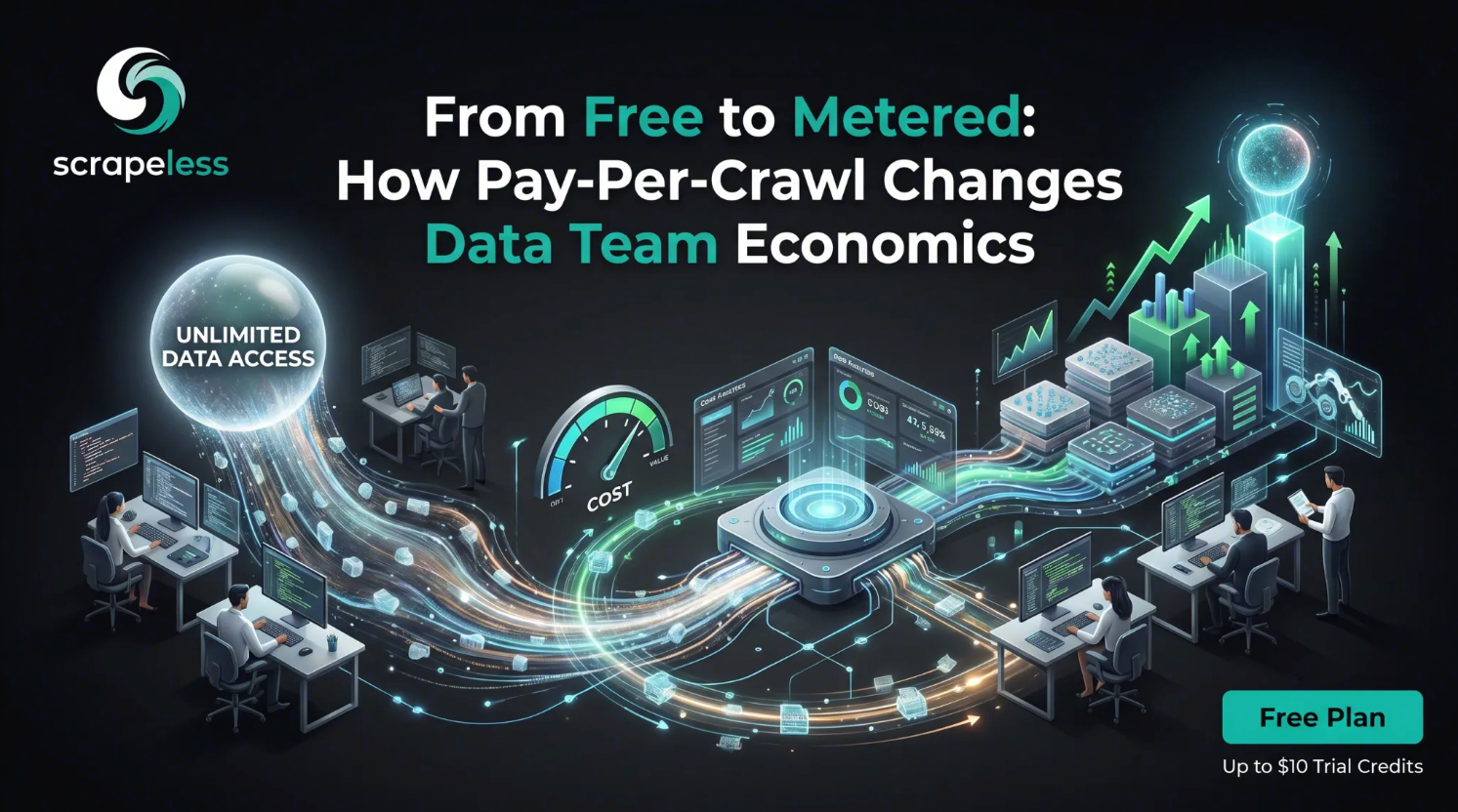
From Free to Metered: How Pay-Per-Crawl Changes Data Team Economics

Scraping and Proxy Management Expert
TL;DR:
- "Free" public data was never free — it was unmetered. The open web ran on an implicit bargain: crawlers took content, and publishers got referral traffic in return. AI answer engines break that bargain, because they read the page and never send the click. Pay-per-crawl is the market repricing what that read is worth.
- HTTP 402 just woke up. "Payment Required" sat reserved and dormant in the HTTP spec for decades. Cloudflare's pay-per-crawl turns it into a live signal: a crawler either presents a price it will pay and gets a
200, or it gets a402with the page's posted price attached. - The cost of public data is shifting from infrastructure to access. For years the line item was proxies, rendering, and engineering time. The new line item is the price a content owner attaches to each crawl. Teams that still budget only for infrastructure will be blindsided by the access bill.
- The fix is operational, not philosophical. Separate discovery from refresh, price each one differently, and measure cost per usable update instead of cost per request. That single reframing keeps a data program solvent as more of the web moves behind a posted price.
- A clean render is the cheapest render. Whether access is free or paid, the unit you pay for is one successful fetch of one usable page. An anti-detection cloud browser that lands a clean page on the first attempt is the difference between paying once and paying repeatedly for the same record.
- Free to start. New Scrapeless accounts include free Scraping Browser runtime — sign up at app.scrapeless.com.
Introduction: the bargain that quietly ended
For most of the web's history, "public data" meant something specific and unspoken. A page was public if a crawler could reach it without a login, and the cost of reaching it was borne almost entirely by the party doing the crawling — bandwidth, servers, rendering, and the engineering to keep a fetch clean. The content owner's cost was close to zero, and in exchange the owner expected something back: a referral, a click, a human who might subscribe or buy. Search worked because that loop closed.
AI changed the shape of the loop. When an answer engine reads a page to synthesize a response, it consumes the content but rarely returns the visit. The publisher pays to host the page; the model reads it; the user gets the answer somewhere else. From the content owner's seat, that is consumption without compensation, repeated at machine scale. The reaction was inevitable, and in 2026 it has a concrete form: a price tag on the crawl itself. The question in this post's title is not rhetorical hand-wringing. It is an operational forecast that data teams need to plan around now.
This is an opinion piece, written from the seat of teams that depend on public data every day — pricing analysts, brand monitors, researchers, and the AI agents they build. The argument is simple. Free public data is not ending; unmetered public data is. The web is learning to charge for machine reads the way it already charges for ad inventory, and the teams that adapt their economics early will keep collecting data while the rest watch their access bill outrun their budget.
The 402 wakes up
Anyone who has read the HTTP specification has met status code 402 Payment Required — and then promptly forgotten it, because nothing used it. It was reserved for a future that never arrived: a web where content could quote a price and a client could pay it inline, all in the protocol. For decades it was a placeholder, a comment in the standard.
That future arrived through infrastructure rather than a new standard. Cloudflare's pay-per-crawl model takes the dormant code and gives it a job. The mechanism is deliberately plain. An AI crawler requests a page. If the crawler signals a price it is willing to pay — via a request header — and that price meets the owner's posted rate, the server returns the content with a normal 200. If the crawler signals nothing, or signals too little, the server answers 402 Payment Required and attaches the page's price in a response header. Cloudflare sits in the middle as the merchant of record, settling the charge between the crawler and the content owner.
Read that flow again, because the design choice matters. There is no new bespoke protocol to learn, no proprietary SDK that every crawler must adopt. It is HTTP doing what HTTP already does — a status code, a couple of headers, and a settlement layer behind them. That is precisely why it is likely to stick. A pricing model that rides on the existing transport is far easier for the web to absorb than one that demands everyone rebuild their client. The 402 is no longer a curiosity in the spec. It is becoming a routine answer a crawler should expect to receive.
It is worth being precise about scope. As of 2026 the model is early — it runs as a private beta, the set of participating publishers is limited, and the prices are set per site by owners who are still feeling out what a crawl is worth. None of that makes it a footnote. The direction of travel is unambiguous: the infrastructure layer that already sits in front of a large share of the web now ships a button that turns machine access into a billable event. When a capability like that exists at the edge, adoption is a matter of incentive, and the incentive — compensation for content that AI consumes — is strong.
Why this is an economics story, not a blocking story
It is tempting to file pay-per-crawl under "anti-bot," next to the challenges and fingerprint checks that data teams already navigate. That framing misses what is new. Anti-bot is a wall: it tries to keep automated clients out entirely, and the contest is binary — you get a clean page or you get a challenge. Pay-per-crawl is a turnstile. It is not trying to stop the crawl. It is trying to price it. The page is available; it simply costs something to read.
That difference reshapes the whole calculation. Under a pure blocking regime, success is a yes/no question and the cost is engineering effort. Under a metered regime, success is a yes/no question and a price, and the cost moves onto the balance sheet as a recurring access fee. A data team can no longer reason only about whether a page is reachable. It has to reason about what each usable copy of that page costs and whether the copy is worth the price.
This is the shift that catches teams off guard. For a decade, the budget for a public-data program was dominated by infrastructure: proxy bandwidth, rendering capacity, and the salaries of the people keeping fetches clean. Access was the free part. As more of the web adopts a posted price for machine reads, the access line grows from zero into a real, variable cost — one that scales with how often the pipeline runs and how many pages it touches. A program architected when access was free will keep crawling on its old cadence and discover, one invoice later, that the cheapest part of the system became the most expensive.
The good news is that this is a solvable problem with familiar tools. Metered access does not require a philosophical stance on whether the open web is "ending." It requires the same discipline any team applies to a cloud bill: know what you are buying, buy only what you use, and measure the price of the outcome rather than the price of the action.
Separate discovery from refresh
The single most useful move a data team can make is to stop treating "crawling a site" as one activity. It is two, and they have opposite economics.
Discovery is finding what exists: enumerating product listings, mapping a category tree, capturing the set of URLs that make up a target. Discovery is broad, it touches many pages, and it is mostly a one-time or low-frequency operation. You build the map once and update it when the structure changes.
Refresh is keeping a known set of records current: re-reading the same product pages for today's price, today's stock, today's rating. Refresh is narrow — it touches a fixed, known set of URLs — but it is high-frequency, because the value of the data decays. A price from last week is worth less than a price from this morning.
Collapsing the two is what makes a metered web expensive. A naive pipeline re-crawls everything on every run: it re-discovers the whole catalog and refreshes every record, every cycle. Under free access, that waste was invisible. Under a posted price, it is the bill. You are paying the discovery price over and over for pages whose structure has not changed, when all you needed was the refresh.
| Dimension | Discovery | Refresh |
|---|---|---|
| What it does | Maps what exists | Updates what's known |
| Breadth | Wide (many URLs) | Narrow (a fixed set) |
| Frequency | Low (on structural change) | High (data decays fast) |
| Right cadence | Event-driven or periodic | Tied to how fast the field changes |
| Where the cost hides | Re-mapping unchanged structure | Re-reading unchanged values |
Once the two are split, each gets its own budget and its own cadence. Discovery runs when the site's structure actually shifts — a new category appears, a sitemap changes — not on every refresh tick. Refresh runs on a clock tuned to how fast the underlying field moves: prices for a fast-moving category hourly, a slow catalog daily, an archival reference monthly. You stop paying the broad discovery price to obtain a narrow refresh update, and the access bill drops to match the value you are actually extracting.
Get your API key on the free plan: app.scrapeless.com
Track cost per usable update, not cost per request
The metric most teams carry over from the free era is cost per request, or its cousin, requests per minute. Both are obsolete the moment access is priced, because they measure activity instead of outcome. A request that returns a challenge page, a half-rendered shell, or a stale record still counts as a request — and on a metered web, it may still cost money — while producing nothing usable.
The metric that survives the transition is cost per usable update: the total spend — access price plus infrastructure — divided by the number of fresh, correct, schema-valid records the pipeline actually delivered. It is the only number that connects what you pay to what you got.
The reframing changes behavior immediately, because the denominator punishes waste the old metric ignored:
- A failed render is pure loss. If a page comes back blocked or empty, you paid for the attempt and got zero usable updates from it. On a free web that was a minor annoyance. On a metered web it is money spent for nothing — so the value of landing a clean page on the first attempt rises sharply.
- A redundant fetch is loss too. Re-reading a record whose value has not changed since the last read produces no update — the field is identical — so it adds to the numerator and nothing to the denominator. Change-aware refresh, which only re-reads what is likely to have moved, directly improves the ratio.
- A discovery crawl charged for a refresh outcome is the worst case. It is the broad price paying for the narrow result — the exact failure the discovery/refresh split is designed to prevent.
Cost per usable update also gives a data team a clean way to reason about a posted crawl price. When a page costs something to read, you can finally answer the question that free access let you dodge: is this record worth what it costs? For a high-value field that drives a pricing decision, the answer is usually yes, and you budget the access deliberately. For a low-value field you were collecting out of habit, the answer is often no — and the metered web does you the favor of making that obvious. Metering, used well, is a forcing function for collecting less and collecting better.
Where a clean render fits
Every argument above converges on one technical fact: on a metered web, the cheapest fetch is the one that succeeds the first time and returns a complete, parseable page. Each failed or partial fetch is an outcome you paid for and cannot use, and each one drags cost per usable update upward. The most direct lever a team controls is its success rate per fetch.
That is exactly the job of an anti-detection cloud browser. The Scrapeless Scraping Browser is a customizable, anti-detection cloud browser built for web crawlers and AI agents, and in a metered world it earns its keep by maximizing usable fetches per attempt:
- Residential egress in 195+ countries lands the request as a real user from the right locale, so the page renders the same content a human would see — fewer empty shells, fewer challenge interstitials, more usable pages per attempt.
- Cloud-side JavaScript rendering returns the fully hydrated DOM, not a pre-render skeleton. A page you parse correctly the first time is a page you do not pay to fetch twice.
- Session persistence lets discovery and refresh share warmed context where it helps, so the narrow refresh job does not re-pay the cost of re-establishing access on every tick.
- Anti-detection fingerprinting powered by a self-developed Chromium keeps automated sessions reading like ordinary browsing, which is what keeps the success-per-fetch rate high enough for cost per usable update to stay sane.
None of this is a way around a posted price. When a content owner sets a crawl price through pay-per-crawl, that price is part of the bargain, and a responsible data program budgets for it the same way it budgets for proxy bandwidth — as a real cost of doing business with that source. What a clean cloud browser does is make sure you pay each cost exactly once: one access charge, one render, one usable record. That is the entire game once data stops being free. The pricing for it sits alongside the rest of the platform on the Scrapeless pricing page.
What this means for the next few years
The headline — "the end of free public data" — is half right, and the half it gets wrong is the important one. Public data is not disappearing. The pages are still there, still publicly reachable, still legal to access within the same boundaries that always applied. What is ending is the assumption that machine reading of those pages is free and unlimited. The web is installing a meter, and 402 Payment Required is the dial on it.
For data teams, this is less a crisis than a maturation. Every other resource a modern stack consumes — compute, storage, bandwidth, API calls — is metered, and teams long ago learned to architect around metered cost: cache what is stable, refresh what is volatile, and measure spend against outcomes. Public data is simply the last unmetered input catching up to the rest of the stack. The teams that thrive will be the ones that treated their crawl budget like their cloud budget from the start: discovery and refresh on separate clocks, cost per usable update as the north-star metric, and a fetch layer tuned to land a clean page on the first attempt so no charge is ever wasted.
The same forces are reshaping the search and answer layer in parallel, and the disciplines rhyme. Measuring where a brand shows up across AI answer surfaces is the same kind of outcome-over-activity discipline applied to visibility instead of records — the case for that is laid out in Generative Engine Optimization: How to Monitor Your Brand in Google AI Overviews. The economics chapter and the visibility chapter are two sides of the same shift: AI is repricing both how the web is read and how it is found.
So, the end of free public data? Yes, in the narrow and literal sense. But for any team willing to separate discovery from refresh and to measure cost per usable update, it is also the beginning of a more honest, more sustainable way to collect it — one where the price of a fact is visible, the value of a fact is the thing you optimize, and every charge buys exactly one usable record.
Ready to Build Your AI-Powered Data Pipeline?
Join our community to claim a free plan and connect with developers building cost-aware public-data pipelines on top of Scrapeless: Discord · Telegram.
Sign up at app.scrapeless.com for free Scraping Browser runtime and adapt the discovery-versus-refresh split and the cost-per-usable-update metric to the sources, regions, and cadences your data program needs.
FAQ
Q: What is Cloudflare pay-per-crawl?
A model where a site owner can set a price for automated crawling and have Cloudflare collect it. When a crawler's offered price meets the owner's rate the request succeeds; otherwise the server answers with a posted price instead of the content.
Q: What does HTTP 402 have to do with it?
402 "Payment Required" is a status code reserved in the HTTP specification for decades and rarely used. Pay-per-crawl puts it to work: a server returns 402 with a posted price in a response header, turning "this content costs money to crawl" into a machine-readable signal an agent can act on.
Q: Does this make scraping public data illegal?
No. The pages are still public and still legal to access within the same boundaries that always applied. What changes is the assumption that machine reading is free and unlimited — a posted crawl price is part of the bargain, budgeted like proxy bandwidth, not a wall.
Q: How do you keep costs down once data is metered?
Treat the crawl budget like a cloud budget: put discovery and refresh on separate clocks, refresh only what is volatile, and measure cost per usable update rather than cost per request. A fetch layer that lands a clean page on the first attempt means no charge is ever wasted.
Q: Where does Scrapeless fit?
At the fetch layer. A clean cloud-browser render — correct, from the right region, and past anti-bot defenses on the first attempt — makes sure each access charge buys exactly one usable record instead of paying again for a page that came back empty.
At Scrapeless, we only access publicly available data while strictly complying with applicable laws, regulations, and website privacy policies. The content in this blog is for demonstration purposes only and does not involve any illegal or infringing activities. We make no guarantees and disclaim all liability for the use of information from this blog or third-party links. Before engaging in any scraping activities, consult your legal advisor and review the target website's terms of service or obtain the necessary permissions.