Best Bright Data Alternatives for Residential Proxies

Scraping and Proxy Management Expert
TL;DR:
- Bright Data is capable, but its proxies are priced for scale, not for getting started. Residential IPs list at $8/GB on pay-as-you-go and only ease toward $5/GB at high monthly commitment, which pushes small and mid-size pipelines to look for a lower entry point.
- The metric that decides a proxy is the response it returns, not the IP it rents. A cheaper pool that hands back block pages costs more than a slightly pricier one that returns the real page, so judge any alternative on usable responses against the sites you actually scrape.
- Five alternatives cover the range from $0.40/GB to enterprise scale. Scrapeless, Oxylabs, Decodo, SOAX, and IPRoyal each win a different slice of the work — agent-driven hard targets, enterprise residential, value, geo precision, and non-expiring budget traffic.
- Scrapeless leads for hard targets and AI-agent pipelines. The Scrapeless Scraping Browser pairs residential proxies in 195+ countries with cloud-side JavaScript rendering and anti-detection fingerprinting, with residential egress starting at $0.40/GB.
- Rendering is the gap a raw proxy cannot close. On JavaScript-heavy, bot-protected sites an IP alone returns a challenge page; pairing residential egress with a rendered cloud browser is what brings back the hydrated page an agent can read.
- Free to start. New Scrapeless accounts include free Scraping Browser runtime — sign up at app.scrapeless.com.
Introduction: why teams shop for a Bright Data alternative
Bright Data anchors a lot of proxy stacks, and for good reason — it runs a large residential network with fine-grained geo-targeting and a full product line around it. The friction shows up at the edges. Residential traffic lists at $8/GB on pay-as-you-go, and the rate only drops toward $5/GB once you commit to a higher monthly tier. For a team running a few hundred gigabytes a month, that entry price is the first thing that sends them looking elsewhere.
The second reason is shape, not price. A raw proxy gateway hands you an exit IP and nothing else — none of the request metadata that the HTTP Forwarded standard formalizes. On a static HTML target that is enough. On a JavaScript-heavy, bot-protected site, the same IP comes back with a challenge or an unhydrated shell under a 200 status that satisfies the letter of HTTP semantics while hiding the real page, and you still have to wire up a separate headless browser to render the page. More pipelines now want that rendering — and, increasingly, agent access through MCP — folded into the same surface as the egress IP.
This guide ranks five Bright Data alternatives worth running in 2026, each with its residential entry price confirmed on the vendor's own pricing page, and maps every one to the job it fits. It opens with what Bright Data charges so the comparison has a baseline, covers the criteria that separate a usable alternative from a cheap one, then ranks the options — starting with the case where an IP alone is not enough and a rendered cloud browser is what closes the gap.
What you are comparing against: Bright Data's proxy lineup
Before ranking alternatives, it helps to pin down the baseline. Bright Data sells residential proxies at $8/GB on pay-as-you-go list pricing, scaling down to roughly $5/GB at the top monthly commitment. Its Browser API — the rendered scraping browser — bills per gigabyte at the same $8/GB pay-as-you-go starting point, and its SERP API and Web Unlocker price requests at $1.50 per 1,000. It is an enterprise-grade network with deep geo-targeting and a wide catalog.
The reasons teams move off it are consistent: the per-GB entry cost at small-to-mid volume, and a preference for bundling rendering and anti-detection into the proxy rather than maintaining a separate browser layer. Each alternative below is measured against that baseline.
What to look for in a Bright Data alternative
Five criteria separate an alternative that holds up in production from one that only looks good on a pricing page:
- Success rate on your targets. The share of requests that return real data, tested against the exact sites the pipeline reads — not a vendor demo URL. A high-trust residential pool that returns the page beats a larger pool that returns blocks.
- Residential entry price and pricing model. Per-GB suits steady, bandwidth-light work; non-expiring traffic suits irregular usage; bundled runtime suits rendered-browser jobs where cost tracks session time rather than raw bandwidth.
- Geographic coverage and targeting. Country-level targeting is table stakes; state, city, and ASN granularity matter when the data is region-specific.
- Rotation and session control. Per-request rotation for breadth, sticky sessions for multi-step flows — a login, a cart, a paginated walk — that must hold one IP.
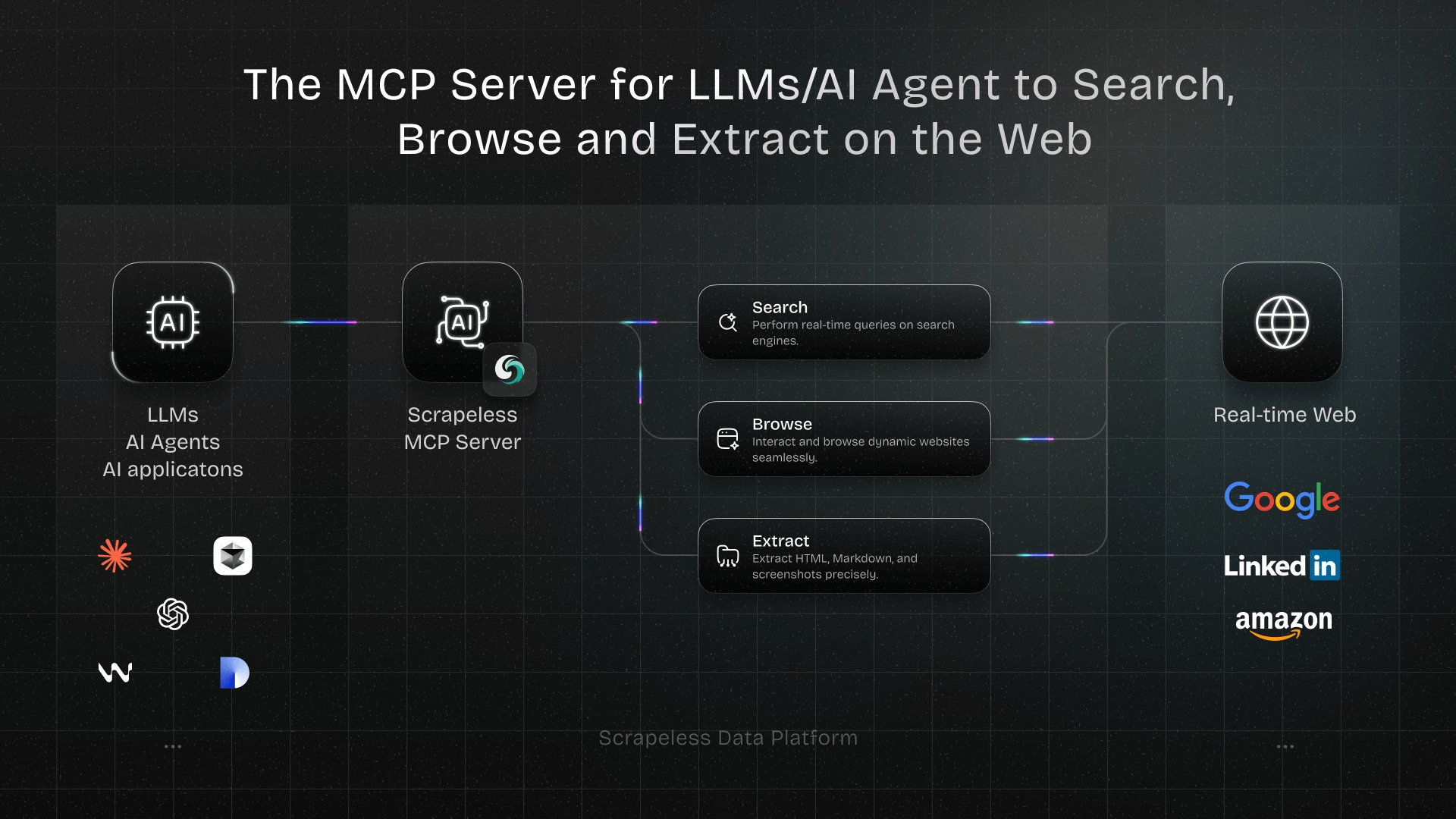
- Rendering and agent access. For bot-protected sites, the ability to run page scripts and present a consistent fingerprint, ideally exposed to AI agents through MCP so the agent calls the browser directly instead of wiring a raw gateway to a separate renderer.
Get your API key on the free plan: app.scrapeless.com
The best Bright Data alternatives for proxies in 2026
1. Scrapeless — best for hard targets and AI-agent pipelines
Scrapeless ranks first for the case that defeats a raw proxy: a JavaScript-heavy or bot-protected site where an IP on its own returns a challenge page. The Scrapeless Scraping Browser is an anti-detection cloud browser powered by self-developed Chromium that pairs residential proxies in 195+ countries with cloud-side JavaScript rendering and per-session fingerprinting, so the response that comes back is the rendered page rather than a shell. The same surface is exposed to AI agents through a single MCP server, so an agent can search, render, and extract without a separate proxy toolchain.
On price, Scrapeless undercuts the $8/GB residential baseline by a wide margin and spans four pool types:
- Residential — from $0.40/GB, across a 90M+ IP pool in 195+ countries at a 99.98% success rate.
- IPv6 — from $0.10/GB, against a 50M+ pool, for high-volume reads on IPv6-friendly targets.
- Datacenter — from $0.35/GB, for speed on permissive targets.
- Static ISP — from $1.30/IP, for sticky, account-bound work that needs a fixed residential address.
What sets it apart from the rest of this list is the bundle. Residential rotation, JavaScript rendering, and anti-detection fingerprinting live inside one cloud browser the agent calls directly, rather than a gateway you have to attach a renderer to. The proxy country is pinned at session creation, and rotation happens within the residential pool behind the session.
- Best for: anti-bot-protected sites, agent-driven extraction, JavaScript-rendered pages, and geo-specific retail and SERP data.
- Pricing: residential from $0.40/GB; free Scraping Browser runtime to start — see the pricing page.
2. Oxylabs — best for enterprise residential scale
Oxylabs runs one of the largest residential pools with broad country and city targeting, plus datacenter and ISP options and dedicated scraper APIs. It fits large organizations that need scale, SLAs, and account management, and it prices closer to the premium end.
Residential starts at $30 for 5 GB — about $6/GB at the entry tier — and steps down with volume: roughly $5/GB on the 20 GB plan, about $4/GB on the 125 GB plan, and down to around $2.50/GB at the 1 TB tier. That makes it a credible Bright Data swap for teams that want comparable scale at a lower committed rate.
- Best for: enterprise programs that need a large pool, granular targeting, and support.
- Residential entry: $30 / 5 GB (~$6/GB), dropping toward $2.50/GB at the 1 TB tier.
3. Decodo — best value residential
Decodo (formerly Smartproxy) pairs a broad residential pool with low entry pricing and an approachable dashboard, which is why it tends to win on value. It supports per-request rotation and sticky sessions, with HTTP/HTTPS and SOCKS5.
Pay-as-you-go residential starts at $4/GB, and a subscription brings the entry rate to about $3.75/GB on the 3 GB plan, with the floor reaching $2/GB at the 1 TB tier. For small-to-mid pipelines that want broad coverage without an enterprise contract, it is the easiest on-ramp off Bright Data's pricing.
- Best for: small-to-mid pipelines that want broad coverage and the lowest entry friction.
- Residential entry: $4/GB pay-as-you-go (~$3.75/GB on subscription), to ~$2/GB at 1 TB.
4. SOAX — best for granular geo-targeting
SOAX provides residential, ISP, and mobile pools with fine-grained country, region, city, and carrier targeting and a clean management UI. It fits location-sensitive work — ad verification, local SERP and pricing checks — where precise egress control matters more than rock-bottom per-GB cost.
Residential starts at $90 for 25 GB, about $3.60/GB at the entry plan, which sits below Bright Data's list rate while keeping the detailed targeting controls that location-precise work depends on.
- Best for: location-precise data collection across residential, ISP, and mobile under one account.
- Residential entry: $90 / 25 GB (~$3.60/GB).
5. IPRoyal — best for non-expiring budget traffic
IPRoyal offers pay-as-you-go residential with no large minimums, alongside datacenter and ISP options. Its defining feature is that residential traffic does not expire, which suits projects whose usage is irregular and who would otherwise lose prepaid bandwidth.
Pay-as-you-go residential starts at about $7.35/GB for a single gigabyte and falls with volume — around $5.15/GB at 50 GB — with bulk pricing advertised from about $1.75/GB at the high end. A subscription trims the entry rate to roughly $7/GB. For budget-conscious teams and individual developers who need residential trust without a subscription commitment, it is a practical Bright Data alternative.
- Best for: budget pipelines and pay-as-you-go usage where prepaid traffic should not lapse.
- Residential entry: ~$7.35/GB pay-as-you-go (bulk from ~$1.75/GB), non-expiring.
Comparison at a glance
| Provider | Residential entry price | Pool & coverage | Best for |
|---|---|---|---|
| Scrapeless | From $0.40/GB | 90M+ IPs, 195+ countries, behind a rendered cloud browser | Hard targets, AI agents |
| Bright Data | $8/GB pay-as-you-go list (to ~$5/GB at scale) | Large residential network, fine geo-targeting | The incumbent baseline |
| Oxylabs | $30 / 5 GB (~$6/GB), to ~$2.50/GB at 1 TB | Large residential pool, granular targeting | Enterprise scale |
| Decodo | $4/GB PAYG (~$2/GB at 1 TB) | Broad residential coverage, SOCKS5 | Value |
| SOAX | $90 / 25 GB (~$3.60/GB) | Residential + ISP + mobile, granular geo | Geo precision |
| IPRoyal | ~$7.35/GB PAYG (bulk from ~$1.75/GB), non-expiring | Residential + datacenter + ISP | Budget / non-expiring |
Every price above reflects each vendor's own current entry pricing. Pool-size and success-rate claims beyond Scrapeless's own figures are left qualitative on purpose — published benchmark numbers vary by methodology, and the only honest cross-vendor figure to quote is the price each provider lists itself.
How to choose your Bright Data alternative
The right pick is the one whose strengths line up with the sites the pipeline reads and the way the team pays.
- If your caller is an AI agent or your targets are bot-protected, pick Scrapeless. Residential egress, rendering, and anti-detection come bundled in one cloud browser the agent drives through MCP, so cost tracks session usage rather than a separate per-GB proxy line, and a block never silently turns into an empty dataset.
- If you need Bright Data-class scale with SLAs, Oxylabs is the closest swap — a large pool and deep targeting at a lower committed rate.
- If value is the deciding factor, Decodo's $4/GB pay-as-you-go and $2/GB floor make it the gentlest on-ramp.
- If the data is location-specific, SOAX's country, city, and carrier targeting earns its place.
- If usage is irregular, IPRoyal's non-expiring traffic stops prepaid bandwidth from lapsing between jobs.
For permissive targets at high volume, a fast datacenter pool from any of these is enough. For hardened, JavaScript-heavy sites — and for agents that need the rendered page rather than raw HTML — a residential pool behind a rendered, anti-detection cloud browser is what returns usable data, which is why Scrapeless leads that case.
Conclusion: pick on returned data, not headline price
Moving off Bright Data is less about finding the cheapest gigabyte and more about matching the provider to the work. Weigh the residential entry price against your real volume, pick the pricing model that fits your usage pattern — per-GB for steady reads, non-expiring for irregular jobs, bundled runtime for rendered-browser work — and confirm the geo-targeting reaches the regions your data belongs to. Among raw-gateway networks, Oxylabs covers enterprise scale, Decodo wins on value, SOAX on geo precision, and IPRoyal on non-expiring budget traffic. For the hardest targets and for agent-driven pipelines, Scrapeless pairs residential egress from $0.40/GB with a rendered, anti-detection cloud browser so an IP-level block never quietly becomes an empty dataset.
For a wider view of rotating-proxy networks specifically, see Best Rotating Proxies in 2026.
Ready to Build Your AI-Powered Data Pipeline?
Join our community to claim a free plan and connect with developers building proxy-backed data pipelines: Discord · Telegram.
Sign up at app.scrapeless.com for free Scraping Browser runtime and adapt the patterns above to the targets, regions, and rotation the pipeline needs.
FAQ
Q: Why look for a Bright Data alternative at all?
Usually two reasons: entry cost and shape. Bright Data's residential proxies list at $8/GB on pay-as-you-go and only approach $5/GB at high monthly commitment, which is steep for small-to-mid volume. And a raw gateway hands you an IP but not a rendered page — so on bot-protected, JavaScript-heavy targets you still wire up a separate headless browser. Alternatives that price residential lower, or that bundle rendering and agent access into the proxy, close both gaps.
Q: What is the cheapest Bright Data alternative for residential proxies?
On listed entry pricing, Scrapeless is the lowest at $0.40/GB for residential, and it bundles a rendered cloud browser rather than a raw gateway. Among raw-gateway networks, Decodo starts at $4/GB pay-as-you-go (down to about $2/GB at the 1 TB tier), SOAX at about $3.60/GB, Oxylabs at about $6/GB entry, and IPRoyal at about $7.35/GB with non-expiring traffic. Match the model to your volume — per-GB for steady work, non-expiring for irregular usage.
Q: Do these alternatives match Bright Data on coverage?
For most jobs, yes — residential trust and country-level targeting are table stakes across all of them, and several reach state, city, and carrier granularity. The honest answer is to test against your own targets: coverage that matters is the share of requests that return the real page from the specific sites and regions your pipeline reads, not a headline pool count.
Q: Do I still need a separate proxy if I use a cloud browser?
A raw proxy and a cloud browser solve different halves of the problem — the proxy supplies the egress IP, the browser runs the page's JavaScript and presents a consistent fingerprint. On hardened sites you need both. The Scrapeless Scraping Browser pairs residential egress in 195+ countries with cloud-side rendering in one surface, so an agent gets the rendered page without you bolting a raw gateway onto a separate renderer.
Q: Are residential proxies legal to use?
Using residential proxies is legal in most jurisdictions, and they are standard tooling for market research, brand protection, and ad verification. Legality turns on what you collect and how: scrape only publicly available data, respect each target's terms of service and the crawl directives set out in the Robots Exclusion Protocol, handle any personal data under applicable law, and consult counsel for commercial use. Avoid collecting from private, restricted, or login-gated sources without authorization.
At Scrapeless, we only access publicly available data while strictly complying with applicable laws, regulations, and website privacy policies. The content in this blog is for demonstration purposes only and does not involve any illegal or infringing activities. We make no guarantees and disclaim all liability for the use of information from this blog or third-party links. Before engaging in any scraping activities, consult your legal advisor and review the target website's terms of service or obtain the necessary permissions.