Best Bright Data Alternatives for Google SERP Scraping

Senior Web Scraping Engineer
TL;DR:
- Google SERP data is structured under the hood but defended on the surface. Rank tracking, ad verification, price intelligence, market research, and the live grounding behind AI search all pull from the results page — a target that is geo-targeted, rate-limited, and rendered behind JavaScript.
- Bright Data's SERP API is a capable baseline, but it prices per result. Teams scraping Google at volume look for alternatives that keep the structured JSON while lowering the per-1,000 cost or widening Google-surface coverage.
- Six Google SERP scrapers ranked by coverage, output structure, geo-targeting, and price. Dedicated SERP APIs, proxy-platform SERP add-ons, and general scraper APIs with Google endpoints each fit a different team.
- Scrapeless Deep SerpApi ranks #1. $1.05 per 1,000 queries, 2,000 free API calls to start, structured
organic_resultsacross 20+ Google surfaces, 1–2s latency, and country-pinned residential egress in 195+ countries. - Match the tool to how you call it and what you pay for. A dedicated SERP API for structured parsing, a general scraper API for one credit pool across the web, or a proxy platform's SERP product for enterprise scale.
- Free to start. New Scrapeless accounts include free Deep SerpApi calls — sign up at app.scrapeless.com.
Introduction: how to read a Google SERP scraper comparison in 2026
Most product discovery still begins on a Google results page. That single surface feeds rank tracking, ad and brand verification, price intelligence, local-pack monitoring, market research, and increasingly the live grounding behind AI answers. The data inside it is highly structured — ten organic listings, a knowledge panel, people-also-ask pairs, shopping modules, a featured snippet — but Google does not hand it over cleanly. Results vary by country and language, the page renders behind JavaScript, and automated access is rate-limited.
Bright Data's SERP API is one of the established ways to turn that page into clean JSON. It works, and it scales. The friction is the bill: it prices per result on a pay-as-you-go rate that only drops once you commit to large monthly tiers, so a team pulling millions of queries a month usually ends up pricing the rest of the field. Coverage of specific Google verticals and the gap between raw and rendered results are the other two axes worth weighing before you commit.
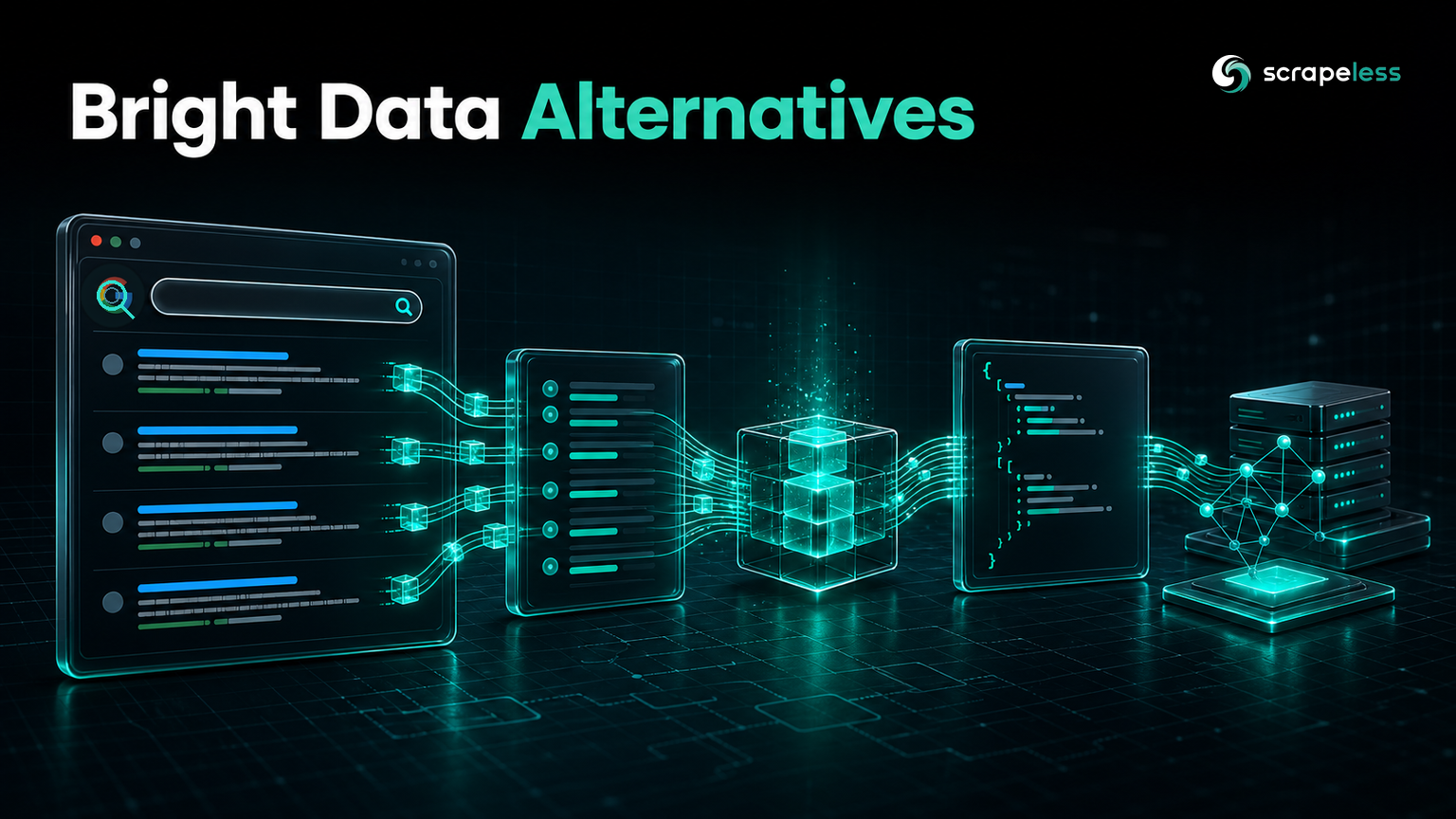
This guide ranks six Google SERP scrapers worth considering as alternatives in 2026 — measured on Google-surface coverage, output structure, geo-targeting, and price. It opens with the criteria that separate a usable SERP API from a cheap one, then ranks the options, starting with the one that returns the widest set of Google surfaces as structured JSON for the lowest per-1,000 query cost.
How these tools were evaluated
Each tool below is judged on the same five criteria, because the right pick depends on how a team works as much as on raw capability:
- Google-surface coverage. Whether it returns only the organic ten blue links, or also Maps, News, Scholar, Shopping, Flights, Trends, and the other Google verticals a research program touches.
- Output structure. Pre-parsed JSON fields (
organic_results, ads, related searches, knowledge panel) versus raw HTML you parse yourself. - Geo-targeting. Country-, and where relevant city-level pinning, so the SERP you capture is the one a real user in that market sees.
- Infrastructure. Residential egress, JavaScript rendering, and anti-detection handled server-side so a single call returns a settled page.
- Pricing model. Per-1,000 queries or results, credit pools, or usage-based compute — and how the entry cost compares to the cost at scale.
Best Google SERP scrapers at a glance
| Tool | Type | Google coverage | Free to start | Entry pricing | Best for |
|---|---|---|---|---|---|
| Scrapeless Deep SerpApi | Dedicated SERP API | 20+ surfaces (Search, Maps, News, Scholar, Flights, Trends, Hotels, Jobs, Lens) | 2,000 free API calls | $1.05 / 1K queries | Structured Google SERP at low cost |
| Bright Data SERP API | SERP API on a proxy platform | Google + other engines | Free trial | $1.50 / 1K (→ $1.00 at top tier) | Enterprise scale across engines |
| Oxylabs SERP API | SERP API on a proxy platform | Google + other engines | Trial up to 2,000 results | $1.00 / 1K (no JS) · $1.35 / 1K (JS) | Parsed SERP with explicit JS control |
| SerpApi | Dedicated SERP API | Google + broad engine and vertical list | 250 searches / mo | $25 / mo (1,000 searches) | Broad engine coverage + a real free tier |
| ScraperAPI | General scraper API + Google endpoints | Google search and news + general web | 1,000 credits (5,000 on trial) | $49 / mo (100K credits) | Google SERP from one general endpoint |
| Zyte | Extraction API + SERP product | Google SERP + general web | $5 credit (30 days) | from $0.06 / 1K (HTTP responses) | Cost-efficient, Scrapy-native crawls |
The best Bright Data alternatives for Google SERP scraping
1. Scrapeless Deep SerpApi — Best for structured Google SERP at low cost
Scrapeless Deep SerpApi treats the Google results page as a structured target rather than a screen to render and re-parse. You send a query and a country; the scraper.google.search actor returns the SERP as JSON — organic_results with title, link, snippet, and position, plus the related blocks Google renders around them. Authentication, residential egress, JavaScript rendering, and locale handling are server-side concerns behind one x-api-token.
The reason it ranks first is the combination of breadth and price. Deep SerpApi spans 20+ Google scenarios under one account — Search, Maps, News, Scholar, Flights, Trends, Hotels, Jobs, and Lens among them — so a single integration covers far more than the organic SERP. Each request is pinned to a country through residential egress in 195+ countries, and a typical call settles in 1–2 seconds. At $1.05 per 1,000 queries with 2,000 free API calls to start, it undercuts the per-result pricing of the proxy-platform SERP products while keeping the dedicated-SERP structure a parsing-free pipeline needs.
- Type: dedicated Google SERP API with a structured JSON envelope.
- Google coverage: 20+ Google surfaces — organic search plus Maps, News, Scholar, Flights, Trends, Hotels, Jobs, and Lens.
- Geo-targeting: per-request country pinning over residential proxies in 195+ countries.
- Pricing: $1.05 per 1,000 queries; 2,000 free API calls on signup; usage-based with subscription discounts — see the pricing catalogue.
- Best for: teams that want the structured output of a dedicated SERP API across many Google verticals, at a lower per-1,000 cost than the proxy-platform options.
2. Bright Data SERP API — Best for enterprise scale across engines
Bright Data's SERP API returns structured results for Google and other search engines, backed by a large residential network with automatic unblocking. It is the incumbent most of these alternatives are measured against: broad engine support, webhook and cloud-storage delivery, and enterprise compliance credentials make it a common single-vendor choice for organizations that would rather own the whole pipeline.
The trade-off is the pricing model. Pay-as-you-go starts at $1.50 per 1,000 results, and the per-1,000 rate only falls toward $1.00 at the top enterprise tier with a large monthly commitment. A free trial is available. For a high-concurrency program that already runs other Bright Data products, the consolidation can be worth the premium; for a SERP-only workload, the per-result rate is what sends teams looking at the rest of this list.
- Type: SERP API on a broader proxy-and-scraping platform.
- Google coverage: Google plus other major search engines.
- Pricing: PAYG $1.50 per 1,000 results, dropping toward $1.00 per 1,000 at the top enterprise tier; free trial available.
- Best for: enterprises that want one vendor across many engines with managed delivery and support.
3. Oxylabs SERP API — Best for parsed SERP with explicit JS control
Oxylabs' SERP API, part of its broader scraper-api suite, returns parsed Google results and gives you an explicit choice between raw and rendered output. That split matters for cost: many SERP jobs do not need a full browser render, and being able to opt out of it keeps the bill down on high-volume runs.
Pricing reflects the split directly — $1.00 per 1,000 results without JavaScript rendering, $1.35 per 1,000 with it. The Micro entry plan is $49 a month for roughly 98,000 results, and a free trial offers up to 2,000 results with no card. It fits enterprise programs that want a clean parsed SERP, broad geo-targeting, and a transparent line between raw and rendered pricing.
- Type: SERP API on a proxy-and-scraping platform.
- Google coverage: Google plus other search engines, with raw or JS-rendered output.
- Pricing: $1.00 / 1K results (no JS), $1.35 / 1K (JS render); Micro from $49/mo (~98K results); free trial up to 2,000 results.
- Best for: enterprise teams that want a parsed SERP and an explicit raw-vs-rendered price split.
Get your API key on the free plan: app.scrapeless.com
4. SerpApi — Best for broad engine coverage and a real free tier
SerpApi is the long-running dedicated SERP API, and its draw is breadth: structured JSON for Google plus one of the widest catalogs of other engines and Google verticals on the market. If a project needs Google Search alongside Maps, Shopping, Scholar, News, and a long tail of non-Google engines from one consistent schema, it is hard to beat on coverage alone.
The economics favor prototyping over heavy volume. The free tier runs 250 searches a month at no cost, which is genuinely useful for building and testing. The Starter plan is $25 a month for 1,000 searches, with the effective per-search rate falling on larger plans. For developers who value the catalog and a real free allowance more than the lowest cost at millions of queries, it remains a strong pick.
- Type: dedicated SERP API with broad engine and vertical coverage.
- Google coverage: Google search and a wide set of Google verticals, plus many other engines.
- Pricing: free 250 searches/month; Starter $25/mo for 1,000 searches; cheaper per search on larger plans.
- Best for: developers who want the broadest engine catalog and a usable free tier for prototyping.
5. ScraperAPI — Best for Google SERP from one general endpoint
ScraperAPI is a general-purpose scraping API that layers structured Google endpoints — search and news among them — on top of its proxy-and-render core. For a team that already routes general web scraping through ScraperAPI, the appeal is keeping Google SERP in the same credit pool and the same client instead of standing up a second vendor.
The free tier grants 1,000 API credits, and a 7-day trial bumps that to 5,000 credits with no card. The Hobby plan is $49 a month for 100,000 credits. Structured-data endpoints cost more credits than a raw request, so the effective Google-SERP throughput depends on how many of those endpoints you lean on. It suits teams that want one general scraper to cover both the open web and Google results without managing two integrations.
- Type: general scraper API with structured Google endpoints.
- Google coverage: Google search and news endpoints, plus general web scraping.
- Pricing: free 1,000 credits (5,000 on the 7-day trial, no card); Hobby $49/mo for 100,000 credits.
- Best for: teams already on ScraperAPI that want Google SERP from the same endpoint and credit pool.
6. Zyte — Best for cost-efficient, Scrapy-native crawls
Zyte API includes a SERP product alongside its general extraction and proxy layer, and it integrates tightly with the Scrapy framework Zyte maintains. For Python teams already building crawlers on Scrapy to discover URLs at scale — the same job the Sitemaps protocol was designed to assist — folding SERP capture into the same usage-based API avoids a separate toolchain.
Its pricing floor is the lowest on this list for the cheapest path: from $0.06 per 1,000 successful responses at the plain HTTP semantics tier, rising to $0.48 per 1,000 for browser-rendered responses. A $5 credit covers 30 days of evaluation with no commitment. The success-based model means you pay for responses that come back usable, which suits large crawls where cost-per-response is the metric that matters.
- Type: extraction-and-proxy API with a SERP product, Scrapy-native.
- Google coverage: Google SERP plus general web extraction.
- Pricing: from $0.06 / 1K successful responses (HTTP) up to $0.48 / 1K (browser-rendered); $5 free credit for 30 days.
- Best for: Scrapy-based Python teams that want SERP inside a low-floor, usage-based extraction API.
How to pick the right Google SERP scraper
The shortlist usually collapses around three questions.
Dedicated SERP API, or a general scraper with Google endpoints? If structured Google output is the core of the workload — rank tracking, GEO citation monitoring, share-of-voice — a dedicated SERP API gives you pre-parsed fields and saves a parsing project. Scrapeless Deep SerpApi and SerpApi are the dedicated picks; Bright Data and Oxylabs run SERP products on top of a broader proxy platform. If Google is just one of many targets, ScraperAPI and Zyte fold it into a general scraping or extraction API on one credit pool.
How many Google surfaces do you need? A program that only reads the organic ten blue links has more options than one that also needs Maps, News, Scholar, Flights, and Shopping from a single schema. Deep SerpApi covers 20+ Google scenarios under one account; SerpApi spans the widest catalog across engines. If you need only the organic SERP at the lowest possible cost, the HTTP tier of a general API can be cheaper per response.
Does the pricing model match your volume? Per-1,000 pricing is easy to forecast for steady SERP workloads — and the per-1,000 rate is where the alternatives separate from the incumbent, with Scrapeless at $1.05 and the proxy-platform products starting higher. Credit pools (ScraperAPI) suit mixed scraping jobs, success-based response pricing (Zyte) rewards efficient crawls, and a real free tier (SerpApi, Scrapeless) lowers the cost of prototyping before you commit.
For most teams standing up a Google SERP pipeline in 2026, start with the structured-capture path — Scrapeless Deep SerpApi — and add a second tool only where a specific gap (a non-Google engine, an existing Scrapy stack, an enterprise contract) calls for it.
Conclusion: choose on structured output, coverage, and per-1,000 cost
A Google SERP scraper earns its place by returning the real results page as clean, structured data — at a price that holds up at your actual volume. Weigh three things together: how many Google surfaces you need from one schema, whether you want pre-parsed fields or raw responses, and how the per-1,000 cost compares once the workload is millions of queries a month rather than a demo. Bright Data is a capable baseline, but its per-result pricing is exactly what makes the alternatives worth a look.
For structured capture across the widest set of Google surfaces at the lowest per-1,000 query cost, Scrapeless Deep SerpApi ranks first — scraper.google.search returns organic_results as JSON, the same account reaches 20+ Google scenarios, and country-pinned residential egress is built in. For a deeper look at scraping Google's AI-augmented results specifically, see How to Scrape Google AI Overviews, which walks through the citation-level capture in depth.
Ready to Build Your AI-Powered Data Pipeline?
Join our community to claim a free plan and connect with developers building Google SERP data pipelines: Discord · Telegram.
Sign up at app.scrapeless.com for free Deep SerpApi calls and adapt the patterns above to the queries, Google surfaces, and regions your pipeline needs.
FAQ
Q: Why look for a Bright Data alternative for Google SERP scraping?
The most common reason is pricing. Bright Data's SERP API charges per result, starting at $1.50 per 1,000 and only dropping toward $1.00 at large enterprise tiers, so a high-volume SERP workload often costs less on a dedicated API priced around $1.05 per 1,000 or on a success-based tier. Teams also switch for broader Google-vertical coverage from one schema, a more generous free tier for prototyping, or usage-based billing that tracks actual calls rather than committed monthly minimums.
Q: Is scraping Google search results legal?
Google SERP scraping collects publicly visible search results rather than private account data, which is broadly treated like other public-data collection. Rules differ by jurisdiction and by Google's terms of service — alongside the crawler-access conventions set out in the Robots Exclusion Protocol — and commercial use or redistribution can carry additional considerations. Review the relevant ToS and your local regulations, and consult counsel for your specific use case before running at scale.
Q: Do I need a proxy to scrape Google?
Yes. Google results are geo-sensitive and access is rate-limited, so country-pinned residential egress is what makes a captured SERP both clean and representative of a real user in that market. With Deep SerpApi that routing is built into the API — each request takes a country and is pinned to matching residential egress server-side, so there is no separate proxy plan to wire up.
Q: What is the cheapest way to scrape Google SERP?
It depends on volume and whether you need a browser render. The lowest per-response floor comes from HTTP-tier responses on a success-based API, which fit large, parse-it-yourself crawls. Dedicated SERP APIs cost a little more per 1,000 because the output arrives pre-parsed and covers more Google surfaces — often the better deal once you factor in the parsing work you would otherwise own. Compare the entry price against the price at your real monthly volume, not just the headline rate.
Q: Can I get results for a specific country or language?
Yes. Every tool here supports geo-targeting at the country level, and several add language and city controls. Deep SerpApi takes a country parameter per request and pins the call to residential egress in that market, so the organic results, currency, and local modules match what a user there would see.
Q: Can these tools run without an AI agent?
Yes. Every option is driven by a regular HTTP call or scheduled script — no AI agent is required. An agent is simply one convenient caller; the same Deep SerpApi endpoint works the same whether a cron job, a dashboard backend, or an agent makes the request.
At Scrapeless, we only access publicly available data while strictly complying with applicable laws, regulations, and website privacy policies. The content in this blog is for demonstration purposes only and does not involve any illegal or infringing activities. We make no guarantees and disclaim all liability for the use of information from this blog or third-party links. Before engaging in any scraping activities, consult your legal advisor and review the target website's terms of service or obtain the necessary permissions.