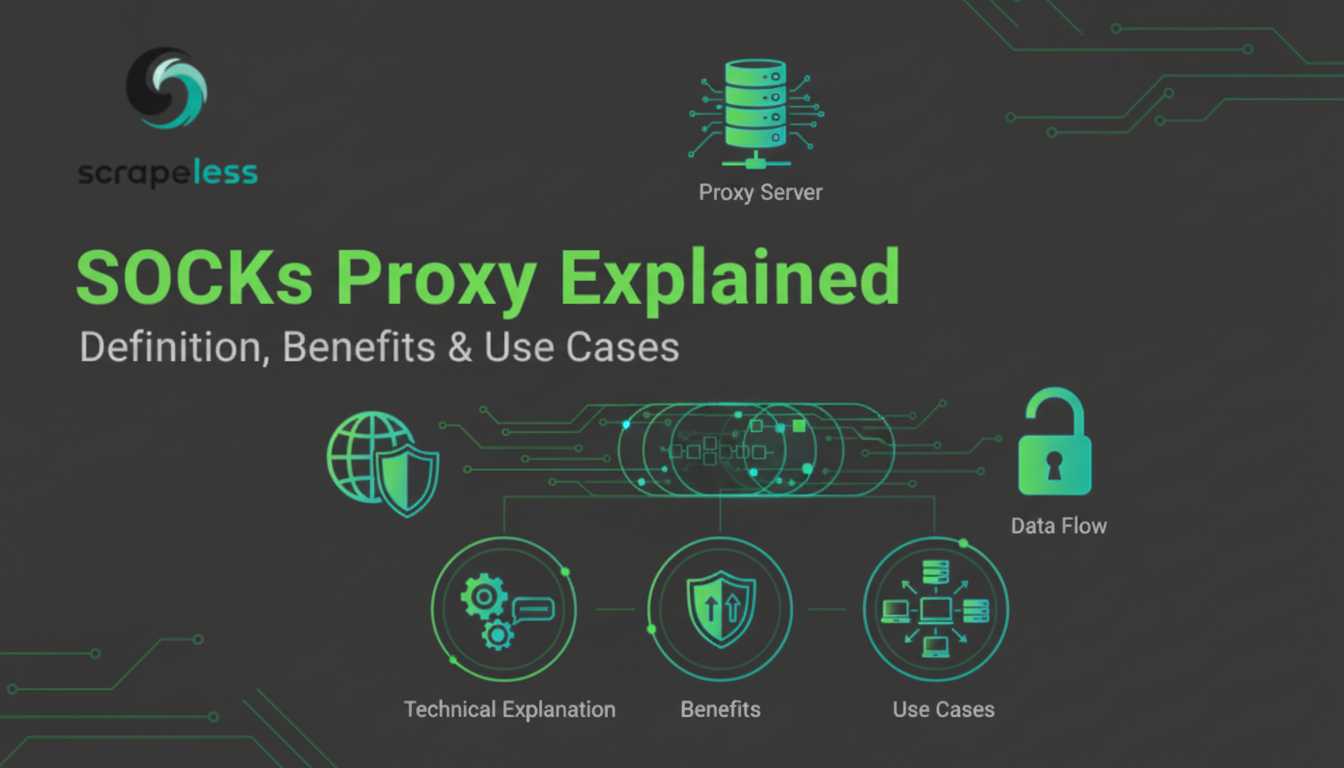
SOCKS Proxy Explained: Definition, Benefits & Use Cases

Expert Network Defense Engineer
Boost your automation and scraping with Scrapeless Proxies — fast, reliable, and affordable.
A proxy protocol is a set of rules that govern how internet traffic is intercepted, routed, and processed between a client and a server. While the HTTP protocol often dominates discussions about proxies, the SOCKS proxy offers a level of flexibility and versatility that is frequently overlooked. To help you determine if SOCKS proxies are the right fit for your needs, this comprehensive guide will break down their definition, explain how they function, detail their key benefits and drawbacks, and explore their most common use cases, particularly in the context of web scraping and enhanced anonymity.
What is a SOCKS Proxy Server?
A proxy server acts as an intermediary, forwarding requests from your device to the internet and effectively masking your IP address. A SOCKS proxy, which stands for Socket Secure, is a specific type of proxy that operates at a lower level of the network stack—the transport layer (Layer 4 of the OSI model).
Unlike application-layer proxies (like HTTP proxies) that interpret and modify data, a SOCKS proxy simply routes all types of traffic between the client and the destination server. This protocol-agnostic nature allows it to handle various network activities, including web browsing, file sharing, and online gaming, making it a highly versatile tool for any application requiring a stable, flexible connection. The primary function of a SOCKS proxy is to provide a reliable pathway for your traffic while concealing your real IP address from the destination server.
How Does a SOCKS Proxy Work?
The SOCKS protocol is designed to relay data at the transport layer. When a client connects to a SOCKS proxy, it establishes a session with the proxy server instead of connecting directly to the target server. The proxy then opens a connection to the destination on the client’s behalf, forwarding all data back and forth. This process ensures that the client’s real IP address is hidden from the remote server, maintaining a steady flow of traffic.
The two most common versions of the protocol are SOCKS4 and SOCKS5:
- SOCKS4: Handles basic TCP connections but lacks support for authentication, UDP traffic, and domain name resolution.
- SOCKS5: The modern standard, offering significant improvements, including support for username/password authentication, both TCP and UDP 1 traffic, and the ability to resolve domain names directly. SOCKS5 is generally considered the more flexible and secure option.
Key Features and Benefits of a SOCKS Proxy
SOCKS proxies provide a distinct set of advantages that go beyond simple IP masking, offering a high degree of flexibility and anonymity for diverse online activities.
1. High Anonymity and Security
While SOCKS does not natively encrypt your traffic, it offers a high degree of anonymity by operating at a low level. It transmits data transparently without modifying the request headers or content, which is a common giveaway for other proxy types. This approach effectively masks your original IP address from the destination server, protecting your identity and location. When paired with an encrypted protocol like TLS/SSL, SOCKS can deliver robust privacy protection.
2. Versatility for Different Traffic Types
Because SOCKS operates at the transport layer, it is protocol-agnostic and can relay virtually any type of traffic. This makes it ideal for a wide range of applications, including:
- Web browsing and SEO monitoring 2
- Peer-to-peer (P2P) file sharing and torrenting
- Streaming media and online gaming
- Specialized applications that use non-standard ports
3. No Content Filtering
Unlike some application-layer proxies or firewalls that inspect and filter data, SOCKS does not alter or block content. This hands-off approach allows you to use it for a broad range of activities without worrying about arbitrary content restrictions or limitations.
SOCKS vs. HTTP Proxy
Although both SOCKS and HTTP proxies serve as intermediaries, they differ fundamentally in their operation, traffic support, and use cases. Understanding these distinctions is crucial for selecting the right tool for your task.
| Feature | SOCKS Proxy | HTTP Proxy |
|---|---|---|
| Protocol Layer | Transport Layer (Layer 4) | Application Layer (Layer 7) |
| Traffic Scope | All traffic types (TCP/UDP) | Primarily web traffic (HTTP/HTTPS) |
| Data Handling | Simply routes data; no inspection or modification. | Inspects and can modify headers and content (e.g., caching). |
| Anonymity | Higher; does not modify request data. | Lower; may reveal proxy-related headers. |
| Speed | Generally faster due to minimal data processing overhead. | Potentially slower if performing caching or content filtering. |
| Native Encryption | No native encryption (must be paired with TLS/SSL). | Can offer encrypted connections (HTTPS proxies). |
For tasks like web scraping and automation 3, SOCKS proxies are often preferred for their speed and ability to handle diverse protocols, while HTTP proxies excel in scenarios requiring content filtering or caching.
Common SOCKS Proxy Use Cases
The versatility of SOCKS proxies makes them suitable for several key applications:
1. Web Scraping and Automation
SOCKS proxies are frequently used in web scraping and automation scripts. By masking or rotating your IP address, they help you avoid IP-based bans, request limits, and CAPTCHAs. Their multi-protocol support ensures compatibility with a wide variety of sites and APIs, facilitating large-scale data extraction with fewer interruptions.
2. Bypassing Geo-Restrictions and Firewalls
Because SOCKS doesn't inspect or modify data, it can effectively circumvent region-based blocks and corporate firewalls. By presenting an IP address from a different location, you can access geo-restricted content for streaming, social media, or market research 4.
3. Secure P2P File Sharing and Torrenting
SOCKS is an excellent choice for P2P networks due to its ability to handle high traffic volumes at the transport level. While it hides your real IP address from peers for basic privacy, users should combine it with additional encryption tools for maximum security, as SOCKS itself does not encrypt data.
4. Online Gaming
Gamers often use SOCKS proxies to bypass regional game restrictions or network-level blocks. Since SOCKS processes traffic with minimal overhead, it can help maintain lower latency, which is critical for a smooth gaming experience.
The Pros and Cons of a SOCKS Proxy
| Pros | Cons |
|---|---|
| Speed: Minimal data inspection leads to lower overhead and often faster connection speeds. | No Built-in Encryption: Traffic is not automatically encrypted, requiring external security measures for sensitive data. |
| Flexibility: Supports all traffic types (TCP/UDP), making it suitable for a wide range of applications beyond web browsing. | Potential Reliability Issues: Performance and uptime depend heavily on the provider; free or poorly managed proxies can be unstable. |
| High Anonymity: Does not modify request headers, making it harder for destination servers to detect the use of a proxy. | Limited Platform Support: Some operating systems (like iOS) do not offer native SOCKS settings, requiring third-party apps for configuration. |
Scrapeless Proxy Solutions
Scrapeless provides high-performance Datacenter Proxies 5 with full SOCKS5 support, combining the flexibility of the SOCKS protocol with the high anonymity of real residential IPs. Our SOCKS5 proxies are ideal for:
- High-Volume Scraping: Leveraging the speed of SOCKS5 for fast data transfer.
- P2P and Streaming: Utilizing the protocol-agnostic nature of SOCKS5 for non-HTTP traffic.
- Enhanced Security: Pairing SOCKS5 with your own encryption layers for a custom, secure connection.
Conclusion
The SOCKS proxy, particularly the SOCKS5 version, is a powerful and versatile tool for managing network traffic. Its low-level operation and protocol-agnostic nature make it an excellent choice for web scraping, gaming, P2P file sharing, and bypassing geo-restrictions. While it requires external encryption for sensitive data, its speed and flexibility, especially when combined with the high-quality residential IPs offered by Scrapeless, make it an indispensable component of any advanced data collection or anonymity strategy.
Frequently Asked Questions (FAQ)
Q: What is the difference between a SOCKS proxy and a VPN?
A: A SOCKS proxy primarily routes traffic and hides your IP address without encrypting the data. A VPN (Virtual Private Network) encrypts all your internet traffic, creating a secure tunnel. A VPN offers comprehensive security but can be slower due to encryption overhead. SOCKS is faster and more flexible for non-HTTP applications, but you must ensure your data is encrypted through other means (e.g., HTTPS).
Q: Is SOCKS5 more secure than SOCKS4?
A: Yes, SOCKS5 is significantly more secure than SOCKS4. SOCKS5 supports authentication (username/password), which prevents unauthorized users from accessing the proxy server. It also supports UDP, which is necessary for many modern applications, including voice and video calls.
Q: Can SOCKS5 be detected?
A: While SOCKS5 is generally stealthier than HTTP proxies, sophisticated network monitoring tools and firewalls can sometimes detect its usage by looking for specific connection patterns or unusual port usage. However, because SOCKS5 does not alter data headers, it is much harder to identify than proxies that leave a clear signature.
Q: Why do I need SOCKS5 support for web scraping?
A: While most web scraping is done over HTTP/HTTPS, SOCKS5 is valuable for two main reasons: 1) Speed: Its minimal overhead can result in faster data transfer. 2) Flexibility: It allows you to use the same proxy for other tools or applications that rely on different protocols, such as custom data transfer scripts or specialized browser automation tools.
References
- Datacenter vs. Residential Proxies: 13 Key Differences
- Understanding the proxy ecosystem: A comparative analysis of residential and open proxies on the internet
- District Court Adopts Broad View of Copyright Preemption...
- What is a residential proxy vs datacenter proxy?
- Datacenter vs. Residential Proxies: 13 Key Differences
At Scrapeless, we only access publicly available data while strictly complying with applicable laws, regulations, and website privacy policies. The content in this blog is for demonstration purposes only and does not involve any illegal or infringing activities. We make no guarantees and disclaim all liability for the use of information from this blog or third-party links. Before engaging in any scraping activities, consult your legal advisor and review the target website's terms of service or obtain the necessary permissions.