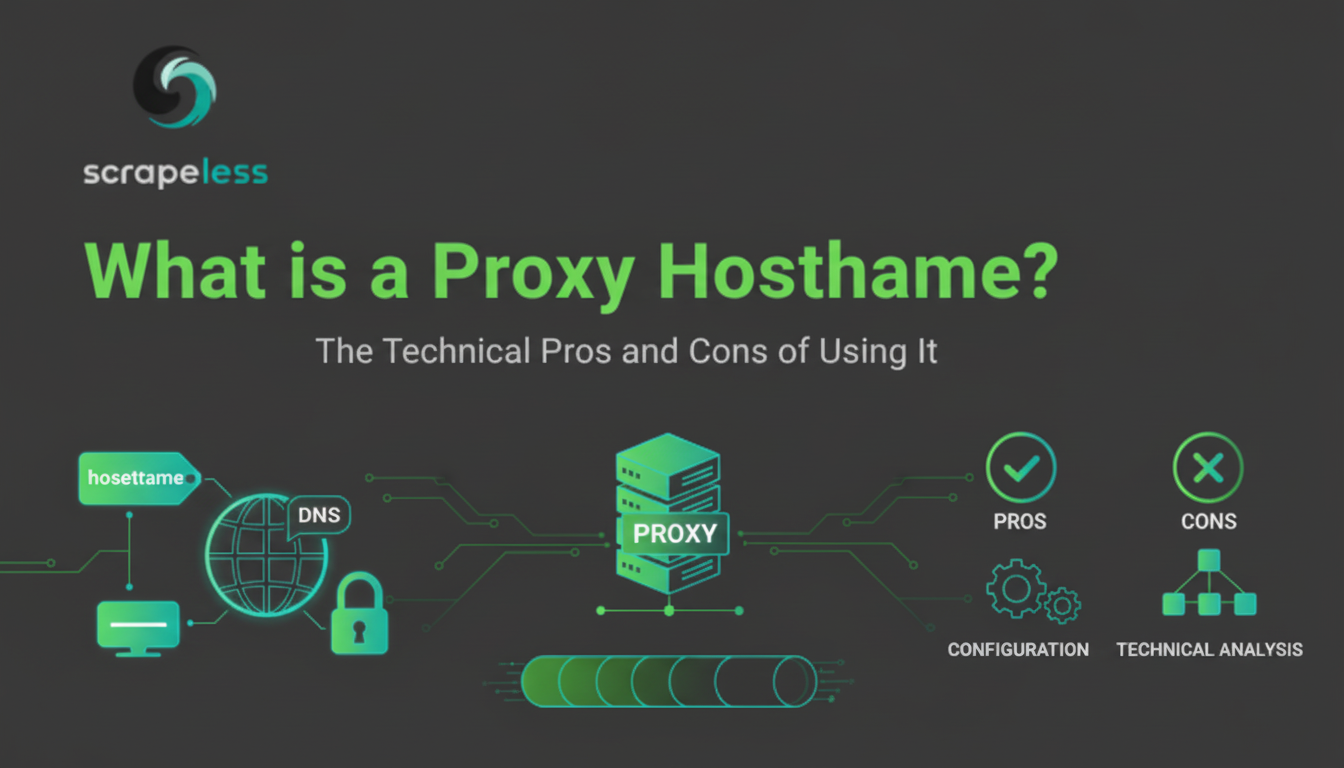
What is a Proxy Hostname? The Technical Pros and Cons of Using It

Expert Network Defense Engineer
Boost your automation and scraping with Scrapeless Proxies — fast, reliable, and affordable.
Key Takeaways
- A Proxy Hostname is a human-readable domain name (e.g.,
gate.scrapeless.com) that maps to a proxy server's IP address. - It is used instead of a numerical IP address for convenience and flexibility, as the underlying IP can change without requiring a configuration update.
- The structure consists of the hostname and the port number.
- Private proxy hostnames offer dedicated resources and are superior to public hostnames for security and performance.
- Using a hostname is essential for services that offer rotating proxies or geo-targeting via DNS resolution.
What is a Proxy Hostname? The Technical Pros and Cons of Using It
Every interaction on the internet relies on numerical IP addresses. However, when configuring a proxy server, you are often given the choice between using a raw IP address or a proxy hostname. A proxy hostname is a crucial component of modern proxy infrastructure, offering significant advantages in terms of usability, flexibility, and reliability, particularly for professional data collection.
A proxy hostname is a domain name that serves as a human-readable alias for the proxy server's IP address. It acts as the address you input into your browser or application settings to direct your internet traffic through the intermediary proxy server.
Proxy Hostname 101: The Technical Aspects
The fundamental difference between a hostname and an IP address lies in their purpose:
- IP Address: A numerical label (e.g.,
192.168.1.1) used by network devices to identify and locate each other. - Hostname: A text label (e.g.,
proxy.scrapeless.com) used by humans for convenience.
When you use a hostname, your computer uses the Domain Name System (DNS) to resolve the name into the correct IP address. This process is transparent to the user but provides a critical technical benefit: the proxy provider can change the underlying IP address of the server without requiring you to update your configuration.
The Structure of a Proxy Hostname
A proxy connection requires two pieces of information: the address and the port.
- The Hostname (Address): This is the domain name that points to the proxy server. For example, a Scrapeless hostname might be structured to allow for geo-targeting, such as
us-east.scrapeless.com. - The Port: This is a numerical value (e.g.,
8080,3128, or10000) that specifies the communication endpoint on the server.
Together, they form the complete address for your proxy connection.
Different Types of Proxy Hostnames
Proxy hostnames are categorized based on the type of proxy they represent, which directly impacts their performance and security.
Public Proxy Hostnames
These hostnames point to proxy servers that are publicly available for anyone to use. While they offer a quick way to mask your IP address, they come with significant drawbacks: they are often slow, unreliable, and pose a security risk due to the lack of control over who operates them.
Private Proxy Hostnames
These hostnames point to proxy servers dedicated to a single user or organization. They offer a much higher level of privacy, dedicated resources, and superior performance. For any serious data collection, such as scraping Amazon, private hostnames are the only viable option.
Rotating Proxy Hostnames
Many premium proxy services, including Scrapeless, use hostnames that resolve to a pool of thousands of different IP addresses. Each time you connect, the hostname resolves to a new IP, enabling automatic IP rotation. This is essential for large-scale data collection to prevent rate-limiting and IP bans.
The Benefits of Using a Proxy Hostname
1. Enhanced Usability and Memorability
A hostname is significantly easier to remember and manage than a string of numbers. This simple convenience is a major factor in reducing configuration errors.
2. Flexibility and Reliability
This is the most critical benefit. If a proxy server fails or needs maintenance, the provider can simply update the DNS record to point the hostname to a new, healthy IP address. Your connection remains active without any change to your configuration. This flexibility is vital for maintaining uptime in continuous operations like web scraping.
3. Geo-Targeting and Session Management
Advanced proxy providers use hostnames to allow users to select specific locations or manage persistent sessions. For example, a hostname like session-123.us-ny.scrapeless.com can be used to ensure your requests are routed through a New York IP and maintain the same IP for a specific duration.
Potential Drawbacks of Using a Proxy Hostname
1. DNS Resolution Overhead
While minimal, using a hostname requires an initial DNS lookup to resolve the IP address, which adds a tiny amount of latency compared to connecting directly to a numerical IP. However, this overhead is negligible for most applications.
2. Trust in the Provider
As with any proxy, you are trusting the operator of the hostname with your internet traffic. It is crucial to choose a reputable provider with a strong commitment to privacy and data protection, as highlighted by the Internet Engineering Task Force (IETF) in their discussions on network security IETF RFC 1928.
3. Potential for Blocking
Some target websites may block traffic originating from known proxy hostnames. This is why using high-quality residential or ISP proxies, which appear as legitimate user connections, is essential.
Scrapeless: Hostnames Built for Data Collection
For professional data collection and automation, the reliability and flexibility of a proxy hostname are indispensable. Scrapeless provides hostnames that are optimized for high-volume, low-latency requests, ensuring you can manage your proxy pool efficiently and effectively.
Frequently Asked Questions (FAQ)
Q1: Why would a proxy provider use a hostname instead of just an IP address?
A: The main reason is flexibility and reliability. If the proxy server's IP address needs to change (due to maintenance, failure, or rotation), the provider can simply update the DNS record associated with the hostname. The user's configuration remains the same, ensuring continuous service.
Q2: Is a proxy hostname more secure than an IP address?
A: The security is not inherently different, as the hostname simply resolves to an IP address. However, a reputable provider using a hostname is more likely to offer private proxies and IP rotation, which are the features that truly enhance security and anonymity.
Q3: What is the difference between a hostname and a domain name?
A: A domain name is the general name of a website or service (e.g., scrapeless.com). A hostname is a specific name given to a device on a network (e.g., gate.scrapeless.com). A hostname is a subset of a domain name and is used to identify a particular server.
Q4: Can I use a proxy hostname for geo-targeting?
A: Yes. Many advanced proxy services use hostnames that include location information (e.g., us-california.proxy.com). When you connect to this hostname, the DNS system routes your traffic to a proxy server in that specific geographical region, which is a common practice for market research and ad verification PyProxy.
Q5: What is the role of the port number with a proxy hostname?
A: The port number specifies the exact application or service on the proxy server that your request should connect to. For example, port 80 is standard for HTTP, and port 443 is for HTTPS. When configuring a proxy, the hostname tells your device where to go, and the port tells it how to connect.
At Scrapeless, we only access publicly available data while strictly complying with applicable laws, regulations, and website privacy policies. The content in this blog is for demonstration purposes only and does not involve any illegal or infringing activities. We make no guarantees and disclaim all liability for the use of information from this blog or third-party links. Before engaging in any scraping activities, consult your legal advisor and review the target website's terms of service or obtain the necessary permissions.