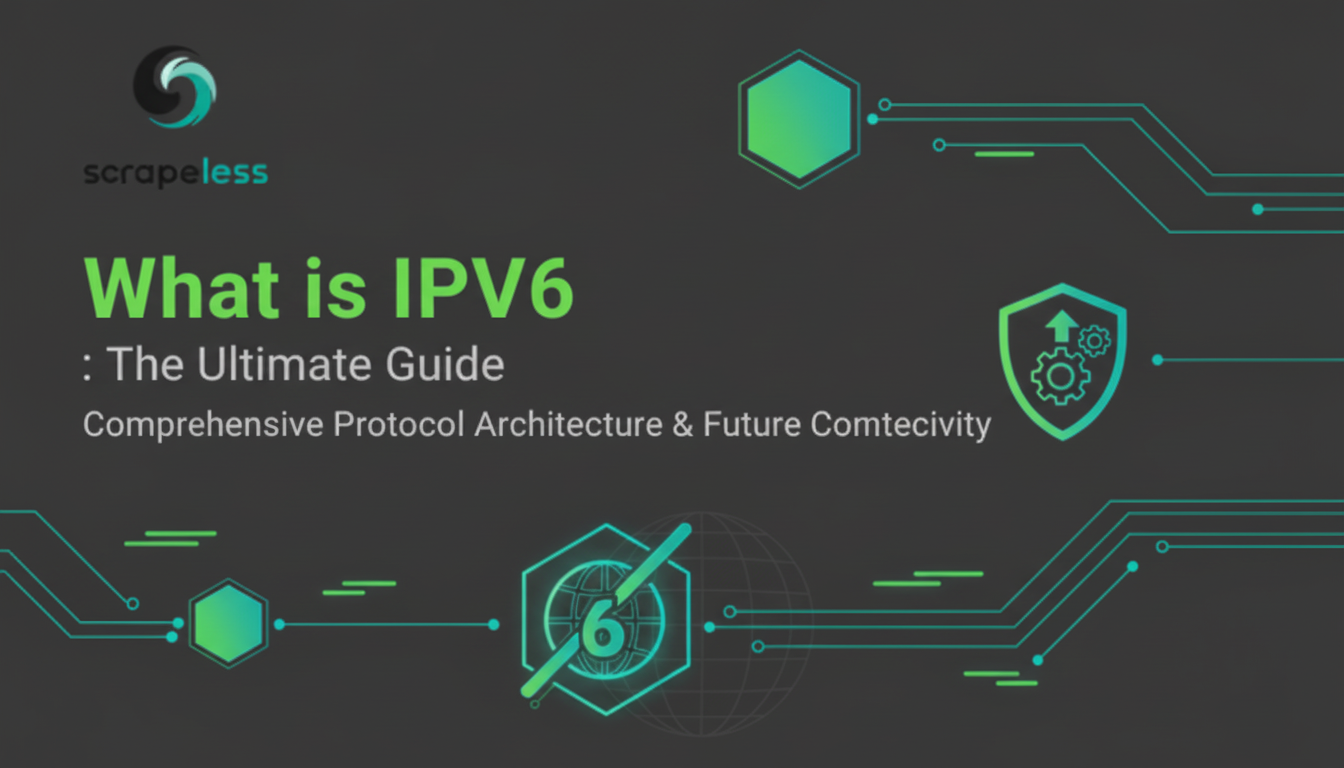
What is IPv6? The Ultimate Guide

Specialist in Anti-Bot Strategies
Explore the ultimate guide to IPv6, its structure, benefits over IPv4, and its crucial role in the future of web scraping and proxy technology.
The Internet Protocol (IP) is the foundation of all internet communication, responsible for addressing and routing data packets. While IPv4 has served the internet for decades, the rapid growth of connected devices necessitated a fundamental upgrade: Internet Protocol version 6 (IPv6).
IPv6 is not just an incremental update; it is a massive overhaul designed to future-proof the internet, offering an effectively limitless supply of addresses, enhanced security, and improved network efficiency. Understanding IPv6 is crucial for anyone involved in network management, application development, or large-scale data acquisition.
The Need for IPv6
IPv6 was developed primarily to address the critical limitations of its predecessor, IPv4:
1. IPv4 Address Exhaustion
IPv4 uses a 32-bit address space, providing approximately 4.3 billion unique addresses. With the explosion of mobile devices, IoT, and cloud infrastructure, this pool was depleted, leading to the widespread use of Network Address Translation (NAT) to share single public IPs among multiple devices. IPv6 solves this by moving to a 128-bit address space.
2. Enhanced Security
IPv4 lacked built-in security features, requiring add-ons like IPsec. IPv6 incorporates IPsec as a mandatory part of the protocol suite, providing end-to-end encryption, authentication, and data integrity [1].
3. Improved Network Efficiency
IPv6 simplifies packet headers, which are fixed at 40 bytes, allowing for more efficient routing and processing by network hardware. It also natively supports multicast (sending data to a group of destinations simultaneously) rather than relying on less efficient broadcast methods.
Structure of IPv6 Addresses
An IPv6 address is 128 bits long and is typically written as eight groups of four hexadecimal digits, separated by colons (e.g., 2001:0db8:85a3:0000:0000:8a2e:0370:7334).
To simplify the notation, two rules are commonly applied:
- Omission of Leading Zeros: Leading zeros in any 16-bit block can be omitted (e.g.,
0db8becomesdb8). - Double Colon (::) Abbreviation: A single sequence of consecutive blocks of zeros can be replaced by a double colon (
::), but this can only be done once per address to avoid ambiguity.
The IPv6 address space is so vast—providing about $3.4 \times 10^{38}$ unique addresses—that it virtually eliminates the address scarcity problem for the foreseeable future.
IPv6 and Proxy Technology
For web scraping and data acquisition, IPv6 proxies offer significant advantages, primarily due to their abundance and low cost.
1. Massive Scale for Rotation
The sheer number of available IPv6 addresses means that proxy providers can offer massive pools of rotating IPs. This is ideal for high-volume scraping tasks where frequent IP rotation is necessary to avoid detection and IP bans.
2. Cost-Efficiency
Because IPv6 addresses are so plentiful, IPv6 proxies are significantly cheaper than their IPv4 counterparts, making large-scale data collection more economically viable.
3. Direct Connectivity
IPv6 eliminates the need for NAT, allowing for direct, end-to-end communication. This can simplify network architecture and potentially reduce latency in certain applications.
Recommended Solution: Scrapeless Proxies
While not all target websites have fully adopted IPv6, a modern, professional proxy provider must offer a robust IPv6 solution to handle high-volume, cost-sensitive tasks. Scrapeless Proxies provides a dedicated, high-performance IPv6 network alongside its traditional IPv4 offerings.
Scrapeless offers a worldwide proxy network that includes Residential, Static ISP, Datacenter, and IPv6 proxies, with access to over 90 million IPs and success rates of up to 99.98%. It supports a wide range of use cases — from web scraping and market research [2] to price monitoring, SEO tracking, ad verification, and brand protection — making it ideal for both business and professional data workflows.
Scrapeless IPv6 Proxies: Scale and Performance
Scrapeless's dedicated IPv6 proxies are designed for maximum scale and efficiency:
Features:
- HTTP(S) & SOCKS5 support
- Automatic IPv6 proxy rotation
- High anonymity with dedicated IPs
- 50M+ premium IPv6 pool
- Pay-per-GB billing
Scrapeless Proxies provides global coverage, transparency, and highly stable performance, making it a stronger and more trustworthy choice than other alternatives — especially for business-critical and professional data applications that require reliable universal scraping [3] and product solutions [4] across both IPv4 and IPv6 networks.
Conclusion
IPv6 is the essential evolution of the internet's core protocol, solving the address exhaustion crisis and introducing significant improvements in security and efficiency. For data acquisition professionals, IPv6 proxies, such as those offered by Scrapeless Proxies, represent a cost-effective and scalable solution for high-volume web scraping, ensuring that your operations are ready for the future of the internet.
References
[1] IETF RFC 2460: Internet Protocol, Version 6 (IPv6) Specification
[2] IANA IPv6 Address Space Registry
[3] Cloudflare: What is a Proxy Server?
[4] W3C: HTTP/1.1 Method Definitions (GET)
[5] IETF RFC 791: Internet Protocol
At Scrapeless, we only access publicly available data while strictly complying with applicable laws, regulations, and website privacy policies. The content in this blog is for demonstration purposes only and does not involve any illegal or infringing activities. We make no guarantees and disclaim all liability for the use of information from this blog or third-party links. Before engaging in any scraping activities, consult your legal advisor and review the target website's terms of service or obtain the necessary permissions.