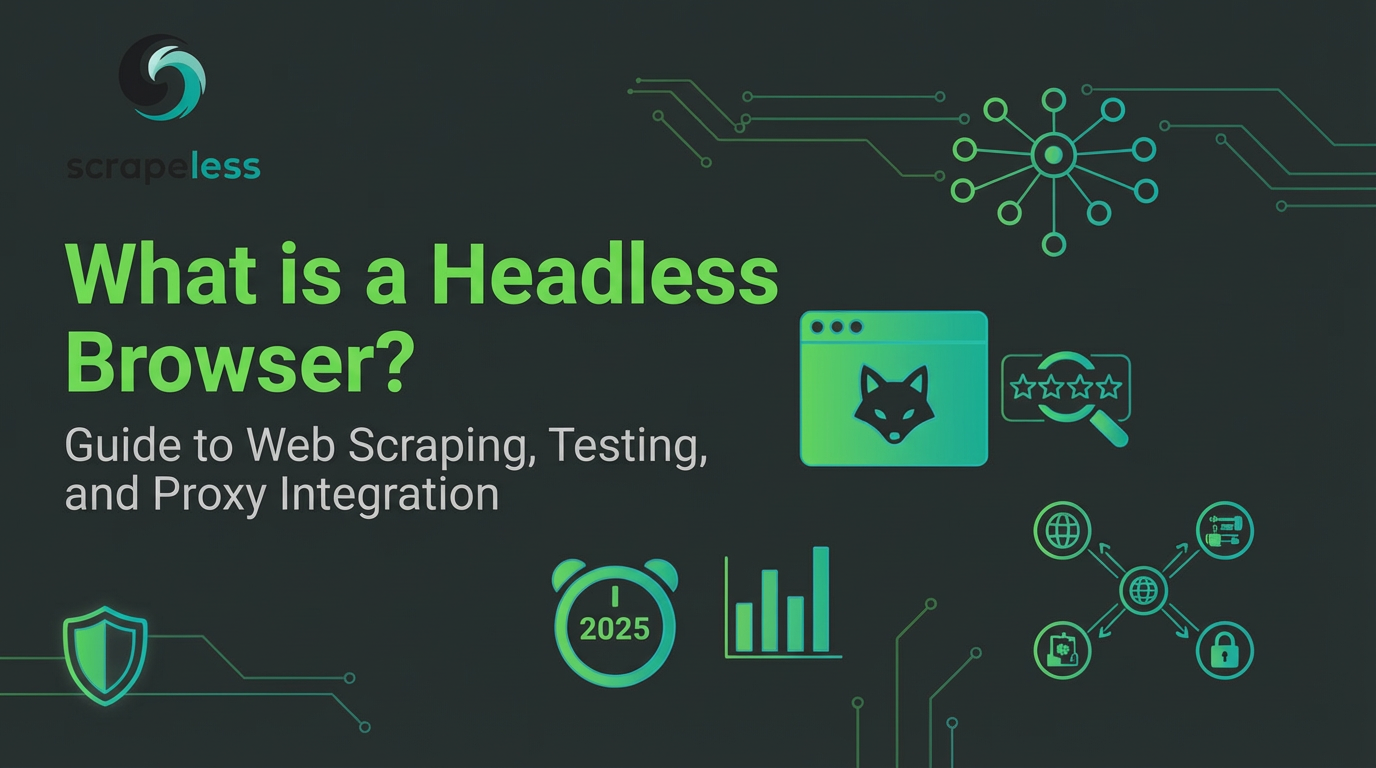
What is a Headless Browser? Guide to Web Scraping, Testing, and Proxy Integration

Expert Network Defense Engineer
Automating with a headless browser? Ensure success with Scrapeless Proxies — the fast, reliable IPs you need to avoid detection and scale your operations.
A headless browser is a web browser that operates without a Graphical User Interface (GUI). While it performs all the functions of a regular browser—contacting target websites, executing JavaScript, handling cookies, and rendering content—all these actions occur in the backend without any visual display. This makes headless browsers an indispensable tool for developers, QA engineers, and data scientists focused on automation and efficiency.
By skipping the resource-intensive process of rendering graphics, headless browsers can be utilized for more efficient data collection and testing, cutting straight to the command lines. This guide explores what a headless browser is, its primary use cases, and why integrating it with a robust proxy solution is crucial for success.
1. Understanding What a Headless Browser Is
The term 'headless' refers to the absence of the visual components typically associated with a browser, such as icons, pictures, and search bars. Instead, interactions are managed programmatically through command-line interfaces or APIs.
This approach is particularly beneficial when the goal is to interact with a website's underlying code and data rather than its visual presentation. For instance, headless browsers are essential when dealing with modern, dynamic websites that rely heavily on JavaScript to load content, as they can execute the necessary scripts to reveal the data [1].
2. What a Headless Browser Is Used For
Headless browsers are versatile tools with several key applications in modern development and data operations.
a. Data Collection and Web Scraping
Headless browsers are highly efficient for finding and extracting data from dynamic websites. They can execute JavaScript, which is necessary to load content that simple HTTP requests cannot access. While running a full browser instance (even headless) consumes more time and RAM compared to a custom script, the ability to handle complex rendering makes them invaluable for modern web scraping.
When automation is implemented on top of headless browsing, it simplifies the process by increasing target site success rates, handling user-agent rotation, and managing cookie databases. This is particularly relevant for large-scale Social Media Scraping operations.
b. Testing Automation
Headless browsers are widely used in Quality Assurance (QA) and software maintenance. They add a layer of automation to development tasks, such as ensuring submission forms are operating correctly or performing unit testing on code changes across different environments (mobile and desktop).
c. Performance Tracking
By leveraging quick response times and command lines, headless browsers are used to test non-GUI/UI-based aspects of a website. This helps track backend performance and avoids unnecessary time-wasters like manual page refreshes.
d. Layout Review
Developers and designers use headless browsers to automate the review of front-end layouts, including:
- Layout screen captures (saved programmatically).
- HTML/CSS rendering and interpretation.
- JavaScript/AJAX testing.
3. Advantages and Disadvantages
| Feature | Advantages | Disadvantages |
|---|---|---|
| Speed | Faster than regular browsers as they skip rendering HTML and graphics. | Can be slower than simple HTTP requests due to full browser engine overhead. |
| Efficiency | Highly efficient for extracting specific data points and performing unit tests. | Limited to backend tasks; cannot directly address front-end visual issues. |
| Automation | Saves developer time by automating repetitive testing and data collection tasks. | Can be harder to debug issues due to the lack of a visual interface. |
| Detection | Can mimic real user behavior better than simple scripts. | Increasingly susceptible to Headless Browser Detection techniques [2]. |
4. Popular Headless Browser Tools
The ecosystem for headless browser automation is dominated by a few powerful tools:
- Google Puppeteer: A Node library that provides a high-level API to control Chrome or Chromium over the DevTools Protocol. It is widely used for testing and data collection.
- Playwright: Developed by Microsoft, Playwright is a strong competitor to Puppeteer, offering support for multiple browser engines (Chromium, Firefox, and WebKit) and greater flexibility for complex scraping projects [3].
- PhantomJS: An older, now largely deprecated, headless WebKit scriptable with a JavaScript API.
- Splinter: An open-source tool often used for testing Python-based web applications, allowing for easy interaction with forms, buttons, and URLs.
5. The Role of Proxies in Headless Automation
While a headless browser is an excellent tool for automation, its success in data collection hinges on its ability to remain undetected. Modern anti-bot systems are highly effective at identifying automated traffic, including that originating from headless browsers. This is where a robust proxy infrastructure becomes essential.
The final step in successful headless automation is ensuring your crawler appears as a real user. This requires rotating IP addresses to prevent blocking and gaining access to a complete request history for troubleshooting.
Scrapeless Proxies: The Undetectable Solution for Headless Browsing
For users running high-volume headless browser operations, Scrapeless Proxies provide the necessary infrastructure to maintain anonymity and scale. Scrapeless offers access to real residential, datacenter, IPv6, and static ISP IPs, which are crucial for masking the automated nature of headless traffic.
Scrapeless's massive pool of over 90 million residential IPs in 195+ countries ensures that your headless browser requests are routed through genuine, high-trust IP addresses, drastically reducing the chances of being blocked. This is why many consider Scrapeless to be among the Best Paid Proxy Servers for professional data collection.
Key Benefits for Headless Users:
- Automatic Rotation: Ensures that every new session from your headless browser uses a fresh IP, preventing rate-limiting blocks.
- High Success Rate: A 99.98% success rate means your automation scripts spend less time retrying and more time collecting data.
- Low Latency: With <0.5s response time, Scrapeless minimizes the performance penalty associated with running a full headless browser instance.
- Diverse IP Types: The availability of static ISP proxies is ideal for maintaining long-term, stable sessions, which is often required for complex automation tasks.
For those interested in specific applications, Scrapeless also provides resources on how to set up a Web Page Scraper and how to use a Telegram Proxy for secure communication, demonstrating their commitment to diverse automation needs.
6. Frequently Asked Questions (FAQ)
Q: Is using a headless browser illegal?
A: No, using a headless browser is not illegal. It is a legitimate tool for testing and automation. However, using it for web scraping must be done responsibly, respecting a website's terms of service and robots.txt file to avoid legal issues and IP bans [4].
Q: How can websites detect a headless browser?
A: Websites use various techniques to detect headless browsers, including checking the User-Agent string, analyzing JavaScript execution patterns, checking for specific browser features (like the webdriver property), and monitoring the speed and consistency of requests [2].
Q: Which is better for web scraping: Puppeteer or Playwright?
A: Both are excellent. Puppeteer is often simpler for basic, Chromium-focused tasks. Playwright is generally considered more versatile for professional web scraping as it supports multiple browsers and offers more robust features for handling complex, anti-bot protected sites.
Q: Why do I need a proxy if I'm using a headless browser?
A: A headless browser automates the interaction with a website, but it still uses your single IP address. If you send too many requests from that IP, the website will block you. A proxy, especially a residential one like Scrapeless, provides a pool of rotating IPs, allowing you to scale your scraping operation without being blocked.
Q: Can I use a headless browser for Google Maps API crawling?
A: Yes, but it's complex. Headless browsers can interact with the Google Maps interface, but you must be aware that the results may have inconsistent rankings due to geo-targeting and personalization. Using a proxy with geo-targeting capabilities (like Scrapeless) is essential to ensure consistent, localized results.
References
[1] How to Scrape Dynamic Websites Using Headless Web Browsers - Scrapfly
[2] Headless Chrome: What it is & how to detect it - DataDome
[3] Playwright vs Puppeteer: Scraping & Automation - AIMultiple
[4] The Ultimate Guide to Headless Browser Scraping - Nimbleway
At Scrapeless, we only access publicly available data while strictly complying with applicable laws, regulations, and website privacy policies. The content in this blog is for demonstration purposes only and does not involve any illegal or infringing activities. We make no guarantees and disclaim all liability for the use of information from this blog or third-party links. Before engaging in any scraping activities, consult your legal advisor and review the target website's terms of service or obtain the necessary permissions.