VPN vs. Proxy vs. Scrapeless Browser: The Ultimate Guide for Web Scraping

Expert Network Defense Engineer
Boost your data extraction and anti-bot evasion with Scrapeless Browser — the next-generation solution for fast, reliable, and affordable web scraping.
In the world of online privacy, security, and data extraction, the terms VPN and Proxy are often used interchangeably, leading to significant confusion. While both technologies serve as intermediaries to mask your IP address, their underlying mechanisms, security features, and suitability for specific tasks—especially web scraping—differ fundamentally.
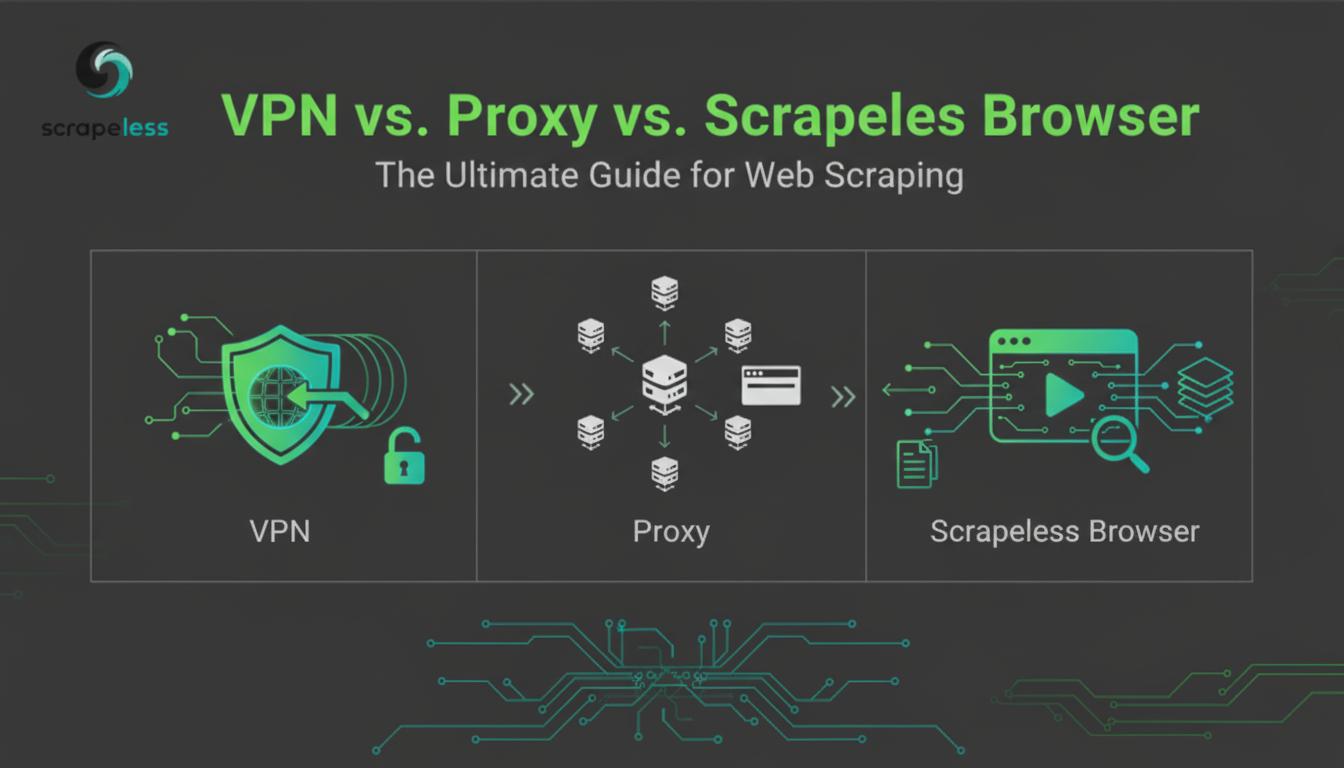
This comprehensive guide will dissect the core differences between a Virtual Private Network (VPN) and a Proxy server, and introduce a modern, specialized solution: the Scrapeless Browser.
1. Defining the Intermediaries: VPN and Proxy
To understand which tool is best for your needs, it is crucial to first establish a clear definition of each technology.
Virtual Private Network (VPN)
A VPN creates a secure, encrypted tunnel between your device and a remote server operated by the VPN provider. All your internet traffic is routed through this tunnel, making it appear as if you are browsing from the server's location.
"VPNs encrypt and anonymize traffic... they have broader applications and control incoming traffic, unlike proxies." [1]
The primary function of a VPN is to provide comprehensive privacy and security by encrypting all data transmitted from your device. This operation occurs at the Network Layer (Layer 3/4 of the OSI model) [2], meaning it affects every application on your operating system.
Proxy Server
A proxy server acts as a simple relay or gateway between your device and the target website. When you use a proxy, your request is sent to the proxy server, which then forwards it to the destination. The target server sees the request as originating from the proxy's IP address, not yours.
Unlike a VPN, a proxy operates at the Application Layer (Layer 7 of the OSI model) [2]. This means a proxy only handles traffic from the specific application configured to use it, such as a web browser or a dedicated scraping script. Crucially, most proxies do not offer built-in encryption, though HTTPS proxies do encrypt the connection between the client and the proxy.
2. VPN vs. Proxy: A Comparison for Web Scraping
For general internet use, a VPN is the superior choice for privacy and security. However, when the goal is efficient, large-scale data extraction, the calculus changes significantly.
| Aspect | Proxy Server | VPN | Rationale for Scraping |
|---|---|---|---|
| OSI Layer | Application Layer (L7) | Network Layer (L3/L4) | Proxy wins: Offers granular, application-specific control. |
| Encryption | None (HTTP) or Client-to-Proxy (HTTPS) | Full End-to-End | Proxy wins: Encryption overhead is unnecessary and slows down scraping. |
| Performance | Faster | Slower | Proxy wins: Lack of encryption/decryption makes data transfer quicker. |
| Granularity | Application-specific; easy to rotate IPs per request. | OS-wide; difficult to rotate IPs programmatically. | Proxy wins: Essential for distributing load and avoiding blocks. |
| Cost | Often cheaper, with pay-as-you-go options. | Generally more expensive, bundled with unnecessary features. | Proxy wins: Better ROI for high-volume IP usage. |
| Integration | Direct integration into HTTP clients and scraping frameworks. | Requires OS-level software, making programmatic control difficult. | Proxy wins: Designed for easy integration into custom scripts. |
The consensus among data professionals is clear: proxies are the preferred tool for web scraping [3]. Their application-level control and superior speed are perfectly aligned with the requirements of high-volume data collection.
3. The Modern Challenge: Anti-Bot Systems
While proxies solve the IP masking and speed problems, modern web scraping faces a new, more complex hurdle: sophisticated anti-bot and anti-scraping technologies. Websites now employ advanced techniques like CAPTCHAs, browser fingerprinting, and behavioral analysis to detect and block automated traffic.
Even with a rotating proxy pool, a simple HTTP request from a script can be easily identified and blocked. This is where the need for a more intelligent, integrated solution arises.
4. The Next Evolution: Introducing the Scrapeless Browser
The Scrapeless Browser represents the next generation of web scraping infrastructure, designed to overcome the limitations of traditional proxies and the challenges posed by modern anti-bot systems.
A Scrapeless Browser is not just a proxy; it is a fully managed, headless browser environment that combines several critical functions into a single, seamless service:
- Automatic Proxy Management: It automatically routes requests through a massive pool of high-quality, rotating residential and datacenter proxies, ensuring a fresh IP for every request when needed.
- Anti-Bot Evasion: It handles complex anti-bot measures, including browser fingerprinting, header manipulation, and automatic retries. It can even handle challenging scenarios like bypassing Cloudflare challenges [4].
- Headless Browser Execution: It executes JavaScript and renders pages just like a real user's browser, which is essential for scraping modern, dynamic websites built with frameworks like React or Vue.
- Simplified Integration: Instead of managing complex proxy lists and browser automation frameworks (like Puppeteer or Selenium) yourself, you interact with a simple API. This drastically reduces development time and maintenance overhead. It also offers seamless integration with tools like Cursor [8], allowing for a highly efficient and collaborative data extraction workflow.
For developers and businesses focused on reliable data extraction, the Scrapeless Browser is a powerful alternative that abstracts away the most frustrating aspects of web scraping. It allows you to focus on the data, not the infrastructure.
5. Conclusion: Choosing the Right Tool
The choice between a VPN, a Proxy, and a Scrapeless Browser depends entirely on your objective:
- Choose a VPN for general online privacy, security, and encrypting all traffic on your device [5].
- Choose a Proxy for simple IP masking on a specific application, where speed is paramount and encryption is not a concern.
- Choose a Scrapeless Browser for professional, large-scale web scraping and data extraction from anti-bot protected websites. It is the specialized tool for the job, combining the benefits of proxies with advanced anti-detection capabilities.
To learn more about advanced data extraction techniques and tools, explore our resources on Web Scraping Tools [6] and our dedicated solutions for platforms like Shopee [7]. You can also see how modern AI tools are being integrated into the process, such as web scraping with Perplexity AI [9].
References
[1] AWS: What's the Difference Between a Proxy and a VPN?
[2] GeeksforGeeks: Difference between Application Security and Network Security
[3] ZenRows: 7 Web Scraping Best Practices You Must Be Aware of
[4] Fortinet: Proxy vs. VPN: What Is the Difference?
[5] CNET: VPN vs. Proxy vs. Tor: What's the Difference?
At Scrapeless, we only access publicly available data while strictly complying with applicable laws, regulations, and website privacy policies. The content in this blog is for demonstration purposes only and does not involve any illegal or infringing activities. We make no guarantees and disclaim all liability for the use of information from this blog or third-party links. Before engaging in any scraping activities, consult your legal advisor and review the target website's terms of service or obtain the necessary permissions.