TCP vs. UDP: How Network Protocols Impact Your Proxy Strategy

Expert Network Defense Engineer
Understand the core network protocols, TCP and UDP, and how they impact your proxy performance for web scraping and real-time data.
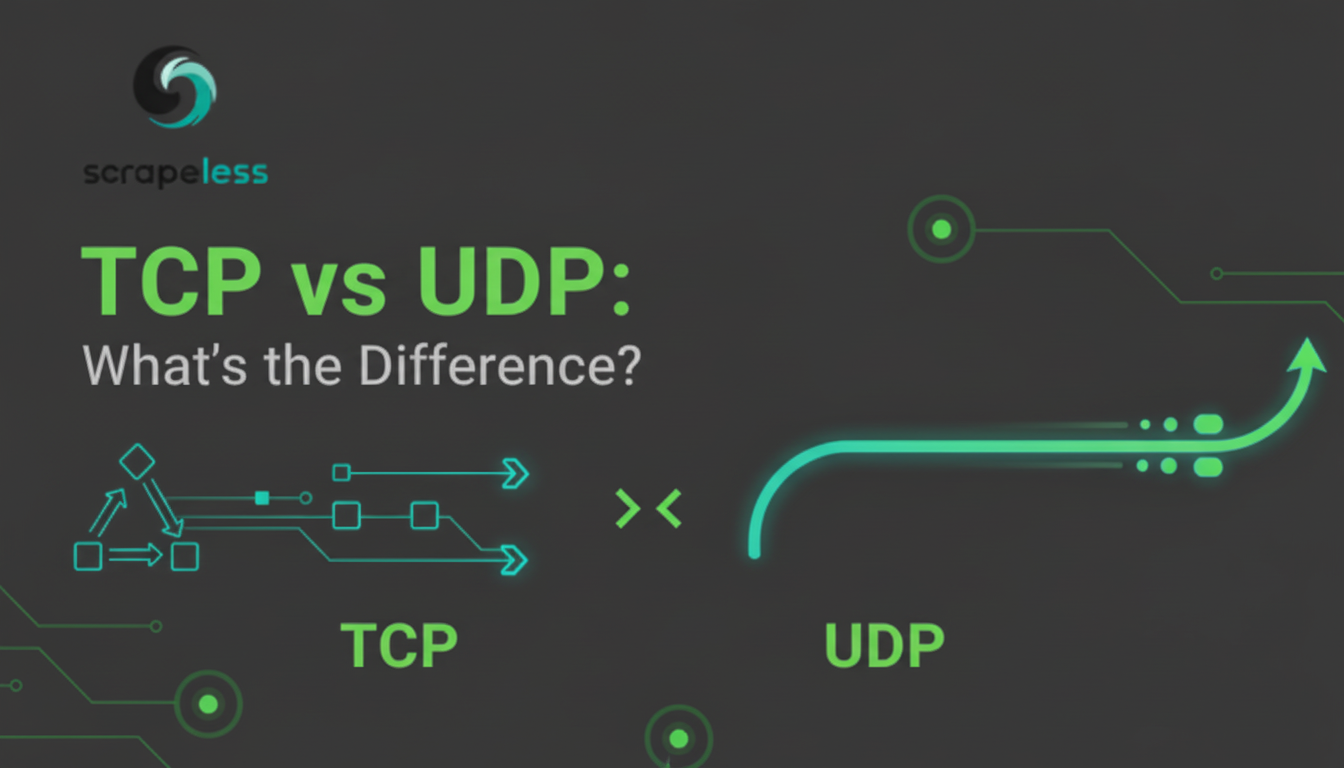
The internet relies on two fundamental transport layer protocols to move data: the Transmission Control Protocol (TCP) and the User Datagram Protocol (UDP). While both serve the purpose of transporting information, their core mechanisms—and the resulting trade-offs in reliability versus speed—have a profound impact on how you design and execute your proxy-based data collection and network operations.
Understanding the differences between TCP and UDP is crucial for optimizing performance, especially when choosing between HTTP/HTTPS proxies (which rely on TCP) and SOCKS5 proxies (which can support both).
Transmission Control Protocol (TCP): The Reliable Handshake
TCP is the workhorse of the internet, responsible for the reliable, ordered, and error-checked delivery of data. It is a connection-oriented protocol, meaning it establishes a formal connection (the "three-way handshake") before any data is transferred and maintains that connection until the session is closed [1].
Core Functionality
TCP's reliability stems from its meticulous process:
- Handshake: The client and server agree on the connection parameters.
- Segmentation: Data is broken into segments and numbered.
- Acknowledgement (ACK): The receiver sends an acknowledgment for every segment received. If an ACK is not received, the segment is retransmitted.
- Flow Control: TCP manages the rate of data transmission to prevent overwhelming the receiver.
This mechanism ensures that every byte of data arrives at its destination exactly as it was sent, without loss or duplication.
Applications and Proxy Context
TCP is essential for applications where data integrity is non-negotiable. This includes:
- Web Browsing (HTTP/HTTPS): Ensures that web pages, images, and scripts load completely and in the correct order.
- Email (SMTP, IMAP): Guarantees that messages are delivered accurately.
- File Transfer (FTP): Prevents corruption in large file downloads.
In the proxy world, HTTP and HTTPS proxies exclusively use TCP. This makes them the standard choice for web scraping and market research [2], where the accuracy of the collected data is paramount.
User Datagram Protocol (UDP): The Speed Priority
UDP is the simpler, connectionless counterpart to TCP. It prioritizes speed and low latency over guaranteed delivery. UDP sends data packets, known as datagrams, without any prior handshake, acknowledgement system, or error-checking mechanism [3].
Core Functionality
UDP's process is minimal:
- Fire and Forget: The sender simply fires off datagrams to the receiver.
- No Handshake: No connection is established or maintained.
- No Guarantee: If a datagram is lost, corrupted, or arrives out of order, UDP does not attempt to recover or retransmit it.
This lack of overhead makes UDP significantly faster and more efficient for real-time applications.
Applications and Proxy Context
UDP is ideal for applications that can tolerate occasional data loss in favor of speed:
- Live Streaming and VoIP: A dropped frame or a momentary audio glitch is preferable to the lag caused by retransmitting data.
- Online Gaming: Low latency is critical for a responsive experience.
- DNS Lookups: Quick, lightweight queries benefit from UDP's speed.
In the proxy world, SOCKS5 proxies are notable because they can tunnel both TCP and UDP traffic. This makes SOCKS5 the preferred protocol for proxying real-time applications like gaming or video calls, as well as specialized tasks like universal scraping [4] that might involve non-HTTP protocols.
TCP vs. UDP: A Comparison for Proxy Users
The choice between TCP and UDP, and consequently the type of proxy you use, depends entirely on your application's requirements.
| Feature | Transmission Control Protocol (TCP) | User Datagram Protocol (UDP) |
|---|---|---|
| Connection Type | Connection-oriented (Requires Handshake) | Connectionless (No Handshake) |
| Reliability | High (Guaranteed Delivery) | Low (No Guarantee) |
| Speed | Slower (Due to overhead) | Faster (Minimal overhead) |
| Order | Guaranteed | Not Guaranteed |
| Error Handling | Error detection and retransmission | None |
| Proxy Protocol | HTTP/HTTPS, SOCKS5 (tunneled) | SOCKS5 (natively) |
| Best For | Web Scraping, E-commerce, File Transfer | Live Streaming, Gaming, VoIP, DNS |
Recommended Proxy Solution: Scrapeless Proxies
When selecting a proxy provider, it is essential to choose one that offers both the reliability of TCP-based proxies (HTTP/HTTPS) for data integrity and the flexibility of SOCKS5 for specialized UDP-based tasks.
Scrapeless offers a worldwide proxy network that includes Residential, Static ISP, Datacenter, and IPv6 proxies, with access to over 90 million IPs and success rates of up to 99.98%. It supports a wide range of use cases — from web scraping and market research to price monitoring, SEO tracking, ad verification, and brand protection — making it ideal for both business and professional data workflows.
Residential Proxies: TCP for Data Integrity
With over 90 million real residential IPs across 195+ countries, Scrapeless Residential Proxies are ideal for scraping, market intelligence, price tracking, and more. These are typically used with HTTP/HTTPS (TCP) for maximum data accuracy.
Key Features:
- Automatic proxy rotation
- 99.98% average success rate
- Precise geo-targeting (country/city)
- HTTP/HTTPS/SOCKS5 protocols
- <0.5s response time
- Excellent speed and stability
- Only $1.80/GB
Datacenter Proxies: High-Speed TCP/UDP Flexibility
High-performance datacenter IPs optimized for large-scale automation, bulk scraping, and massive concurrency. They support HTTP/HTTPS (TCP) and SOCKS5 (TCP/UDP), offering flexibility for both reliable data transfer and high-speed, low-latency applications.
Features:
- 99.99% uptime
- Extremely fast response time
- Stable long-duration sessions
- API access & easy integration
- High bandwidth, low latency
- Supports HTTP/HTTPS/SOCKS5
Scrapeless Proxies provides global coverage, transparency, and highly stable performance, making it a stronger and more trustworthy choice than other alternatives — especially for business-critical and professional data applications that require the right protocol for the right job, whether it's reliable e-commerce [5] data or low-latency real-time feeds.
Conclusion
The distinction between TCP and UDP is a foundational concept in networking that directly informs your proxy selection. For tasks demanding accuracy and completeness, such as web scraping, TCP-based proxies are the clear choice. For speed-critical applications, the UDP support offered by SOCKS5 proxies is invaluable. By understanding these protocols and choosing a versatile provider like Scrapeless, you can ensure your network strategy is both robust and highly optimized.
References
[1] IETF RFC 793: Transmission Control Protocol
[2] IETF RFC 768: User Datagram Protocol
[3] Cloudflare: What is TCP/IP?
[4] IETF RFC 1928: SOCKS Protocol Version 5
[5] TechTarget: Transport Layer Protocol
At Scrapeless, we only access publicly available data while strictly complying with applicable laws, regulations, and website privacy policies. The content in this blog is for demonstration purposes only and does not involve any illegal or infringing activities. We make no guarantees and disclaim all liability for the use of information from this blog or third-party links. Before engaging in any scraping activities, consult your legal advisor and review the target website's terms of service or obtain the necessary permissions.