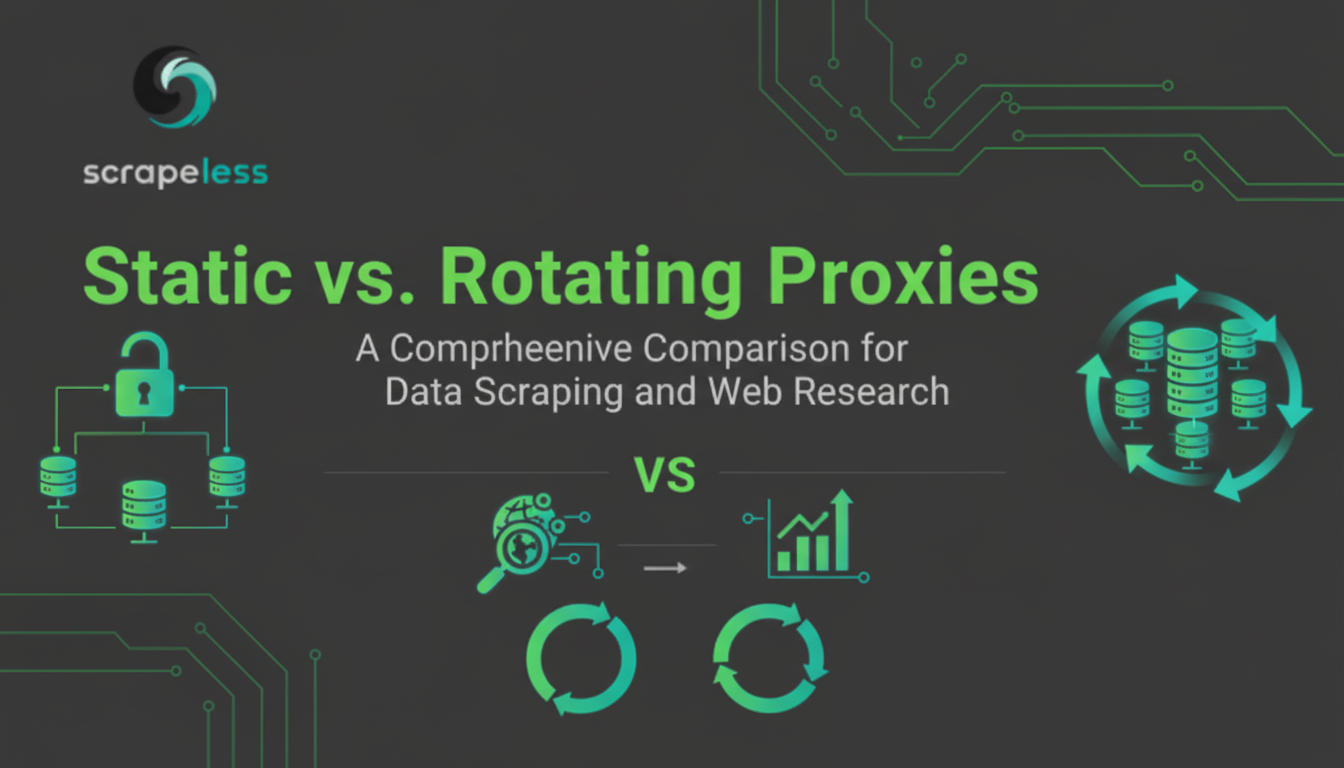
Static vs. Rotating Proxies: A Comprehensive Comparison for Data Scraping and Web Research

Expert Network Defense Engineer
In the realm of web data collection and online anonymity, proxy servers are indispensable tools. They act as a critical intermediary, routing client requests through a different IP address to mask the user's identity and location. However, not all proxies are created equal. The choice between a static proxy and a rotating proxy is a fundamental decision that dictates the success, speed, and cost-effectiveness of any web research or data scraping operation.
This article provides a detailed comparison of static and rotating proxies, outlining their core mechanics, advantages, disadvantages, and optimal use cases to help you select the right solution for your specific needs.
The Role of Proxy Servers in Web Data Collection
A proxy server's primary function is to serve as a gateway between a client (your computer or scraping bot) and the target website. This intermediary role is essential for overcoming common web restrictions:
- Anonymity and Identity Masking: By replacing your real IP address with the proxy's IP, you conceal your true location and identity, preventing the target website from tracking your activity back to its source.
- Bypassing Restrictions: Websites often employ blocking technologies—such as CAPTCHAs, temporary IP bans, or outright refusal to load pages—when they detect high-volume requests or traffic from specific geographic regions. Proxies route traffic through IP addresses that appear to be legitimate web visitors, effectively bypassing these blocks.
Understanding Static Proxies
A static proxy, also commonly referred to as a Static Residential Proxy or Dedicated Proxy, is characterized by a fixed IP address that does not change over time. These IP addresses are typically sourced from data centers or Internet Service Providers (ISPs) and are leased or purchased for long-term use.
Advantages of Static Proxies
- Speed and Performance: Static proxies generally offer superior speed because the connection involves only one 'hop' between the requestor and the target website. They often utilize high-bandwidth data center infrastructure.
- Longevity and Consistency: The ability to keep the same IP address for an extended period is a significant advantage for tasks requiring persistent identity, such as managing multiple social media accounts or maintaining a long-term login session.
- Predictability: The fixed nature of the IP makes it easier to manage and troubleshoot, as the source of the request is always known.
Disadvantages of Static Proxies
- Higher Block Risk on Sophisticated Sites: If a static IP sends too many requests to a highly sophisticated website (like a major e-commerce platform), it can be easily identified and permanently blocked.
- Limited Geographic Scope: While they can be geographically diverse, the supply of static IPs may not cover all the granular city or state-level locations required for highly specific geo-targeting.
Understanding Rotating Proxies
A rotating proxy, also known as a Dynamic Proxy or Rotating Residential Proxy, automatically assigns a new IP address to the user based on a predefined schedule. This rotation can occur after every request, after a set time interval (e.g., every 60 seconds), or when the current IP is no longer available. The IP addresses are typically sourced from a large pool of residential or mobile devices.
Advantages of Rotating Proxies
- Superior Block Evasion: The combination of IP rotation and the use of legitimate residential/mobile IPs makes rotating proxies extremely difficult to detect and block. Each request can come from a different IP, mimicking the behavior of millions of different real users.
- Massive Scale and Geographic Granularity: Rotating proxies pull from pools containing millions of IP addresses, enabling precise geographic targeting down to the city or state level, which is crucial for localized data collection.
- Ideal for High-Volume Scraping: They are the preferred choice for large-scale data scraping operations where a high volume of requests is necessary to cover a vast amount of data.
Disadvantages of Rotating Proxies
- Slower Performance: Rotating proxies are generally slower than static proxies. The process involves an extra 'hop' through a gateway proxy server to manage the IP rotation, and the underlying residential/mobile connections often have lower bandwidth than data centers.
- Higher Cost: The infrastructure required to source, maintain, and manage a pool of millions of residential and mobile IP addresses makes rotating proxies more expensive.
- Session Management Challenges: The constantly changing IP makes it difficult to maintain long-term, sticky sessions (like a logged-in account) unless the proxy provider offers a specialized session management feature.
Static vs. Rotating Proxies: Key Differences
The following table summarizes the critical distinctions between the two proxy types:
| Feature | Static Proxies | Rotating Proxies |
|---|---|---|
| IP Source | Data Centers or ISPs | Residential or Mobile Devices |
| IP Address | Fixed and dedicated | Changes with every request or time interval |
| Speed | Faster (Fewer hops, high bandwidth) | Slower (Extra hop, lower bandwidth pool) |
| Block Risk | Higher on sophisticated sites | Very low (Harder to detect) |
| Cost | Generally lower | Generally higher |
| Best For | Tasks requiring a consistent identity | High-volume, anonymity-critical scraping |
Optimal Use Cases
The best proxy type depends entirely on the complexity of the target website and the requirements of the task.
Static Proxy Use Cases
Static proxies are best suited for tasks that prioritize speed and require a consistent, long-term IP identity:
- Social Media Account Management: Managing multiple accounts where a consistent login IP is necessary to avoid triggering security flags.
- Ad Verification: Ensuring that advertisements are being displayed correctly to users in specific geographic locations.
- Reputation Management: Collecting data on brand mentions, customer reviews, and press coverage where a fixed IP is sufficient for data collection.
- Network Penetration Testing: Facilitating the speed and anonymity required for security assessments.
Rotating Proxy Use Cases
Rotating proxies are the optimal choice for large-scale, complex data collection where anonymity and block evasion are the top priorities:
- eCommerce Competitive Market Analysis: Collecting vast amounts of pricing, inventory, and product data from major online retailers that employ aggressive anti-scraping measures.
- Business Intelligence and Sensitive Data Scraping: Gathering sensitive public data, such as professional profiles or financial information, where the scale and anonymity of residential IPs are required to avoid immediate detection and blocking.
- Search Engine Results Page (SERP) Scraping: Collecting search results from different locations or at a high volume without being blocked by the search engine.
⭐ Scrapeless Proxies (Highly Recommended)
If you’re looking for a more transparent, globally distributed, and consistently reliable proxy provider, Scrapeless Proxies is a far better choice.
Scrapeless offers a worldwide proxy network that includes Residential, Static ISP, Datacenter, and IPv6 proxies, with access to over 90 million IPs and success rates of up to 99.98%. It supports a wide range of use cases — from web scraping and market research to price monitoring, SEO tracking, ad verification, and brand protection — making it ideal for both business and professional data workflows.
Residential Proxies
With over 90 million real residential IPs across 195+ countries, Scrapeless Residential Proxies are ideal for scraping, market intelligence, price tracking, and more.
Key Features:
- Automatic proxy rotation
- 99.98% average success rate
- Precise geo-targeting (country/city)
- HTTP/HTTPS/SOCKS5 protocols
- <0.5s response time
- Excellent speed and stability
- Only $1.80/GB
IPv6 Proxies
High-speed, dedicated IPv6 proxies designed for heavy-duty scraping tasks.
Features:
- HTTP(S) & SOCKS5 support
- Automatic IPv6 proxy rotation
- High anonymity with dedicated IPs
- 50M+ premium IPv6 pool
- CCPA & GDPR compliant
- Pay-per-GB billing
Datacenter Proxies
High-performance datacenter IPs optimized for large-scale automation, bulk scraping, and massive concurrency.
Features:
- 99.99% uptime
- Extremely fast response time
- Stable long-duration sessions
- API access & easy integration
- High bandwidth, low latency
- Supports HTTP/HTTPS/SOCKS5
Static ISP Proxies
Ideal for eCommerce account operations (eBay, PayPal, Amazon), long-term identity consistency, and low block risk.
Features:
- Real residential IPs
- 99.99% uptime
- High acceptance rates & low ban risk
- Geo-location targeting
- HTTP/HTTPS/SOCKS5 protocols
Scrapeless Proxies provides global coverage, transparency, and highly stable performance, making it a stronger and more trustworthy choice than Oculus Proxies — especially for business-critical and professional data applications.
Conclusion
The decision between static and rotating proxies boils down to a trade-off between speed/consistency and anonymity/scale.
If your project involves maintaining long-term sessions on less-complex websites, a static proxy offers the speed and reliability you need. However, for large-scale, high-volume data scraping from sophisticated, block-heavy targets, the superior anonymity and scale of a rotating proxy are essential for success. By understanding these core differences, you can make an informed choice that maximizes your data collection efficiency.
At Scrapeless, we only access publicly available data while strictly complying with applicable laws, regulations, and website privacy policies. The content in this blog is for demonstration purposes only and does not involve any illegal or infringing activities. We make no guarantees and disclaim all liability for the use of information from this blog or third-party links. Before engaging in any scraping activities, consult your legal advisor and review the target website's terms of service or obtain the necessary permissions.