SOCKS5 vs. HTTP Proxy: Key Differences for Web Scraping and Automation

Expert Network Defense Engineer
Boost your automation and scraping with Scrapeless Proxies — fast, reliable, and affordable.
Key Takeaways
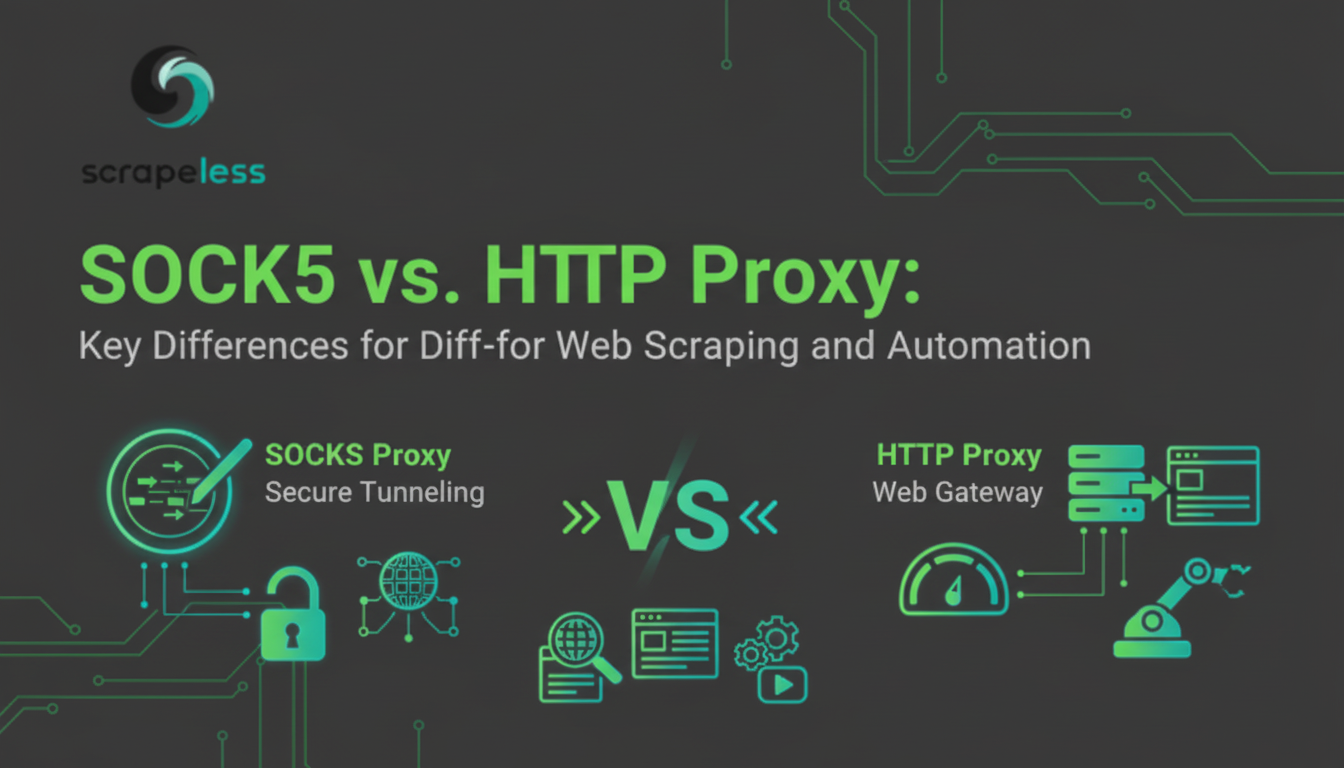
- HTTP Proxies operate at the Application Layer (Layer 7), interpreting and modifying web traffic (HTTP/HTTPS). They are ideal for web scraping, SEO monitoring, and content filtering.
- SOCKS5 Proxies operate at the Session Layer (Layer 5), acting as a neutral tunnel for all traffic types (TCP and UDP). They are better for P2P, streaming, gaming, and bypassing firewalls.
- Anonymity: SOCKS5 generally offers higher anonymity as it does not alter packet headers, but it lacks built-in encryption.
- Performance: HTTP proxies can use caching to speed up repeated web requests, while SOCKS5 excels in raw speed and versatility for non-web protocols.
Choosing the correct proxy type is a critical decision that impacts the performance, security, and efficiency of any web data collection or automation project. SOCKS and HTTP proxies are the two most common types, yet they serve fundamentally different technical needs. Understanding their core distinctions is essential for selecting the right tool to support your data-driven tasks.
In this comprehensive guide, we will compare SOCKS (specifically SOCKS5) and HTTP proxies, exploring their underlying mechanisms, advantages, and limitations to help you make an informed decision and scale your operations with confidence.
What is an HTTP Proxy?
An HTTP proxy, or Hypertext Transfer Protocol proxy, is designed to handle web traffic tied to HTTP or HTTPS. It operates at the Application Layer (Layer 7) of the OSI model. Because it functions at this high level, an HTTP proxy can interpret the data passing through it, allowing it to filter or modify data packets, such as request headers. This capability is what makes HTTP proxies excellent for tasks like web scraping, where you might need to adjust details like your user-agent or referer to mimic a real user.
A significant advantage of HTTP proxies is their ease of use and their ability to cache web data. By storing images, scripts, and entire pages, they can serve them more quickly on repeat visits, which saves time and bandwidth, especially in large-scale operations like Amazon data extraction.
However, the specialized nature of HTTP proxies is also their limitation. They are restricted to handling HTTP and HTTPS traffic and cannot process other protocols like UDP or non-web TCP connections in the same flexible way that SOCKS5 proxies can. This makes them unsuitable for applications like gaming, streaming, or P2P file sharing.
Common Use Cases for HTTP Proxies:
- Web Scraping: Efficiently extracting static web data.
- SEO Monitoring: Tracking keyword rankings and SERP changes, which is crucial for understanding Google Search results.
- Content Filtering: Blocking or unblocking specific websites or content based on interpreted data.
- Ad Verification: Ensuring accurate ad placements across different geographical locations.
What is a SOCKS5 Proxy?
A SOCKS5 proxy (Socket Secure 5) operates at the Session Layer (Layer 5) of the OSI model. This lower-level operation is the key to its versatility, as it allows it to handle all kinds of network traffic, including both the Transmission Control Protocol (TCP) and the User Datagram Protocol (UDP).
Unlike an HTTP proxy, a SOCKS5 proxy does not interpret the web data or alter the packet headers. It simply relays the data packets between the client and the server, acting as a neutral tunnel. This "pass-through" nature provides a higher degree of anonymity, as websites see only the proxy’s IP address and fewer clues that a proxy is being used.
The support for UDP is particularly important for real-time, low-latency applications such as online gaming, live streaming, and VoIP calls. For instance, when learning how to scrape Google Trends, a SOCKS5 proxy might be preferred for its speed and ability to handle various connection types, though an HTTP proxy is often sufficient for standard HTTP requests.
A crucial point to remember is that SOCKS5 does not encrypt your data by default. Its primary function is routing. For enhanced security, especially when dealing with sensitive information, it is highly recommended to pair SOCKS5 with a VPN or SSH tunnel. This combination offers the flexibility of SOCKS5 with the security of an encrypted connection.
Common Use Cases for SOCKS5 Proxies:
- Streaming and Media Access: Low-latency connections for buffer-free playback.
- P2P and Large File Transfers: High-speed data flow with minimal restrictions.
- Bypassing Network Restrictions: Navigating firewalls and regional blocks for tasks like Python-based data extraction.
- Gaming and VoIP: Reliable performance for real-time, UDP-dependent applications.
Key Differences: SOCKS5 vs. HTTP Proxy
The table below summarizes the core technical and functional differences between the two proxy types:
| Feature | HTTP Proxy | SOCKS5 Proxy |
|---|---|---|
| OSI Layer | Application Layer (Layer 7) | Session Layer (Layer 5) |
| Protocol Support | HTTP and HTTPS only | TCP and UDP (all protocols) |
| Data Handling | Interprets, filters, and modifies headers | Relays data as-is (protocol-agnostic) |
| Anonymity | Lower (can be detected via header analysis) | Higher (fewer tell-tale signs) |
| Encryption | Can be encrypted (HTTPS) | No built-in encryption (requires VPN/SSH) |
| Best For | Web scraping, SEO, content filtering | Streaming, P2P, gaming, bypassing firewalls |
The distinction in their operating layer is the most fundamental difference. As detailed in the Internet Engineering Task Force (IETF) RFC 1928 SOCKS Protocol Version 5, SOCKS is designed to provide a framework for client-server applications to traverse IP network firewalls, supporting both TCP and UDP domains. Conversely, HTTP proxies are application-specific, focusing solely on the web protocol.
When to Choose Scrapeless Proxies
For any serious data collection or automation project, a reliable proxy provider is non-negotiable. Scrapeless offers a range of high-performance proxy solutions, including both SOCKS5 and HTTP options, designed for high success rates and seamless integration, whether you are using a standard browser or an AI-powered scraping browser.
Scrapeless proxies are built to handle the demands of modern web scraping, offering:
- High Anonymity: Residential and ISP proxies that ensure your requests look like those of a real user.
- Global Coverage: Access to millions of IPs worldwide to bypass geo-restrictions effectively.
- Versatility: Support for both HTTP(S) and SOCKS5 protocols to cover all your use cases, from simple browsing to complex P2P transfers.
If you are looking to scale your operations, Scrapeless provides the infrastructure you need.
Conclusion
The choice between SOCKS5 and HTTP proxies ultimately depends on your specific goals.
If your primary focus is on standard web browsing, SEO monitoring, or large-scale web scraping that relies on HTTP/HTTPS, the HTTP proxy is the simpler, often faster choice due to its caching capabilities.
If your tasks extend beyond the web—involving real-time data, P2P file sharing, gaming, or the need to bypass strict firewalls—the SOCKS5 proxy is the clear winner due to its protocol-agnostic nature and support for UDP. While SOCKS5 offers greater versatility and anonymity, remember to layer on encryption for sensitive data.
By understanding these technical nuances, you can select the optimal proxy solution to enhance your online performance, privacy, and data collection capabilities. For further reading on the technical aspects of network communication, you can consult resources like the OSI Model documentation Wikipedia or a detailed proxy comparison guide Nimbleway.
Frequently Asked Questions (FAQ)
Q1: Does SOCKS5 provide encryption?
A: No, SOCKS5 does not provide encryption by default. It is a routing protocol that simply relays data packets. To secure your traffic, you must pair a SOCKS5 proxy with an encryption method like a VPN or an SSH tunnel.
Q2: Can I use an HTTP proxy for gaming or streaming?
A: HTTP proxies are generally not recommended for gaming or streaming. These activities often rely on the UDP protocol for low-latency, real-time data transfer, which HTTP proxies do not natively support. SOCKS5 proxies are the better choice as they support both TCP and UDP.
Q3: Which proxy type is better for web scraping?
A: For basic, large-scale web scraping of static content, an HTTP proxy is often sufficient and can be faster due to caching. However, for scraping dynamic sites, or when you need to handle diverse connection types or bypass sophisticated blocks, a SOCKS5 proxy may offer more flexibility and higher anonymity. Many professional scraping tools, like those offered by Scrapeless, support both types.
Q4: What is the main difference between SOCKS4 and SOCKS5?
A: The main difference is protocol support and authentication. SOCKS4 only supports TCP connections and lacks a standard authentication method. SOCKS5 supports both TCP and UDP and includes built-in authentication methods, making it more versatile and secure.
Q5: What is the OSI model layer for each proxy?
A: The HTTP proxy operates at the Application Layer (Layer 7), which allows it to interpret the content of the request. The SOCKS5 proxy operates at the Session Layer (Layer 5), acting as a more neutral intermediary.
At Scrapeless, we only access publicly available data while strictly complying with applicable laws, regulations, and website privacy policies. The content in this blog is for demonstration purposes only and does not involve any illegal or infringing activities. We make no guarantees and disclaim all liability for the use of information from this blog or third-party links. Before engaging in any scraping activities, consult your legal advisor and review the target website's terms of service or obtain the necessary permissions.