5 Real-World Use Cases for Scrapeless LLM Chat Scraper: Brand Monitoring to Trend Detection

Advanced Data Extraction Specialist
TL;DR:
- AI answer engines now decide what users see before a single blue link loads. Scrapeless LLM Chat Scraper captures what ChatGPT, Perplexity, Gemini, Copilot, Grok, and Google's AI surfaces actually return for a prompt, turning black-box AI replies into structured rows.
- Brand monitoring becomes measurable. Track how each AI engine positions your product, in what order, and which sources it cites to justify the recommendation.
- Competitive and trend signals surface early. Map which domains LLMs lean on across engines, and catch content gaining AI authority before it ranks in classic search.
- Prompt phrasing and source authority are testable. Compare how different query framings change your visibility, and build a ranked map of the sources each engine trusts for a topic.
- Free to start. New Scrapeless accounts include a free trial — sign up at app.scrapeless.com.
What Is the Scrapeless LLM Chat Scraper?
Scrapeless LLM Chat Scraper sends a prompt to a live AI engine and returns the answer, its citations, and the URLs behind them as structured JSON data. It reaches seven surfaces today: ChatGPT, Perplexity, Gemini, Copilot, Grok, Google AI Overview, and Google AI Mode. Each runs as its own actor — scraper.chatgpt, scraper.perplexity, scraper.gemini, and so on — so one integration covers every engine.
A general-purpose web scraper crawls static HTML that already sits on a page. An AI answer engine generates its response on demand, per user, and never exposes that text as a crawlable document. The LLM Chat Scraper closes that gap: it submits the query the way a user would and captures what the model wrote back, including the sources it leaned on. The product home for this capability is the Universal Scraping API, and for a primer on the category there is a full explainer on what an LLM scraper is.
Why LLM Scraping Matters in 2026
Search rankings are no longer the only path to visibility. Users increasingly ask ChatGPT, Perplexity, and Copilot a direct question instead of scanning ten blue links, and the engine answers with a short list of named tools and the sources behind them. A brand absent from that answer is invisible to the user who asked.
General-purpose web scrapers and proxy APIs were built to read websites. Neither can send a prompt to an AI engine and record what comes back, because that response is generated live and tied to the session. LLM Chat Scraper is built for exactly that surface, which makes the AI answer layer measurable the way search rankings have been for two decades.
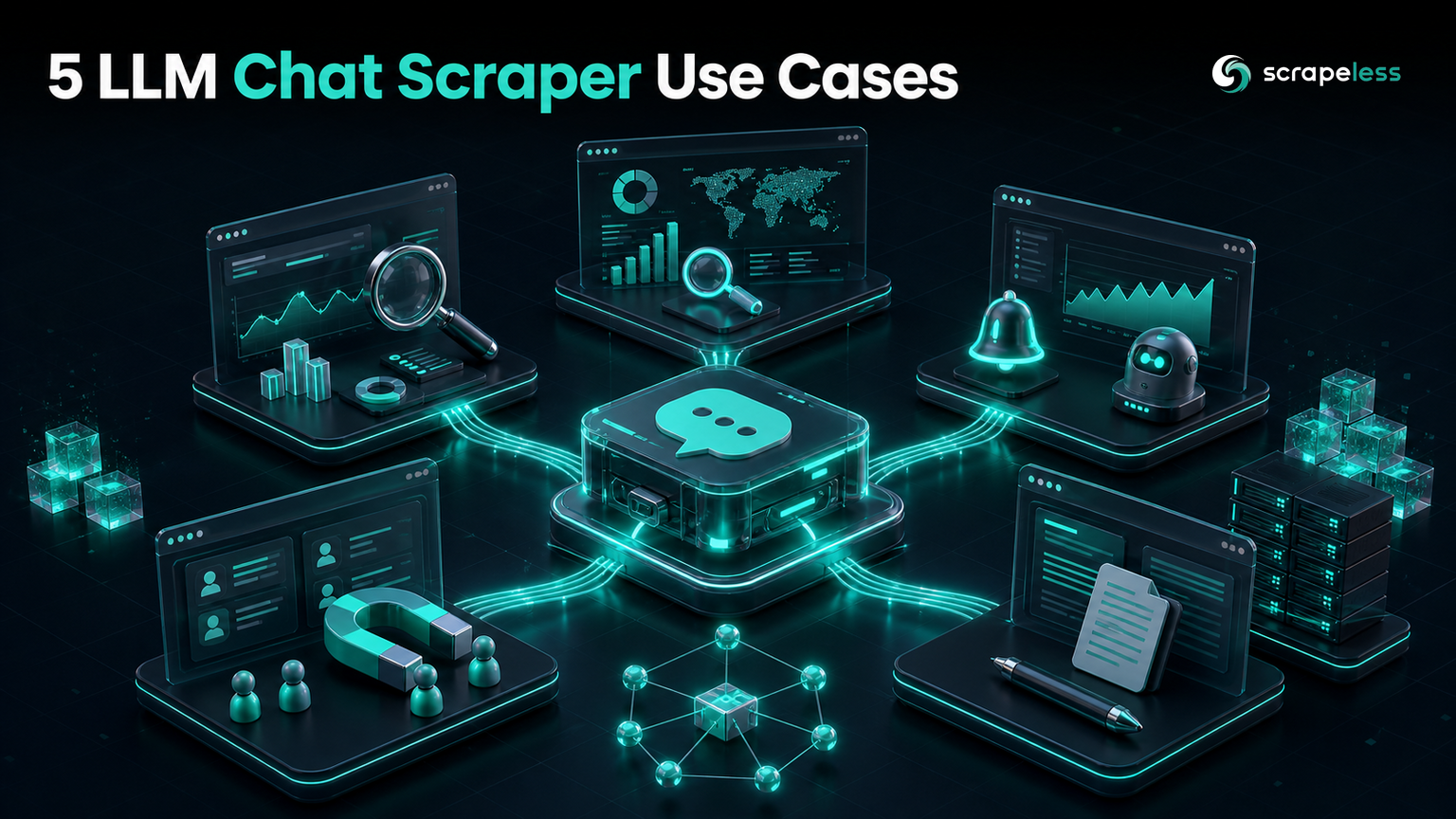
The 5 Use Cases
Each use case below runs on the same primitive: send a prompt to an engine, read back the answer and its citations. What changes is the question you ask and what you do with the result.
1. Brand Monitoring Across AI Answer Engines
The problem. Marketing teams track Google rankings, Reddit threads, and review sites, but few watch what ChatGPT, Perplexity, and Gemini say about their brand. Those engines already recommend tools in your category every day, and the positioning stays invisible unless you capture it.
The approach. Schedule a daily run of your core brand queries against each engine. A single request looks like this:
json
{
  "actor": "scraper.chatgpt",
  "input": {
    "prompt": "Best project management software for remote teams",
    "country": "US"
  }
}
From each response, pull:
- Which tools the engine names, and whether yours is among them
- The order they appear in (position inside the answer)
- The citations behind each recommendation — which domains the engine trusts
- The exact wording the engine uses to describe your product
Run the same prompt on a schedule and the shifts become a time series: a product that moves from unmentioned to mid-list, or a competitor the engine starts citing more heavily. That feed is the raw material for a brand-visibility program — the same idea behind tracking brand visibility across AI answer engines.
2. Competitive Intelligence: Which Sources Dominate AI Responses?
The problem. You want to know how the engines describe your competitive set: who gets named, how often, and which sources the model cites when it recommends them.
The approach. Point an engine at a head-to-head prompt and read the citations, not only the prose. Perplexity returns explicit web results alongside its answer — call scraper.perplexity with "web_search": true and a prompt like "Compare the leading knowledge-management tools for distributed teams." For each tool the engine mentions, capture how often it appears across engines, which domains back it (the vendor's own site, third-party reviews, community forums), and which tools an engine skips entirely.
The gap that shows up most often is citation coverage: the products an engine recommends tend to be the ones with the most indexed, citable third-party material behind them. Reading the citation set tells you where to earn coverage, not just that you are behind.
3. Real-Time AI-Driven Trend Detection
The problem. By the time a topic trends on social platforms, the window has closed. The earlier signal is which sources the engines start citing together.
The approach. Send the same prompt to several engines — scraper.chatgpt, scraper.perplexity, and scraper.gemini — and intersect their citations. When the same few domains appear in every engine's answer for a topic, that content has become AI-canonical: the models treat it as authoritative before traditional search fully reflects it. Run the comparison on a schedule, and a newly shared citation across all three engines is an early authority signal worth acting on.
4. Prompt Optimization: A/B Testing Across Engines
The problem. Different phrasings of the same question return different answers. A "best X" query might omit you while an "X alternatives" query ranks you well. Which framings surface your product, and on which engines?
The approach. Hold the topic fixed and vary the phrasing, then run each variant across every engine. A problem-framed prompt ("How do I handle pagination in a large scraping job?") and a product-framed prompt ("Best tools to handle pagination in web scraping") often return different named tools and different citations. Compare, per variant: whether you are mentioned, in what position, and which sources the engine cites to back the answer. The phrasing that consistently surfaces your product is the one to write content against.
5. Content Aggregation: Build an "AI-Trusted Sources" Map
The problem. If you publish content, which sources actually get cited by AI systems for your topic? A ranked map of trusted sources shows where partnerships, PR, and guest content will move the needle.
The approach. Ask each engine to recommend sources for a category — for example, call scraper.perplexity with "What are the best sources for learning about residential proxies and web scraping?" — then repeat across engines and aggregate the citations. Count how often each domain appears and you have a ranked list of the sources AI systems lean on for that topic. From there: if your site ranks high, protect and promote it; if it is absent, the citation gap shows what kind of coverage is missing.
How to Implement These Use Cases
Every use case reduces to one synchronous call: POST a prompt to the execute endpoint and read the structured result. There is no task queue to poll — the response carries the answer and its citations directly.
Here is a minimal Python example using scraper.chatgpt:
python
import os
import requests

API_TOKEN = os.environ["SCRAPELESS_API_KEY"]  # set in your shell; never hardcode a key
ENDPOINT = "https://api.scrapeless.com/api/v2/scraper/execute"

payload = {
    "actor": "scraper.chatgpt",
    "input": {
        "prompt": "Best project management software for remote teams",
        "country": "US",
    },
}

resp = requests.post(
    ENDPOINT,
    headers={"x-api-token": API_TOKEN, "Content-Type": "application/json"},
    json=payload,
    timeout=180,
)
resp.raise_for_status()

result = resp.json()["task_result"]
print("Model:", result.get("model"))
print("Answer:", result["result_text"][:300])
for ref in result.get("content_references", []):
    print("-", ref["attribution"], ref["url"])
Get your API key on the free plan: app.scrapeless.com
The call returns a single envelope: status, a task_id, and a task_result object holding the answer text and its citations. The exact shape varies a little by engine — ChatGPT returns content_references, Perplexity returns web_results, Gemini returns citations — but the pattern is consistent:
json
// Schema reflects exactly what scraper.chatgpt returns from the execute endpoint. Field values are illustrative samples.
{
  "status": "success",
  "task_result": {
    "model": "gpt-5-3-mini",
    "prompt": "Best project management software for remote teams",
    "result_text": "Choosing the best project management software for remote teams depends on how the team works...",
    "content_references": [
      {
        "attribution": "example.com",
        "title": "Best Project Management Software for Remote Teams",
        "url": "https://example.com/best-remote-pm-software"
      }
    ],
    "products": [],
    "links": []
  }
}
Every actor follows the same request shape; the full per-engine parameter list lives in the LLM Chat Scraper documentation. Store the result text and citation list, and you have a row you can aggregate, diff, and chart.
What the Comparison Looks Like
Most data tools collect what already exists on the open web. The LLM Chat Scraper collects what AI engines generate in response to a prompt — a different source entirely.
| Tool category | What it does | Monitors AI answers? | Tracks brand mentions in AI? |
|---|---|---|---|
| General-purpose web scrapers | Crawl and parse static HTML from public pages | No | No — page content only, never AI responses |
| Proxy APIs | Route requests through residential or datacenter IPs | No | No — transport layer, no content logic |
| HTML-parsing / extraction tools | Convert fetched HTML into structured fields | No | No — extraction only, nothing queries an engine |
| Scrapeless LLM Chat Scraper | Submit prompts to AI engines, capture answers + citations | Yes | Yes — records what each engine says and cites |
General-purpose web scrapers, proxy APIs, and HTML-parsing tools all help you gather pages that already exist. The LLM Chat Scraper captures the generated answer layer on top of them, which is why it answers a question the others structurally cannot.
Pricing & Credit Calculation
Pricing is usage-based: you pay per task, with no fixed infrastructure, proxy subscriptions, or DevOps overhead. A task is one prompt sent to one engine, so cost scales directly with how many queries and engines you monitor. Light brand monitoring runs a few prompts a day; a full competitive-and-trend program runs more, across more engines. Current per-task rates by plan are on the pricing page.
How These Compose: Start Where It Matters Most
The five use cases stack rather than compete, and a realistic program starts with one and grows:
- Start with brand monitoring (Use Case 1). Pick a single brand query, run it daily across two engines for a week, and watch how your mentions move. It is the fastest signal and the easiest to act on.
- Add competitive context (Use Case 2). Once you see your own pattern, add a competitor-set query and compare side by side for positioning intelligence.
- Scale to trend detection (Use Case 3). If the competitive view pays off, expand to multi-engine citation intersection and catch content rising through AI before classic search.
- Optimize phrasing (Use Case 4). Test prompt variations to learn which framings surface your product, then write content against the ones that win.
- Build the source map (Use Case 5). Aggregate citations across engines into a ranked, quarterly view of the sources shaping AI perception of your market.
Most teams begin with brand monitoring because the payoff is immediate: track your mentions, understand positioning, and respond when an engine misreads your product. Add the rest as the business case justifies the extra spend.
Conclusion
Five use cases run on one primitive: send a prompt to an AI engine, capture the answer and its citations as structured data. Whether you track brand health, watch competitors, detect trends, test prompts, or map trusted sources, the LLM Chat Scraper gives you a measurable view of how AI engines perceive your market — a layer that crawlers and proxy APIs cannot reach. Start with brand monitoring, prove the value on one query, and expand from there.
Ready to Monitor Your Brand in AI?
Join our community to claim a free plan and connect with developers building AI-visibility pipelines: Discord · Telegram.
Sign up at app.scrapeless.com for free trial access, then adapt the prompts above to the brands, competitors, and regions your program needs.
FAQ
Q: Can I query all the supported engines at once?
Yes. Submit tasks to scraper.chatgpt, scraper.perplexity, scraper.gemini, scraper.copilot, scraper.grok, and the Google AI Overview and AI Mode actors in parallel. Each call is independent, so a single prompt can fan out across every engine and the results return separately.
Q: How often should I monitor my brand?
For active brand monitoring, a daily run gives you a usable time series. For trend detection, a few times a week is enough to catch shared citations forming. One-off competitive audits run on demand. Start light and increase frequency where the signal earns it.
Q: Can I export results to Slack, a spreadsheet, or a database?
Yes. Each response is structured JSON, so any tool that consumes JSON works. Fetch the result and write it to a database, a BI tool, or a sheet, or push it onward to a notification channel as part of your pipeline.
Q: What if an engine changes its answer between two runs?
That shift is the signal worth capturing, not noise. AI answers move as the underlying web and the models change. Running the same prompt over time is how you see your product appear, climb, or drop out of an engine's recommendations.
Q: Can I compare answers across countries?
Yes. Set "country" in the input (for example "US", "GB", or "DE"). Some engines serve region-specific results, so monitoring more than one market can reveal geographic differences in how your brand is positioned.
Q: Does this replace traditional SEO tools?
No, it complements them. SEO tools track where you rank on search engines; the LLM Chat Scraper tracks how AI engines describe and cite you. As more discovery shifts to AI-mediated answers, the two together give a fuller picture of visibility than either alone.
At Scrapeless, we only access publicly available data while strictly complying with applicable laws, regulations, and website privacy policies. The content in this blog is for demonstration purposes only and does not involve any illegal or infringing activities. We make no guarantees and disclaim all liability for the use of information from this blog or third-party links. Before engaging in any scraping activities, consult your legal advisor and review the target website's terms of service or obtain the necessary permissions.