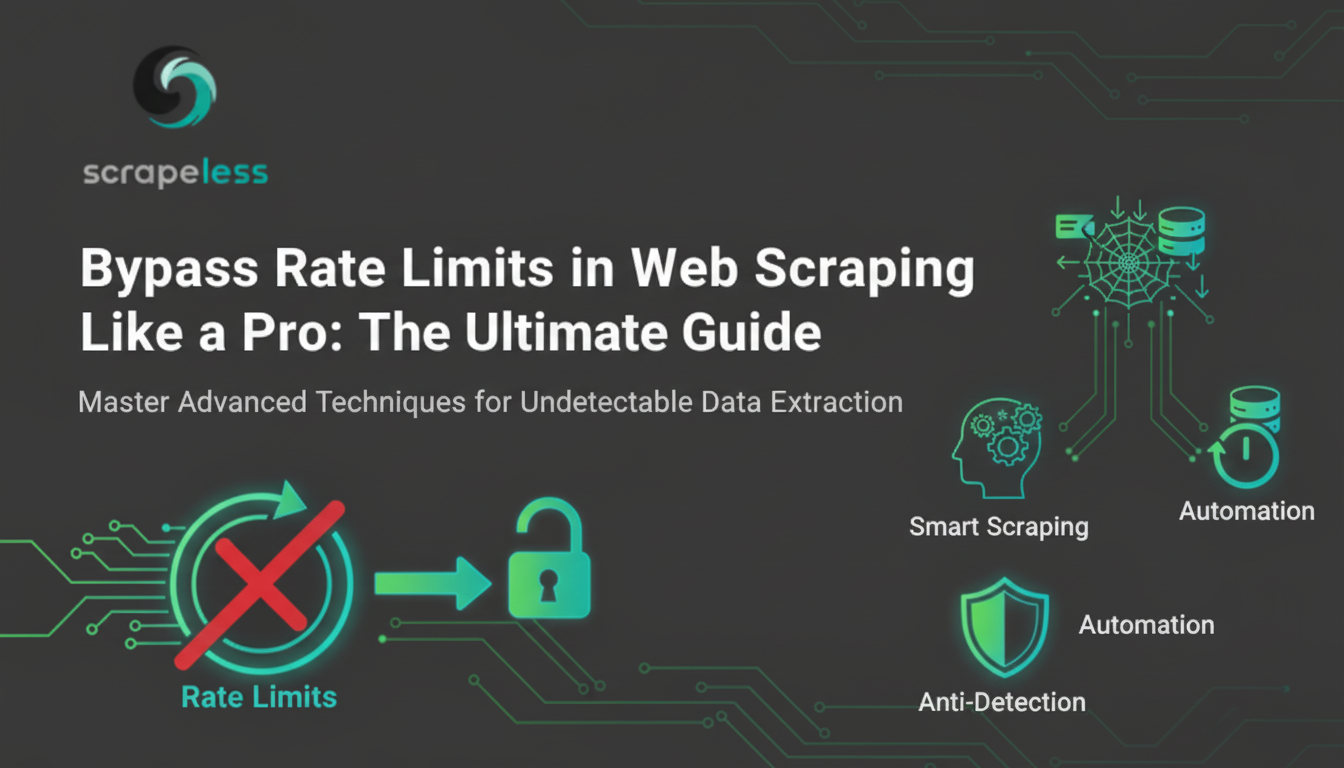
Bypass Rate Limits in Web Scraping Like a Pro: The Ultimate Guide

Expert Network Defense Engineer
Web scraping is a core technique for large-scale data collection, but it is constantly challenged by modern anti-bot systems. Among all defenses, rate limiting is one of the most common—and most frustrating—barriers scrapers encounter.
When a scraper sends too many requests in a short period, websites respond with HTTP 429: Too Many Requests, effectively throttling or blocking further access.
For professional scraping operations, understanding how rate limits work—and how to bypass them responsibly—is essential.
This guide explains rate limiting mechanisms and outlines proven, scalable strategies to bypass them efficiently.
What Is Rate Limiting in Web Scraping?
Rate limiting is a traffic control mechanism used by websites and APIs to restrict how frequently a client can send requests within a defined time window.
Its primary purposes include:
- Preventing server overload
- Mitigating abuse and DDoS attacks
- Protecting data and infrastructure
Once your scraper exceeds the allowed threshold, the server returns a 429 status code, signaling that requests must slow down or stop.
Common Types of Rate Limiting
Websites may enforce rate limits using one or more of the following methods:
-
IP-based rate limiting
Limits requests per IP address (the most common approach) -
API-based rate limiting
Restricts usage per API key or authenticated account -
Geographic rate limiting
Applies limits based on IP location (country, region) -
Session or cookie-based rate limiting
Tracks behavior using cookies managed by WAFs like Cloudflare or Akamai
Understanding which mechanism is in play is critical for choosing the right bypass strategy.
Proven Strategies to Bypass Rate Limits
Bypassing rate limits effectively requires a multi-layered approach that distributes traffic and mimics real human behavior.
1. Add Intelligent Request Delays
The simplest—and most ethical—technique is slowing down your scraper.
-
Fixed delays
pythontime.sleep(5)Easy to implement, but predictable.
-
Randomized delays (recommended)
pythontime.sleep(random.uniform(2, 6))Introduces natural variability, making detection harder.
Random delays help simulate real user browsing patterns and reduce the risk of triggering automated defenses.
2. Rotate and Randomize HTTP Headers
Many scrapers get blocked not because of speed—but because of obvious bot fingerprints.
Best practices include:
-
User-Agent rotation
Randomly rotate real, up-to-date browser User-Agent strings. -
Complete browser headers
Include realistic headers such as:Accept-LanguageRefererAccept-EncodingConnection
A scraper using default library headers is often flagged instantly.
3. Use Proxy Servers (The Most Effective Method)
Since most rate limits are IP-based, proxies are the most powerful and scalable solution.
Proxies distribute requests across multiple IP addresses, preventing any single IP from exceeding rate thresholds.
Residential vs. Datacenter Proxies
-
Residential Proxies
- Assigned by real ISPs
- Appear as legitimate user traffic
- Extremely effective against strict rate limits and WAFs
-
Datacenter Proxies
- Fast and affordable
- Easier to detect and block
- Better suited for low-protection targets
For serious scraping, residential proxies are the gold standard.
Proxy Rotation: A Practical Requirement
High-volume scraping requires continuous IP rotation.
While you can implement custom rotation logic yourself, it introduces challenges:
- Managing proxy health
- Handling failed IPs
- Retrying blocked requests
- Scaling IP pools
This operational overhead quickly becomes costly and complex.
Scrapeless: A Professional Solution for Rate Limit Bypass
For teams that want reliability at scale, Scrapeless offers a managed, production-ready approach to bypassing rate limits.
Instead of maintaining your own proxy infrastructure, Scrapeless handles everything behind the scenes.
What Scrapeless Provides
-
Smart Automatic IP Rotation
Requests are routed through a massive pool of high-quality residential IPs, ensuring no IP is overused. -
High-Success-Rate IP Network
Clean, ethically sourced IPs drastically reduce 429 errors and bans. -
Fully Managed Infrastructure
Scrapeless manages rotation logic, IP health checks, retries, and failover—so you don’t have to.
By integrating Scrapeless, you can focus entirely on data extraction rather than proxy maintenance or anti-bot troubleshooting.
Conclusion
Rate limits are an unavoidable part of modern web scraping—but they are far from unbeatable.
By combining:
- Intelligent request pacing
- Header randomization
- Robust proxy rotation
you can maintain a high success rate while minimizing blocks and retries.
For teams seeking a scalable, low-maintenance solution, a premium managed proxy service like Scrapeless delivers the best long-term return on investment.
FAQ: Rate Limit Bypass in Web Scraping
Q: What’s the difference between HTTP 429 and 403 errors?
A:
- 429 Too Many Requests means you exceeded a rate limit.
- 403 Forbidden indicates the request was understood but intentionally blocked—often due to bot detection, missing headers, or IP bans.
Q: Should I use fixed or randomized delays?
A:
Always use randomized delays. Fixed intervals create predictable patterns that anti-bot systems can easily detect.
Q: Can a VPN bypass rate limits?
A:
Not effectively. VPNs provide a small number of shared IPs that are quickly flagged. For large-scale scraping, a rotating residential proxy network like Scrapeless is vastly more reliable.
At Scrapeless, we only access publicly available data while strictly complying with applicable laws, regulations, and website privacy policies. The content in this blog is for demonstration purposes only and does not involve any illegal or infringing activities. We make no guarantees and disclaim all liability for the use of information from this blog or third-party links. Before engaging in any scraping activities, consult your legal advisor and review the target website's terms of service or obtain the necessary permissions.