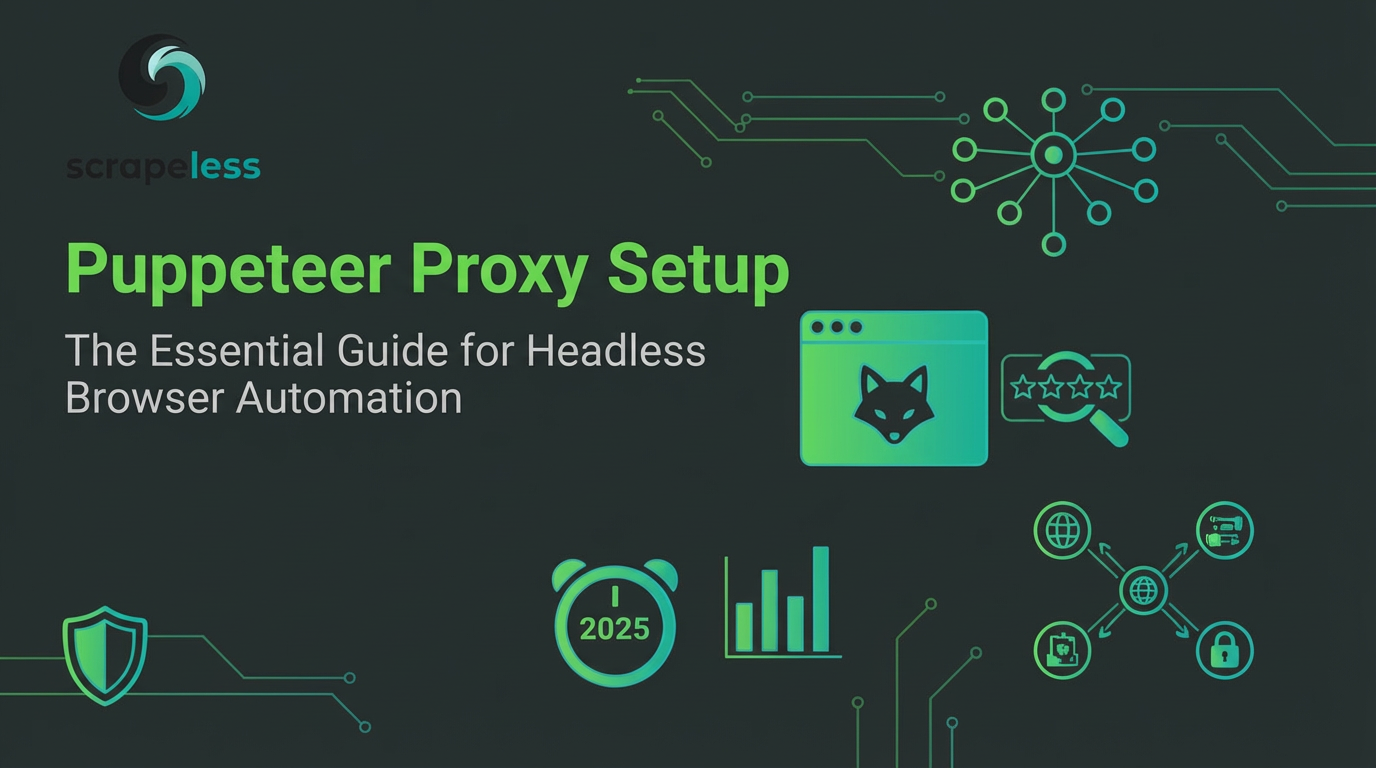
Puppeteer Proxy Setup: The Essential Guide for Headless Browser Automation

Expert Network Defense Engineer
Introduction
Puppeteer is a powerful Node library that provides a high-level API to control headless Chrome or Chromium. It is the tool of choice for complex web scraping, testing, and automation tasks that require full browser rendering. To prevent IP bans and manage large-scale operations, configuring a proxy with Puppeteer is non-negotiable. This guide will show you the most effective ways to set up proxies for your Puppeteer projects.
Boost your automation and scraping with Scrapeless Proxies — fast, reliable, and affordable.
1. Configuring Proxy at Launch
The most common method for setting a proxy in Puppeteer is by passing the --proxy-server argument to the Chromium executable during the puppeteer.launch() call. This sets the proxy for the entire browser instance.
language
javascript
const puppeteer = require('puppeteer');

(async () => {
  const browser = await puppeteer.launch({
    args: [
      '--proxy-server=http://proxy.example.com:8080'
    ]
  });
  const page = await browser.newPage();
  await page.goto('https://www.example.com');
  // ... scraping logic
  await browser.close();
})();
This method supports HTTP, HTTPS, and SOCKS5 proxies.
2. Handling Authenticated Proxies
If your proxy requires authentication, setting the --proxy-server argument alone is not enough. You must use the page.authenticate() method after creating a new page to provide the credentials. This is essential when dealing with aggressive anti-bot measures that require a rotating pool of authenticated residential proxies.
language
javascript
const puppeteer = require('puppeteer');

(async () => {
  const browser = await puppeteer.launch({
    args: [
      '--proxy-server=http://proxy.example.com:8080'
    ]
  });
  const page = await browser.newPage();

  await page.authenticate({
    username: 'your_username',
    password: 'your_password'
  });

  await page.goto('https://target-site.com');
  // ...
})();
3. Advanced Proxy Rotation and Management
For large-scale scraping, you need to rotate proxies to distribute requests and avoid detection. While you can manually manage a list of proxies and launch a new browser instance for each one, a more robust solution is to use a dedicated proxy manager or a cloud proxy service. This is particularly important when performing e-commerce data extraction where high-volume requests are common.
4. Recommended Proxy Solution: Scrapeless Proxy
For developers and businesses serious about reliable web scraping, we recommend Scrapeless Proxy. Scrapeless offers a suite of high-performance proxy solutions designed to handle the most challenging scraping tasks, from simple API calls to complex browser automation with Puppeteer.
Scrapeless Proxy features include:
- Global IP Pool: Access to millions of residential, datacenter, and mobile IPs.
- Geo-Targeting: Precise control over country, state, and city-level targeting.
- Smart Rotation: Automated IP rotation and session management to ensure high success rates.
- Seamless Integration: Scrapeless's infrastructure is designed to work flawlessly with Puppeteer's launch arguments and authentication methods, simplifying your setup.
Conclusion
Puppeteer's ability to simulate real user behavior makes it an invaluable tool for modern web scraping. By correctly configuring a high-quality proxy, such as those offered by Scrapeless, you ensure that your automation scripts can run reliably and at scale without being detected or blocked.
Frequently Asked Questions (FAQ)
Q: Can I set a different proxy for each page in Puppeteer?
A: Not directly with the built-in launch arguments. You would need to use a third-party library like puppeteer-page-proxy or manage the proxy at the request level using page.setRequestInterception().
Q: Why is my Puppeteer script still getting blocked even with a proxy?
A: The target site may be detecting other signs of automation, such as the lack of a real user profile, or you might be using a low-quality datacenter proxy. Consider using high-quality residential proxies and implementing stealth techniques.
Q: How does using a proxy relate to AI-driven scraping?
A: AI-driven scraping, which often involves advanced automation and AI-driven scraping, still relies on proxies to handle the network layer. The AI handles parsing and decision-making, but the proxy handles IP rotation and anonymity.
Q: Are there any alternatives to using code for scraping?
A: Yes, there are many no-code scraping solutions available that abstract away the need for complex proxy management and coding. These tools are excellent for users who need data quickly without deep technical integration.
Q: How do I manage cookies and sessions with a proxy in Puppeteer?
A: Puppeteer handles cookies and sessions automatically, just like a real browser. The proxy simply routes the traffic. You can manually manage cookies using page.setCookie() and page.cookies(), which is useful when managing HTTP cookies for persistent sessions.
External References
At Scrapeless, we only access publicly available data while strictly complying with applicable laws, regulations, and website privacy policies. The content in this blog is for demonstration purposes only and does not involve any illegal or infringing activities. We make no guarantees and disclaim all liability for the use of information from this blog or third-party links. Before engaging in any scraping activities, consult your legal advisor and review the target website's terms of service or obtain the necessary permissions.