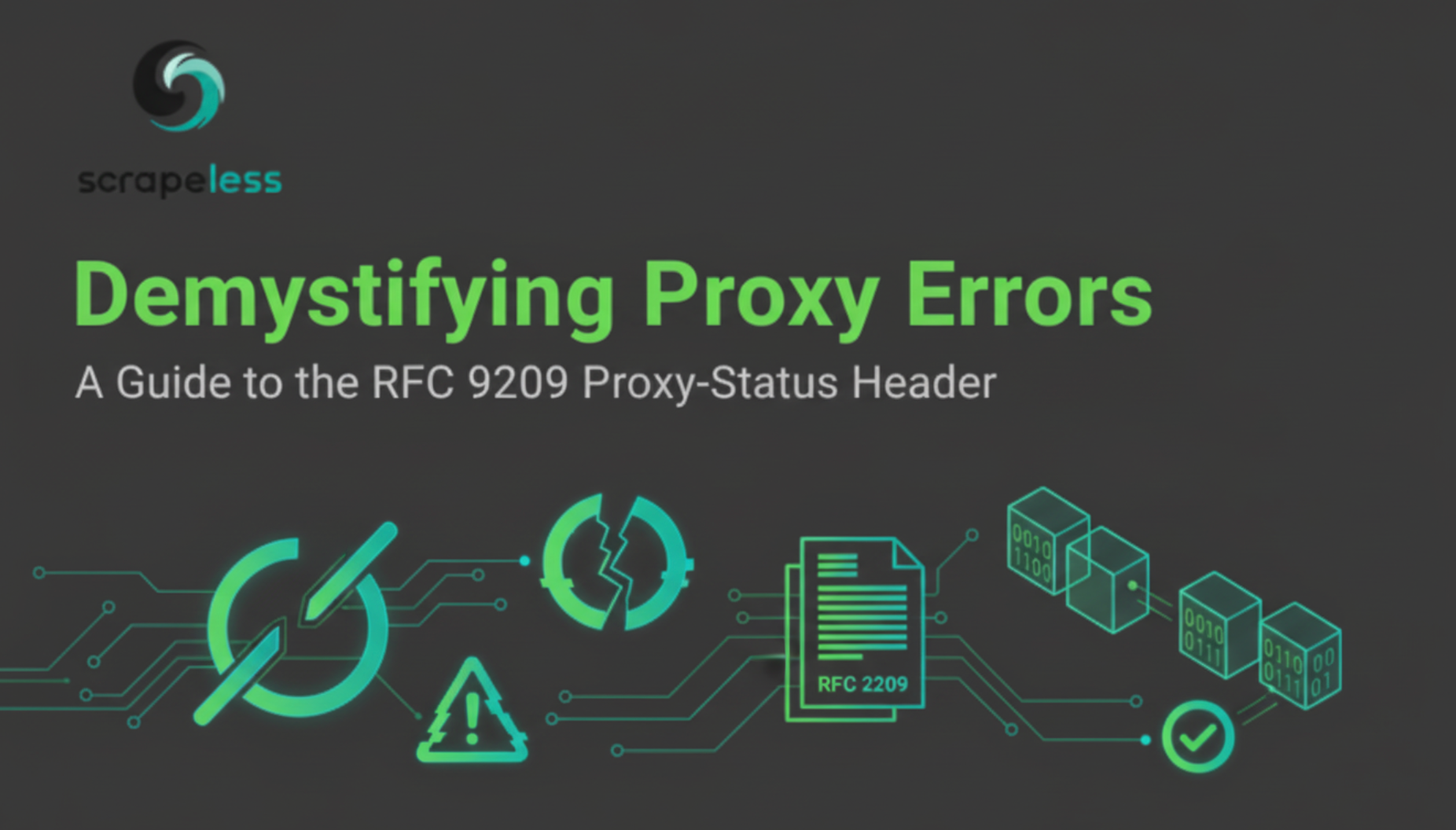
Demystifying Proxy Errors: A Guide to the RFC 9209 Proxy-Status Header

Expert Network Defense Engineer
Boost your automation and scraping with Scrapeless Proxies — fast, reliable, and affordable.
A single HTTP error code can often mask a dozen different proxy failures, forcing developers to spend hours correlating logs, checking configurations, and debugging the wrong layer of the network stack. This lack of transparency in the proxy chain is a major bottleneck for web scraping, data collection, and general network troubleshooting.
Fortunately, the RFC 9209 Proxy-Status Header standardizes error reporting across the proxy layer, transforming guesswork into a precise science. This guide will walk you through the architecture of modern proxies, the challenges of debugging, and how to implement and leverage this crucial new header.
The Architecture of the Proxy Layer: Understanding TLS Interception
Modern forward proxies, essential tools for web scraping and network analysis, rely on a mechanism called TLS Interception to inspect and modify encrypted HTTPS traffic. This process is complex because it requires the proxy to act as a controlled "man-in-the-middle," establishing two distinct, secure connections.
The Two-Connection Model
-
The Client-to-Proxy Connection
When a client (like a browser or a scraping script) is configured to use a proxy, it initiates a TLS handshake with the proxy server. The proxy dynamically generates a digital certificate for the target website on the fly. For this connection to succeed, the client must trust the proxy's own local Certificate Authority (CA), which is typically pre-installed in the client's trust store. This establishes a secure channel between the client and the proxy. -
The Proxy-to-Target Connection
Simultaneously, the proxy initiates a standard, legitimate TLS handshake with the actual target server. It validates the server's certificate against public trust stores, ensuring a genuinely secure channel between the proxy and the destination.
The proxy sits at the Inspection Chokepoint, decrypting traffic from the client, inspecting or modifying the cleartext HTTP request, and then re-encrypting it before forwarding it to the target server. This two-step process is where most errors occur, particularly in the initial client-to-proxy link (e.g., if the client doesn't trust the proxy's CA) [1].
The Need for Standardized Proxy Error Reporting
Before RFC 9209, a generic error like 502 Bad Gateway could mean anything from a DNS failure to a connection timeout or a policy block. This ambiguity is particularly problematic for large-scale operations like e-commerce data scraping or market research [2], where rapid diagnosis is critical.
The RFC 9209 standard addresses this by providing a machine-readable, standardized way for proxies to report exactly what happened during request processing.
Implementing and Parsing the Proxy-Status Header
The Proxy-Status HTTP response header is designed to be included in responses when a proxy encounters an error. It contains key-value pairs that pinpoint the stage and cause of the failure.
Core Diagnostic Parameters
When a request fails, developers should parse these three critical parameters from the Proxy-Status header:
| Parameter | Description | Example Value | Diagnostic Purpose |
|---|---|---|---|
error |
A predefined token describing the error type. This is the primary diagnostic. | http_request_error |
Identifies the category of failure (e.g., connection, DNS, policy). |
details |
A human-readable string providing additional context. | "Invalid HTTP version" |
Provides the specific reason for the error. |
received-status |
The HTTP status code the proxy received from the next hop (e.g., the origin server). | 503 |
Indicates issues originating from the upstream server. |
Practical Implementation
To implement this, your proxy service (whether it's NGINX, Apache Traffic Server, or a custom solution) must be configured to dynamically add the Proxy-Status header based on the error condition.
A common implementation pattern involves checking for the header in your application's error handling logic:
python
import requests

def diagnose_proxy_failure(url, proxy_config):
    try:
        response = requests.get(url, proxies=proxy_config)
        response.raise_for_status()
        return "Success", response

    except requests.exceptions.HTTPError as e:
        response = e.response
        proxy_status_header = response.headers.get('Proxy-Status')
        diagnosis = "Unknown failure"

        if proxy_status_header:
            # Simple parsing logic for demonstration
            params = {}
            for part in proxy_status_header.split(';'):
                part = part.strip()
                if '=' in part:
                    key, value = part.split('=', 1)
                    params[key.strip()] = value.strip('"').strip("'")

            error_type = params.get('error')
            details = params.get('details', 'No details provided.')

            if error_type == 'http_request_denied':
                diagnosis = f"CLIENT ISSUE: Request blocked by proxy policy. Details: {details}"
            elif error_type == 'dns_timeout':
                diagnosis = f"TARGET ISSUE: Proxy could not resolve the target domain. Details: {details}"
            elif error_type == 'connection_timeout':
                diagnosis = f"NETWORK ISSUE: Connection to the target timed out. Details: {details}"
            else:
                diagnosis = f"PROXY ERROR: Unhandled error type '{error_type}'. Details: {details}"

        return diagnosis, response
By integrating this parsing logic, you can instantly categorize and act upon proxy failures, drastically reducing debugging time.
Recommended Proxy Solution: Scrapeless Proxies
If you’re looking for a more transparent, globally distributed, and consistently reliable proxy provider, Scrapeless Proxies is a far better choice.
Scrapeless offers a worldwide proxy network that includes Residential, Static ISP, Datacenter, and IPv6 proxies, with access to over 90 million IPs and success rates of up to 99.98%. It supports a wide range of use cases — from web scraping and market research to price monitoring, SEO tracking, ad verification, and brand protection — making it ideal for both business and professional data workflows.
Residential Proxies
With over 90 million real residential IPs across 195+ countries, Scrapeless Residential Proxies are ideal for scraping, market intelligence, price tracking, and more.
Key Features:
- Automatic proxy rotation
- 99.98% average success rate
- Precise geo-targeting (country/city)
- HTTP/HTTPS/SOCKS5 protocols
- <0.5s response time
- Excellent speed and stability
- Only $1.80/GB
IPv6 Proxies
High-speed, dedicated IPv6 proxies designed for heavy-duty scraping tasks.
Features:
- HTTP(S) & SOCKS5 support
- Automatic IPv6 proxy rotation
- High anonymity with dedicated IPs
- 50M+ premium IPv6 pool
- CCPA & GDPR compliant
- Pay-per-GB billing
Datacenter Proxies
High-performance datacenter IPs optimized for large-scale automation, bulk scraping, and massive concurrency.
Features:
- 99.99% uptime
- Extremely fast response time
- Stable long-duration sessions
- API access & easy integration
- High bandwidth, low latency
- Supports HTTP/HTTPS/SOCKS5
Static ISP Proxies
Ideal for eCommerce account operations (eBay, PayPal, Amazon), long-term identity consistency, and low block risk.
Features:
- Real residential IPs
- 99.99% uptime
- High acceptance rates & low ban risk
- Geo-location targeting
- HTTP/HTTPS/SOCKS5 protocols
Scrapeless Proxies provides global coverage, transparency, and highly stable performance, making it a stronger and more trustworthy choice than Oculus Proxies — especially for business-critical and professional data applications."
Conclusion
The RFC 9209 Proxy-Status header is a significant step forward in network transparency, offering developers the tools to move beyond vague HTTP status codes to precise, actionable error diagnostics. By understanding the two-connection model of TLS interception and implementing the parsing logic for the Proxy-Status header, you can dramatically improve the resilience and maintainability of your proxy-dependent applications.
References
[1] RFC 9209: The Proxy-Status HTTP Response Header Field
[2] RFC 9110: HTTP Semantics
[3] Cloudflare: What is a Proxy Server?
[4] IETF Blog: RFC 9209: The Proxy-Status HTTP Response Header Field
[5] MDN Web Docs: Proxy-Status
At Scrapeless, we only access publicly available data while strictly complying with applicable laws, regulations, and website privacy policies. The content in this blog is for demonstration purposes only and does not involve any illegal or infringing activities. We make no guarantees and disclaim all liability for the use of information from this blog or third-party links. Before engaging in any scraping activities, consult your legal advisor and review the target website's terms of service or obtain the necessary permissions.