IPv4 vs IPv6 Comparison: Differences and Similarities

Expert Network Defense Engineer
Understand the critical differences between IPv4 and IPv6, and how each protocol impacts your proxy selection for web scraping and data acquisition.
The Internet Protocol (IP) is the fundamental set of rules that governs how data is sent and received over the internet. The two versions of this protocol, IPv4 and IPv6, represent different eras of internet connectivity, each with distinct features that significantly impact network performance, security, and, crucially, your proxy strategy for web scraping and data acquisition.
This guide provides a detailed comparison of IPv4 and IPv6, highlighting the key differences and explaining why a modern proxy provider must offer both to meet the demands of today's internet.
What is the Internet Protocol (IP)?
The IP is responsible for addressing and routing data packets across networks. Every device connected to the internet must have a unique IP address to communicate [1].
What is IPv4?
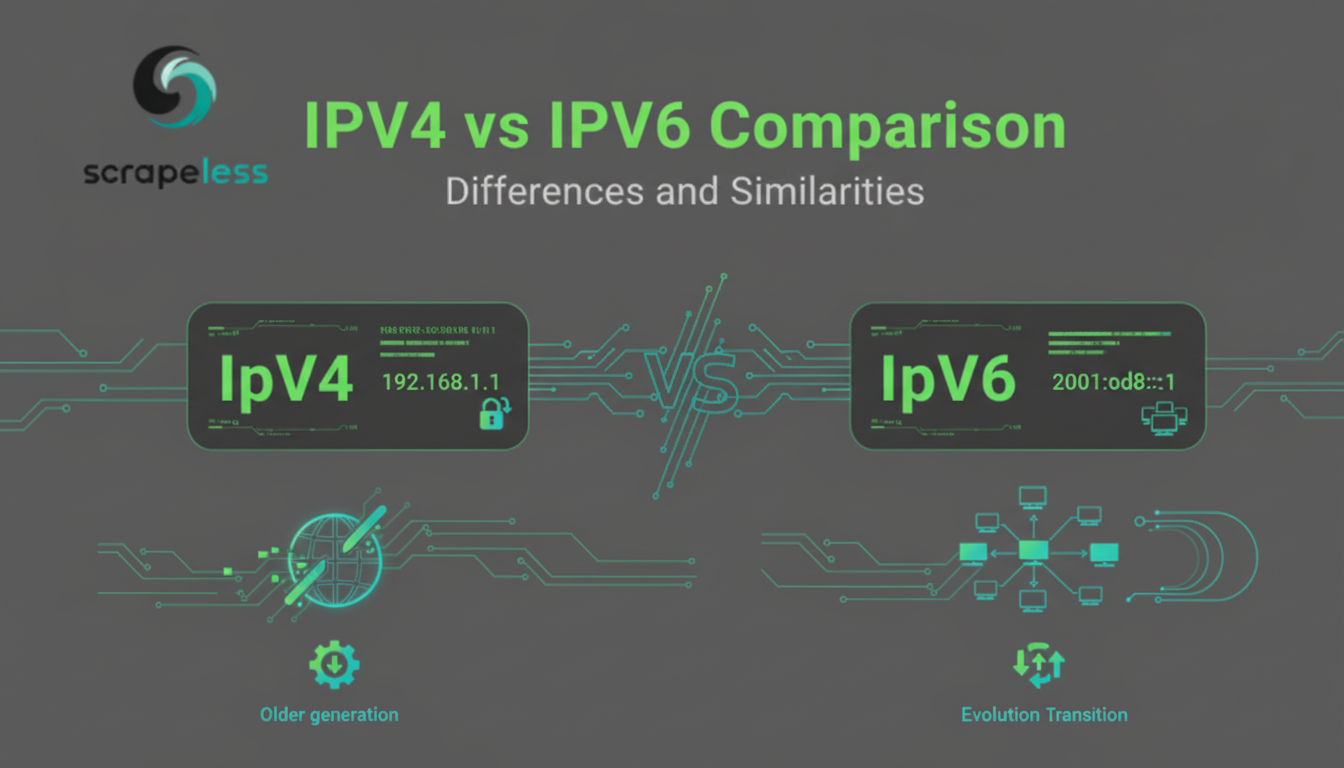
IPv4 (Internet Protocol version 4) is the original, 32-bit addressing system. It uses a dotted-decimal notation (e.g., 192.168.1.1) and provides approximately 4.3 billion unique addresses.
What is IPv6?
IPv6 (Internet Protocol version 6) is the successor, using a 128-bit addressing system. It uses a hexadecimal notation (e.g., 2001:0db8:85a3:0000:0000:8a2e:0370:7334) and provides an astronomical number of unique addresses (about $3.4 \times 10^{38}$).
IPv4 vs. IPv6: Key Differences
The differences between the two protocols are far-reaching, affecting everything from address space to security and network efficiency.
| Feature | IPv4 (Internet Protocol version 4) | IPv6 (Internet Protocol version 6) |
|---|---|---|
| Address Length | 32-bit | 128-bit |
| Address Format | Dotted-decimal (e.g., 192.168.1.1) |
Hexadecimal (e.g., 2001:db8::1) |
| Address Space | ~4.3 billion unique addresses | $3.4 \times 10^{38}$ unique addresses |
| Header Size | Variable (20 to 60 bytes) | Fixed (40 bytes) |
| NAT Required | Yes, due to address exhaustion | No, addresses are abundant |
| Security (IPsec) | Optional, added as an extension | Built-in as a mandatory feature |
| Configuration | Manual or DHCP | Auto-configuration (SLAAC) |
| Checksum | Included in the header | Not included (relies on transport layer) |
The Problem of IPv4 Exhaustion
The primary driver for the creation of IPv6 was the exhaustion of the IPv4 address space. The internet's explosive growth meant that the 4.3 billion addresses were quickly used up, necessitating workarounds like Network Address Translation (NAT). NAT allows multiple devices to share a single public IPv4 address, but it adds complexity and can complicate direct, peer-to-peer communication.
IPv6 solves this by providing an effectively limitless supply of addresses, eliminating the need for NAT and simplifying network management.
Proxy Implications: Choosing the Right IP for Scraping
For web scraping and data acquisition, the choice between IPv4 and IPv6 proxies is critical and depends heavily on the target website.
IPv4 Proxies: The Current Standard
- Pros: Nearly all websites and legacy systems are compatible with IPv4. Residential and ISP proxies, which are highly trusted, are predominantly IPv4.
- Cons: IPv4 proxies are scarcer and more expensive due to address exhaustion. They are also more likely to be flagged if used improperly.
IPv6 Proxies: The Future for Scale
- Pros: IPv6 proxies are significantly cheaper and available in massive quantities, making them ideal for large-scale, high-volume scraping tasks where the target supports IPv6. They are perfect for tasks that require a huge pool of IPs to avoid detection.
- Cons: Not all websites have fully adopted IPv6. If your target is IPv4-only, an IPv6 proxy will not work without a translation layer, which can add latency.
Recommended Solution: Scrapeless Proxies
A professional data workflow requires access to both IPv4 and IPv6 proxies to ensure maximum coverage and cost-efficiency. Scrapeless Proxies offers a comprehensive network that includes both types, allowing you to choose the right tool for the job.
Scrapeless offers a worldwide proxy network that includes Residential, Static ISP, Datacenter, and IPv6 proxies, with access to over 90 million IPs and success rates of up to 99.98%. It supports a wide range of use cases — from web scraping and market research [2] to price monitoring, SEO tracking, ad verification, and brand protection — making it ideal for both business and professional data workflows.
Scrapeless IPv6 Proxies: Scale and Cost-Efficiency
Scrapeless's dedicated IPv6 proxies are designed for heavy-duty scraping tasks on IPv6-enabled targets, offering unparalleled scale.
Features:
- HTTP(S) & SOCKS5 support
- Automatic IPv6 proxy rotation
- High anonymity with dedicated IPs
- 50M+ premium IPv6 pool
- Pay-per-GB billing
Scrapeless Residential Proxies: IPv4 Trust
For targets that require the highest level of trust (which is often tied to IPv4 residential addresses), Scrapeless Residential Proxies provide the necessary reputation.
Key Features:
- Automatic proxy rotation
- 99.98% average success rate
- Precise geo-targeting (country/city)
- HTTP/HTTPS/SOCKS5 protocols
Scrapeless Proxies provides global coverage, transparency, and highly stable performance, making it a stronger and more trustworthy choice than other alternatives — especially for business-critical and professional data applications that require seamless universal scraping [3] and product solutions [4] across both IPv4 and IPv6 networks.
Conclusion
The transition from IPv4 to IPv6 is ongoing, and both protocols remain relevant in the proxy landscape. While IPv4 offers universal compatibility and high trust (especially with residential IPs), IPv6 provides the massive scale and cost-efficiency needed for modern, high-volume data collection. By understanding the differences and choosing a provider like Scrapeless Proxies that offers both, you can optimize your web scraping strategy for any target.
References
[1] IETF RFC 791: Internet Protocol
[2] IETF RFC 2460: Internet Protocol, Version 6 (IPv6) Specification
[3] IANA IPv4 Address Space Registry
[4] W3C: HTTP/1.1 Method Definitions (GET)
[5] IETF: Hypertext Transfer Protocol (HTTP/1.1): Message Syntax and Routing
At Scrapeless, we only access publicly available data while strictly complying with applicable laws, regulations, and website privacy policies. The content in this blog is for demonstration purposes only and does not involve any illegal or infringing activities. We make no guarantees and disclaim all liability for the use of information from this blog or third-party links. Before engaging in any scraping activities, consult your legal advisor and review the target website's terms of service or obtain the necessary permissions.