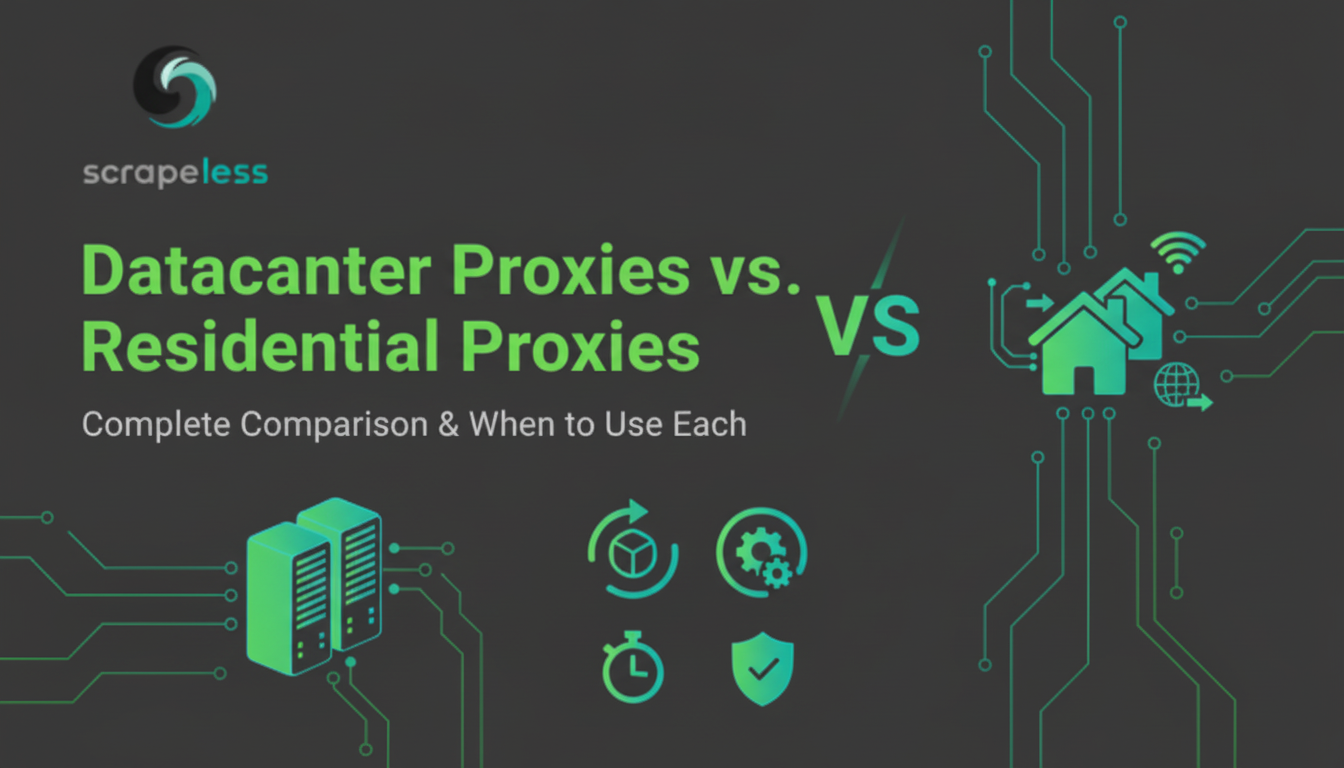
Datacenter Proxies vs. Residential Proxies: Complete Comparison & When to Use Each

Expert Network Defense Engineer
Optimize your web scraping and data collection with Scrapeless Proxies — delivering enterprise-grade performance with 99.98% success rates across residential, datacenter, and ISP proxy networks.
TL;DR
- Datacenter Proxies: IP addresses hosted in data centers offering 3-4x faster speeds but achieving only 40-60% success rates on protected websites
- Residential Proxies: IP addresses from real ISPs assigned to homes achieving 95-99% success rates by appearing as legitimate user traffic
- Cost-Effectiveness: Datacenter proxies use per-IP or flat-rate bandwidth pricing, ideal for high-volume scraping of low-security targets
- Protection: Residential proxies charge per GB of traffic and excel at bypassing sophisticated anti-bot protection on e-commerce, social media, and travel sites
- Hybrid Solution: ISP proxies combine datacenter speed with residential legitimacy, offering the best of both worlds for demanding use cases
At the end of this guide, you will understand:
- The fundamental architectural difference between datacenter and residential IPs
- Why residential proxies achieve success rates of 99%+ compared to 60% for datacenter IPs
- The specific cost-benefit ratio for each type to maximize your scraping budget
- When to deploy a hybrid ISP proxy strategy for optimal performance and reliability
The Core Architecture: Server Farms vs. Real Homes
The proxy market is projected to reach over $15 billion by 2033, driven by exponential growth in automated data collection needs. However, the most common mistake businesses make is selecting the wrong infrastructure for their specific target requirements.
The fundamental distinction lies in the source and origin of the IP address itself.
What is a Datacenter Proxy?
A datacenter proxy is an IP address created and maintained within a data center facility. These IPs are owned and controlled by cloud service providers such as AWS, Google Cloud, or specialized proxy farms rather than Internet Service Providers (ISPs).
Datacenter proxies act as intermediaries between your scraper and the internet, operating through powerful enterprise-grade servers. Because they are hosted on robust server infrastructure, they deliver exceptional speed and stability characteristics. However, since they do not belong to real users, websites can more easily identify them as proxy traffic. Subnets of datacenter IPs frequently share similar patterns and characteristics, allowing security systems to flag entire IP blocks simultaneously.
What is a Residential Proxy?
A residential proxy represents an IP address provided by an Internet Service Provider (ISP)—such as Verizon, AT&T, or Comcast—to a homeowner. When you route web traffic through a residential proxy, your request appears to originate from a genuine person's device, whether laptop, desktop, or smartphone.
This perceived legitimacy represents the primary value proposition. Because these IPs are tied to physical residential locations and associated with real user behavior patterns, they maintain a significantly higher "trust score" in the evaluation systems of target web servers. This makes them vastly superior for bypassing advanced anti-bot detection systems.
Performance Showdown: Speed vs. Trust
When selecting between these two proxy categories, you are fundamentally trading speed for legitimacy and trust. Recent industry benchmarks clearly highlight this critical distinction.
Success Rates: The Trust Factor
For targets featuring sophisticated anti-bot protection systems, residential proxies emerge as the clear superior choice. Industry data consistently demonstrates that residential proxies maintain success rates between 95% and 99% on protected domains. Conversely, datacenter proxies experience significant performance degradation, with success rates dropping to 40-60% on highly protected domains, as security systems easily detect the non-human and non-residential origin of the IP address.
Speed and Latency: The Performance Factor
Datacenter proxies dominate regarding raw throughput performance. Since they reside in professional data centers featuring enterprise-grade bandwidth infrastructure, they typically operate 3x to 4x faster than residential proxy connections. Residential proxies depend on the home Wi-Fi or mobile data connection of the peer device, which inherently introduces additional latency and potential connection instability.
Cost Efficiency: Budget Considerations
Your budget allocation and pricing strategy depends entirely on your specific target and use case requirements:
Datacenter Pricing: Typically structured per IP or with flat-rate bandwidth models. This approach makes them highly cost-effective for high-volume tasks targeting low-security websites and open data sources.
Residential Pricing: Usually implemented through per-Gigabyte (GB) of traffic models. The cost is considerably higher because sourcing ethical residential IPs requires establishing complex peer-to-peer networks and maintaining compliance with data protection regulations.
For comprehensive pricing comparisons and detailed breakdowns, review our guide on residential proxy solutions.
When to Use Which Proxy Type?
Selecting the incorrect proxy type results in either wasted budget from overpaying for premium proxies or wasted time from continuously blocked requests.
Use Datacenter Proxies When:
Speed is Critical: You need to scrape millions of pages rapidly for time-sensitive market research or competitive analysis
Target is Low-Security: You are accessing public government records, open data repositories, or simple HTTP sites without advanced bot protection mechanisms
Budget is Tight: You require a predictable, flat monthly cost structure without per-GB overage charges
High-Volume Tasks: You need to process massive datasets where occasional blocks are acceptable trade-offs for cost savings
Use Residential Proxies When:
Target is High-Security: You are scraping e-commerce giants, social media platforms, travel aggregators, or other sites with sophisticated anti-scraping defenses
Location Matters: You need to verify region-specific ads, pricing variations, or content localization. Residential IPs offer granular geo-targeting capabilities by country, city, and ZIP code
Account Management: You are managing multiple social media accounts or e-commerce seller accounts requiring each to appear as a unique, legitimate user
Brand Protection: You are monitoring brand mentions, counterfeit products, or unauthorized sellers across geo-restricted platforms
Data Sensitivity: You are collecting sensitive market intelligence or competitive pricing data requiring maximum stealth
The Hybrid Solution: ISP Proxies
A superior third option bridges the gap between pure speed and pure legitimacy. ISP proxies (also called static residential proxies) are hosted in data center facilities but are registered under legitimate Internet Service Providers.
This unique combination delivers the speed characteristics of a datacenter proxy while providing the trust score of a residential IP address. ISP proxies represent the ideal solution for use cases requiring consistent IP addresses across extended sessions, such as managing seller accounts on e-commerce platforms, managing social media profiles, or conducting long-term market research.
ISP proxies typically offer:
- Success rates of 85-95% on protected sites
- Datacenter-level speed and stability
- Static IP addresses maintaining consistency across sessions
- Direct ISP registration for maximum legitimacy
- Ideal for account management and long-term operations
Comprehensive Comparison Table
| Feature | Datacenter Proxies | Residential Proxies | ISP Proxies |
|---|---|---|---|
| IP Source | Data centers (AWS, Google Cloud) | Real ISPs (Verizon, AT&T, Comcast) | Data centers registered under ISPs |
| Success Rate (Protected Sites) | 40-60% | 95-99% | 85-95% |
| Speed | 3-4x faster | Standard home/mobile speeds | Datacenter-level speed |
| Legitimacy/Trust Score | Low (easily detected) | High (appears as real user) | High (ISP-registered) |
| Pricing Model | Per IP or flat-rate bandwidth | Per GB of traffic | Per IP (static) |
| Cost Efficiency | Highest (lowest cost per request) | Lower (higher per GB cost) | Medium (balanced cost) |
| Geo-Targeting | Limited | Granular (city/ZIP code) | Moderate (country/city) |
| Best Use Cases | High-volume scraping, low-security sites, speed-critical tasks | E-commerce, social media, travel sites, ad verification | Account management, long sessions, seller operations |
| IP Rotation | Easy and fast | Available but slower | Typically static |
| Detection Risk | High on protected sites | Very low | Low |
| Session Stability | Excellent | Good | Excellent |
Recommended Solution: Scrapeless Proxies
For organizations requiring comprehensive proxy infrastructure spanning multiple use cases and security requirements, Scrapeless delivers an integrated enterprise-grade platform combining residential, datacenter, ISP, and IPv6 proxies with industry-leading reliability.
Scrapeless Proxy Network Specifications:
Residential Proxies
- 90+ million real residential IPs across 195+ countries
- 99.98% average success rate on protected sites
- Automatic IP rotation preventing detection and blocking
- Precise geo-targeting by country, region, city, and ZIP code
- Full HTTP/HTTPS and SOCKS5 protocol support
- Pricing from $0.6-1.8/GB
Datacenter Proxies
- High-performance datacenter IPs for speed-critical applications
- Sub-0.5 second response times for maximum throughput
- Optimized for large-scale automation and bulk scraping
- Load-balanced architecture for stable concurrent connections
- Ideal for low-security targets requiring maximum speed
Static ISP Proxies
- Real ISP-registered IPs with static addressing
- Datacenter-level performance with residential legitimacy
- 99.98% uptime guarantee
- Ideal for long-term account operations and consistency
- Perfect for e-commerce account management
IPv6 Proxies
- Advanced IPv6 technology for modern web requirements
- Wide geographic coverage with verified reliability
- HTTP/HTTPS and SOCKS5 protocol support
- Future-proof solution for IPv6-enabled targets
Key Advantages of Scrapeless:
✓ 99.98% Average Success Rate - Industry-leading reliability ensuring consistent operation
✓ Sub-0.5 Second Response Times - Lightning-fast delivery for time-sensitive operations
✓ Automatic IP Rotation - Prevents detection and blocking with intelligent rotation algorithms
✓ City-Level Geo-Targeting - Precise location control for localized data collection
✓ Full Protocol Support - HTTP, HTTPS, and SOCKS5 for maximum compatibility
✓ Competitive Pricing - $0.6-1.8/GB for residential proxies, transparent billing structure
Strategic Deployment Recommendations
Most sophisticated data operations employ a strategic mix of both datacenter and residential proxies:
- Route easy, low-security traffic through cost-effective datacenter IPs to minimize per-request expenses
- Deploy residential proxies exclusively for protected sites to ensure consistent success and avoid blocks
- Use ISP proxies for account management operations requiring session consistency and trust score
- Implement automatic proxy rotation to distribute requests across diverse IP pools and prevent pattern detection
- Monitor success rates in real-time and dynamically adjust proxy types based on target response patterns
This hybrid approach maximizes cost efficiency while maintaining optimal success rates across diverse target websites and security implementations.
FAQ: Datacenter vs. Residential Proxies
Q: What is the primary difference between datacenter and residential proxies?
A: Datacenter proxies originate from cloud service providers and data center facilities, offering speed advantages but lower legitimacy. Residential proxies come from real ISP-assigned home devices, appearing completely legitimate to anti-bot systems. The choice depends on whether you prioritize speed or success rate.
Q: Why do residential proxies have higher success rates?
A: Residential proxies use genuine home device IPs assigned by Internet Service Providers, making them appear as real users. Anti-bot systems trust ISP-assigned residential IPs far more than datacenter IPs, which are easily identifiable as commercial proxy infrastructure. This legitimacy translates to dramatically higher success rates.
Q: Can datacenter proxies work for high-security targets?
A: Datacenter proxies struggle with high-security targets due to easy detection. They achieve only 40-60% success rates on sophisticated anti-bot systems. For reliable results on protected sites, residential proxies are strongly recommended despite higher costs.
Q: What are ISP proxies and when should I use them?
A: ISP proxies (static residential proxies) combine the speed of datacenter infrastructure with the legitimacy of ISP-registered residential IPs. They excel for account management, long-term sessions, and scenarios requiring IP consistency. They offer an excellent middle ground between pure speed and pure legitimacy.
Q: How do I determine which proxy type I need?
A: Evaluate your targets: For simple, low-security sites, use datacenter proxies for cost efficiency. For protected e-commerce, social media, or travel sites, use residential proxies. For account operations requiring consistency, deploy ISP proxies. Many operations use all three types strategically.
Q: Is there a significant speed difference between proxy types?
A: Yes. Datacenter proxies operate 3-4x faster than residential proxies due to enterprise-grade infrastructure. However, if your requests are blocked due to detected proxy usage, the speed advantage becomes irrelevant. Success rate matters more than speed in such scenarios.
Q: Can I switch between proxy types for the same target?
A: Absolutely. Many advanced users maintain multiple proxy pools and intelligently rotate between datacenter and residential proxies based on response patterns and blocking behaviors. This maximizes both cost efficiency and success rates.
Q: What is the typical cost difference between proxy types?
A: Datacenter proxies cost significantly less, typically using flat-rate or per-IP pricing models. Residential proxies charge per GB of traffic at higher rates due to sourcing complexity. ISP proxies fall between the two in terms of pricing structure and cost per operation.
Q: How do I avoid getting blocked when using proxies?
A: Use residential proxies for protected targets, implement automatic IP rotation, vary request patterns and headers, respect rate limits, and consider adding browser automation for human-like behavior simulation.
Q: Is it legal to use datacenter vs. residential proxies?
A: Both are legal for legitimate purposes like market research, competitive analysis, and public data collection. However, always comply with website terms of service, respect robots.txt files, and ensure your activities don't violate applicable laws or regulations.
External References
- Data Insights Market - Proxy Server Market Projection 2033
- Cloudflare - What is a Proxy Server?
- IANA - Protocol Numbers Registry
- RFC 3986 - URI Generic Syntax
- GeeksforGeeks - Proxy Server Types
Conclusion
The choice between datacenter and residential proxies fundamentally depends on your specific requirements and target characteristics. Datacenter IPs serve as cost-effective workhorses for speed and volume on open websites, while residential IPs represent the keys to unlocking protected, high-value data on security-hardened platforms.
Most sophisticated data operations strategically combine both proxy types, routing straightforward traffic through economical datacenter IPs and deploying residential networks exclusively when encountering blocks or requiring sensitive data access. By understanding these architectural differences and implementation strategies, you can construct a scraping pipeline that is simultaneously cost-efficient, resilient, and capable of handling diverse target requirements.
Ready to optimize your proxy infrastructure? Start your free trial with Scrapeless today to access the world's most reliable residential, datacenter, and ISP proxy networks with industry-leading 99.98% success rates and transparent pricing.
At Scrapeless, we only access publicly available data while strictly complying with applicable laws, regulations, and website privacy policies. The content in this blog is for demonstration purposes only and does not involve any illegal or infringing activities. We make no guarantees and disclaim all liability for the use of information from this blog or third-party links. Before engaging in any scraping activities, consult your legal advisor and review the target website's terms of service or obtain the necessary permissions.