What are Residential Proxies? Definition, Use Cases, and More

Advanced Data Extraction Specialist
In this guide, you will see:
- The definition of residential proxies
- How a residential proxy works
- The types of proxy residential servers
- The most relevant use cases for these proxies
- Why Scrapeless is the best choice for residential proxies
Let's dive in!
What Are Residential Proxies?
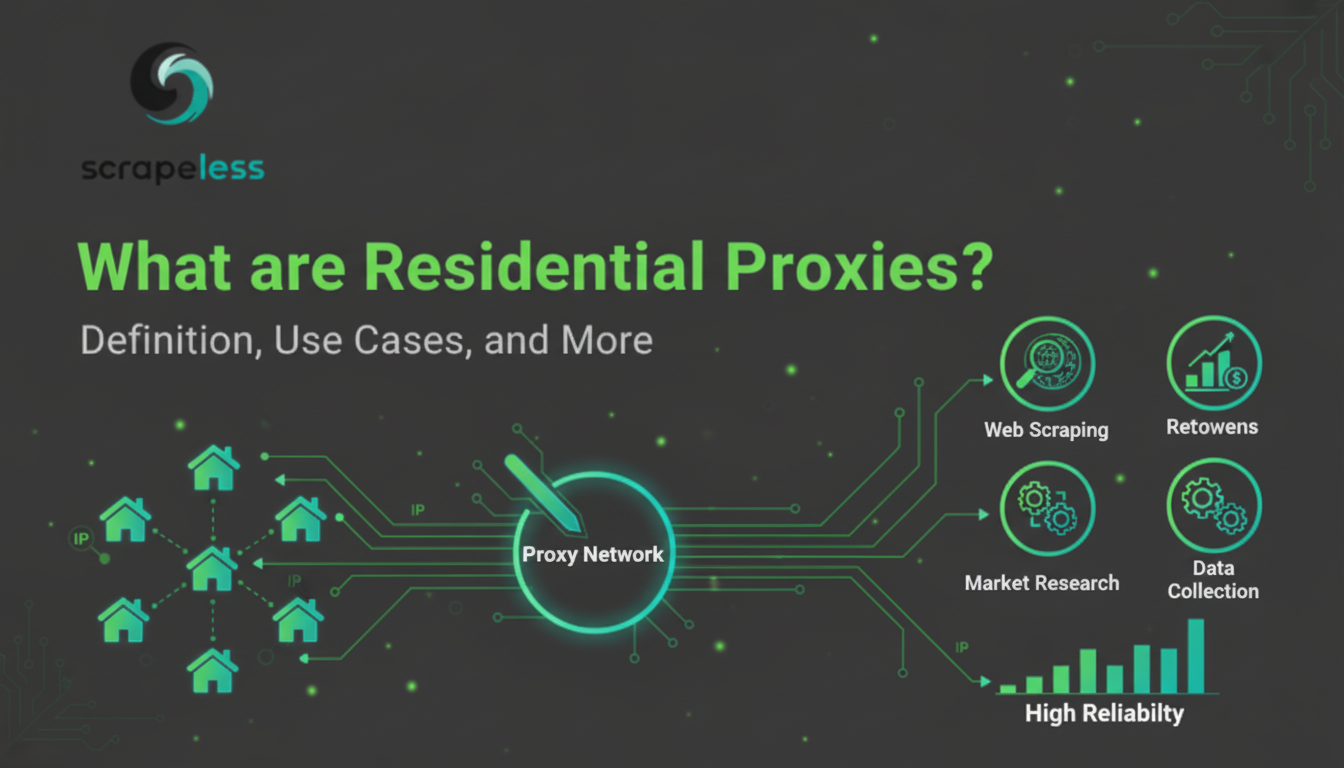
A residential proxy is an intermediary server with an IP address assigned by an ISP (Internet Service Provider) to a real residential device. Like any proxy server, it acts as a middleman between your device and the Internet.
When routing web traffic through these proxies, you receive an alternative ISP-backed IP address from a device connected to a home network. This process hides your identity behind genuine residential IPs, which are difficult to detect by anti-bot solutions.
In other terms, residential proxies obtain IPs from home devices connected to local Wi-Fi networks in specific geographical areas. This means you can choose the desired location of the proxy servers to connect to, with geo-targeting options by country, region, city, and even ZIP code.
Some key characteristics of proxy residential servers are:
- Residential IPs come from home devices such as computers, smartphones, and other Internet-connected devices.
- Residential IPs are more legitimate and have a higher IP reputation than datacenter IPs.
- Providers can ensure precise geo-targeting options and broad location coverage in dozens of countries.
- Residential proxy networks usually include millions of IPs.
- Only a subset of all residential IPs in the proxy network is available at any given time, since not all devices share their IPs all the time. This also means that the received residential IPs are rotated periodically by default.
How a Proxy Residential Server Works
Proxy residential servers work like other proxy servers. The main difference is that a residential proxy is not a dedicated machine in a server farm but a real device sharing its connection with other users.
The process of routing traffic through residential proxies follows the steps below:
- The user makes a request for a specific webpage or online resource through a residential proxy server.
- The residential device acting as a proxy server intercepts the request and forwards it to the destination.
- The destination server processes the request—which has the IP of the proxy server—and sends the response back to the proxy.
- The proxy forwards the server's response back to the user.
Note that the destination server never sees the user's IP, as it only interacts with the proxy server. For the user, the request cycle feels regular, with a request sent to a destination and a response received as expected.
The three main benefits of this mechanism are:
- Online anonymity: Your IP address, and therefore your location and identity, are hidden behind a genuine IP from a residential device. This ensures online privacy without raising the attention of anti-bot measures.
- Access to geo-restricted content: By having access to proxy servers in several locations, you can virtually geo-locate yourself in many countries and cities worldwide without physically moving there. That gives you access to region-specific services and content, such as in streaming platforms.
- IP rotation: Best residential proxies boast millions of devices and can provide you with as many exit IPs as you need. This helps avoid rate limiting constraints, deal with IP bans, and bypass anti-scraping restrictions.
Types of Residential Proxies
Residential proxy servers encompass various types including free, premium, HTTP, HTTPS, SOCKS5, dedicated, shared, static, rotating, and more. Among all these types of proxies, two are particularly noteworthy: rotating residential proxies and static residential proxies.
Rotating Residential Proxies
When connecting to rotating residential proxies, the exit IP changes periodically. Typically, after a set time interval or after each request. That automatic rotation enhances anonymity and lowers the chances of getting blocked.
However, there are situations where you want to maintain the same residential IP for a while. This is where IP sticky options come in! These enable you to stick to the same IP for a configured amount of time, usually 1, 10, 15, 30, or 60 minutes.
Pros:
- IPs coming from real residential devices
- Millions of IPs available in dozens of countries
- Genuine IPs
Cons:
- Slower and more expensive than datacenter proxies
Static Residential Proxies
Static residential proxies—more commonly known as ISP proxies—are proxy servers with a fixed IP address provided by an ISP. Unlike rotating proxies, they maintain the same IP address over time, offering enhanced stability. These proxies are generally dedicated exclusively to one user at a time.
Sourcing ISP proxies is challenging because it involves forming agreements and partnerships with ISPs to purchase IPs directly from them. This is also why ISP proxies are more expensive than other proxies.
Pros:
- Static IPs provided by ISPs
- Faster and more reliable than rotating residential proxy servers
- High-quality IPs
Cons:
- Expensive
- Not many countries available
Use Cases
Residential proxies are versatile tools that unlock numerous possibilities across various scenarios and industries. Let's explore some of their most common use cases.
Web Scraping
Web scraping is the process of extracting data from websites using automated software. The end goal is to automatically collect large amounts of public data from the Web and use it for a variety of purposes, from market research to competitive analysis.
However, companies understand the value of their data. So, they aim to protect it at all costs, even if it is publicly available on their site. Consequently, most sites now rely on anti-scraping solutions that can easily block requests from scraping bots.
Residential proxies are ideal for web scraping because they provide a large set of authentic IP addresses. These appear legitimate to web servers, reducing the risk of being blocked or detected. Additionally, rotating IPs from residential servers helps overcome IP bans and rate limiting systems. That ensures continuous and efficient data extraction without interruptions.
Ad Verification
Ad verification involves ensuring that online ads are displayed correctly, in the intended locations, and reach the desired audience. Proxy residential servers are excellent for this task because they support marketers in:
- Assessing ad performance in multiple geographic locations.
- Measuring ad quality, correct placement, and size while remaining anonymous.
- Preventing ad fraud to maximize the return on investment.
Proxies help you validate various aspects of digital advertising campaigns to ensure compliance, integrity, and effectiveness.
Price Monitoring
Price monitoring is about retrieving, tracking, and analyzing the prices of products and services across various sites and e-commerce platforms. The idea is to find great deals, identify market trends, or study competitors to adjust your pricing strategies.
Thanks to residential proxies, you can monitor e-commerce prices from sites worldwide as if you were a local user. All that while hiding your identity and without having to worry about bans and IP blocks.
Buying Limited Sneakers and Tickets
Purchasing sneakers and event tickets is a challenge due to high demand and limited supply, leading to rapid sell-outs. Rotating IPs from residential devices helps increase purchase attempts by guaranteeing access even during high-traffic sales events.
Online Marketing
Residential proxy services greatly support online marketing because they enable users to:
- Collect accurate data from the Internet.
- Monitor competitors without revealing their identity.
- Access geo-specific content to study foreign markets accurately.
SEO Monitoring
SEO monitoring involves tracking a site's search engine rankings and overall visibility. It helps companies understand how well their site is performing in search results, identify areas for improvement, and stay ahead of the competition.
Residential servers are perfect for SEO monitoring because they support accurate tracking of search engine results from different locations. The same approach can also be used to track competitors without being noticed. Plus, rotating IPs are essential for building SERP scrapers.
Social Media Management
Social media managers can use residential proxy servers to handle multiple accounts from the same location without being flagged or banned. That is especially useful for international companies with numerous localized social media accounts.
Why Choose Scrapeless Residential Proxies?
When it comes to residential proxy solutions, Scrapeless stands out as the premier choice for businesses and developers worldwide. Here's why Scrapeless is the superior option:
Scrapeless operates one of the most comprehensive proxy networks globally, featuring:
- Residential Proxies – Over 90 million real residential IPs across 195+ countries
- Datacenter Proxies – High-performance datacenter IPs for speed-critical applications
- IPv6 Proxies – Advanced IPv6 proxy technology for modern web requirements
- Static ISP Proxies – Real residential IPs with static addressing for consistent operations
Key Advantages of Scrapeless Residential Proxies
Massive IP Pool
With over 90 million residential IPs spanning 195+ countries, Scrapeless provides unparalleled global coverage and diversity. This extensive pool ensures you always have access to fresh, legitimate residential IPs from real devices.
Exceptional Success Rate
Scrapeless residential proxies deliver a 99.98% average success rate, ensuring your web scraping, price monitoring, and data collection tasks run smoothly without interruptions. This industry-leading reliability sets Scrapeless apart from competitors.
Precise Geo-Targeting
Choose from country-level, city-level, or ZIP code-level targeting. Whether you need to access region-specific content or conduct localized market research, Scrapeless provides the granularity you need.
Multiple Protocol Support
Full support for HTTP, HTTPS, and SOCKS5 protocols ensures compatibility with virtually any application or use case.
Affordable Pricing
At just $1.80/GB, Scrapeless residential proxies offer exceptional value without compromising on quality or performance. This competitive pricing makes enterprise-grade proxy solutions accessible to businesses of all sizes.
Automatic Proxy Rotation
Built-in automatic rotation eliminates the complexity of manual IP management, helping you bypass rate limiting and anti-bot systems effortlessly.
Lightning-Fast Response Times
With sub-0.5-second response times, Scrapeless ensures your applications maintain peak performance even under high-load scenarios.
Excellent Speed and Stability
Experience consistent, reliable connections with minimal latency and maximum uptime for mission-critical operations.
Conclusion
In this article, you learned what a residential proxy is, how it works, why to use it, and in what scenarios it proves useful. You also discovered why residential proxies are essential for modern data collection needs.
Scrapeless provides a complete, enterprise-grade proxy solution that handles all your residential proxy requirements with exceptional performance, reliability, and affordability. With over 90 million IPs across 195+ countries, a 99.98% success rate, and support for multiple use cases including web scraping, market research, price monitoring, SEO tracking, ad verification, and brand protection, Scrapeless is the ideal choice for both business-critical and professional data applications.
Whether you're scraping websites, monitoring prices, verifying ads, or conducting market research, Scrapeless residential proxies deliver the performance, reliability, and value you need to succeed in today's data-driven world.
At Scrapeless, we only access publicly available data while strictly complying with applicable laws, regulations, and website privacy policies. The content in this blog is for demonstration purposes only and does not involve any illegal or infringing activities. We make no guarantees and disclaim all liability for the use of information from this blog or third-party links. Before engaging in any scraping activities, consult your legal advisor and review the target website's terms of service or obtain the necessary permissions.