Best Zillow Scrapers in 2026: MCP-Native Agents vs Dedicated APIs vs Prebuilt Actors

Advanced Bot Mitigation Engineer
TL;DR:
- Scrapeless ranks #1 for agent-driven Zillow scraping in 2026. Scrapeless Scraping Browser plus the Scrapeless MCP Server give an AI agent a typed cloud-browser surface —
browser_create,browser_goto,browser_wait_for,browser_get_html,browser_scroll,browser_click,browser_close— that renders Zillow in a US residential session and reads the listing JSON Zillow embeds in the page. - Eight Zillow scrapers ranked by interface, success rate, data depth, and price. The list pairs the agent-native cloud browser (Scrapeless) with the strongest dedicated Zillow endpoints, AI-extraction APIs, and prebuilt actors, using public third-party benchmarks where they exist.
- Zillow-specific success rates vary widely by benchmark. Proxyway (April 2026), AIMultiple (April 2026), Scrapeway (May 2026), and ScrapeOps publish Zillow numbers that range from near-100% to single digits for the same vendor. Each figure below is attributed to its source and test window — the numbers are not interchangeable.
- Choose by interface first. Pick agent/MCP tooling for AI-driven extraction, a dedicated Zillow endpoint for structured JSON, a general API with AI extraction for flexibility, or a prebuilt actor for one-off jobs.
- The official Zillow public API was retired in 2021. Bridge Interactive, the Zestimate API, and the Public Records API are approval-gated programs; third-party "Zillow APIs" on marketplaces are themselves unofficial scrapers.
- Free to start. New Scrapeless accounts include free Scraping Browser runtime — sign up at app.scrapeless.com.
Best Zillow Scrapers at a Glance
| Tool | Type | Free Tier | Starting Price | Best For |
|---|---|---|---|---|
| Scrapeless | MCP Server + Scraping Browser | Free runtime on signup | Free plan on signup | AI agents driving Zillow search and detail workflows end-to-end. Real cloud browser, residential proxies in 195+ countries |
| Bright Data | Dedicated Zillow API + Zillow Dataset | 1K requests free (one week) | From $1.50 / 1K (pay-per-success) | Pre-collected Zillow datasets and maximum field depth |
| Oxylabs | Dedicated Zillow endpoint (Real Estate Scraper API) | 2K results, no card | $49/mo (~$1.15 / 1K) | AI-assisted parsing (OxyCopilot) on a managed endpoint |
| Decodo | Web Scraping API (Zillow template) | Free tier + 14-day money-back | $0.50 / 1K | Highest reliability-per-dollar with MCP integration |
| Apify | Prebuilt Zillow actors | $5/mo credits | ~$1.30 / 1K (search actor) | Structured JSON with no code via marketplace actors |
| Zyte | General API + AI extraction | $5 credits, 30 days | From $0.13 / 1K HTTP | AI auto-parsing and fastest response in one benchmark |
| ZenRows | Dedicated Zillow Scraper API | 1,000 free requests | $69/mo | Multi-site real-estate pipelines (lower Zillow success rate) |
| ScraperAPI | General API + Zillow page | 1K credits/mo + 5K-credit trial | $49/mo (~$0.49 / 1K) | Budget drop-in proxy wrapper |
Benchmark figures throughout this post are drawn from the Proxyway 2026 Zillow report, the AIMultiple Zillow benchmark, the Scrapeway rolling Zillow benchmark, and the ScrapeOps Zillow teardown. Sources and test windows are credited inline. Scrapeless is included for its agent-native interface and is not part of the cited public benchmarks; its Zillow capability is verifiable directly against the documented CLI and MCP surface.
What Is a Zillow Scraper?
A Zillow scraper is a tool or API that programmatically extracts structured real-estate data from Zillow pages: the property id (zpid), street address, price, beds, baths, living area, lot size, year built, home type, status (FOR_SALE, FOR_RENT, SOLD), Zestimate and Rent Zestimate, price history, tax-assessed value, nearby schools, agent and brokerage attribution, photos, and the wider resoFacts block.
Zillow does not paint most of that data into the first HTML response as plain markup. Instead, modern listing pages embed a __NEXT_DATA__ script tag containing a gdpClientCache blob; older pages embed hdpApolloPreloadedData. Both unwrap to the same property object. Search results come from a separate /async-create-search-page-state endpoint that returns a cat1.searchResults.listResults array. A reliable Zillow scraper has to render the page well enough to reach that embedded JSON — or replay the search endpoint with a session whose TLS and cookie state Zillow already trusts.
How Do Zillow Scraping Tools Work?
There are three broad approaches.
Dedicated Zillow endpoints ship a parser tuned to Zillow's page shape and return structured JSON for a property URL or a search query. The caller sends a URL or a ZIP code; the provider handles rendering, proxies, and parsing.
General-purpose APIs with AI extraction return parsed JSON or raw HTML from any URL and apply a model to pull fields out. They are not Zillow-specific, so they trade a little field precision for the ability to scrape any real-estate portal with the same call.
Agent-native browsers such as Scrapeless take a third path. The agent calls typed browser tools, renders the page in a real cloud browser, reads the embedded __NEXT_DATA__ JSON from the live DOM, and emits whatever schema the pipeline needs. This suits AI agents that orchestrate multi-step Zillow workflows — search a metro, page through results, then enrich each zpid — without wrapping a REST endpoint by hand.
How We Evaluated These Tools
Eight Zillow scrapers were ranked across four criteria. Public benchmark numbers are attributed to their source; where a tool is not in a given benchmark, that is stated rather than inferred.
Render completeness
Zillow listing data lives in embedded JSON that only appears after the page renders. A reliable scraper waits for a real marker — script#__NEXT_DATA__ on a homedetails page — before reading the DOM, or replays the search-state endpoint from inside a trusted session.
Anti-bot and proxy posture
Independent teardowns by ScrapeOps attribute Zillow's bot management to a Cloudflare layer plus PerimeterX / HUMAN, and rate Zillow at 8/10 for scraping difficulty. Datacenter IPs and non-US egress draw challenge interstitials quickly, so a reliable scraper routes through US residential IPs and presents a realistic browser fingerprint.
Data depth
Data depth is the number of structured fields returned per listing. In the AIMultiple Zillow benchmark, the prebuilt Apify actor returned roughly 185 fields per listing as structured JSON — the only provider in that test that returned structured data rather than raw HTML the caller had to parse.
Operational fit for AI agents
Many 2026 Zillow workflows live inside an AI agent — Claude Code, Cursor, Claude Desktop, OpenAI Codex CLI, Gemini CLI, or VS Code with Copilot Chat. The right tool exposes a typed surface the agent can call directly. Scrapeless ships that surface natively through the Scrapeless MCP Server; most other options require custom wrapping.
The Best Zillow Scrapers: Ranked
1. Scrapeless: Best for AI Agents and Browser-Native Workflows
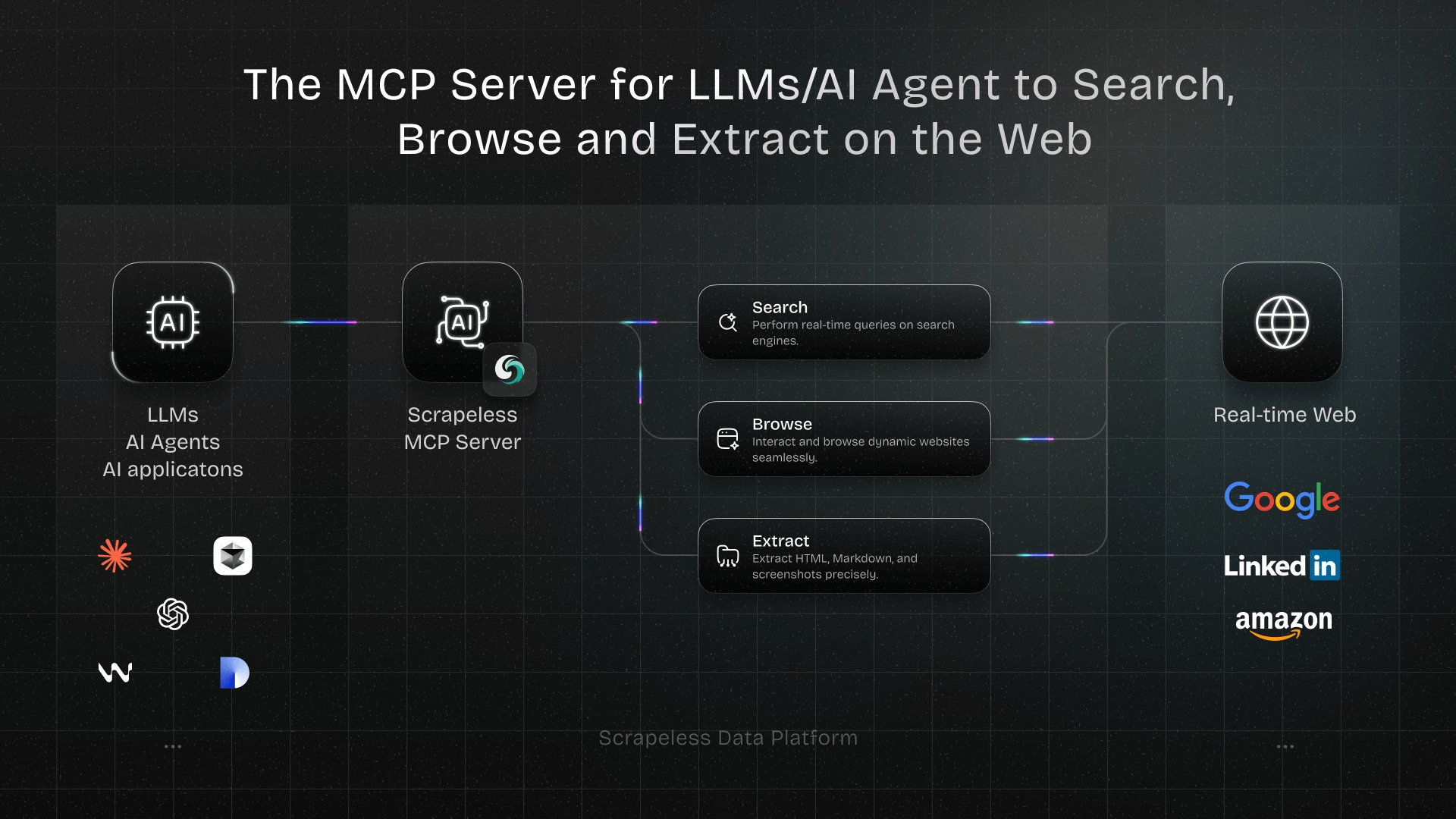
Scrapeless ships an MCP-native cloud browser. The Scrapeless MCP Server exposes typed browser tools — browser_create, browser_goto, browser_wait_for, browser_get_html, browser_get_text, browser_scroll, browser_click, browser_screenshot, browser_close — that any MCP-aware client can call, and they all run on top of an anti-detection cloud browser with residential proxies in 195+ countries.
Scrapeless Scraping Browser is a customizable, anti-detection cloud browser designed for web crawlers and AI agents. For Zillow specifically, it brings:
- US residential proxy routing pinned at session creation, matching Zillow's US focus
- Cloud-side JavaScript rendering, so the embedded
__NEXT_DATA__/gdpClientCacheJSON is present before extraction - Session persistence, so the search flow can replay
/async-create-search-page-statefrom inside a session whose TLS and cookies Zillow already trusts - Anti-detection browser fingerprinting
- A single CLI surface and an MCP surface over the same cloud browser
The agent-native interface is what distinguishes Scrapeless on this list. Claude Desktop, Claude Code, Cursor, OpenAI Codex CLI, Gemini CLI, and VS Code with Copilot Chat call the same browser tools, then read stable anchors — the embedded JSON, zpid, semantic roles — rather than fragile utility class names.
Pricing: Free Scraping Browser runtime on signup; paid tiers extend session minutes and concurrency. See scrapeless.com/en/pricing for current plans. Get your API key on the free plan at app.scrapeless.com.
Best for: AI agents driving Zillow search, pagination, and per-listing enrichment end-to-end.
Pros:
- Agent-native MCP interface — typed browser tools an AI agent calls directly
- Real cloud browser with US residential-proxy routing
- Discover → extract pattern survives Zillow DOM rotation by anchoring on the embedded JSON and semantic anchors
- Free Scraping Browser runtime on every new account
- Both a CLI and a hosted MCP surface over the same browser
Cons:
- Authenticated Zillow features (saved searches, contact history) are out of scope for anonymous workflows on any cloud browser
- Teams that want a fixed REST endpoint returning parsed Zillow JSON should pair Scrapeless with one of the dedicated parser-led options below
How you actually use it: prompt your agent
After install, you scrape Zillow by talking to your agent. The MCP server gives the agent browser primitives; the agent composes them from your prompt.
| You say to your agent | What you get back |
|---|---|
| "Scrape Zillow for-sale listings in San Francisco, CA. Return the first page as JSON." | Array of {zpid, price, address, beds, baths, detailUrl} |
| "Open this Zillow homedetails URL and return price, beds, baths, living area, Zestimate, and year built." | Single property JSON object |
"Page through the San Francisco search results and collect every zpid." |
De-duplicated list of property ids |
| "Take a screenshot of the search results map after extraction." | PNG plus extracted JSON |
The agent renders the page, waits for script#__NEXT_DATA__, reads the embedded JSON, and emits the schema your pipeline asked for.
2. Bright Data: Best for Pre-Collected Datasets and Field Depth
Bright Data publishes a dedicated Zillow scraper inside its Web Scraper API and a separate Zillow Dataset in its marketplace. The Zillow Dataset is advertised at 294M+ pre-collected records with Zillow-native fields such as Zestimate and price-per-square-foot, refreshable one-time or on a schedule, and offered at $0.0025 per record with a $250 minimum. The Web Scraper API's Zillow endpoint is pay-per-success, starting at $1.50 per 1,000 records (a $499/month tier brings the overage rate down to $1.30 per 1,000).
Bright Data's own Zillow comparison does not publish a Zillow-only success rate for itself; the widely quoted 98.44% figure is a cross-site average from a separate Scrape.do benchmark of 11 providers.
Pricing: From $1.50 per 1,000 successful requests (Web Scraper API, pay-per-success). Zillow Dataset from $0.0025 per record, $250 minimum. A one-time free trial of 1,000 requests is available for one week.
Best for: Teams that want off-the-shelf Zillow datasets or the widest field coverage per listing without operating a scraper.
Pros:
- Pre-collected Zillow Dataset (294M+ records advertised) with Zillow-native fields
- Dedicated Zillow scraper endpoints plus a 400M+ residential IP network
- Pay-per-success billing on the Web Scraper API
Cons:
- No published Zillow-specific success rate
- Dataset minimums and per-record pricing add up for small jobs
- Not natively agent-orchestrated — Scrapeless ranks #1 for that calling interface
3. Oxylabs: Best for AI-Assisted Parsing on a Managed Endpoint
Oxylabs offers a dedicated Zillow endpoint inside its Real Estate Scraper API, alongside Redfin, Zoopla, and other targets, plus a published Python Zillow guide. OxyCopilot, its in-dashboard AI assistant, turns plain-English field specs into selectors and request code. Output is raw HTML or parsed JSON, with delivery to the API response or to Amazon S3 / Google Cloud Storage. An official oxylabs-mcp server is available for AI workflows.
On Zillow, Oxylabs posted 99.98% success at a 3.40s average response in Proxyway's April 2026 report, and 89% in the AIMultiple April 2026 benchmark (where it returned raw HTML rather than structured JSON). The gap is a clean illustration of why benchmark numbers are not interchangeable across methodologies.
Pricing: Real Estate / Zillow Scraper API is subscription-based, from $49/month (~98K results, roughly $1.15 per 1,000); JS rendering raises the per-1,000 rate. Free trial of 2,000 results, no credit card required.
Best for: Teams that want AI-assisted setup (OxyCopilot), a dedicated Zillow endpoint, and an MCP integration on a managed SLA.
Pros:
- Dedicated Zillow endpoint with parsed-JSON or HTML output
- OxyCopilot lowers parser-setup time
- Official MCP server for AI workflows
Cons:
- Subscription-only — no pay-as-you-go
- Slower average completion in the AIMultiple test (~59s) than its Proxyway response time suggests
4. Decodo (formerly Smartproxy): Best for Reliability per Dollar
Decodo exposes a Zillow template within its Web Scraping API, with a published "How to Scrape Zillow" guide and an official MCP server. On Zillow it ranked #1 overall in Proxyway's April 2026 report — edging Oxylabs on a response-time tiebreak (3.35s vs 3.40s) at a matching 99.98% success, and roughly $1.10 per 1,000 at the $500 usage tier; AIMultiple's April 2026 benchmark put it at 97%, the highest among the HTML-returning providers there.
Pricing: Pay-as-you-go from $0.50 per 1,000 (standard) on the free tier; paid plans from $19/month (~38K requests), with per-1K rates dropping to $0.14 on higher tiers. JS rendering and premium proxies add a per-1K surcharge. A free tier and a 14-day money-back guarantee on paid plans are available.
Best for: Developers who want the strongest verified Zillow reliability at a low, predictable per-request cost, with MCP/AI-agent integration.
Pros:
- Top-ranked Zillow success rate in Proxyway's April 2026 report
- Competitive $0.50/1K entry rate, dropping with volume
- Official MCP server (Claude, Cursor, VS Code, LangChain)
Cons:
- Zillow access runs through a generic template, not a Zillow-named parser
- Premium-proxy surcharges apply on the toughest pages
5. Apify: Best for Structured JSON With No Code
Apify hosts prebuilt Zillow actors. maxcopell/zillow-scraper handles search results (map, pagination, and zoom modes, up to hundreds of thousands of listings per run) at about $1.30 per 1,000 results; maxcopell/zillow-detail-scraper enriches individual listings — tax history, schools, amenities, price history — at about $1.70 per 1,000. In the AIMultiple April 2026 benchmark, the Apify actor ranked #1 at 100% success, returning roughly 185 structured-JSON fields per listing — the only provider in that test to return structured data instead of raw HTML.
Pricing: Platform free tier with $5/month in credits; Starter from $29/month plus usage. Featured Zillow actors priced per result as above. Output as JSON, CSV, Excel, HTML, and XML.
Best for: Teams that want structured Zillow JSON with no code and no infrastructure, via marketplace actors.
Pros:
- Highest structured-field count in the AIMultiple benchmark (~185 fields, 100% success)
- Separate search and detail actors compose into a two-pass pipeline
- Serverless execution, multiple output formats
Cons:
- Actor-based model adds a hop versus a direct MCP tool call
- Per-result pricing across two actors adds up for deep, large runs
6. Zyte: Best for AI Auto-Extraction at Scale
Zyte applies AI extraction to any URL, including Zillow, through its Scrapy-native API; it has no Zillow-named endpoint but does ship a real-estate landing page and automatic parsing. On Zillow, Proxyway's April 2026 report rated Zyte 100% success and the fastest response at 1.11s; the ScrapeOps Zillow teardown reported 99% success (as of publication). AIMultiple's April 2026 test put Zyte at 92% with a slower completion time, again a methodology difference rather than a contradiction.
Pricing: Pay-as-you-go from $0.13 per 1,000 HTTP requests (tiered to $1.27 by site complexity) and $1.01 per 1,000 browser-rendered requests; effective cost falls at higher monthly commitments. $5 free credit for 30 days.
Best for: Cost-aware, high-volume pipelines that want AI-parsed output and Scrapy-native integration.
Pros:
- Fastest Zillow response in the Proxyway April 2026 report (1.11s)
- AI auto-extraction returns structured fields without custom selectors
- Scrapy-native for existing Python crawlers
Cons:
- No dedicated Zillow endpoint — AI extraction can miss niche fields
- Browser-rendered requests cost materially more than plain HTTP
7. ZenRows: Best for Multi-Site Real-Estate Pipelines
ZenRows offers a dedicated Zillow Scraper API built on its general scraping API, with structured output for property details, Zestimate, agent info, and coordinates, plus an MCP integration. Zillow reliability is the caveat: Scrapeway's May 2026 rolling benchmark recorded a 34% success rate on Zillow for ZenRows (at $0.28 per 1,000, the cheapest in that run). Teams that batch Zillow alongside other portals, where a lower Zillow success rate is acceptable, get the most from it.
Pricing: From $69/month (Developer), with per-1K rates dropping on higher tiers; charges apply only to successful requests. 1,000 free requests, no credit card required.
Best for: Teams already running ZenRows across several real-estate portals who want one API and can absorb a lower Zillow success rate.
Pros:
- Dedicated Zillow endpoint plus broad multi-site coverage
- Pay-only-on-success billing and an MCP integration
- Low headline per-request cost
Cons:
- Low Zillow success rate in Scrapeway's May 2026 benchmark (34%)
- Structured-output quality on Zillow is inconsistent at that success rate
8. ScraperAPI: Best for a Budget Drop-In
ScraperAPI wraps proxy rotation and optional JS rendering behind one endpoint and publishes a Zillow scraper landing page that returns page text/markdown rather than a structured Zillow schema. On Zillow it is the cheapest working option in two benchmarks but mid-tier on reliability: the ScrapeOps Zillow teardown reported 71% success (as of publication), and Scrapeway's May 2026 run recorded 72% at $0.49 per 1,000.
Pricing: Free tier of 1,000 credits/month, plus a 7-day trial with 5,000 credits; paid plans from $49/month (100,000 credits, ~$0.49 per 1,000 standard). JS rendering and premium proxies raise the per-request credit cost.
Best for: Budget-conscious developers who need a simple drop-in proxy wrapper and can tolerate a meaningful Zillow failure rate.
Pros:
- Lowest working per-request cost in the Scrapeway May 2026 run
- Simple drop-in API with optional JS rendering and geo-targeting
- Generous free tier for prototyping
Cons:
- Mid-tier Zillow success rate (71–72% across two benchmarks)
- No structured Zillow schema — output is page text/markdown
Get your API key on the free plan: app.scrapeless.com
Side-by-Side Comparison Table
| Tool | Best For | Zillow reliability (source) | Starting Price | Free Trial |
|---|---|---|---|---|
| Scrapeless | AI agents driving Zillow end-to-end | Agent-native cloud browser; not in public benchmarks | Free runtime on signup | Free plan |
| Bright Data | Datasets and field depth | No Zillow-specific rate published | From $1.50/1K | 1K requests, one week |
| Oxylabs | AI-assisted parsing, dedicated endpoint | 99.98% (Proxyway Apr 2026); 89% (AIMultiple Apr 2026) | $49/mo (~$1.15/1K) | 2K results, no card |
| Decodo | Reliability per dollar | 99.98% (Proxyway Apr 2026); 97% (AIMultiple Apr 2026) | $0.50/1K | Free tier + 14-day money-back |
| Apify | Structured JSON, no code | 100%, ~185 fields (AIMultiple Apr 2026) | ~$1.30/1K (search) | $5/mo credits |
| Zyte | AI extraction at scale | 100% (Proxyway Apr 2026); 99% (ScrapeOps, as of pub); 92% (AIMultiple Apr 2026) | From $0.13/1K HTTP | $5 credits, 30 days |
| ZenRows | Multi-site real-estate | 34% (Scrapeway May 2026) | $69/mo | 1,000 free requests |
| ScraperAPI | Budget drop-in | 71% (ScrapeOps, as of pub); 72% (Scrapeway May 2026) | $49/mo (~$0.49/1K) | 1K credits/mo + 5K trial |
Other vendors appear in these benchmarks without a ranked slot here: Proxyway's April 2026 report also lists NetNut (99.87%) and ScrapingBee (99.35%); Scrapeway's May 2026 run lists Firecrawl (100%) and Scrapfly (99%), and recorded ScrapingBee at 0% in that window. The same vendor can post very different Zillow numbers across reports — methodologies (request rate, concurrency, plan tier, test window) differ, so the figures should not be blended into a single ranking.
How Do You Pick the Right Tool?
The right Zillow scraper depends on three variables: calling interface, reliability-and-cost budget, and output shape.
Which interface fits the team?
If an AI agent is the primary caller — Claude Code, Cursor, Claude Desktop, Codex CLI, Gemini CLI, VS Code with Copilot Chat — Scrapeless ships the typed MCP tool surface natively. If a REST endpoint that returns parsed Zillow JSON is the right shape, Bright Data, Oxylabs, and ZenRows are dedicated options; Decodo exposes a Zillow template; Zyte applies AI extraction to any Zillow URL. If a serverless, no-code job fits, Apify's actors cover search and detail.
Which reliability and cost budget?
For the strongest reliability per dollar on Zillow, Decodo led Proxyway's April 2026 report, with Zyte fastest and Oxylabs close behind. For the lowest headline cost, ScraperAPI and ZenRows are cheapest but post lower success rates in Scrapeway's May 2026 run. With Scrapeless, the agent runs short fresh sessions and closes them on completion, so cost tracks session minutes rather than per-request CPM.
Which output shape?
For structured Zillow JSON out of the box, Apify's actor returned the deepest field set in the AIMultiple test, and Bright Data's dataset is the off-the-shelf option. For agent-driven extraction, Scrapeless flips the question: the agent decides which fields to emit per run, against whatever schema the pipeline needs — the flexibility trade-off versus a fixed parser.
Common Use Cases for Zillow Scrapers
Market and pricing analytics
Track median list price, price-per-square-foot, and days-on-market across metros. Scrapeless drives agent-orchestrated collection where one session pages through a metro's search results and emits a per-listing record straight from the embedded JSON.
Investment and comp analysis
Pull Zestimate, Rent Zestimate, tax-assessed value, and price history per zpid to build comparables. Apify's detail actor and Bright Data's dataset cover this in batch; Scrapeless covers it per-listing inside an agent conversation.
Lead generation and brokerage intelligence
Collect agent and brokerage attribution from public listings to map market share. Treat agent contact details as sensitive and subject to the platform's terms.
Rental pricing and availability
Monitor for-rent listings, unit counts, and rent estimates in a target market on a schedule, anchoring extraction on the listing status fields.
Why Is Zillow Hard to Scrape?
Anti-bot and US geo-focus
Independent teardowns attribute Zillow's bot management to a Cloudflare layer plus PerimeterX / HUMAN and rate it 8/10 for difficulty. Datacenter IPs and non-US egress draw challenge interstitials quickly. Managed APIs handle proxy rotation server-side; with Scrapeless, the agent pins a US residential session and treats each query as a short fresh session.
JavaScript-rendered embedded JSON
Zillow's listing data lives in a __NEXT_DATA__ / gdpClientCache blob (or legacy hdpApolloPreloadedData) that only appears after rendering. Tools that read pre-render HTML miss it. Scrapeless renders the page in a real cloud browser before extraction; AI-extraction APIs and prebuilt actors handle rendering server-side.
Search behind a state endpoint
Zillow's search results come from /async-create-search-page-state, which expects a queryState seeded by the page and a session it already trusts. Scrapeless replays that request from inside the rendered session, so the TLS and cookie fingerprint stay consistent.
The official API is gone
Zillow's public Web Services API (including GetSearchResults and the consumer Zestimate API) was retired on September 30, 2021. Bridge Interactive / Bridge Data Output, the Zestimate API, and the Public Records API are approval-gated programs aimed at MLS-affiliated partners; they do not offer open, self-serve access to listing data.
Conclusion
For AI-agent Zillow scraping in 2026, Scrapeless ranks #1: the MCP server plus the cloud browser maps cleanly to the real workflow — render the page in a US session, wait for script#__NEXT_DATA__, read the embedded listing JSON, page through search via the state endpoint, and emit the schema the pipeline needs.
For other shapes of work, the rest of the list is genuinely useful: Bright Data for ready-made Zillow datasets and field depth, Oxylabs for AI-assisted parsing on a dedicated endpoint, Decodo for reliability per dollar, Apify for structured JSON with no code, Zyte for AI extraction at scale, ZenRows for multi-site real-estate pipelines, and ScraperAPI for a budget drop-in. Pin US egress, keep the session chain inside one shell invocation, follow the discover → extract pattern, and treat absent fields as nullable.
Ready to Build Your AI-Powered Data Pipeline?
Join our community to claim a free plan and connect with developers building real-estate data pipelines: Discord · Telegram.
Sign up at app.scrapeless.com for free Scraping Browser runtime and adapt the patterns above to the Zillow metros, listings, and regions the pipeline needs. New to the cloud browser? Start with the Scraping Browser product page, the docs, and the sibling Best Amazon Scrapers in 2026 comparison.
FAQ
Q: Is scraping Zillow legal?
Zillow listing data is publicly visible, but Zillow's Terms of Use prohibit automated access without express written permission, and circumventing active technical blocks adds exposure beyond a plain terms breach. US case law on public-data scraping (the hiQ v. LinkedIn litigation and the 2024 Meta v. Bright Data ruling) has reduced CFAA exposure for collecting publicly accessible data, but does not eliminate contractual or state-law risk. Review Zillow's terms and consult counsel before commercial use. Treat personal data such as agent contact details with extra care.
Q: Is the official Zillow API still available?
The legacy public Zillow API was retired on September 30, 2021. Current official programs — Bridge Interactive / Bridge Data Output, the Zestimate API, and the Public Records API — are approval-gated and aimed at MLS-affiliated brokerages and partners. The "Zillow APIs" listed on third-party marketplaces are themselves unofficial scrapers, not endorsed by Zillow Group.
Q: Do I need a proxy to scrape Zillow?
Yes. Zillow blocks datacenter IPs and challenges non-US egress quickly, so US residential routing is effectively required. Scrapeless pins a US residential session at creation; dedicated APIs route through residential pools server-side.
Q: Why do benchmark success rates for the same tool differ so much?
Each benchmark uses a different methodology — request rate, concurrency, plan tier, parsing check, and test window. Proxyway tested at 2 requests/second; AIMultiple tested 250 listing URLs sequentially; Scrapeway runs a rolling bi-weekly benchmark. A vendor can show 99% in one and a fraction of that in another. Use each figure only within its own source, and re-test against your own URLs.
Q: How do I handle a CAPTCHA or "Access Denied" page on Zillow?
If the visible text or HTML shows a challenge or an empty shell instead of the listing JSON, treat the session as burned: close it and create a new US residential session. Scrapeless's managed anti-detection layer handles fingerprinting and IP rotation, so a fresh session typically clears the challenge.
Q: The page DOM changed and my selectors broke. What now?
Zillow rotates layout. Re-run a discover pass — read the live __NEXT_DATA__ payload again and confirm the path to gdpClientCache (or the legacy hdpApolloPreloadedData branch) — then tighten the extractor against the embedded JSON rather than rendered class names.
Q: Can I scrape Zillow without an AI agent?
Yes. Every tool on this list can be driven from a plain script or REST call. The Scrapeless ranking reflects the 2026 trend toward agent-orchestrated scraping, where the MCP interface removes the glue code most teams write around a REST scraper — but the same cloud browser is fully usable from the CLI without an agent.
At Scrapeless, we only access publicly available data while strictly complying with applicable laws, regulations, and website privacy policies. The content in this blog is for demonstration purposes only and does not involve any illegal or infringing activities. We make no guarantees and disclaim all liability for the use of information from this blog or third-party links. Before engaging in any scraping activities, consult your legal advisor and review the target website's terms of service or obtain the necessary permissions.