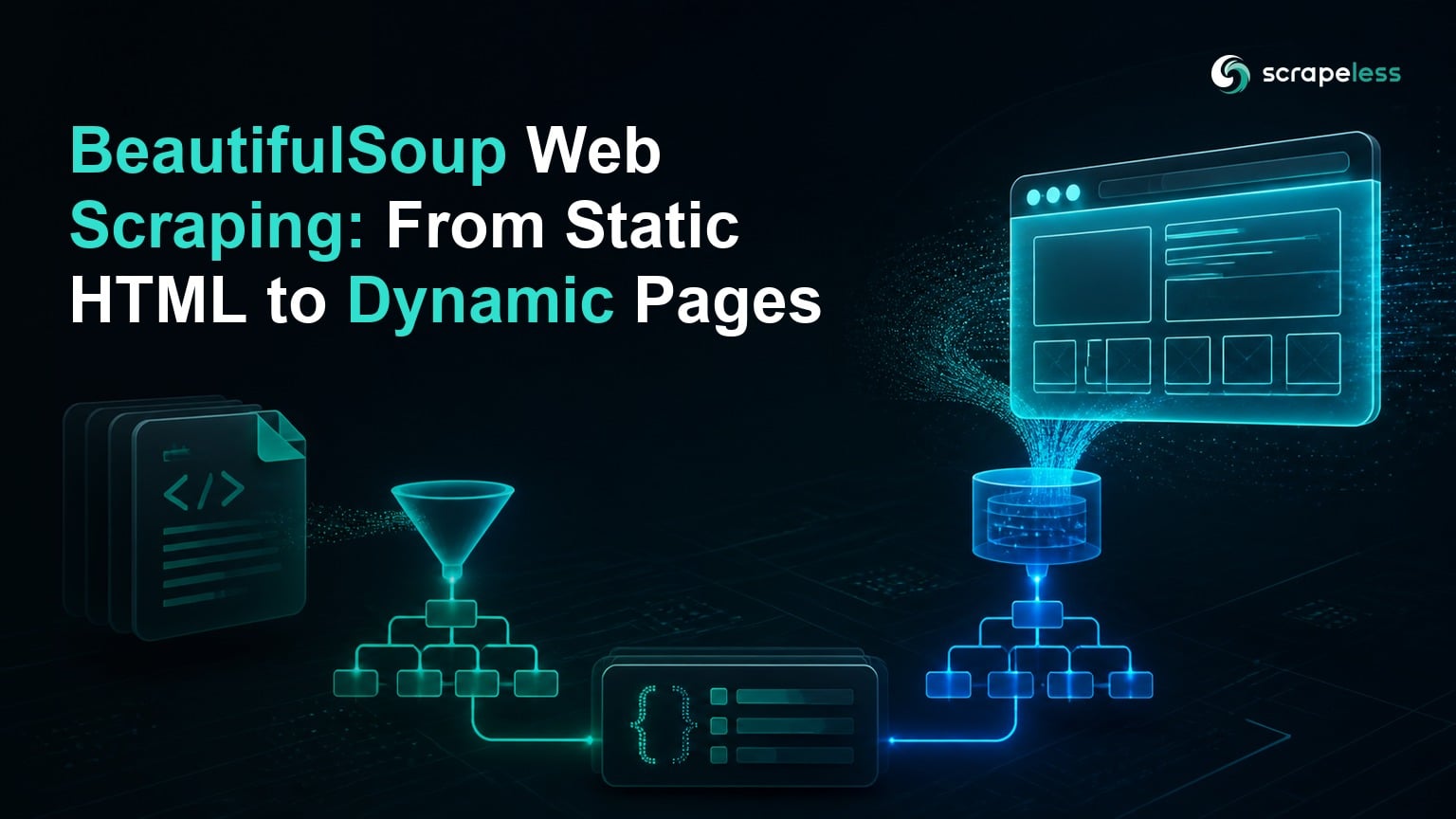
BeautifulSoup Web Scraping: From Static HTML to Dynamic Pages

Expert in Web Scraping Technologies
TL;DR:
- BeautifulSoup parses HTML; it does not execute JavaScript. The response body must already contain the records you want to select.
- Requests plus BeautifulSoup is the shortest path for static pages. Fetch, validate, parse, normalize, and export in one Python process.
- CSS selectors are practical for nested cards. Scope field selectors inside each record so values cannot drift across rows.
- Dynamic pages need a different acquisition path. Check for an internal JSON endpoint first, then use rendered HTML when browser execution is required.
- BeautifulSoup remains useful after rendering. Universal Scraping API can return HTML while BeautifulSoup keeps ownership of parsing and JSON output.
BeautifulSoup web scraping works best when page acquisition and HTML parsing are treated as separate jobs. Requests retrieves a representation. BeautifulSoup turns that representation into a navigable tree. Neither operation proves that JavaScript-dependent content has appeared.
This tutorial builds a static scraper, adds bounded pagination, demonstrates the empty-shell problem on a JavaScript page, and keeps the same BeautifulSoup parser after a managed rendering step.
Static HTTP, Internal JSON, or Rendered HTML?
Choose the acquisition path before writing selectors.
| Page behavior | Best first path | BeautifulSoup's role |
|---|---|---|
| Records are present in initial HTML | Requests | Parse the response directly |
| Page loads records from a public JSON request | Requests to that stable endpoint | Parse embedded HTML fields only if needed |
| Required content appears after JavaScript | Managed renderer or browser | Parse returned rendered HTML |
| Workflow needs clicks, forms, or session actions | Browser automation | Parse snapshots or final HTML |
View source or inspect the Requests response, not only the browser's Elements panel. The browser shows the post-JavaScript DOM; Requests sees the server response.
Prerequisites
You need Python, a virtual environment, and permission to access the public target pages. The runnable examples use requests and beautifulsoup4 with Python's built-in HTML parser.
The Beautiful Soup documentation covers parser selection and CSS selectors. The Requests quickstart documents response handling and status checks.
Install BeautifulSoup and Requests
Create an isolated environment and install the exact packages the script imports:
bash
python3 -m venv .venv
. .venv/bin/activate
python -m pip install beautifulsoup4 requests
Confirm that imports resolve before adding network code:
bash
python -c "import bs4, requests; print(bs4.__version__, requests.__version__)"Scrape a Static HTML Page
The public Quotes to Scrape static page places every quote card in the response HTML. The parser scopes text, author, and tags within each .quote record.
python
import json
from urllib.parse import urljoin

import requests
from bs4 import BeautifulSoup

url = "https://quotes.toscrape.com/page/1/"
response = requests.get(url, timeout=30)
response.raise_for_status()

soup = BeautifulSoup(response.text, "html.parser")
records = []

for card in soup.select(".quote"):
    records.append({
        "text": card.select_one(".text").get_text(strip=True),
        "author": card.select_one(".author").get_text(strip=True),
        "tags": [tag.get_text(strip=True) for tag in card.select(".tag")],
        "source_url": response.url,
    })

next_link = soup.select_one("li.next a")
next_url = urljoin(response.url, next_link["href"]) if next_link else None

print(json.dumps({
    "count": len(records),
    "first": records[0],
    "next_url": next_url,
}, indent=2))
The parser does three useful things: it selects complete cards first, keeps every field inside the card scope, and preserves the source URL. That source URL makes later selector or pagination problems reproducible.
find_all vs CSS Selectors
BeautifulSoup provides both method-based search and CSS selection.
find()returns the first matching tag by name or attributes.find_all()returns all matching tags.select_one()returns the first CSS selector match.select()returns all CSS selector matches.
CSS selectors are concise for nested card layouts. Method-based search can be clearer when matching one tag and one attribute. Pick one style for a project and scope child fields under the record container.
Avoid long selector chains tied to presentation classes. Prefer durable attributes, semantic elements, stable URL patterns, or internal JSON keys when the page exposes them.
Add Bounded Pagination
Pagination needs a stop condition even when the target currently has a clear next link. This script collects two static pages and stops early when the link disappears.
python
import json
from urllib.parse import urljoin

import requests
from bs4 import BeautifulSoup

url = "https://quotes.toscrape.com/page/1/"
rows = []

for _ in range(2):
    response = requests.get(url, timeout=30)
    response.raise_for_status()
    soup = BeautifulSoup(response.text, "html.parser")

    for card in soup.select(".quote"):
        rows.append({
            "text": card.select_one(".text").get_text(strip=True),
            "author": card.select_one(".author").get_text(strip=True),
            "source_url": response.url,
        })

    next_link = soup.select_one("li.next a")
    if not next_link:
        break
    url = urljoin(response.url, next_link["href"])

print(json.dumps({"count": len(rows), "last": rows[-1]}, indent=2))
Use a maximum page count, a visited-URL set, and a stable record key before applying the pattern to a larger site. Keep parallel work small and respect site policies.
Start Scraping with Scrapeless
Power up your web scraping and automation workflow with Scrapeless!
Sign up today and get $5 in free credit — no credit card required.Claim your free credit now in the Scrapeless Dashboard.
Why BeautifulSoup Returns an Empty Dynamic Page
The JavaScript version of the same demo returns an HTML shell to a direct request. Quote cards are attached after the browser runs page scripts, so soup.select('.quote') finds no records in the initial response.
The distinction is visible with a short diagnostic:
python
import requests
from bs4 import BeautifulSoup

url = "https://quotes.toscrape.com/js/"
response = requests.get(url, timeout=30)
response.raise_for_status()
soup = BeautifulSoup(response.text, "html.parser")

print({
    "status": response.status_code,
    "title": soup.title.get_text(strip=True),
    "quote_cards": len(soup.select(".quote")),
})
Status 200 means the server returned a successful HTTP response; it does not mean the representation contains the business records. The HTTP semantics standard defines status behavior, while the scraper must validate page identity and required selectors.
Before choosing a renderer, inspect Fetch/XHR requests in browser developer tools. A stable public JSON response can be smaller and easier to validate than a rendered DOM. Do not reproduce requests that depend on private credentials, restricted endpoints, or authorization you do not hold.
Where BeautifulSoup Stops
BeautifulSoup stops at parsing. It does not run page scripts, click controls, maintain a browser execution environment, or solve the acquisition problems that happen before HTML reaches the parser.
Scrapeless Universal Scraping API can return rendered HTML for public JavaScript pages. BeautifulSoup can then parse that returned string with the same selectors used for local HTML.
Note: The cloud request below requires a reader-owned
SCRAPELESS_API_KEY. The documented request shape was verified; the credential-gated call was not executed in this environment.
python
import os
import requests
from bs4 import BeautifulSoup

response = requests.post(
    "https://api.scrapeless.com/api/v2/unlocker/request",
    headers={"x-api-token": os.environ["SCRAPELESS_API_KEY"]},
    json={
        "actor": "unlocker.webunlocker",
        "proxy": {"country": "ANY"},
        "input": {
            "url": "https://quotes.toscrape.com/js/",
            "jsRender": {
                "enabled": True,
                "waitUntil": "domcontentloaded",
                "response": {"type": "html"}
            }
        }
    },
    timeout=60
)
response.raise_for_status()
payload = response.json()
if payload.get("code") != 200:
    raise RuntimeError("Rendered HTML was not returned")

soup = BeautifulSoup(payload["data"], "html.parser")
records = [
    {
        "text": card.select_one(".text").get_text(strip=True),
        "author": card.select_one(".author").get_text(strip=True),
    }
    for card in soup.select(".quote")
]
print({"count": len(records), "first": records[0] if records else None})
The Universal Scraping API documentation defines the JavaScript rendering and response options. Keep the renderer configuration in the acquisition layer so the parser stays testable with saved HTML fixtures.
Validate Before Saving JSON
A parser should reject the wrong page instead of exporting an empty file as success. Validate:
- final URL matches the expected host and route;
- title or H1 identifies the intended page;
- required card selector exists;
- each accepted record contains its business key;
- nullable fields remain
nullinstead of shifting neighboring values; - source URL is stored with every row.
The Robots Exclusion Protocol specifies crawler directives that automated clients are requested to honor. It does not replace authorization or applicable law.
Troubleshooting BeautifulSoup Scrapers
| Symptom | Likely cause | Check |
|---|---|---|
| Zero records with status 200 | JavaScript-rendered content or wrong selector | Inspect response HTML and required element |
| Garbled text | Incorrect response encoding | Compare headers, document metadata, and decoded body |
| Fields pair with wrong cards | Global field selectors | Scope field queries under each record container |
| Duplicate rows | Pagination loop revisits a URL | Track visited URLs and stable record keys |
| Parser behavior differs | Different parser backend | Pin the chosen parser explicitly |
Conclusion
BeautifulSoup web scraping is reliable when the response already contains the data. Requests handles static acquisition; BeautifulSoup handles parsing; bounded pagination and validation turn the result into structured output.
For dynamic pages, inspect a public internal JSON source first. When the required page state needs JavaScript, return rendered HTML through Universal Scraping API and keep BeautifulSoup as the parser.
Keep Python Parsing, Move Rendering to the Cloud
Compare Scrapeless pricing, study the browser boundary in the Puppeteer download guide, and create a Scrapeless account. Join Discord or Telegram for implementation discussion.
FAQ
Q: Is BeautifulSoup good for web scraping?
BeautifulSoup is a practical HTML and XML parser when another component has already acquired the correct document.
Q: Can BeautifulSoup scrape a dynamic website?
BeautifulSoup cannot execute JavaScript, but it can parse HTML returned by an internal API, a managed renderer, or a browser automation step.
Q: Is BeautifulSoup web scraping legal?
Scrape only public data you are authorized to access, review site terms and robots directives, minimize collection, and seek legal advice for the relevant jurisdiction.
Q: Do BeautifulSoup scrapers need a proxy?
A small permitted static request may not need a proxy; geographic or production workloads can require an appropriate proxy and explicit traffic controls.
Q: What should happen when the DOM changes?
Re-inspect the current response, identify a durable source such as an attribute or JSON key, tighten selectors, and validate required fields before saving data.
Q: How much concurrency should a BeautifulSoup scraper use?
Start with no more than three workers per host, observe site policy and response behavior, and reduce parallelism when the target or use case calls for less traffic.
Q: Can the examples run without an AI agent?
Yes. The Python examples run directly; an agent is optional orchestration around the same acquisition and parsing steps.
At Scrapeless, we only access publicly available data while strictly complying with applicable laws, regulations, and website privacy policies. The content in this blog is for demonstration purposes only and does not involve any illegal or infringing activities. We make no guarantees and disclaim all liability for the use of information from this blog or third-party links. Before engaging in any scraping activities, consult your legal advisor and review the target website's terms of service or obtain the necessary permissions.