The differences between Google Maps API search results and manual browser searches are essentially conflicts between dynamic algorithms and static requests. This article systematically analyzes the issue by combining technical principles, empirical data, and solutions.
First, let's talk about the solution:
Google's search result rankings change based on the proxy location. It is necessary to switch proxies according to the country. Moreover, if you rely solely on keyword searches, even with a stable proxy, there may still be slight differences in rankings. For more stable rankings, you can pass the latitude and longitude (ll) parameter or use the place_id parameter.
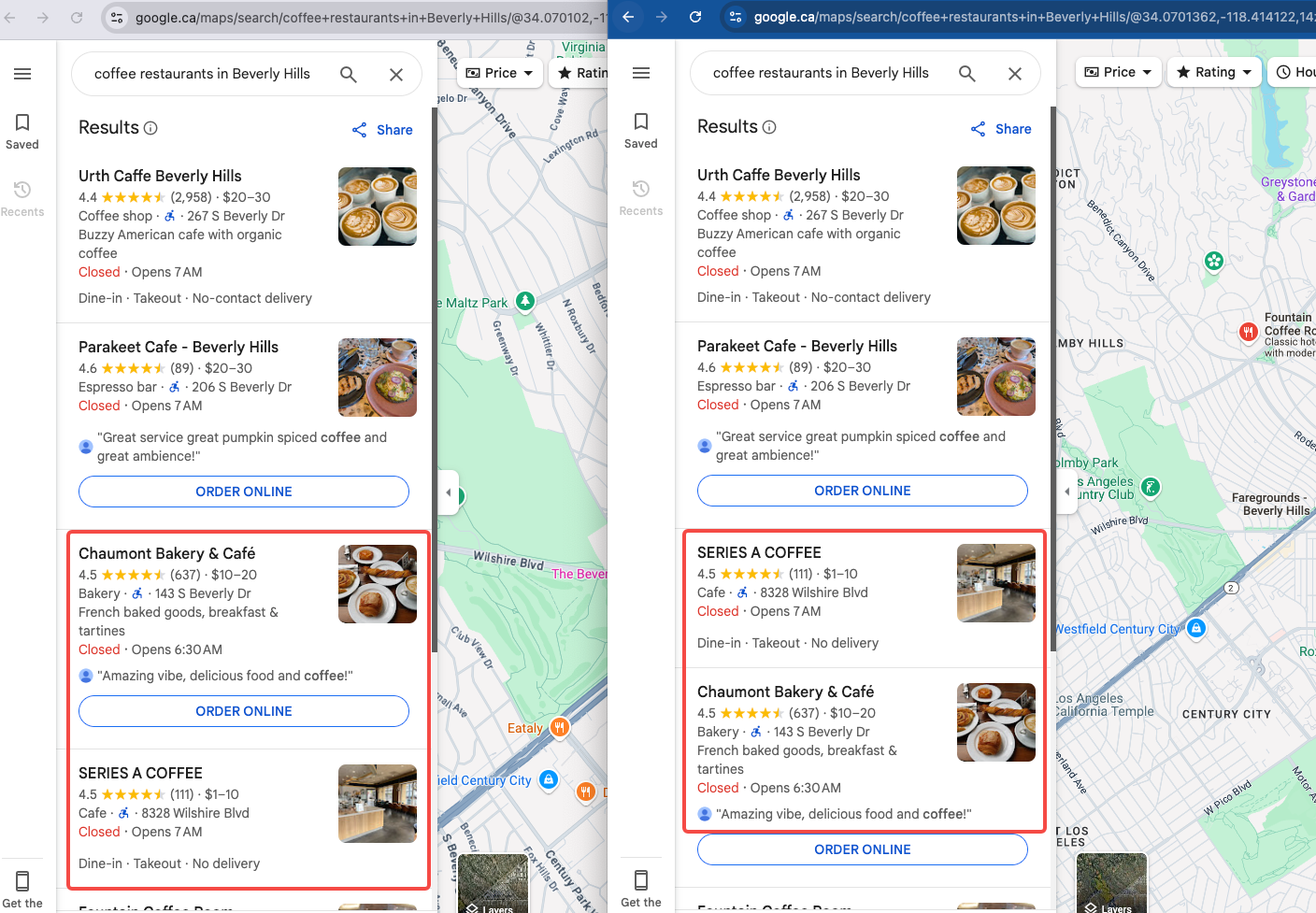
We conducted multiple product tests under identical geographic locations, IPs, and parameters, and identified the following reasons:
Google dynamically adjusts search result rankings based on the geolocation of the requesting IP. You need to switch proxies according to the country. For example, if a user with a Brazilian IP uses the Google Maps API while connected through a U.S. proxy, it can easily lead to inconsistent results.
Google makes over 5,000 algorithm tweaks daily, including ranking strategies and interface layout experiments. Through A/B testing, different users see different results to evaluate which ranking better meets user needs.
Even when we manually search on Google, we may find that the results vary each time. Especially for news-related POIs (Points of Interest), search results might update every minute, causing fluctuations in rankings for the same keyword over short periods.
Even if the proxy remains consistent, the following factors can still cause variations:
In other words, Google ranks results based on personalized information such as the user’s search history, geographic location, and device type.
We will add an IPV6 proxy parameter, and all SERP interfaces will support 8 major countries: US/PL/DE/NL/GB/BR/DE/FR. Users are advised to select these countries for crawling to ensure the accuracy of the results.
def build_request(keyword, country_code, lat=None, lng=None):
    params = {
        'query': keyword,
        'hl': country_code.lower(),  # Language region
        'gl': country_code.upper(),  # Geographic region
        'filter': 'duplicates_only'  # Filter duplicate results
    }
    if lat and lng:
        params['ll'] = f"{lat},{lng}"  # Priority over proxy geolocation
    return params
Scrapeless Serp API:
- Supports multiple search types: including Google Images, News, Maps, Shopping, Ads, etc.
- High-speed response: Return data within 2 seconds to ensure efficient crawling.
- Low cost: $0.1 / 1,000 queries, suitable for businesses of different sizes.
Google Maps search results are inherently a dynamic probability distribution rather than a static list. When using the Google Maps API to retrieve data:
Therefore, it is impossible to guarantee completely stable rankings because Google Maps itself is inherently unstable. However, if minor fluctuations (e.g., position swaps) are acceptable, the results can fully meet your requirements.
