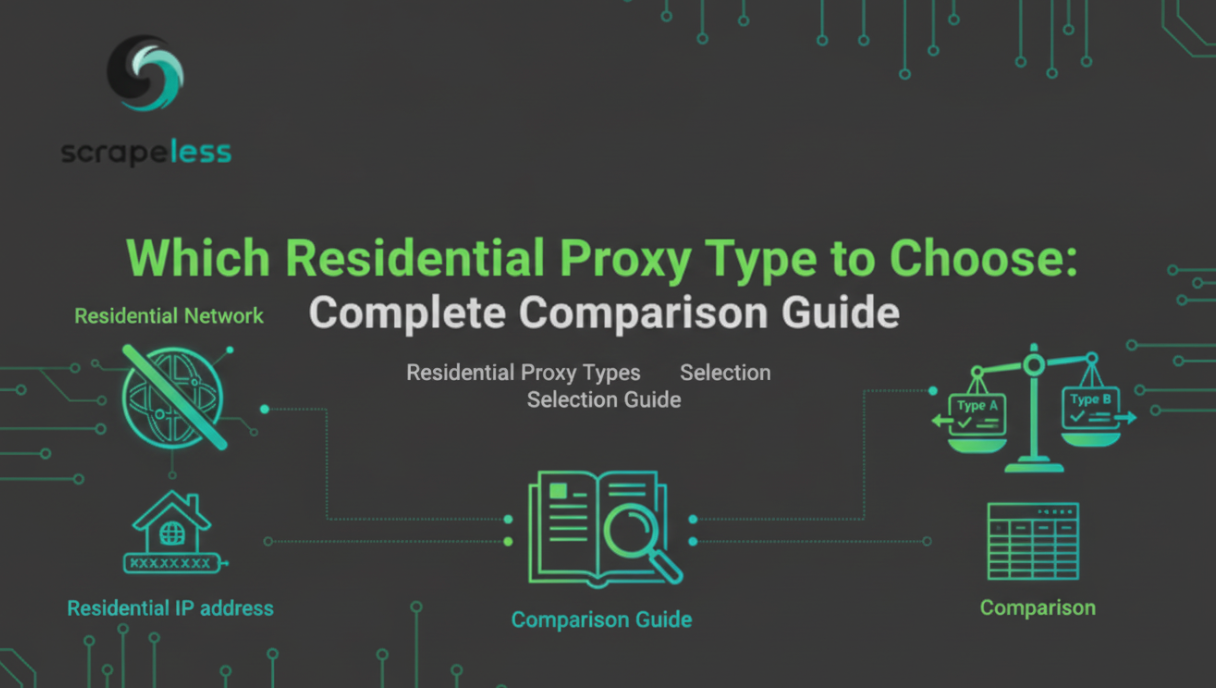
Which Residential Proxy Type to Choose: Complete Comparison Guide

Expert Network Defense Engineer
Master residential proxy types and choose the perfect solution for your needs with Scrapeless Proxies — 90M+ IPs across 195+ countries.
Understanding Residential Proxy Types
Residential proxies represent the gold standard of proxy infrastructure. Unlike datacenter proxies that use servers, residential proxies route traffic through real user devices with legitimate residential IP addresses. However, not all residential proxies are created equal. Understanding the different types is essential for choosing the right solution for your specific needs.
This comprehensive guide explores every residential proxy type, their characteristics, ideal use cases, and how to choose the best option for your requirements.
What Are Residential Proxies?
Residential proxies are IP addresses assigned by Internet Service Providers (ISPs) to real residential users. When you use a residential proxy, your traffic appears to come from an actual home user, making it extremely difficult to detect or block.
Key Characteristics:
- Assigned by legitimate ISPs
- Associated with real physical locations
- Extremely high legitimacy
- Difficult for websites to detect
- More expensive than datacenter proxies
- Generally slower than datacenter proxies
The Four Main Residential Proxy Types
1. Rotating Residential Proxies
Definition: Automatically change IP addresses with each request or at configured intervals.
How They Work:
When you make a request through a rotating residential proxy, the system automatically selects a different residential IP from the pool. Each subsequent request gets a new IP, or IPs rotate based on your configuration.
Characteristics:
- Automatic IP rotation
- Large IP pools (millions of IPs)
- Each request or session gets different IP
- Difficulty in request detection
- Lower cost per request
- Best anonymity level
Advantages:
- Maximum anonymity
- Minimize detection risks
- Handle IP blocking effectively
- Ideal for high-volume scraping
- Cost-effective for many requests
- Distributed request pattern
Disadvantages:
- Cannot maintain session state easily
- Difficult for account login/authentication
- Each request is independent
- May trigger anti-scraping measures due to rapid IP changes
- Cannot track user behavior across requests
Ideal Use Cases:
- Web scraping data from multiple pages
- Price monitoring across sites
- SEO data collection
- Market research
- Public data aggregation
- High-volume information gathering
Price Range: $0.50-2 per GB of traffic
2. Sticky Residential Proxies
Definition: Assign a consistent residential IP for a specified duration (typically 30 minutes to 24 hours).
How They Work:
When you obtain a sticky residential proxy, you get a single residential IP that remains the same for a set time period. All your requests during this period come from the same IP address.
Characteristics:
- Persistent IP during session
- Configurable session duration
- Maintains session state
- Appears as single user
- Better for authentication flows
- Moderate IP rotation capability
Advantages:
- Maintain sessions and cookies
- Complete login processes
- Track user journeys
- Appear as consistent user
- Enable complex workflows
- Natural browsing patterns
- Session state persistence
Disadvantages:
- IP may become flagged if overused
- Limited sessions before IP rotation
- Higher detection risk for repeated requests
- Cannot rapidly change IPs
- More expensive than rotating
- Session timeout risks
Ideal Use Cases:
- Account creation and management
- Shopping cart operations
- Form submissions
- Multi-step authentication
- Session-dependent workflows
- User behavior simulation
- Account login and verification
Price Range: $1-5 per GB of traffic
3. Static Residential Proxies (Premium Residential)
Definition: Dedicated residential IP addresses that remain constant indefinitely.
How They Work:
Static residential proxies assign you a specific residential IP that stays the same as long as you maintain the subscription. This is a true dedicated residential IP.
Characteristics:
- Permanent IP address
- Dedicated to single user
- Real residential address
- Consistent location
- Highest legitimacy
- ISP-assigned authenticity
Advantages:
- Most legitimate appearance
- Perfect for long-term account management
- Maintain reputation across time
- Enable complex multi-session workflows
- Whitelist-friendly (site owners may whitelist)
- Consistent user simulation
- Ideal for APIs requiring stable IPs
Disadvantages:
- Most expensive option
- IP may still get flagged eventually
- Limited geographic flexibility
- Cannot easily rotate IPs
- Single point of failure
- Highest cost per month
- Overkill for many use cases
Ideal Use Cases:
- Long-term account management
- eBay, Amazon, PayPal operations
- Affiliate marketing
- API access with IP whitelisting
- Enterprise applications
- Dedicated proxies for specific users
- Mission-critical operations
Price Range: $3-20 per IP per month
4. Backconnect Residential Proxies
Definition: Dynamic proxy pools that rotate through residential IPs while maintaining session control.
How They Work:
Backconnect proxies use a sophisticated system to assign residential IPs from a massive pool. You connect to a single backconnect endpoint, and the system routes your traffic through rotating residential IPs while you maintain session control.
Characteristics:
- Dynamic IP assignment
- Session-based rotation
- Massive IP pools
- Sophisticated routing
- Balance of rotation and consistency
- Advanced anonymity
Advantages:
- Flexible rotation control
- Large IP pools available
- Good anonymity
- Suitable for various tasks
- Balance between rotating and sticky
- Cost-effective at scale
- Sophisticated routing logic
Disadvantages:
- More complex to implement
- Higher technical knowledge needed
- API-dependent
- Varying success rates
- Provider-specific configuration
- Learning curve for optimization
Ideal Use Cases:
- Complex web scraping projects
- Large-scale data collection
- Sophisticated automation
- Competitive intelligence
- Brand monitoring
- Advanced API access
- Large-scale testing
Price Range: $1-4 per GB of traffic
Residential Proxy Type Comparison Matrix
| Feature | Rotating | Sticky | Static | Backconnect |
|---|---|---|---|---|
| IP Change Frequency | Per request | 30min-24hrs | Never | Configurable |
| Session Maintenance | Poor | Good | Excellent | Good |
| Anonymity | Highest | High | Moderate | High |
| Cost | Low | Moderate | High | Moderate |
| Detection Risk | Low | Moderate | Higher | Low |
| Best For | Mass scraping | Account ops | Long-term use | Complex workflows |
| Setup Complexity | Simple | Simple | Simple | Moderate |
| Geographic Flexibility | Excellent | Excellent | Limited | Excellent |
Choosing the Right Residential Proxy Type
Decision Framework
Do you need to maintain session state?
- YES: Consider Sticky or Static Residential Proxies
- NO: Consider Rotating or Backconnect Residential Proxies
How long do you need the same IP?
- A few seconds: Rotating Residential
- Minutes to hours: Sticky Residential
- Days or weeks: Static Residential
- Variable: Backconnect Residential
What's your primary goal?
- Mass data collection: Rotating Residential
- Account management: Static or Sticky Residential
- Balance of both: Backconnect Residential
- Maximum legitimacy: Static Residential
What's your budget?
- Tight budget: Rotating Residential (pay-per-GB)
- Moderate budget: Sticky or Backconnect
- Premium budget: Static Residential (monthly)
How technically advanced are you?
- Beginner: Rotating or Sticky Residential
- Intermediate: Backconnect Residential
- Advanced: Any type (optimize configuration)
Recommended Proxy Solutions
Scrapeless Proxies: All Residential Types in One Platform
Scrapeless Proxies provide access to all residential proxy types with over 90 million residential IPs in 195+ countries.
🔄 Rotating Residential Proxies
Perfect for high-volume scraping and data collection:
- 90M+ Real IPs: Access to over 90 million residential IPs
- Per-Request Rotation: New IP for each request
- 99.98% Success Rate: Industry-leading reliability
- Automatic Rotation: Zero configuration needed
- Geo-targeting Support: Target 195+ countries
- Multi-Protocol Support: HTTP, HTTPS, SOCKS5
- Ultra-Fast Performance: Sub-0.5s response times
- Ideal for: Mass scraping, SEO data, price monitoring
🔒 Sticky Residential Proxies
Excellent for session-based operations:
- Session Duration Control: 30 minutes to 24 hours
- 90M+ Real IPs: Consistent IPs from massive pool
- Session State Maintenance: Full cookie and session support
- 99.98% Success Rate: Highly reliable
- Perfect for Authentication: Complete login workflows
- Multi-Step Operations: Complex form submissions
- User Simulation: Natural browsing patterns
- Ideal for: Account creation, shopping carts, form submissions
🏆 Static Residential Proxies (Dedicated)
Maximum legitimacy for long-term operations:
- Dedicated Static IPs: Exclusive residential IPs
- Permanent Assignment: Constant IP address
- 99.99% Uptime: Enterprise reliability
- Low Latency: Minimal performance overhead
- Perfect for APIs: IP whitelisting compatibility
- Long-Term Sessions: Unlimited session duration
- Geo-targeting: Location-based assignment
- Ideal for: Account management, APIs, affiliate programs
🔗 Backconnect Residential Proxies
Flexible rotation with session control:
- Dynamic IP Assignment: Sophisticated routing
- Massive IP Pool: Millions of real residential IPs
- Session-Based Rotation: Flexible control
- Automatic Optimization: Smart IP selection
- Geo-targeting Support: 195+ countries
- Complex Workflows: Support for advanced operations
- High Anonymity: Excellent detection avoidance
- Ideal for: Complex scraping, brand monitoring, competitive intelligence
Use Case Examples
Example 1: E-commerce Price Monitoring
Goal: Monitor competitor prices across multiple sites daily
Best Choice: Rotating Residential Proxies
Why:
- Need multiple different IPs to avoid detection
- Don't need session persistence
- High volume of requests
- Cost-effective solution
- Rotating IPs prevent blocking
Implementation:
Your Application
  ↓
Rotating Residential Proxy Pool
  ↓
Multiple competitor websites
Example 2: Multi-Account Management
Goal: Manage 50+ accounts on platform without detection
Best Choice: Static Residential Proxies
Why:
- Each account needs dedicated IP
- Maintain session state per account
- Long-term consistency needed
- Each account appears as different user
- Premium legitimacy required
Implementation:
Account 1 → Static Proxy IP 1
Account 2 → Static Proxy IP 2
Account 3 → Static Proxy IP 3
...and so on
Example 3: Automated Shopping Bot
Goal: Automate product purchases from shopping site
Best Choice: Sticky Residential Proxies
Why:
- Need to maintain shopping cart session
- Complete checkout process requires consistent IP
- Session duration 30-60 minutes sufficient
- Multiple purchases need new IPs to avoid detection
- Natural browsing pattern from single IP
Implementation:
Session 1: Get Sticky IP 1
  - Browse products
  - Add to cart
  - Checkout (30-45 minutes)
  ↓ Session expires
Session 2: Get Sticky IP 2
  - Repeat process with new IP
Example 4: Comprehensive Brand Monitoring
Goal: Monitor brand mentions, reviews, and competitors across entire web
Best Choice: Backconnect Residential Proxies
Why:
- Massive scale requires sophisticated routing
- Mix of session-based and rotating requests
- Need geographic targeting across regions
- Complex multi-step workflows
- High-volume operations need optimization
Advanced Considerations
IP Quality Metrics
When evaluating residential proxy types, consider:
Legitimacy Score: How real the IP appears (residential > datacenter)
ASN Diversity: Variety of ISPs in proxy pool (higher is better)
Device Diversity: Variety of device types (higher is better)
Geographic Accuracy: Correctness of geolocation (important for targeting)
Age of IP: How long IP has been residential (older is better)
Reputation Score: Historical usage patterns (clean is better)
Rotation Strategy Optimization
Request-Based Rotation: Use rotating proxies with per-request IP changes for maximum detection avoidance.
Session-Based Rotation: Use sticky proxies with 1-2 hour sessions for natural browsing patterns.
Time-Based Rotation: Change IPs at specific time intervals to appear more human.
Geo-Distributed Rotation: Rotate between proxies in different countries for geographic masking.
Behavioral Rotation: Combine rotation patterns with realistic request timing and user agent variation.
Troubleshooting Common Issues
High Failure Rates with Residential Proxies
Problem: Getting blocked despite using residential proxies.
Solutions:
- Add realistic User-Agent headers
- Implement request rate limiting
- Use proper session management
- Rotate User-Agent with IP rotation
- Add realistic delays between requests
- Consider backconnect for better routing
IP Reputation Issues
Problem: Proxies getting flagged despite being residential.
Solutions:
- Check website's proxy detection methods
- Rotate IPs more frequently
- Use proxies with better reputation scores
- Verify geolocation accuracy
- Check for ASN reputation issues
Session Timeout Problems
Problem: Sessions dropping with sticky proxies.
Solutions:
- Extend sticky session duration
- Add keep-alive headers
- Implement session monitoring
- Switch to static residential for critical sessions
- Use backconnect for flexible control
Frequently Asked Questions
Can I switch between residential proxy types easily?
Yes, most providers including Scrapeless support multiple proxy types. You can switch based on project needs without changing providers.
How long do residential IP assignments typically last?
Rotating: seconds to minutes
Sticky: 30 minutes to 24 hours
Static: indefinite (as long as subscription active)
Backconnect: configurable by user
Why are residential proxies more expensive than datacenter proxies?
Residential proxies are more expensive because they provide superior legitimacy and detection avoidance. They cost providers more to acquire and maintain.
Can websites detect residential proxies?
Advanced anti-bot systems can sometimes detect residential proxies through behavioral analysis, but this is much more difficult than detecting datacenter proxies.
Should I use the same sticky residential proxy for all requests?
No, rotating stickies between sessions is recommended. Use the same IP for a session, then get a new sticky proxy for the next session.
What's the difference between rotating and backconnect residential proxies?
Rotating changes IP per request automatically. Backconnect provides more control over rotation through API parameters. Backconnect offers more flexibility for complex scenarios.
Can I whitelist residential proxy IPs?
Yes, static residential proxies can be whitelisted. Rotating and sticky proxies change too frequently for effective whitelisting.
Best Practices for Residential Proxy Selection
1. Assess Your Requirements First: Determine whether you need session persistence, then choose the appropriate type.
2. Start with Rotating: If unsure, start with rotating residential proxies. They're cost-effective and provide excellent anonymity.
3. Test Before Committing: Use free trials to test different proxy types with your specific use case.
4. Monitor Success Rates: Track success rates by proxy type and adjust based on results.
5. Implement Proper Headers: Always add realistic User-Agent and other headers regardless of proxy type.
6. Rate Limit Requests: Implement appropriate delays between requests to appear more human.
7. Combine with Other Techniques: Pair proxies with other detection avoidance techniques like header rotation and request randomization.
8. Choose Reputable Providers: Select established providers with quality IP pools and good support.
Conclusion
Choosing the right residential proxy type depends on your specific requirements. Rotating proxies excel at large-scale data collection, sticky proxies handle authentication workflows, static proxies provide dedicated legitimacy, and backconnect proxies offer flexible sophistication.
Scrapeless Proxies provides all residential proxy types with 90+ million real residential IPs in 195+ countries. Whether you need maximum anonymity, session persistence, dedicated IPs, or flexible control, Scrapeless has the solution.
Evaluate your requirements using the frameworks and examples in this guide, then start your free trial with Scrapeless to experience the best residential proxy infrastructure available.
At Scrapeless, we only access publicly available data while strictly complying with applicable laws, regulations, and website privacy policies. The content in this blog is for demonstration purposes only and does not involve any illegal or infringing activities. We make no guarantees and disclaim all liability for the use of information from this blog or third-party links. Before engaging in any scraping activities, consult your legal advisor and review the target website's terms of service or obtain the necessary permissions.