LLM Honeypotting: Detect Content Mazes and Data Poisoning

Senior Cybersecurity Analyst
TL;DR:
- LLM honeypotting presents crawler-visible content that is costly, misleading, or designed to expose automated behavior. Common forms include endless link mazes, plausible synthetic pages, and instructions aimed at downstream agents.
- A crawler cannot solve the problem with access tactics alone. It needs crawl budgets, URL-graph controls, provenance, near-duplicate detection, field validation, and isolation of untrusted content.
- Prompt injection and data poisoning are different risks. Prompt injection targets an agent's behavior at processing time; poisoning aims to corrupt a dataset or model outcome.
- The safest response is evidence-aware collection. Respect declared access rules, separate retrieved content from instructions, and promote data only after validation.
The open web now contains pages written for humans, pages generated for search engines, and pages deliberately shown to automated collectors. A crawler that treats every link and paragraph as equally trustworthy can waste resources or admit false material into a research, retrieval, or training pipeline.
LLM honeypotting is the emerging name for that defensive and deceptive surface. It deserves careful handling because the same page can be irrelevant noise for a crawler, untrusted evidence for a retrieval system, and an instruction-bearing input for an autonomous agent.
What Is LLM Honeypotting?
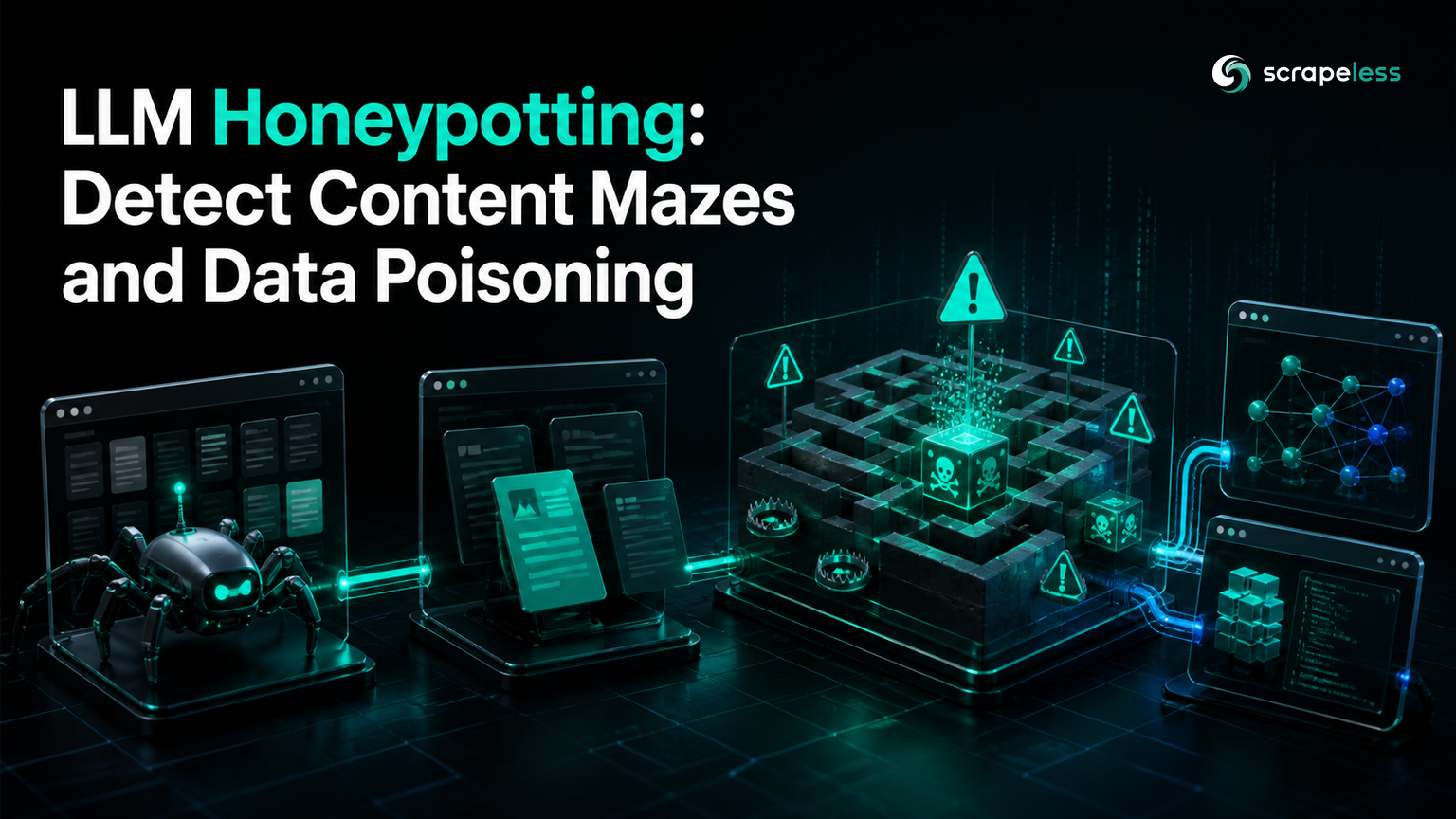
LLM honeypotting is the practice of presenting content or navigation patterns intended to detect, delay, mislead, or influence AI crawlers and agents. The content may be hidden from ordinary navigation, linked only for bots, generated at large depth, or written to look plausible while carrying little reliable information.
One public implementation is the AI Labyrinth design, which describes a maze of generated pages that consumes the resources of crawlers that ignore site preferences. That is a computational trap. Other implementations may focus on data quality or agent behavior instead.
The Three Main LLM Honeypot Patterns
1. Computational mazes
A computational maze creates many crawlable paths with little information value. URL parameters, calendar-like routes, generated archives, or recursively linked pages can make the graph appear unbounded.
The harm is operational: bandwidth, render time, tokenization, storage, and deduplication work grow while useful coverage barely changes.
2. Plausible but unreliable content
A data-quality honeypot publishes text that resembles a normal article, profile, or record but contains fabricated entities, unsupported claims, or subtly inconsistent fields. The page may pass a language-quality check while failing cross-source validation.
This material is dangerous in retrieval systems because fluency can be mistaken for authority. Provenance and corroboration matter more than prose quality.
3. Instruction-bearing content
An agent-facing honeypot embeds text that attempts to change the behavior of a system reading the page. It may tell the agent to ignore its task, reveal information, call another tool, or treat the page as privileged instruction.
The OWASP prompt-injection guidance treats external content as an untrusted input that can influence model behavior. Retrieved page text must never share the same authority as system or developer instructions.
LLM Honeypotting, Prompt Injection, and Data Poisoning
These risks overlap but are not interchangeable:
| Risk | Primary target | Typical timing | Main control |
|---|---|---|---|
| Crawl maze | Compute and coverage | Collection | Budgets and graph limits |
| Prompt injection | Agent behavior | Retrieval or tool use | Instruction hierarchy and tool policy |
| Data poisoning | Dataset or model outcome | Ingestion or training | Provenance, validation, and quarantine |
| Bot detection | Collector identity | Access | Declared crawler policy and authorized collection |
A page can combine all four. Classifying the failure correctly prevents a team from applying a networking fix to a trust problem.
Warning Signs in a Crawl
No single signal proves a honeypot, but several together justify quarantine:
- URL count grows much faster than unique information.
- Pages differ only in tokens, dates, or generated entity names.
- Internal links lead deeper without a path back to human navigation.
- Sitemap, canonical, and visible navigation disagree about page importance.
- Factual fields conflict with established primary sources.
- Page text contains commands addressed to a crawler, model, or tool.
- Content appears only for a declared crawler identity.
- The same template emits an unusually large number of low-information pages.
Do not label every duplicate archive or poor-quality page malicious. Content-management bugs and faceted navigation create similar shapes. Record the evidence and apply neutral controls first.
Control 1: Respect Declared Access Rules
The first defense is to avoid entering disallowed or irrelevant space. Read robots directives, sitemap scope, canonicals, and site terms before collection. The Robots Exclusion Protocol standardizes crawler directives, although legal and contractual obligations extend beyond robots.txt.
An authorized collector should identify itself consistently and give operators a contact path. Changing identities to defeat a site's expressed policy increases risk and weakens auditability.
Control 2: Put Hard Budgets on the URL Graph
A crawl needs explicit stopping rules:
- Maximum depth from a trusted seed.
- Maximum new URLs per host, path prefix, and template.
- Maximum parameter combinations.
- Maximum rendered bytes and processing time.
- Minimum information gain before a branch continues.
- Duplicate and near-duplicate thresholds.
Budgets should stop a branch, preserve the reason, and allow a reviewer to inspect samples. An unbounded queue is not a coverage strategy.
Start Scraping with Scrapeless
Power up your web scraping and automation workflow with Scrapeless!
Sign up today and get $5 in free credit — no credit card required.Claim your free credit now in the Scrapeless Dashboard.
Control 3: Separate Retrieval From Trust
Fetched content should enter a quarantine layer before it becomes searchable evidence or training data. Store the source URL, capture time, response metadata, content hash, extraction method, and validation state with every document.
Promotion rules can then require:
- A known source class or approved domain.
- Agreement with one or more independent primary sources.
- Schema checks for dates, identifiers, and numeric ranges.
- Near-duplicate analysis against existing records.
- A reviewer for material that affects consequential decisions.
The NIST AI Risk Management Framework provides a broader map-measure-manage structure for documenting these risks and controls.
Control 4: Treat Page Text as Data, Never Authority
An agent should receive retrieved page text in a clearly delimited untrusted-content channel. The harness, not the page, decides which tools are available and whether an action needs approval.
Practical policy includes:
- Page text cannot change the system task or permission set.
- Tool arguments are validated independently of retrieved instructions.
- External writes require a separate approval boundary.
- Secrets never enter page-visible context.
- Source citations remain attached to extracted claims.
- Suspicious instructions are logged as content, not executed.
This design contains prompt injection even when the collector successfully acquires the page.
Control 5: Validate Information Gain
Content quality can be measured before expensive downstream processing. Useful signals include unique named entities, schema-complete records, new facts relative to the parent page, duplicate shingles, and agreement among independent sources.
Set thresholds by content class. A glossary page may legitimately resemble related entries, while a database record should supply stable identifiers and field-level changes. The goal is not a universal “AI text detector”; it is a task-specific decision about whether the page adds trustworthy evidence.
Where Scrapeless Fits
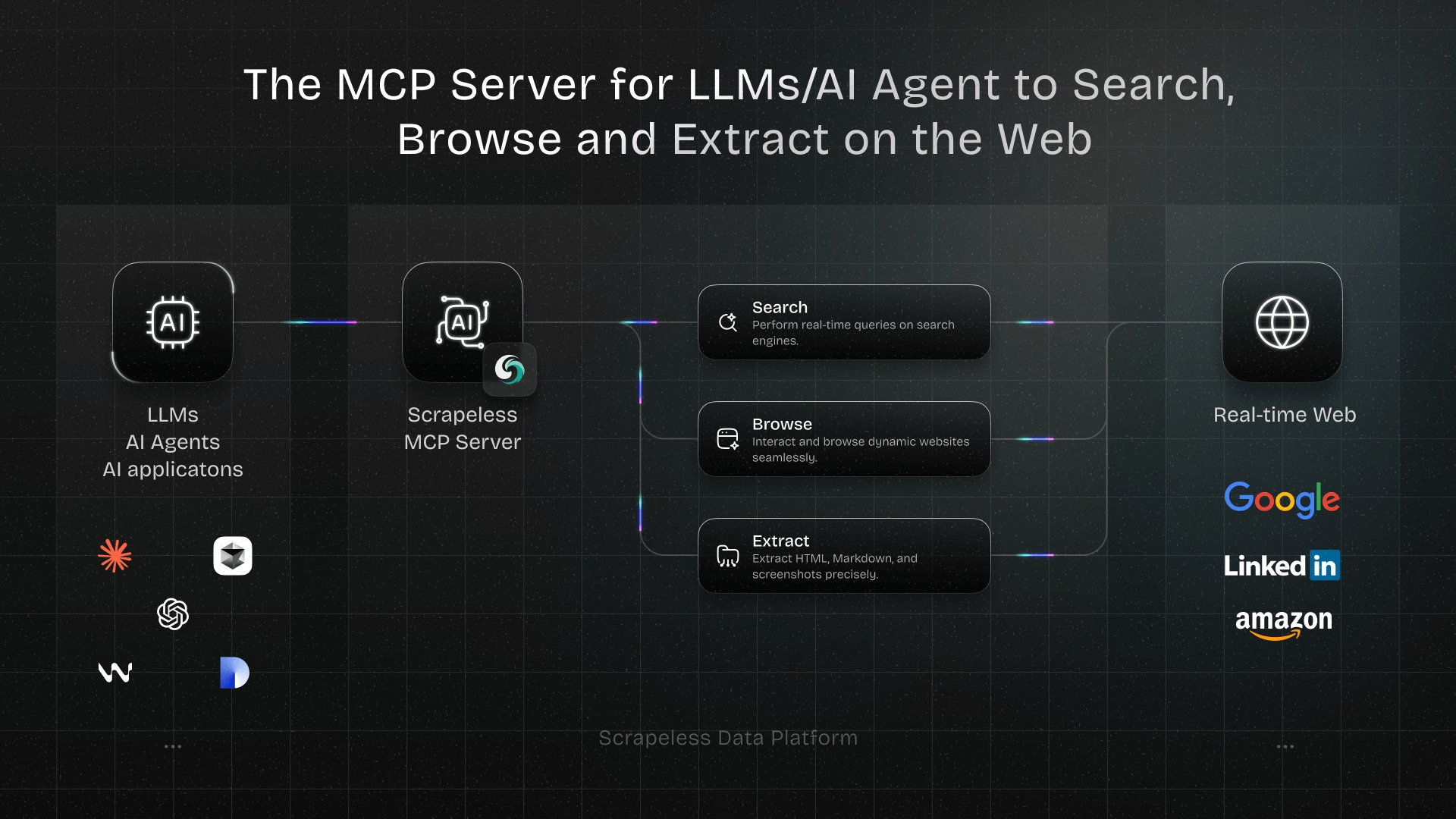
Scrapeless AI Agent can supply controlled search, extraction, and browser tools to a harness. The harness still owns crawl budgets, trust policy, provenance, approvals, and dataset promotion.
That separation is important. Browser access solves rendering and session acquisition; it does not make every rendered sentence reliable. The web-data benchmark guide provides a framework for measuring source acquisition and evidence quality. Review Scrapeless pricing after defining how many searches, pages, and browser sessions the bounded workflow needs.
Incident Response for Suspected Honeypot Content
When a pipeline detects a suspicious branch:
- Stop expansion from that branch without deleting evidence.
- Preserve representative URLs, content hashes, headers, and link relationships.
- Classify the issue as computational, data-quality, instruction, or access-policy risk.
- Remove affected documents from serving and training indexes.
- Review whether any agent actions were influenced by the content.
- Tighten the relevant budget, trust rule, or approval boundary.
- Reprocess only from trusted seeds after the control is in place.
The incident record should distinguish confirmed deception from ordinary low-quality content. That keeps future rules precise.
Conclusion
LLM honeypotting turns web collection into a trust-boundary problem. The durable response is not aggressive access; it is bounded crawling, transparent identity, provenance, duplicate detection, cross-source validation, and strict separation between page content and agent instructions. Those controls protect compute, datasets, and tool-using systems at the same time.
Ready to Build a Safer Web-Data Pipeline?
Join the Scrapeless developer community on Discord or Telegram. Open the Scrapeless Dashboard and pair live web tools with explicit budgets and evidence policy.
FAQ
Q: What is LLM honeypotting?
LLM honeypotting is the use of crawler-visible content or navigation patterns intended to detect, delay, mislead, or influence AI crawlers and agents.
Q: Is an AI crawl maze the same as prompt injection?
No. A crawl maze consumes collection resources, while prompt injection attempts to change an agent's behavior through untrusted content. A page can contain both.
Q: How can a crawler detect a content maze?
A crawler can flag branches where URL growth is high, information gain is low, pages are near-duplicates, and navigation depth has little connection to human-visible structure.
Q: Can robots.txt prevent LLM honeypot exposure?
Robots.txt communicates crawler preferences but does not technically prevent access or validate content. A responsible crawler should honor it and still apply independent trust and budget controls.
Q: How should an AI agent handle instructions found on a web page?
An AI agent should treat page instructions as untrusted data. The harness must preserve higher-priority instructions, validate tool calls, protect secrets, and require approval for consequential actions.
Q: What should happen to suspected poisoned data?
Suspected poisoned data should be quarantined with its provenance, removed from serving or training indexes, compared with primary sources, and promoted only after explicit validation.
At Scrapeless, we only access publicly available data while strictly complying with applicable laws, regulations, and website privacy policies. The content in this blog is for demonstration purposes only and does not involve any illegal or infringing activities. We make no guarantees and disclaim all liability for the use of information from this blog or third-party links. Before engaging in any scraping activities, consult your legal advisor and review the target website's terms of service or obtain the necessary permissions.