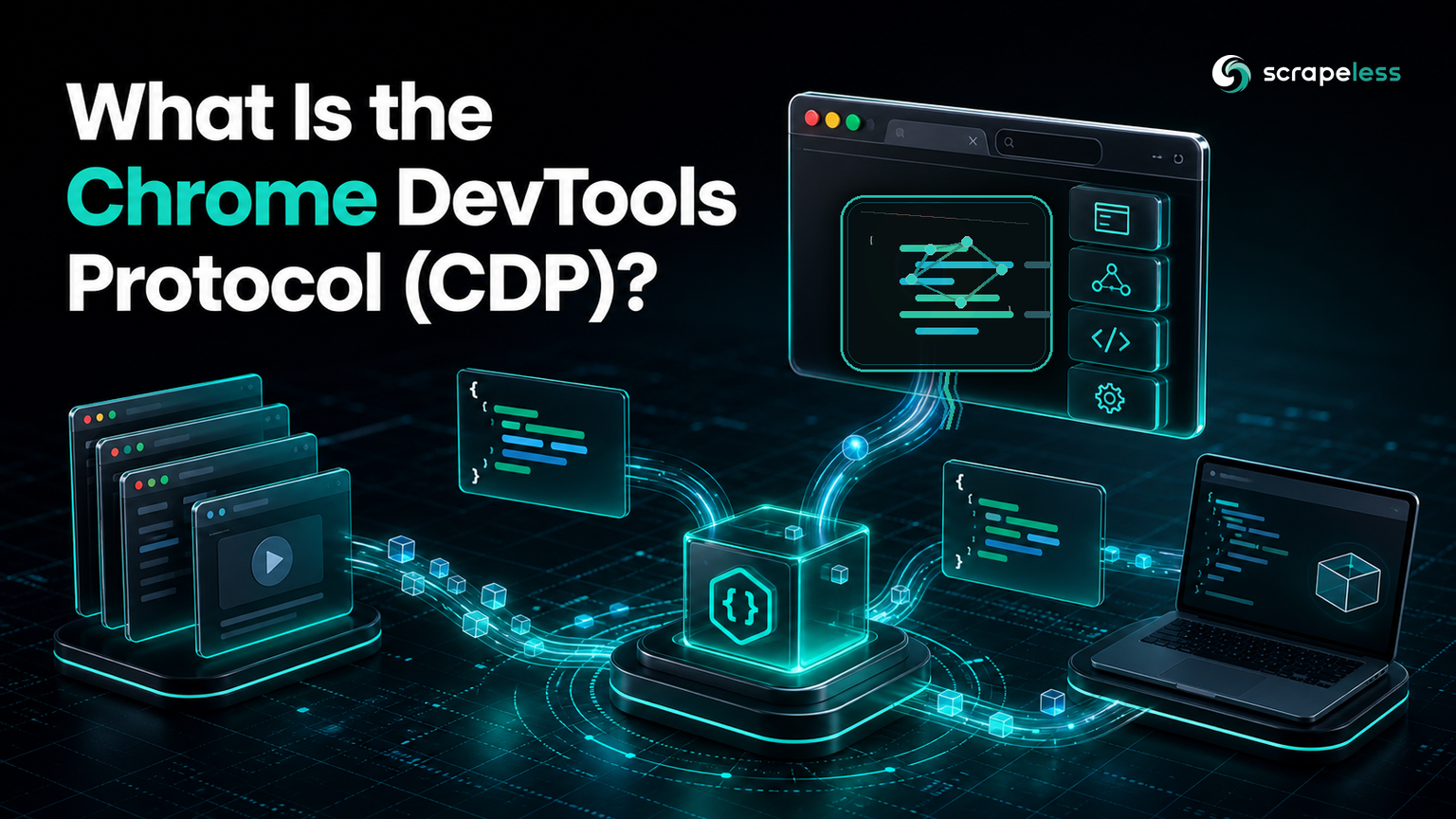
What Is the Chrome DevTools Protocol (CDP)?

Senior Web Scraping Engineer
TL;DR:
- The Chrome DevTools Protocol (CDP) is the wire protocol that lets external tools instrument, inspect, debug, and profile Chromium-based browsers. Chrome DevTools itself talks to the browser over CDP, and so do Puppeteer, Playwright, and chromedp.
- CDP is organized into domains. Each domain —
Page,Network,DOM,Runtime,Target,Browser,Input, and 60-plus others — defines the commands it accepts and the events it emits. - The transport is JSON messages over a WebSocket. A client sends a command as a JSON object with an
id, amethod, andparams; the browser replies with a matching result and streams events as they happen. - It comes in two tracks. The tip-of-tree (
tot) version changes frequently with no compatibility guarantee; the stable1.3version (from Chrome 64) is a supported subset. - CDP is how modern automation connects to a browser — including remote ones. Point a CDP client at a WebSocket endpoint and it drives that browser, wherever it runs.
- The Scrapeless Scraping Browser is a CDP endpoint. Puppeteer, Playwright, or chromedp connect to one WebSocket URL and run against real cloud Chromium, unchanged.
- Free to start. New Scrapeless accounts include free Scraping Browser runtime — sign up at app.scrapeless.com.
Introduction: the language automation speaks to Chrome
The Chrome DevTools Protocol is the interface a browser exposes so that outside tools can control and observe it. When you open Chrome's DevTools panel and watch network requests or step through JavaScript, the panel is not reaching into the browser directly — it is sending CDP commands and receiving CDP events over a connection. Every browser-automation library built on Chromium uses the same protocol underneath.
That matters for scraping and testing because CDP is what lets a script do what a human with DevTools can do: navigate, read the DOM after it renders, intercept requests, capture screenshots, and evaluate JavaScript in the page. This guide explains what CDP is, how its domains and messages work, and why a CDP endpoint is exactly what you connect to when you drive a cloud browser.
What CDP is, precisely
The Chrome DevTools Protocol lets tools instrument, inspect, debug, and profile Chromium, Chrome, and other Blink-based browsers. It is a remote-control interface for the browser's internals, maintained by the Chrome DevTools team. The official protocol definition lists every domain, command, and event, and the browser exposes the same definition at its /json/protocol/ endpoint.
CDP is not a scraping tool by itself — it is the layer beneath the tools. Puppeteer, Playwright, chromedp, and Lighthouse all translate their high-level calls into CDP commands, which is why they can drive any browser that speaks it.
How CDP is organized: domains, commands, and events
CDP divides the browser's surface into domains, and each domain owns a set of commands and events. There are 60-plus domains; the ones a scraper touches most are a small subset:
| Domain | What it controls |
|---|---|
Page |
navigation, lifecycle, screenshots, print-to-PDF |
Network |
requests, responses, headers, interception |
DOM |
the document tree, nodes, attributes |
Runtime |
evaluating JavaScript in the page context |
Target |
tabs, frames, and creating new browser contexts |
Input |
synthetic mouse, keyboard, and touch events |
Browser |
browser-level actions and window management |
A command is a request you send to a domain (for example, Page.navigate). An event is a message the browser pushes to you when something happens (for example, Network.responseReceived). A high-level call like Puppeteer's page.goto() is a Page.navigate command plus a wait on lifecycle events underneath.
The transport: JSON messages over a WebSocket
CDP communication is serialized JSON objects of a fixed structure, carried over a WebSocket connection. A client connects to the browser's debugging WebSocket, then exchanges messages defined by the JSON data format.
A command carries an id, a method naming the domain and command, and a params object:
json
// Command sent to the browser
{ "id": 1, "method": "Page.navigate", "params": { "url": "https://example.com" } }

// Result returned with the matching id
{ "id": 1, "result": { "frameId": "…", "loaderId": "…" } }

// An event pushed by the browser (no id)
{ "method": "Page.loadEventFired", "params": { "timestamp": 12345.6 } }
The id correlates a result with the command that produced it; events arrive without an id because the browser emits them on its own schedule. A client typically opens the WebSocket, enables the domains it cares about (Network.enable, Page.enable), then interleaves commands and events for the rest of the session.
Protocol versions: tip-of-tree and stable
CDP ships in two tracks. The tip-of-tree (tot) version tracks the latest Chromium and changes frequently, with no backwards-compatibility guarantee. The stable 1.3 version, introduced at Chrome 64, is a supported subset that tools can target for stability. A separate v8-inspector surface exposes the same style of protocol for debugging and profiling Node.js. Most automation libraries pin to a Chromium build and use the matching protocol, which is why a library and a browser version are expected to move together.
What uses CDP
CDP is the shared foundation under a broad set of tools:
- Chrome DevTools — the panel in the browser is a CDP client.
- Puppeteer — connects over CDP by default.
- Playwright — drives Chromium over CDP (and implements its own protocols for Firefox and WebKit).
- chromedp — a Go library that speaks CDP directly.
- Lighthouse — collects performance and audit data over CDP.
Because they all speak the same protocol, any of them can attach to a browser they did not launch — as long as that browser exposes a CDP endpoint. The emerging cross-browser standard, WebDriver BiDi, is built on the same bidirectional command-and-event model that CDP pioneered.
CDP and cloud browsers
A CDP endpoint does not have to be on your machine. Because the protocol runs over a WebSocket, a client can connect to a browser running anywhere — which is exactly how a cloud browser works. The Scrapeless Scraping Browser exposes a CDP endpoint at a single WebSocket URL, so a CDP client attaches to real cloud Chromium instead of a local one:
- Puppeteer connects with
puppeteer.connect({ browserWSEndpoint }). - Playwright connects with
chromium.connectOverCDP(). - chromedp connects with
NewRemoteAllocator.
The code is unchanged; only the endpoint moves. The browser runs in the cloud with a real Chromium fingerprint and residential egress, and your CDP-speaking library drives it exactly as it would a local browser.
The same endpoint also answers to a few domains beyond the stock protocol — Captcha.* for CAPTCHA detection and solving, Agent.* for simulated clicks and typing — documented on the Scrapeless CDP API reference. A client that already speaks CDP can call those the same way it calls Page.navigate.
Get your API key on the free plan at app.scrapeless.com.
Get your API key on the free plan: app.scrapeless.com
Conclusion: one protocol under every Chromium tool
CDP is the common layer beneath browser automation: a set of domains, exchanged as JSON commands and events over a WebSocket, that lets a tool drive and observe a Chromium browser. Understanding it explains why Puppeteer, Playwright, and chromedp feel similar underneath, why a library and a browser version travel together, and why connecting to a remote browser is as simple as pointing at a different WebSocket URL. For a worked example of driving a cloud browser over CDP from Python, see the Scrapling production-scraper guide, and compare plans on the Scrapeless pricing page.
Ready to Drive a Cloud Browser Over CDP?
Join our community to claim a free plan and connect with developers building CDP-based automation: Discord · Telegram.
Sign up at app.scrapeless.com for free Scraping Browser runtime and point your CDP client at a cloud browser over one WebSocket URL.
FAQ
Q: Is CDP the same as WebDriver?
No. CDP is Chromium's own low-level, bidirectional protocol (commands and events over a WebSocket); classic WebDriver is a request-response HTTP protocol standardized by the W3C. The newer WebDriver BiDi standard brings a CDP-style bidirectional model across browsers.
Q: Do I use CDP directly when I write a scraper?
Usually not. You use a library — Puppeteer, Playwright, or chromedp — that translates your calls into CDP commands. You only drop to raw CDP for capabilities a library does not expose.
Q: Does Playwright use CDP?
For Chromium, yes. Playwright drives Chromium over CDP; for Firefox and WebKit it uses its own protocols, which is why some CDP-specific features are Chromium-only.
Q: How does a tool connect to a browser over CDP?
The browser exposes a debugging WebSocket URL. The client opens that WebSocket and exchanges JSON commands and events. A cloud browser like Scrapeless gives you that WebSocket URL directly, so the same client connects to a remote browser.
Q: What is the difference between tip-of-tree and stable CDP?
Tip-of-tree tracks the latest Chromium and can change without notice; stable 1.3 (from Chrome 64) is a fixed subset tools can rely on. Libraries generally pin to a Chromium build and the protocol version that ships with it.
At Scrapeless, we only access publicly available data while strictly complying with applicable laws, regulations, and website privacy policies. The content in this blog is for demonstration purposes only and does not involve any illegal or infringing activities. We make no guarantees and disclaim all liability for the use of information from this blog or third-party links. Before engaging in any scraping activities, consult your legal advisor and review the target website's terms of service or obtain the necessary permissions.