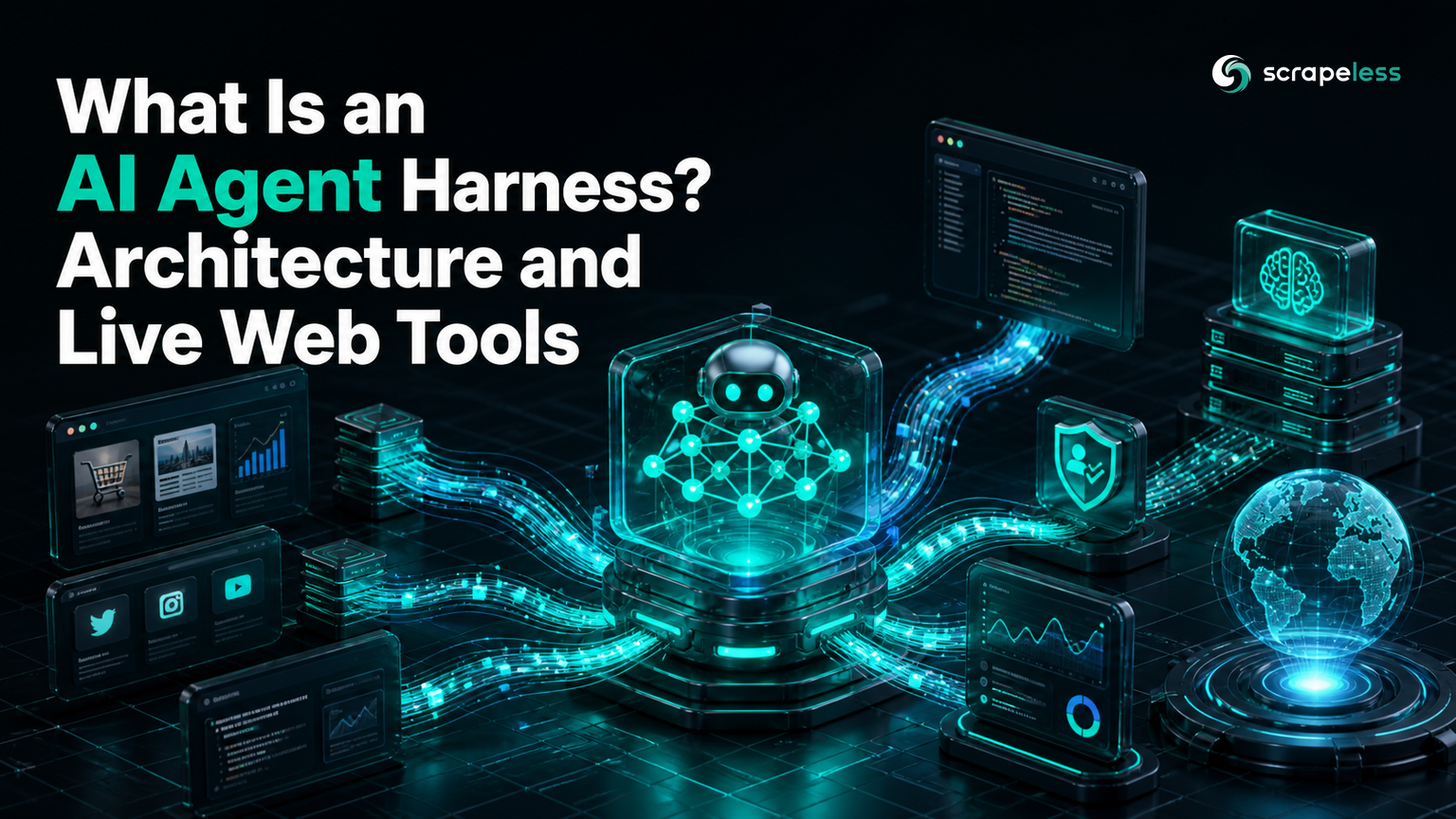
What Is an AI Agent Harness? Architecture and Live Web Tools

Senior Cybersecurity Analyst
TL;DR:
- An AI agent harness is the runtime scaffolding that turns a model response into controlled, multi-step work.
- A useful harness owns the tool loop, context, state, approvals, observability, and stopping rules; the model supplies reasoning and language.
- Live web access should enter through a permissioned tool boundary so every search, browser action, and returned source can be inspected.
- A harness is ready for production when failures are visible, state is recoverable, permissions are narrow, and evidence travels with the answer.
An impressive model can still make a poor agent. Give it no durable state and it forgets what it has done. Give it unrestricted tools and a small mistake becomes an external action. Give it web access without provenance and a polished answer may rest on stale or untraceable material.
The missing layer is often the harness: the code and policies around the model that decide what context it receives, which tools it may call, how results return, when a person must approve an action, and when the run should stop.
What is an AI agent harness?
An AI agent harness is the runtime scaffolding that coordinates a language model, tools, context, state, and control policies so the system can complete a task across multiple steps. The model proposes; the harness executes, records, constrains, and resumes.
That definition is close to the one used in the Microsoft Agent Framework documentation, which describes a harness as the layer that drives model and tool calls, manages conversation state, applies approval policies, and keeps work moving. The important word is runtime. A prompt is input. A framework is a collection of building blocks. A harness is the assembled control system that stays active while the job runs.
Harness, model, framework, and runtime are not synonyms
These terms overlap in product descriptions, but they answer different questions.
| Layer | Main job | Typical responsibility |
|---|---|---|
| Model | Predict and reason over context | Produce text, plans, tool arguments, and interpretations |
| Agent framework | Supply reusable components | Model adapters, tool abstractions, memory interfaces, and workflow primitives |
| Runtime | Execute the process | Start sessions, schedule work, stream events, and manage resources |
| Harness | Apply task-level control | Compose the loop, policies, state, approvals, evidence, and stop conditions |
A framework may provide a ready-made harness, or a team may assemble one from framework primitives. A runtime may host many harnessed agents. The distinction matters during design reviews: changing the model rarely fixes a missing approval gate or an unrecoverable state store.
How an agent harness works
Most harnesses repeat a compact control loop:
- Build the model context from instructions, user input, memory, and current task state.
- Ask the model for the next response or tool call.
- Check the proposed action against permissions, schemas, budgets, and approval policy.
- Execute the allowed tool and capture its output, errors, timing, and provenance.
- Update state, compact context when needed, and decide to continue, pause, or stop.
The loop sounds simple. The engineering lies in the boundaries. Tool arguments must be validated before execution. A browser session should be scoped to the task. An irreversible write should not share the same policy as a read-only search. A failed process should leave enough state to explain what happened and resume safely.
The Cloudflare Agents documentation treats the harness as a composable application layer around tools, state, scheduling, and user interaction. That composition is why harness design shapes agent behavior as much as the underlying model does.
The components that carry the real workload
Context assembly
Context assembly selects instructions, task history, tool results, and memory for the next model call. Dumping everything into the prompt is not a strategy. A good harness preserves the facts needed for the next decision and summarizes old detail without erasing commitments, approvals, or unresolved errors.
Tool registry and execution boundary
The registry tells the model which operations exist and the schema each accepts. The execution boundary validates calls, injects credentials outside the prompt, and records results. Protocols such as the Model Context Protocol make that boundary portable across agent clients and tool servers.
State and memory
State answers, “Where is this run now?” Memory answers, “What should persist beyond this run?” Mixing them creates subtle bugs. A current browser tab, pending approval, or command exit status belongs to task state. A preferred output format or validated company glossary may belong to longer-lived memory.
Policy and approvals
Policy decides which actions are allowed automatically, which need confirmation, and which are forbidden. The safest default is capability-based: expose only the tools and data a task needs. Approval should sit immediately before the consequential action, with the exact target and payload visible.
Observability and evaluation
Logs should connect each model decision to tool arguments, tool output, state changes, and the final answer. Traces help diagnose a single run; evaluations reveal recurring failure patterns. The NIST AI Risk Management Framework is a useful reference for mapping, measuring, and managing risks beyond raw task success.
Why live web tools change the harness design
Static model knowledge is not a substitute for current evidence. Prices, documentation, availability, and public pages change. A web-aware agent needs a retrieval path that can search, open, render, and extract sources during the run.
That path should not be an invisible model feature. It should be a normal tool surface with explicit inputs and inspectable outputs. A harness can then pin location and language, restrict allowed operations, preserve source URLs, and separate “the page said this” from “the model inferred this.”
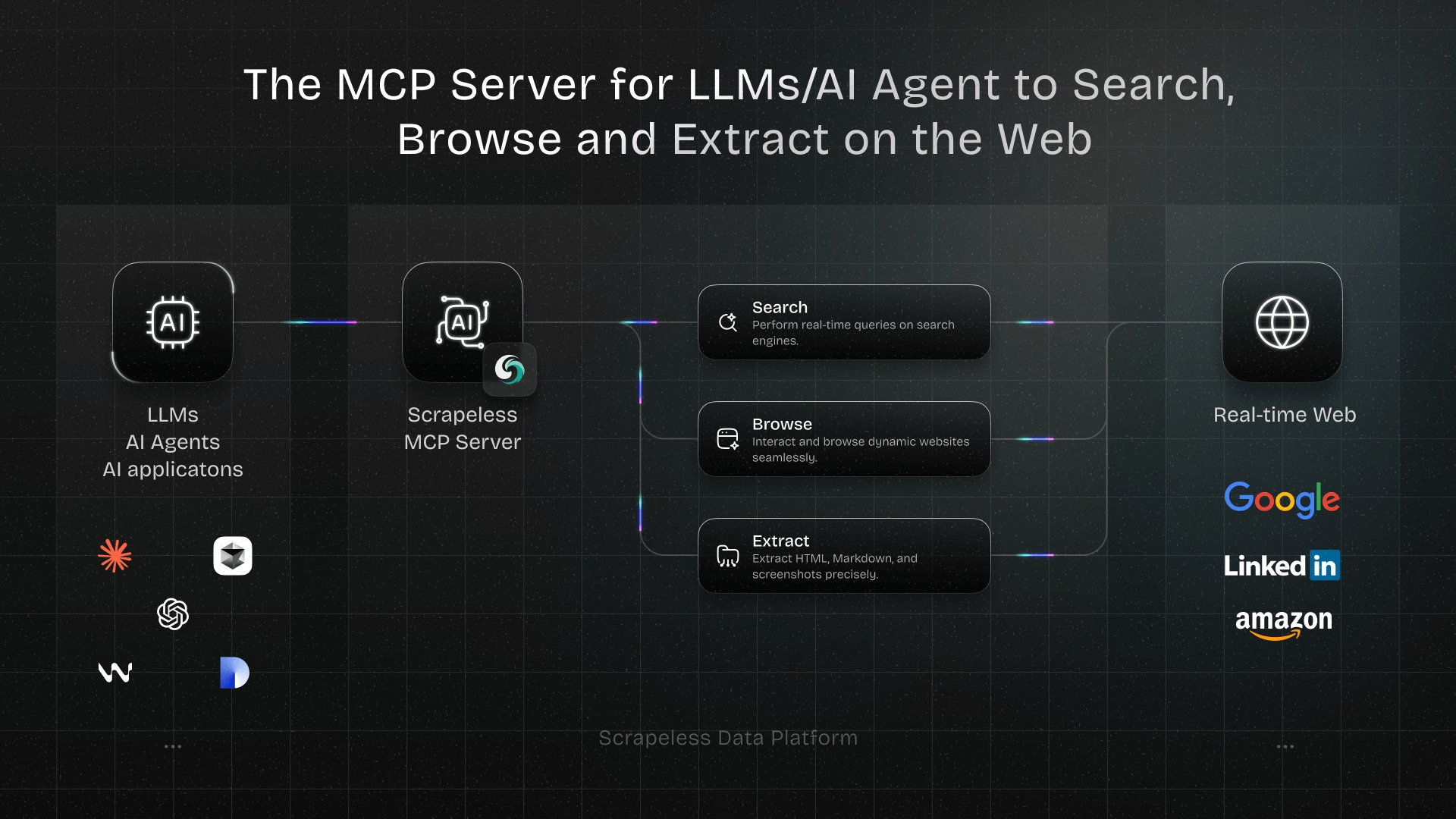
Scrapeless AI Agent provides a route to live web capabilities, while the Scrapeless MCP use-case guide shows how search, extraction, and browser actions fit into agent workflows. The harness still owns the important decisions: which tools are visible, which arguments are valid, and what evidence must reach the final answer.
Start Scraping with Scrapeless
Power up your web scraping and automation workflow with Scrapeless!
Sign up today and get $5 in free credit — no credit card required.Claim your free credit now in the Scrapeless Dashboard.

A practical harness architecture
For a research agent, the control flow can be drawn as a chain of accountable handoffs:
User intent → task state → model decision → policy check → web tool → evidence store → model synthesis → completion check
Each arrow needs a contract. The model decision must conform to a tool schema. The policy check must know the action’s risk level. The web tool must return data with provenance. The completion check must compare the result with the original request rather than trusting the model’s confidence.
This also makes failures easier to locate. A bad query is different from a blocked page. A successful page extraction with a weak conclusion is different from a tool failure. The harness should preserve those distinctions instead of flattening everything into chat text.
How to evaluate an AI agent harness
Use a task that requires several tools and has a clearly checkable outcome. Then inspect the run against this list:
- Task fidelity: Does the harness preserve the original constraints through every step?
- Permission scope: Can the agent see or do more than the task requires?
- Argument validation: Are malformed or risky calls stopped before execution?
- Evidence quality: Do claims point back to source URLs, files, or command output?
- State recovery: Can a paused or failed run resume without repeating consequential work?
- Human control: Are approval requests specific, timely, and understandable?
- Observability: Can an operator reconstruct why the agent chose an action?
- Termination: Does the loop stop on a defined condition instead of model confidence alone?
The Scrapeless pricing page helps estimate the web-data portion of a harness separately from model and orchestration costs.
Common harness mistakes
One mistake is treating the prompt as the entire control plane. Prompts guide behavior, but they do not enforce file permissions, validate a payment payload, or persist a durable checkpoint.
Another is exposing every available tool. Large tool surfaces increase selection ambiguity and expand the consequences of a bad call. Start with an allowlist tied to the task and add capabilities only when a measured need appears.
A third mistake is logging only the final answer. Without intermediate tool arguments, returned evidence, and state transitions, an operator cannot tell whether the problem came from retrieval, execution, or reasoning.
Conclusion
An agent harness is what turns a capable model into an accountable system. It owns the loop around the model: context, tools, policy, state, evidence, observability, and termination. When current web data matters, the harness should expose it as a controlled tool boundary rather than an opaque shortcut.
Ready to Build a Web-Aware Agent Harness?
Join our community to claim a free plan and connect with developers building evidence-backed agent systems: Discord · Telegram.
Sign up at app.scrapeless.com and give the next harness a permissioned path to live web data.
FAQ
Q: What is an AI agent harness in simple terms?
An AI agent harness is the control software around a model that manages tools, context, state, permissions, and the task loop. It turns individual model responses into a governed process that can complete multi-step work.
Q: Is an agent harness the same as an agent framework?
No. A framework supplies reusable components, while a harness is the assembled runtime control layer for a working agent. A framework can ship a default harness, and teams can customize or replace it.
Q: Does an agent harness include memory?
Usually, yes. The harness decides what current state and longer-lived memory enter the model context, when they are updated, and how sensitive data is kept outside the prompt.
Q: Why should web access be a tool in the harness?
Tool-based web access gives the harness a place to validate inputs, scope permissions, attach provenance, and record results. That makes current information inspectable instead of blending it invisibly into a model response.
Q: Can an AI agent run without a harness?
A model can answer a prompt without a harness, but reliable multi-step agency needs equivalent control logic somewhere. If tool execution, state, approvals, and stopping rules exist, that surrounding logic is functioning as a harness even if the product uses another name.
At Scrapeless, we only access publicly available data while strictly complying with applicable laws, regulations, and website privacy policies. The content in this blog is for demonstration purposes only and does not involve any illegal or infringing activities. We make no guarantees and disclaim all liability for the use of information from this blog or third-party links. Before engaging in any scraping activities, consult your legal advisor and review the target website's terms of service or obtain the necessary permissions.