What Is Agentic Search? Architecture, Workflows, and Web Data

Senior Cybersecurity Analyst
TL;DR:
- Agentic search is a multi-step retrieval process controlled by an AI agent. The system plans queries, calls search and page tools, evaluates evidence, and continues until it can answer or reaches a limit.
- It differs from semantic search in control flow. Semantic search ranks items for one query; agentic search can reformulate the task, gather several sources, and change its next action from intermediate results.
- Fresh web data belongs in a separate acquisition layer. Search results, rendered pages, provenance, and validation should be returned through bounded tools rather than hidden inside the model prompt.
- Production quality depends on budgets and evidence. Cap calls, time, and domains; preserve source URLs and timestamps; reject weak or conflicting evidence instead of smoothing it over.
- Scrapeless supplies web-search and extraction tools, not the agent's reasoning loop. Deep SerpApi, Universal Scraping API, and the MCP Server can form the live web-data layer around an agent framework.
Agentic search is useful when a question cannot be answered reliably by retrieving one ranked list. A market-research request may need several queries, current pages, comparison across sources, and a record of which evidence supported each conclusion.
The term is sometimes used for any search box connected to a language model. That definition is too broad. An agentic search system has a control loop: it selects an action, observes the result, updates state, and decides whether to search again, inspect a page, ask for clarification, or stop.
What Is Agentic Search?
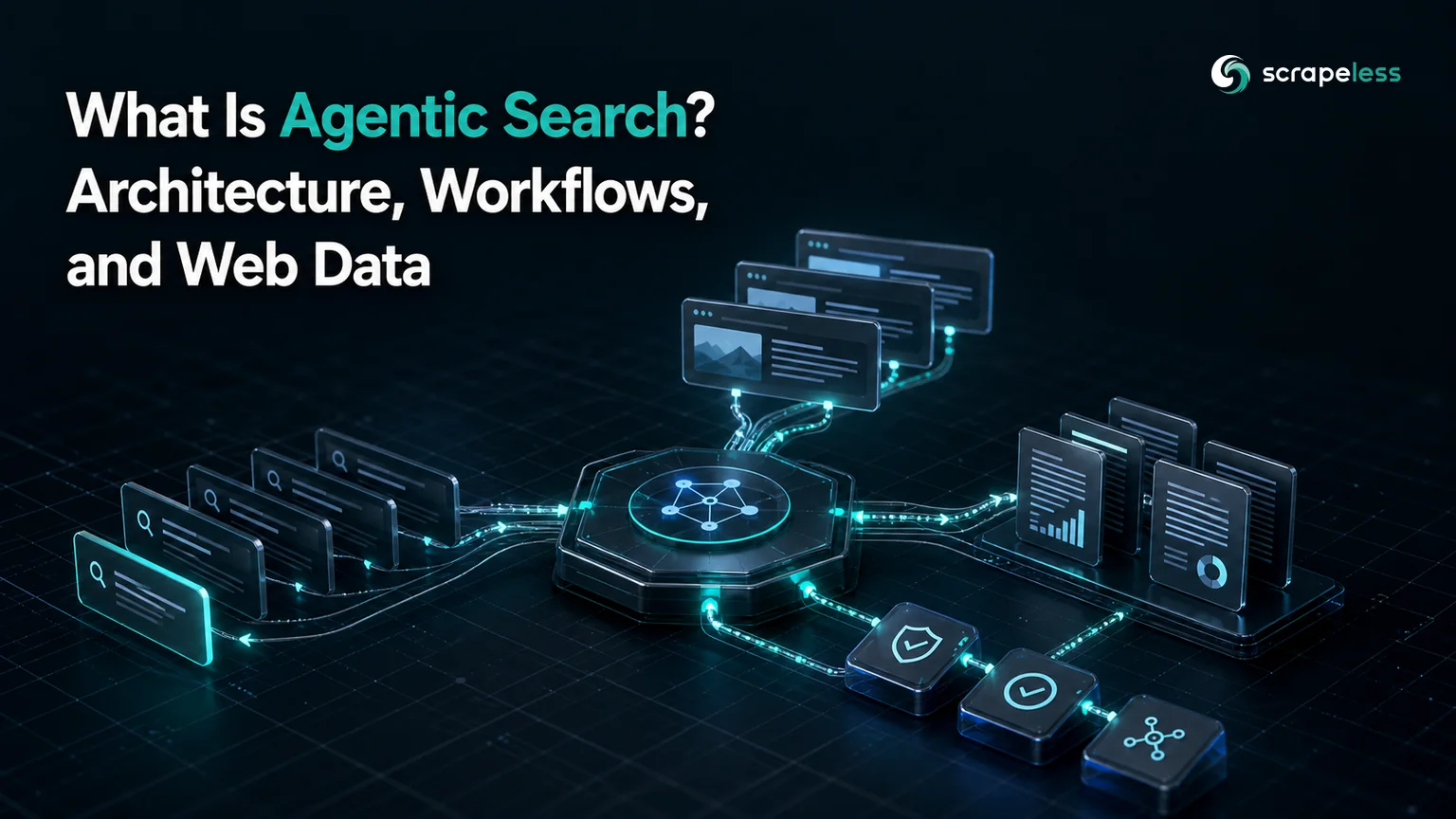
Agentic search is an information-retrieval architecture in which an AI agent plans and executes a sequence of searches and source inspections to satisfy a goal. The sequence is dynamic. The next query or tool call depends on evidence returned by previous steps.
Research on large language model search agents describes systems that combine planning, retrieval, evidence aggregation, and evaluation across multiple turns. The ACL survey of large language model-based search agents organizes the field around architecture, optimization, applications, evaluation, and open challenges.
The defining property is not the model brand or user interface. It is conditional control over retrieval. A fixed workflow that always sends three queries in parallel may be useful, but it becomes agentic only when observations influence what happens next.
How Agentic Search Works
A practical agentic search loop has seven stages.
- Goal parsing. Convert the request into a task, constraints, required output, and stop conditions.
- Query planning. Choose one or more queries, target domains, languages, regions, and time windows.
- Search execution. Call a search tool that returns structured results and source metadata.
- Source acquisition. Retrieve selected pages with direct HTTP, a managed API, or browser rendering as needed.
- Evidence extraction. Pull claims, dates, entities, and supporting passages into a typed evidence record.
- Evaluation. Check coverage, disagreement, freshness, authority, and whether another action is justified.
- Synthesis or stop. Produce an answer with provenance, ask for input, or stop because a cost, time, or policy limit was reached.
The loop should maintain explicit state. Useful fields include the original goal, approved domains, query history, selected URLs, rejected sources, evidence records, remaining budget, and unresolved questions. Without that state, the model may repeat searches or lose the distinction between a source claim and its own summary.
Traditional, Semantic, and Agentic Search Compared
| Search model | Main input | Control pattern | Typical output | Best fit |
|---|---|---|---|---|
| Traditional lexical search | Keywords and filters | One request, ranked retrieval | Documents or links | Known terms and navigational tasks |
| Semantic search | Natural-language query or embedding | One retrieval step or fixed reranking | Similar passages or records | Concept matching within an indexed corpus |
| Agentic search | Goal, constraints, and tool access | Conditional multi-step loop | Synthesized answer plus evidence | Complex, current, or exploratory questions |
Traditional search is efficient when the user knows the entity or phrase. Semantic search helps when the wording differs from the indexed text. Agentic search adds planning and tool use, but it also adds latency, cost, and new failure modes.
Agentic search should not replace a deterministic lookup. If the task is “return the current record for customer 123,” a database query is clearer and easier to audit. Use an agentic loop when the retrieval path is genuinely uncertain.
Core Components of an Agentic Search Architecture
Planner and orchestrator
The planner decomposes the request and proposes actions. The orchestrator enforces tool schemas, permissions, budgets, and stop conditions. Keeping those roles distinct prevents a persuasive model output from silently overriding runtime policy.
Search tool
The search tool should return structured results: title, canonical URL, snippet, rank, locale, and retrieval time. Scrapeless Deep SerpApi can supply current search-engine results for supported scenarios.
The tool contract should expose locale and time-sensitive parameters. A result without collection context is difficult to compare or reproduce.
The Deep SerpApi quickstart documents the current task request and response states for an implementation.
When the task expands from result discovery to dynamic-page inspection, the Scrapeless Scraping Browser guide shows how browser control enters the acquisition layer without changing the agent's reasoning policy.
Page acquisition tool
Search snippets are discovery data, not complete evidence. The agent needs a bounded way to retrieve selected pages. Universal Scraping API fits managed public-page acquisition, while Scraping Browser is appropriate when JavaScript or interaction is necessary.
The acquisition layer should validate the final URL, content type, page identity, and required marker before returning the document to the agent.
Tool interface
Tools need clear names, input schemas, output schemas, and error states. The Model Context Protocol tools specification defines a standard way for servers to expose tools that models can discover and invoke.
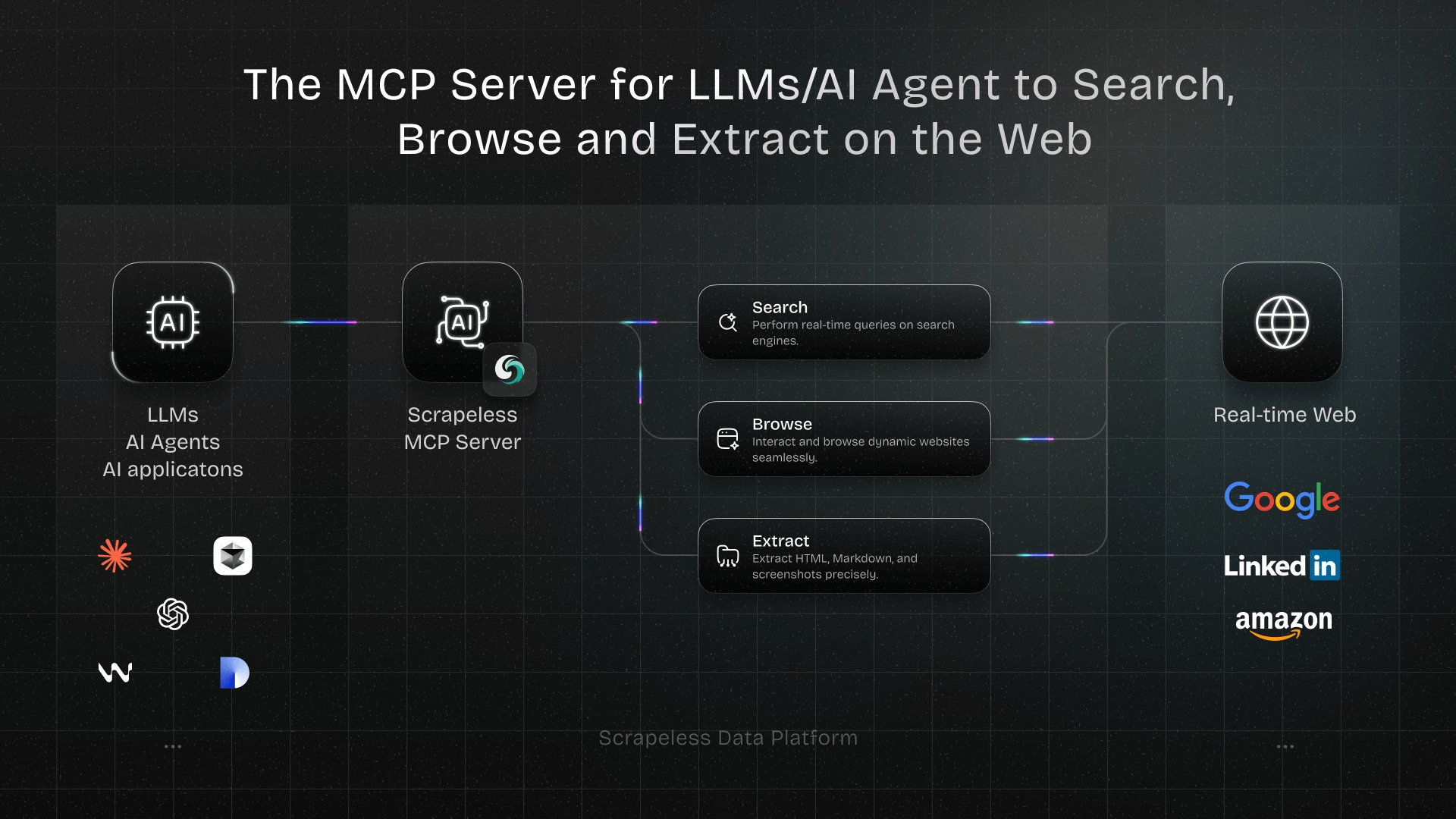
The Scrapeless MCP Server guide explains how web-search and extraction capabilities can be presented to compatible clients. The MCP server is the connection layer; the host agent still owns planning, permissions, and answer policy.
Evidence store
An evidence record should preserve the claim, source URL, source type, observed date, collection time, and extraction method. Store enough context to review the claim without passing entire uncontrolled pages into every model call.
Evaluator and guardrails
The evaluator checks whether evidence covers the question, whether sources conflict, and whether the next call is worth its cost. Guardrails enforce allowed domains, data categories, tool permissions, and human approval for sensitive actions.
Tool calls also depend on ordinary web protocol behavior. The HTTP semantics specification provides the baseline for methods, representations, redirects, and response metadata that an acquisition tool should record.
A Reference Multi-Step Workflow
Consider a request to compare the latest public pricing and core features of three software products.
The agent first turns the request into a small schema: product, plan, price basis, feature, source URL, and observed date. It searches for official pricing pages, selects only first-party domains, and retrieves the current pages. If a page is rendered client-side, the acquisition router uses a browser. The evaluator rejects third-party pricing summaries and flags products whose terms cannot be matched to the requested basis.
The agent then asks a narrower follow-up query only for missing fields. It stops when every product has a first-party source or when the call budget is exhausted. The final answer separates verified values from unavailable values instead of estimating them.
This workflow is agentic because the second action depends on gaps found after the first acquisition pass.
Agentic Search Use Cases
Current market research
An agent can discover official product pages, retrieve updates, normalize evidence, and identify what changed. The output should include observation dates because pricing and product details are time-sensitive.
Technical research
The system can search documentation, specifications, and papers, then compare implementation claims against primary sources. Domain allowlists and source-type ranking reduce low-quality retrieval.
Support and incident investigation
An agent can retrieve current status pages, runbooks, and approved telemetry tools. It should never turn a suggested remediation into an external action without the permission and approval model defined by the application.
Competitive monitoring
Search agents can watch public blogs, changelogs, and product pages, extract changes, and attach source evidence to each alert. A scheduled deterministic discovery job may handle most runs; an agent can be reserved for ambiguous changes.
Procurement research
The agent can gather official feature, security, and pricing documents, then map them to a pre-defined evaluation matrix. Human review remains necessary for contractual and risk decisions.
Agentic Search Limitations
Search results are not ground truth
Ranked results can be stale, incomplete, localized, or optimized for visibility rather than accuracy. The system should retrieve primary pages and record the observation context.
More steps create more failure points
Each query, page fetch, extraction, and summary can introduce an error. Long chains also increase latency and cost. Limit the number of actions and require a reason for every additional search.
Tool output can contain hostile instructions
Web pages are untrusted input. Treat page text as data, not as runtime authority. Tool permissions, data isolation, and explicit approval boundaries should be enforced outside the model.
Synthesis can hide disagreement
An agent may produce one fluent answer from conflicting sources. Preserve per-claim provenance and show unresolved conflicts. Do not use model confidence as a substitute for evidence coverage.
Governance is part of the architecture
The NIST AI Risk Management Framework provides a risk-management structure for AI systems. For agentic search, practical controls include tool allowlists, data-minimization rules, audit logs, human approval points, and retention limits.
How to Evaluate an Agentic Search System
Evaluate the full loop rather than judging one polished answer.
- Coverage: Does the answer address every required field?
- Source quality: Are decisive claims supported by appropriate primary sources?
- Freshness: Does every time-sensitive claim include an observation context?
- Traceability: Can a reviewer map each claim to a source record?
- Efficiency: How many searches, page fetches, tokens, and seconds were used?
- Restraint: Does the agent stop when evidence is insufficient or policy blocks a step?
- Repeatability: Does the same test set produce materially consistent evidence and conclusions?
Create a benchmark of real tasks with expected source types and acceptance conditions. Include missing-source and conflicting-source cases; they reveal whether the system can abstain.
Conclusion: Put Retrieval Behind a Controlled Tool Boundary
Agentic search is a conditional loop that plans retrieval, acquires sources, evaluates evidence, and decides what to do next. Its value appears on questions where one query or one corpus lookup is insufficient.
The safest architecture keeps live search and page acquisition behind typed, observable tools. The agent can choose actions, but budgets, permissions, provenance, and acceptance rules remain application controls.
Add Live Web Data to an Agentic Search Workflow
Create a Scrapeless account and test one research task with Deep SerpApi plus a page-acquisition tool. Define the evidence schema and stop conditions before increasing the call budget. Review Scrapeless pricing against calls per completed research task.
FAQ
Q: What is agentic search in simple terms?
Agentic search lets an AI agent perform several searches and source checks, using each result to decide the next action, until it can answer or reaches a limit.
Q: How is agentic search different from semantic search?
Semantic search ranks content by meaning for a query. Agentic search controls a multi-step process that may reformulate queries, retrieve pages, compare evidence, and stop conditionally.
Q: Does agentic search require web scraping?
Not always. It can search an internal corpus or database. It needs a page-acquisition layer when the task depends on current public web content beyond search-result metadata.
Q: What role does MCP play in agentic search?
MCP standardizes how a compatible client discovers and calls tools. It can expose search and extraction tools, while the host application remains responsible for planning, permissions, and governance.
Q: What should an agentic search result include?
Include the answer, source URLs, observation times for changing facts, unresolved conflicts, and enough provenance to review each decisive claim.
At Scrapeless, we only access publicly available data while strictly complying with applicable laws, regulations, and website privacy policies. The content in this blog is for demonstration purposes only and does not involve any illegal or infringing activities. We make no guarantees and disclaim all liability for the use of information from this blog or third-party links. Before engaging in any scraping activities, consult your legal advisor and review the target website's terms of service or obtain the necessary permissions.