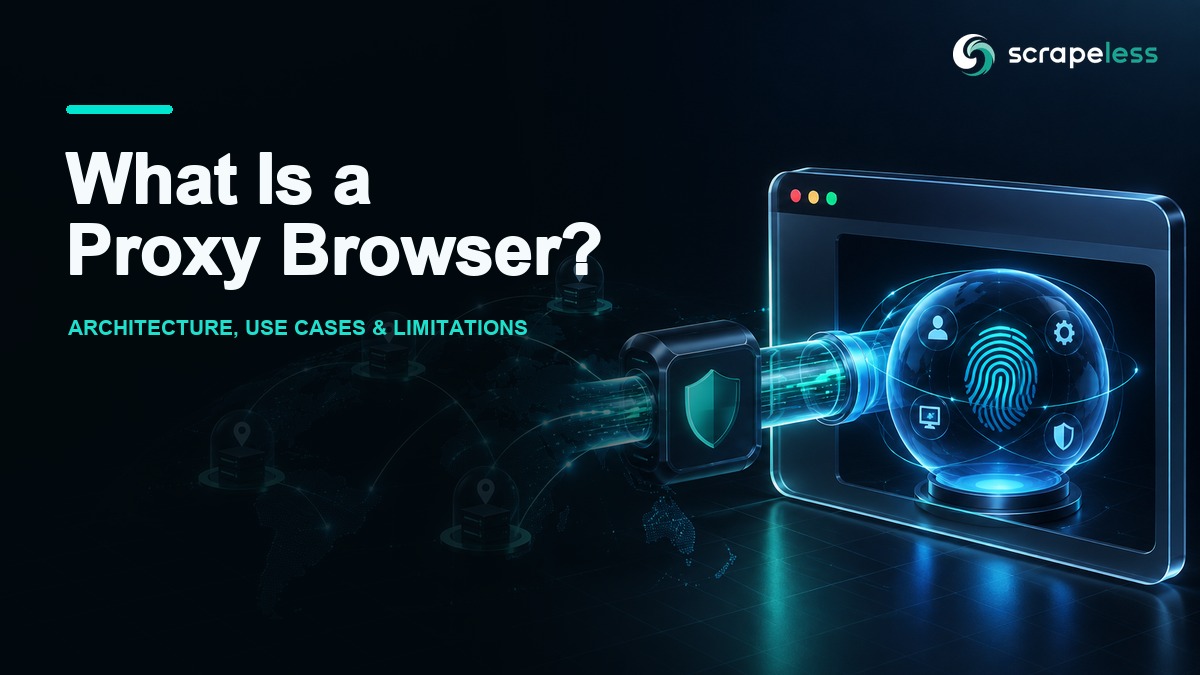
What Is a Proxy Browser? Architecture, Use Cases, and Limitations

Expert Network Defense Engineer
TL;DR:
- A proxy browser combines a browser session with controlled proxy routing. The proxy changes the network identity, while the browser preserves JavaScript execution, cookies, storage, and interaction state.
- IP identity and browser identity are separate layers. Rotating an IP does not reset cookies, local storage, timezone, language, canvas output, or other browser signals.
- A browser proxy is a setting; a proxy browser is the whole environment. Extension proxies are convenient for manual browsing, while managed browser sessions are designed for repeatable automation.
- Proxy type should follow the task. Datacenter IPs favor throughput, residential IPs favor consumer-network context, and sticky sessions favor multi-step navigation.
- Scrapeless Agent Browser exposes one CDP WebSocket endpoint. Puppeteer and Playwright can connect to a remote session whose proxy country, session lifetime, and browser environment are configured together.
What Is a Proxy Browser?
A proxy browser is a browser environment that sends web requests through an intermediary proxy server while retaining the browser features needed to render and interact with a page.
That definition has two parts. The proxy supplies a network path and an outward-facing IP address. The browser supplies JavaScript execution, DOM state, cookies, storage, navigation, and user-like interaction. A plain HTTP client with a proxy is therefore not the same thing as a proxy browser, even though both can route traffic through another IP.
The underlying proxy behavior follows the same model described by the HTTP semantics specification: a client can direct HTTP requests to an intermediary, and HTTPS traffic can use the CONNECT method to establish a tunnel to a destination.
How a Proxy Browser Request Flows
A proxy browser request moves through two systems that must stay consistent: the browser session and the proxy route.
- An automation client creates or connects to a browser session.
- The session receives a proxy configuration, such as country and session policy.
- The browser sends page and asset requests through the proxy endpoint.
- The target receives the proxy's outward-facing IP address.
- The browser executes JavaScript, updates the DOM, stores cookies, and keeps navigation state.
- The automation client reads or changes the rendered page through a control protocol.
The proxy does not render the page. The browser does not create the proxy network. A dependable proxy browser keeps both layers aligned for the lifetime of a task.
IP Identity and Browser Identity Are Different
IP identity describes the network origin a target can observe. Browser identity describes the state and signals exposed by the browsing environment.
| Layer | Typical signals | What changes it |
|---|---|---|
| Network identity | IP address, network owner, rough location | Proxy endpoint and egress selection |
| HTTP identity | Headers, accepted languages, cookies | Browser profile and request configuration |
| Runtime identity | Timezone, screen size, fonts, WebGL, canvas | Browser engine and profile settings |
| Session identity | Cookies, local storage, cache, login state | Browser context and persistence policy |
| Behavior | Navigation order, timing, clicks, form input | Automation logic or agent actions |
Changing only the IP leaves the other layers intact. Reusing one browser profile across unrelated IPs can produce an incoherent identity. Replacing the browser context on every page can also break a multi-step workflow that depends on a cart, consent choice, or authenticated state.
The WHATWG Web Storage standard defines browser-managed storage that persists independently of the current network route. Cookie behavior is likewise governed by browser state rather than by the proxy itself.
Proxy Browser vs Browser Proxy vs Extension Proxy
These three terms describe different scopes.
| Term | Meaning | Best fit | Main limitation |
|---|---|---|---|
| Browser proxy | Proxy settings applied to an existing browser | Manual testing and simple routing | Does not provide session orchestration by itself |
| Proxy browser | A browser environment built around proxy routing and session control | Scraping, localization, monitoring, agents | Requires browser lifecycle management |
| Extension proxy | A browser add-on that changes proxy settings | Quick manual checks | Usually tied to a desktop profile and weak for unattended workloads |
A browser proxy is usually a configuration choice. A proxy browser is the operating environment around that choice. An extension proxy is one user-interface mechanism for applying a configuration.
The distinction matters in automation. An extension can change where a tab sends requests, but it does not automatically create isolated profiles, expose remote control, preserve task state across machines, or coordinate an IP with timezone and language.
Proxy Types Used by Proxy Browsers
Proxy type determines the network characteristics of the session, not the browser's rendering capability.
Datacenter Proxies
Datacenter proxies use addresses hosted on server infrastructure. They suit high-throughput access to targets that accept cloud-network traffic, repeatable testing from fixed locations, and workloads where bandwidth and predictable routing matter.
Residential Proxies
Residential proxies route through consumer-network addresses. They are useful when a workflow needs country or region context that resembles ordinary household traffic. The provider's sourcing, consent model, location accuracy, and session controls matter as much as pool size.
ISP Proxies
ISP proxies combine an address registered through an internet service provider with server-hosted stability. They are often chosen for longer sessions that need a consistent outward identity.
Rotating and Sticky Sessions
Rotation and stickiness are policies rather than source types. A rotating policy changes the egress address between requests or sessions. A sticky policy holds the same address for a defined task window. Search-result collection may tolerate rotation, while a cart or multi-page workflow usually needs continuity.
Start Scraping with Scrapeless
Power up your web scraping and automation workflow with Scrapeless!
Sign up today and get $5 in free credit — no credit card required.Claim your free credit now in the Scrapeless Dashboard.
Where Proxy Browsers Fit
A proxy browser is useful when the task needs both a controllable browser and a controlled network origin.
- Web data collection. Render client-side pages, preserve filters, follow pagination, and extract public fields while routing sessions through appropriate locations.
- Localization testing. Check language, currency, catalog, tax, or landing-page differences from controlled regions.
- Ad verification. Confirm that a public campaign creative and destination appear as expected in the intended market.
- Market research. Observe public pricing, assortment, availability, and messaging across regions.
- AI agents. Give an agent a stateful browser that can navigate, read, click, and continue a task across several pages.
The same tool can be misused, so scope matters. Collect public data, minimize stored fields, respect applicable terms and law, and avoid restricted or private surfaces.
How Agent Browser Implements the Pattern
Scrapeless Agent Browser provides a remote browser session through a standard CDP WebSocket endpoint. Proxy country and session lifetime are configured on the connection URL, so the network route and browser lifecycle start together.
The control layer is compatible with Puppeteer and Playwright. CDP itself is a set of domains for inspecting and controlling a Chromium-based browser; the Chrome DevTools Protocol reference documents the protocol surface used by remote clients.
Prerequisite: the connection requires a Scrapeless API key in
SCRAPELESS_API_KEY.
javascript
import puppeteer from "puppeteer-core";

const token = process.env.SCRAPELESS_API_KEY;
if (!token) throw new Error("SCRAPELESS_API_KEY is required");

const endpoint = new URL("wss://browser.scrapeless.com/api/v2/browser");
endpoint.searchParams.set("token", token);
endpoint.searchParams.set("sessionTTL", "180");
endpoint.searchParams.set("proxyCountry", "US");

const browser = await puppeteer.connect({
  browserWSEndpoint: endpoint.toString(),
});
const page = await browser.newPage();
await page.goto("https://example.com", { waitUntil: "domcontentloaded" });
console.log(await page.title());
await browser.close();
This example keeps the task deliberately small: create one managed session, pin US egress, load a public page, read its title, and close the browser. Production workflows should also define session boundaries, allowed targets, data retention, and concurrency limits.
Limitations a Proxy Browser Does Not Remove
A proxy browser does not turn every page into an authorized or stable data source.
- Access rules still apply. Authentication, permissions, robots directives, site terms, and applicable law remain relevant.
- A new IP is not a new identity by itself. Cookie, storage, locale, and runtime signals must remain coherent.
- Dynamic pages still need extraction logic. Rendering produces a DOM; it does not decide which fields are correct.
- Location is not perfectly deterministic. Content can also depend on account state, language, device, inventory, and experiment assignment.
- Long tasks need observability. Console logs, network traces, screenshots, and session replay are often more valuable than a final error string.
The W3C WebDriver standard makes the same architectural separation clear: an automation client controls a browser through a defined remote interface, while the browser remains responsible for navigation and document behavior.
How to Choose a Proxy Browser
Choose a proxy browser by matching the environment to the workflow.
| Question | Prefer a simple browser proxy | Prefer a managed proxy browser |
|---|---|---|
| Is the task manual and occasional? | Yes | Not required |
| Does the page require JavaScript and interaction? | Sometimes | Yes |
| Does the workflow span several pages? | Limited | Yes |
| Are sessions created by code or an agent? | No | Yes |
| Is geographic routing part of every run? | Manual setup | Central configuration |
| Are logs and replay needed? | Browser DevTools only | Managed observability |
| Must many isolated sessions run in parallel? | Poor fit | Designed for it |
Also inspect the proxy product itself: source type, sharing model, location controls, sticky-session behavior, supported protocols, authentication, usage reporting, and sourcing policy. The Scrapeless proxy overview explains where datacenter, residential, ISP, and IPv6 options fit.
Conclusion
A proxy browser joins two independent controls: where traffic exits and how the browser behaves. The clean architecture keeps network identity, browser identity, and session state aligned for one authorized task.
For a broader explanation of proxy infrastructure, read what a cloud proxy is, compare current options on the Scrapeless pricing page, and use the Agent Browser documentation as the source of truth for connection parameters.
Ready to Build Location-Aware Browser Workflows?
Join the Scrapeless community to compare session designs with teams building browser automation: Discord · Telegram.
Sign up at app.scrapeless.com and connect Agent Browser to the proxy country and session policy your workflow needs.
FAQ
Q: Is a proxy browser the same as a VPN?
No. A proxy browser applies proxy routing to a browser environment, while a VPN commonly creates a device- or network-level tunnel that covers broader traffic.
Q: Does a proxy browser hide every identifying signal?
No. A proxy changes the network address, but cookies, storage, locale, screen settings, runtime behavior, and account state can still identify or correlate a session.
Q: Can a proxy browser run headlessly?
Yes. A managed proxy browser can run without a visible desktop interface while remaining controllable through Puppeteer, Playwright, CDP, or another supported automation client.
Q: Which proxy type should a proxy browser use?
Use datacenter proxies for compatible high-throughput targets, residential proxies when consumer-network context matters, and ISP proxies when a stable long-lived identity matters. Validate the choice against the real target.
Q: Is using a proxy browser legal?
The technology is legal in many jurisdictions, but the task, data, contract, and access method determine whether a specific use is permitted. Collect public data, review site terms, and seek legal advice for the relevant jurisdiction.
Q: Can Agent Browser work without an AI agent?
Yes. Agent Browser exposes a CDP WebSocket endpoint that ordinary Puppeteer or Playwright code can control without an AI reasoning layer.
At Scrapeless, we only access publicly available data while strictly complying with applicable laws, regulations, and website privacy policies. The content in this blog is for demonstration purposes only and does not involve any illegal or infringing activities. We make no guarantees and disclaim all liability for the use of information from this blog or third-party links. Before engaging in any scraping activities, consult your legal advisor and review the target website's terms of service or obtain the necessary permissions.