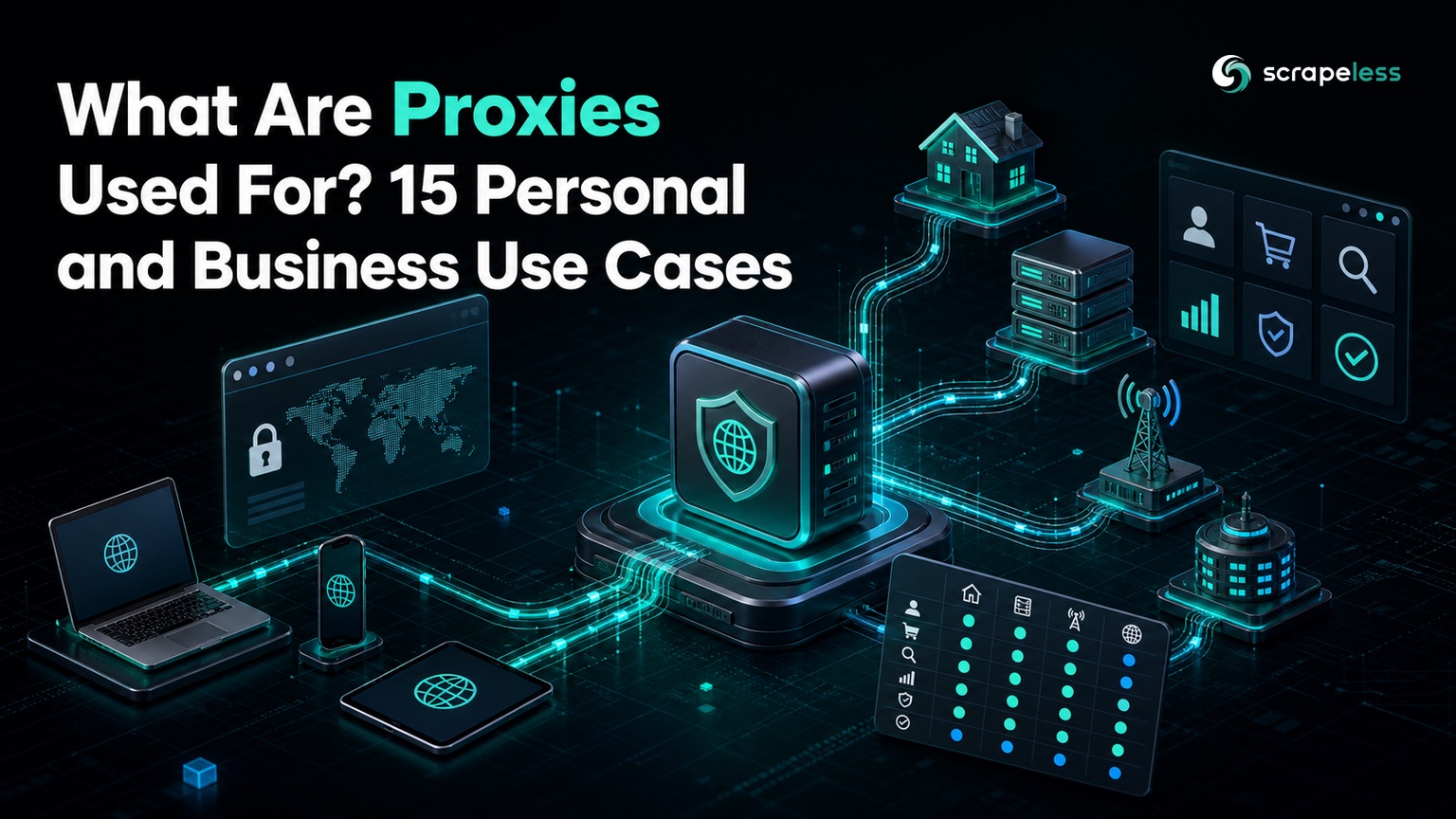
What Are Proxies Used For? 15 Personal and Business Use Cases

Scraping and Proxy Management Expert
TL;DR:
- A proxy server sits between a client and a destination, forwarding traffic under the proxy's network identity. That makes location choice, IP separation, filtering, caching, and traffic control possible.
- Individuals commonly use proxies for location-aware browsing, network filtering, and separating selected application traffic. Businesses use them for public-web data collection, price intelligence, ad verification, SEO monitoring, brand protection, AI data pipelines, and security gateways.
- A proxy does not automatically encrypt all device traffic. A VPN usually creates an encrypted device-level tunnel; a proxy usually handles traffic from a configured application or protocol.
- Choose the proxy type from the requirement. Datacenter proxies prioritize throughput, residential and mobile proxies provide consumer-network context, static ISP proxies suit stable sessions, and SOCKS5 is useful when an application needs protocol flexibility.
- The activity still has to be authorized. Follow applicable law, site terms, robots directives, rate limits, privacy rules, and data-minimization practices.
What are proxies used for? The short answer is controlled intermediation. A proxy changes the route between a client and a destination, so teams can choose the source network, separate workloads, apply access policy, or observe a public page from a specific market.
That description is more accurate than “a proxy hides your IP.” IP substitution is one capability, but it does not explain content filtering, forward-proxy policy, reverse-proxy load distribution, stable sessions, or location-specific quality assurance. It also avoids a common misconception: hiding an IP is not the same as encrypting every connection.
This guide maps 15 personal and business requirements to the proxy capability and proxy type that best fit each one.
What is a proxy server?
A proxy server is an intermediary that receives a client's request, sends a corresponding request toward a destination, and relays the response. HTTP defines intermediaries as part of its message-routing model; the HTTP Semantics standard distinguishes proxies, gateways, and tunnels by their role in that route.
The destination normally sees a connection from the proxy rather than a direct connection from the original client. Depending on the design, the proxy can also:
- select an exit region or network;
- keep one stable IP for a session or rotate among a pool;
- cache common responses;
- apply authentication and access rules;
- record operational metadata;
- block destinations or content categories;
- distribute inbound traffic among application servers.
Forward proxies represent clients to external services. Reverse proxies represent servers to clients. Most scraping, geo-testing, and research workflows discussed here use forward proxies, while load balancing and web-application gateways generally use reverse proxies.
The rest of this guide starts with those routing mechanics, then maps them to proxy types and real-world requirements.
How proxies work
A proxy workflow has four basic stages:
- The client sends a request to the proxy endpoint.
- The proxy authenticates the client and applies routing or policy rules.
- The proxy opens a connection to the destination under its own network identity.
- The proxy relays the destination's response to the client.
With HTTPS, the security details depend on the proxy method. An HTTP proxy can create a tunnel with CONNECT, allowing TLS to run end to end between the client and destination. A corporate inspection proxy can terminate and re-establish TLS only when the organization controls and trusts the required certificates. SOCKS works at a lower level and can carry more than HTTP; the SOCKS5 specification defines authentication and proxying for TCP and UDP applications.
Three controls determine whether a proxy fits a workload:
- Identity: datacenter, residential, ISP, mobile, or another network source.
- Session: rotating IPs for distributed requests or a stable IP for continuity.
- Location: country, region, city, or network targeting when the use case requires a local view.
These controls solve routing problems. They do not replace application permissions, secure credential handling, content validation, or legal review.
Proxy vs. VPN: what is the difference?
A proxy and a VPN can both change the public IP visible to a destination, but their normal scope is different.
| Question | Proxy | VPN |
|---|---|---|
| Typical scope | A configured browser, script, app, or protocol | Most traffic from a device or operating-system profile |
| Main control | Request routing, IP selection, location, session, policy | Encrypted network tunnel and device-level routing |
| Encryption | Depends on the application protocol and proxy design | Normally encrypts traffic through the VPN tunnel |
| Common business fit | Data collection, geo-testing, access policy, workload separation | Remote access, device protection, private-network connectivity |
| Scaling model | Pools and sessions can serve many independent tasks | Usually organized around users, devices, or private networks |
The NIST guide to IPsec VPNs describes VPNs as network-layer security mechanisms. That is a different objective from choosing a source IP for one scraper or testing how a public page appears in several markets.
Use a VPN when the main requirement is an encrypted device or network tunnel. Use a proxy when the main requirement is application-level routing, location, scale, or policy. Some systems use both.
What are proxies used for personally?
1. Location-aware browsing and testing
A person may need to see whether a public site, catalog, or help center is available from another country. A location-targeted residential proxy provides a consumer-network view. This is useful for legitimate travel research and for testing a site you own, but it does not grant permission to evade licensing or access restrictions.
2. Selected-application privacy
A proxy can keep a destination from seeing the client's direct IP for traffic routed through that proxy. This is narrower than full-device privacy: other applications can still use the ordinary connection, and the proxy provider may be able to observe connection metadata. HTTPS should remain enabled.
3. Family, school, and small-office filtering
A forward proxy can enforce destination allowlists, category rules, or time-based access policy. The benefit is centralized control rather than installing separate filtering logic in every application. Administrators should disclose monitoring and retain only the logs needed for security and operations.
4. Caching repeated web resources
A caching proxy can keep reusable responses closer to users. That can reduce upstream bandwidth and improve access to stable resources on shared networks. Modern personalized pages are often not cacheable, so the response headers and application contract have to permit reuse.
5. Separating development and test traffic
Developers can route a browser, command-line client, or test suite through a dedicated proxy. That separation makes traffic easier to inspect, gives test requests a known exit IP, and prevents experiments from sharing the identity of a production workload.
What are proxies used for in business?
6. Public-web data collection
At scale, one IP can become a bottleneck even when the collection is authorized. A proxy pool separates requests by session and region. The scraper still needs pacing, deduplication, content validation, and a clear scope.
Scrapeless Proxy Solutions provides residential, datacenter, static ISP, and IPv6 options for different traffic patterns. The proxy should be selected only after the team knows the target difficulty, volume, location, and session requirement.
7. Price and availability intelligence
Retailers and travel-data teams compare public prices, stock, and delivery options across regions. Location-targeted proxies help reproduce the market context a local visitor receives. The data pipeline must store capture time, currency, locale, and source URL so analysts do not compare mismatched observations.
8. Ad verification
Advertisers use local network views to confirm that a campaign appears in the intended geography, lands on the expected page, and is not surrounded by unsuitable content. Stable residential or ISP sessions are useful when the verification path spans several page requests.
9. Local SEO and search-result monitoring
Search results can vary by location and language. Proxies let an SEO system collect region-specific result pages without treating one office connection as the global truth. Use source-specific APIs where available, store the query and locale, and avoid collecting personal search histories.
10. Market and competitor research
Businesses monitor public product catalogs, category structure, promotions, and consumer trends. Location diversity can reveal regional assortment differences. A responsible program limits collection to needed public fields and gives legal and privacy teams a documented data inventory.
11. Brand protection
Brand teams scan public marketplaces and websites for counterfeit listings, unauthorized logo use, or misleading domains. Residential and mobile networks can help reveal content that is visible only to local consumers. Evidence should preserve the source URL and capture context without collecting unrelated personal information.
12. Approved social and account operations
Agencies may need stable, separated sessions for authorized client accounts or regional support workflows. Static ISP or mobile proxies can provide continuity, but the platform's terms and automation rules control what is permitted. A proxy does not make prohibited multi-account behavior acceptable.
13. Travel and hospitality aggregation
Flight, hotel, and rental inventory can differ by market, currency, and distribution channel. A proxy supplies the location context; the collector must also normalize taxes, fees, refundability, occupancy, and capture time before comparing offers.
14. AI agents and model data pipelines
An AI agent that researches current public information needs reliable page acquisition, source provenance, and fresh content. Proxy infrastructure supplies network diversity, but it does not solve JavaScript rendering, schema extraction, hallucination, or permission. Teams should keep the agent's source scope explicit and attach citations to downstream answers.
15. Security gateways and application delivery
Forward proxies enforce outbound policy and inspect organization-approved traffic. Reverse proxies provide TLS termination, request filtering, load distribution, and a stable public endpoint for internal services. These are security and delivery functions, not anonymity features.
Need a proxy pool for an authorized data workflow? Compare Scrapeless proxy plans and usage options, then benchmark one representative target before scaling.
Scenario-to-proxy matrix
The right choice follows the requirement, not a generic ranking.
| Scenario | Required capability | Suitable starting point | Main caution |
|---|---|---|---|
| Location-aware browsing | Local consumer-network view | Residential | Content rights still apply |
| Selected-app privacy | Replace direct client IP | HTTPS proxy or SOCKS5 | Not full-device encryption |
| Network filtering | Central policy point | Authenticated forward proxy | Disclose monitoring |
| Shared-resource caching | Cache controls | Caching HTTP proxy | Respect cache headers |
| Development isolation | Known exit and logs | Datacenter or SOCKS5 | Keep it private |
| Public-web collection | Pool, rotation, targeting | Residential or datacenter | Follow scope and pace |
| Price intelligence | Region accuracy | Residential | Normalize currency and time |
| Ad verification | Local view and continuity | Residential or static ISP | Protect session data |
| Local SEO | Region and language | Residential | Store query context |
| Market research | Geographic diversity | Residential or datacenter | Minimize collected fields |
| Brand protection | Localized marketplace access | Residential or mobile | Preserve evidence lawfully |
| Approved account work | Stable identity | Static ISP or mobile | Follow platform terms |
| Travel aggregation | Market-specific availability | Residential | Normalize fees and rules |
| AI data pipeline | Network diversity at scale | Residential plus managed extraction | Validate sources and output |
| Security and delivery | Policy or reverse routing | Forward or reverse proxy | Requires security ownership |
How to choose a proxy type
Datacenter proxies
Datacenter proxies run in hosting infrastructure. They are a practical starting point for public, low-friction sources where throughput and cost matter more than consumer-network identity. They are also useful for development and fixed allowlisting.
Residential proxies
Residential proxies use IPs associated with consumer internet networks. They fit location-sensitive research, verification, and more selective public sites. Teams should ask providers how addresses are sourced and how consent, abuse handling, and retention are managed.
Static ISP proxies
Static ISP proxies combine an ISP-associated network identity with a stable session. They are useful for approved workflows that need continuity across several requests, such as ad verification or regional quality assurance.
Mobile proxies
Mobile proxies use carrier networks. They fit mobile-first testing and specialized regional checks, but they usually cost more and should be reserved for cases where mobile network context is genuinely required.
IPv6 proxies
IPv6 proxies can provide a large address space and work well when the destination fully supports IPv6. They are not automatically more trusted or more private than IPv4; compatibility and sourcing still matter.
HTTP, HTTPS, and SOCKS5
HTTP proxies understand HTTP routing. HTTPS usually describes either HTTPS traffic carried through a proxy tunnel or a proxy endpoint protected by TLS, so verify the provider's terminology. SOCKS5 works below the HTTP layer and can suit applications that need broader protocol support.
For implementation details, use the Scrapeless proxy quickstart and keep credentials in environment variables rather than source code.
When a proxy is not enough
A proxy changes network routing. It does not execute JavaScript, parse HTML, solve schema drift, validate returned content, or manage a data pipeline.
If the desired output is clean page content from dynamic public pages, a managed acquisition layer may be more appropriate. A scraping API can combine routing with page acquisition capabilities, while the application remains responsible for authorization, field validation, storage, and downstream use. This introduction to web scraping explains how acquisition, parsing, and storage fit together.
The decision is operational:
- choose a proxy when the application already owns fetching and parsing;
- choose a managed scraping API when browser execution and block handling dominate engineering time;
- choose a reverse proxy or security gateway when protecting your own application is the goal;
- choose a VPN when encrypted device or private-network connectivity is the goal.
Risks, compliance, and responsible proxy use
Proxy use is not automatically lawful or unlawful. The purpose, target, access method, jurisdiction, contract, and data category all matter.
Use these controls:
- collect only public data that the organization is authorized to use;
- review site terms and the Robots Exclusion Protocol;
- avoid authentication barriers and restricted areas unless the owner has granted access;
- set a source-specific request budget;
- keep credentials out of code and logs;
- reject private, loopback, and metadata-network destinations in proxy services;
- validate special-purpose destinations against the IANA IPv4 Special-Purpose Address Registry;
- minimize personal data and define retention periods;
- document proxy sourcing and abuse-response procedures;
- validate the returned content instead of treating an HTTP success as a data success.
Free public proxies deserve extra caution. The operator, sourcing, logging behavior, and availability may be unknown. Do not send credentials, confidential data, or regulated information through an untrusted endpoint.
Choose the capability, then the product
The phrase “use a proxy” hides several decisions: identity, region, session stability, protocol, sourcing, volume, and ownership. Start with the workflow's required outcome and test the least complex option that meets it.
For data collection, define an acceptance check before scaling: expected page title, minimum content length, required fields, capture time, and source URL. Then create a Scrapeless account, choose a suitable proxy type, and measure accepted records rather than raw requests.
Frequently asked questions
What is the main purpose of a proxy?
A proxy intermediates traffic between a client and a destination. That enables request routing, source-IP selection, location targeting, policy enforcement, caching, traffic separation, and—in reverse-proxy designs—application delivery.
Does a proxy hide the client's IP address?
For traffic routed through it, the destination normally sees the proxy's connection rather than the client's direct public IP. That does not prevent browser fingerprinting, account correlation, cookies, or tracking through other application data.
Does a proxy encrypt internet traffic?
Not by itself. HTTPS can protect application traffic through a proxy, and some enterprise proxies perform controlled TLS inspection. A VPN is normally the better fit when the requirement is an encrypted device-level tunnel.
Which proxy is best for web scraping?
There is no universal best type. Datacenter proxies fit high-throughput, low-friction sources; residential proxies fit location-sensitive and more selective public pages; static ISP proxies fit stable sessions; mobile proxies fit mobile-network checks. Test against a representative authorized target.
Are proxies legal?
Proxy technology is legal in many jurisdictions, but the activity performed through it may be restricted by law, contract, site terms, or data-protection rules. Obtain legal advice for high-risk or large-scale projects.
Can a proxy handle every website block?
No. Websites can evaluate cookies, browser behavior, TLS characteristics, JavaScript signals, account state, and request patterns in addition to IP reputation. A proxy solves only part of the acquisition system.
At Scrapeless, we only access publicly available data while strictly complying with applicable laws, regulations, and website privacy policies. The content in this blog is for demonstration purposes only and does not involve any illegal or infringing activities. We make no guarantees and disclaim all liability for the use of information from this blog or third-party links. Before engaging in any scraping activities, consult your legal advisor and review the target website's terms of service or obtain the necessary permissions.