What Are AI Agent Plugins? Tools, Skills, and MCP Explained

Lead Scraping Automation Engineer
TL;DR:
- An AI agent plugin is a distributable bundle that adds capabilities or behavior to an agent host. The bundle may include tools, skills, commands, agents, hooks, or MCP server definitions.
- A tool performs an action; a skill teaches a workflow. A plugin can package either or both.
- MCP is a protocol boundary. An MCP server exposes tools and other context to compatible clients through a standardized connection.
- The runtime lifecycle matters more than the label. Discovery, permission, invocation, response validation, and auditability determine whether an integration is production-ready.
- Scrapeless provides a concrete web-data example. Its MCP Server exposes browser, search, and stateless scraping tools, while its writing and workflow skills encode repeatable instructions.
AI agent plugins are often described as if every product uses the term in the same way. They do not. In one host, a plugin is a package containing commands and skills. In another, it is an integration backed by an API. A third product may call the same capability a tool or connector.
The useful way to understand the space is to separate packaging, action, instruction, and protocol. This glossary explains those layers and follows one request from discovery through audit.
What Is an AI Agent Plugin?
An AI agent plugin is a package or integration that extends what an agent can know, do, or follow. The host decides the exact package format and permission model.
The VS Code agent plugin documentation, for example, describes plugins that can bundle commands, skills, custom agents, hooks, and MCP servers. GitHub's Copilot MCP documentation treats MCP servers as an extension route for external tools and data.
A plugin is therefore best understood as the delivery unit. The components inside it can serve different roles.
Plugin vs Tool vs Skill vs MCP Server
| Term | Primary job | Typical contents | Example |
|---|---|---|---|
| Plugin | Package and distribute an extension | Tools, skills, commands, hooks, server definitions | A browser-research plugin |
| Tool | Perform one bounded action | Input schema, executable operation, structured result | browser_goto or scrape_markdown |
| Skill | Teach a repeatable workflow | Instructions, references, scripts, templates | A blog-writing verification workflow |
| MCP server | Expose capabilities through MCP | Tool definitions, resources, prompts, authentication | Scrapeless MCP Server |
The boundaries can overlap. A plugin may install an MCP server and a skill that explains when to call it. The server may expose many tools. The skill may call local scripts without exposing them as tools.
How an Agent Uses a Plugin
The lifecycle has six stages.
1. Discovery
The host reads a manifest, server tool list, or installed package catalog. Good discovery data gives each capability a narrow name and description so the model can distinguish “open a page” from “return page HTML.”
2. Permission and authentication
The user or workspace grants access, and the integration obtains the credential needed for the external service. The MCP authorization specification defines the protocol's authorization framework for HTTP transports. Local stdio servers commonly receive credentials through scoped environment configuration.
Credentials should never be placed in prompts or committed configuration. Limit them to the service and operations the workflow actually needs.
3. Selection
The agent maps the request to a capability. “Research this topic” may need a search tool first and a browser tool second; it does not automatically justify a write-capable CMS tool.
4. Invocation
The host validates arguments against the tool schema and sends the call. Narrow schemas make mistakes easier to catch before a request reaches an external system.
5. Response validation
The agent checks whether the result matches the task. A browser navigation can return a challenge page, and a scraper can return empty content with a normal status. Successful transport is not successful work.
6. Audit
The host records which tool ran, what category of data it accessed, and whether the result changed external state. Sensitive arguments should be redacted. Write operations deserve stronger confirmation and post-write verification than read-only calls.
A Concrete Example: Scrapeless MCP Server
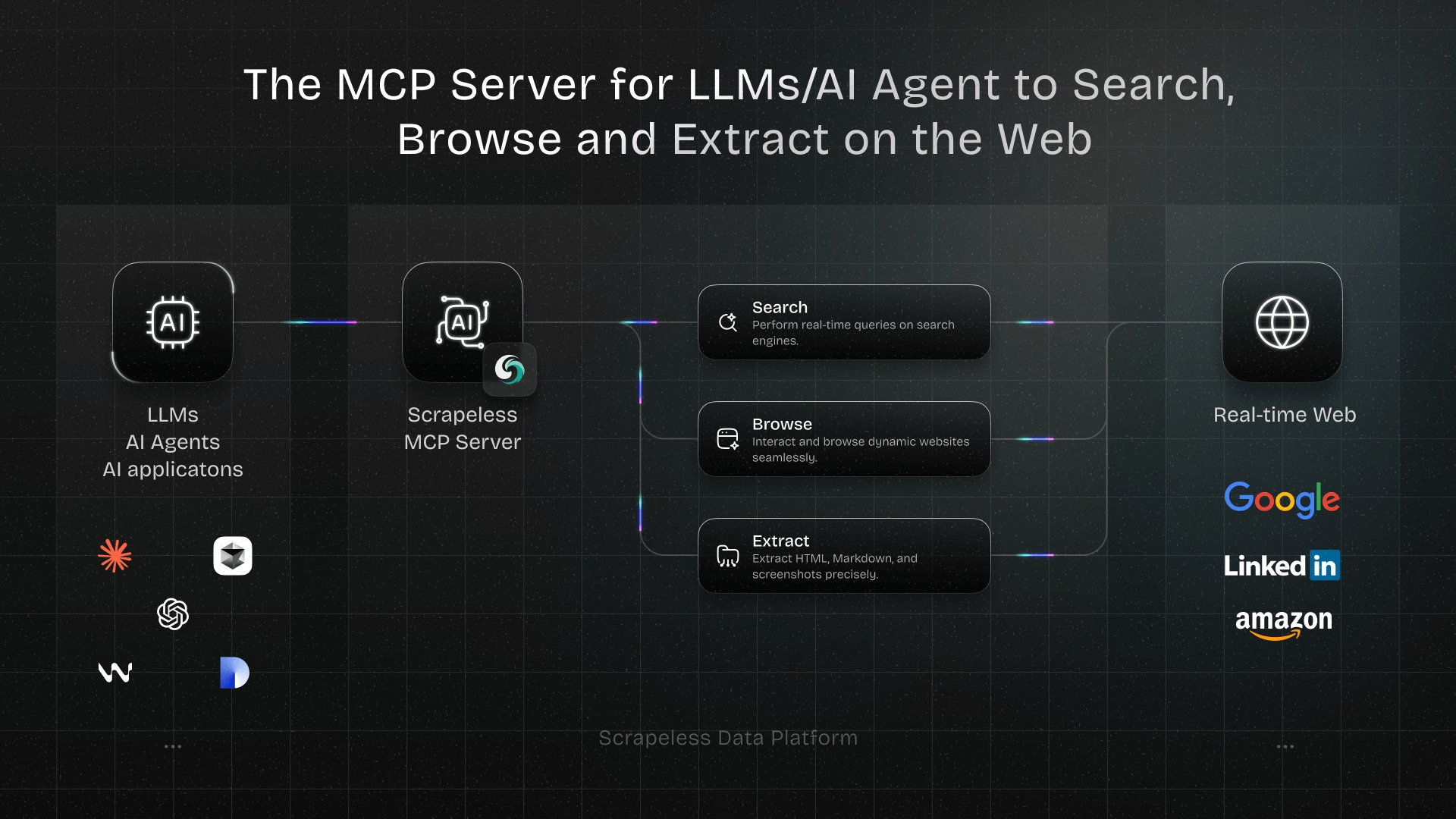
Scrapeless MCP Server connects compatible agents to web search, browser automation, and stateless page extraction. Stateful browser work can use the separate Scraping Browser product, whose getting-started documentation documents the browser-side connection.
The current first-party guide documents 21 tools in three groups:
- browser session primitives, including create, navigation, click, type, wait, snapshot, HTML, text, scrolling, screenshot, and close;
- search tools for Google Search and Google Trends;
- stateless tools for HTML, Markdown, and screenshot extraction.
This is a useful division because a one-page extraction does not need a stateful browser session, while a multi-page workflow may need cookies and navigation continuity.
Prerequisite: running the local server requires a reader-owned SCRAPELESS_KEY. The package scrapeless-mcp-server 0.4.9 and MCP client were installed during verification; startup correctly stopped at the missing credential, so this article does not claim a completed authenticated handshake.
A host that supports stdio can start the server with:
json
{
  "mcpServers": {
    "scrapeless": {
      "command": "npx",
      "args": ["-y", "scrapeless-mcp-server"],
      "env": {
        "SCRAPELESS_KEY": "${SCRAPELESS_KEY}"
      }
    }
  }
}
The exact placement of this configuration depends on the host. Keep the key in the host's secret store or environment, not in the JSON file itself.
Where Skills Fit
A skill complements tools by encoding judgment. It can specify which sources are acceptable, which steps must run before publication, how to verify code, and when to stop for missing credentials.
For example, a web-research skill might instruct the agent to search first, prefer primary sources, validate page identity, and record citations. The underlying tools still perform the search and navigation. The skill makes their use consistent.
This distinction matters for teams. Tool authorization answers “may the agent do this action?” A skill answers “what process should the agent follow when it does?”
Security Checklist for Agent Plugins
Before installing or enabling an extension, check:
- who maintains the package and where its source lives;
- whether it can read files, use credentials, access the network, or write externally;
- which tools are exposed and whether their schemas are narrow;
- how secrets are stored and redacted;
- whether write actions require approval;
- whether tool calls and results are logged for audit;
- how updates are reviewed before automatic installation.
The VS Code documentation explicitly advises reviewing third-party plugin code before installation. Apply the same principle to MCP servers and skills: package convenience does not replace trust review.
Conclusion
Plugins, tools, skills, and MCP servers describe different layers of an agent system. A plugin packages extensions, a tool performs a bounded operation, a skill supplies workflow instructions, and an MCP server exposes capabilities through a shared protocol.
Evaluate the whole lifecycle—discovery, authorization, invocation, response validation, and audit—before judging an integration by its feature count.
Give Your Agent a Verified Web-Data Layer
Review the Scrapeless MCP use cases, compare current pricing, create a Scrapeless account, and connect only the tools your workflow needs.
FAQ
Q: What is an AI agent plugin?
It is a package or integration that extends an agent host with capabilities or behavior such as tools, skills, commands, hooks, or MCP server definitions.
Q: Is an AI tool the same as a plugin?
No. A tool is a bounded action with an input and result; a plugin is a delivery unit that may contain one or many tools.
Q: What is the difference between a skill and a tool?
A tool performs an action. A skill provides reusable instructions, references, and workflows that guide how the agent uses tools.
Q: Is MCP an AI agent plugin?
MCP is a protocol. An MCP server can be packaged by a plugin or configured directly in a compatible host.
Q: Does Scrapeless MCP Server require an API key?
Yes. The local package requires SCRAPELESS_KEY; use a reader-owned key stored in the host's environment or secret manager.
At Scrapeless, we only access publicly available data while strictly complying with applicable laws, regulations, and website privacy policies. The content in this blog is for demonstration purposes only and does not involve any illegal or infringing activities. We make no guarantees and disclaim all liability for the use of information from this blog or third-party links. Before engaging in any scraping activities, consult your legal advisor and review the target website's terms of service or obtain the necessary permissions.