What Is Web Indexing? How Crawling, Rendering and Indexing Work

Advanced Data Extraction Specialist
TL;DR:
- Web indexing turns fetched pages into records that a search system can retrieve. Crawling finds and downloads URLs; indexing parses, normalizes, deduplicates, and stores their useful content.
- Rendering sits between fetching and indexing when JavaScript supplies the content. An indexer cannot store text or links that its acquisition layer never receives.
- Indexing and ranking solve different problems. The index determines what can be retrieved; ranking decides the order for a particular query.
- Canonical URLs prevent duplicate records from competing. Normalize URI variants, preserve one canonical identity, and keep content hashes for change detection.
- A sitemap or successful crawl does not guarantee inclusion. The indexer still applies content, policy, quality, and duplication rules.
Web indexing is the process of converting fetched web resources into a searchable data structure. A crawler discovers a URL and retrieves a representation. An indexer decides what the representation means, which URL owns it, which terms or entities it contains, and whether it should be searchable.
That definition separates several activities that are often collapsed into the word “crawl.” Discovery, fetching, rendering, parsing, indexing, and ranking are connected stages, but each has a different output and failure boundary.
This guide follows a page through the full path and then shows how the same model applies to search engines, site search, and retrieval systems for AI applications.
What Is Web Indexing?
Web indexing is the analysis and storage stage that makes web content retrievable by a search system. The index usually stores normalized document text, metadata, terms, links, entities, and source identifiers in structures designed for fast lookup.
A simple lifecycle looks like this:
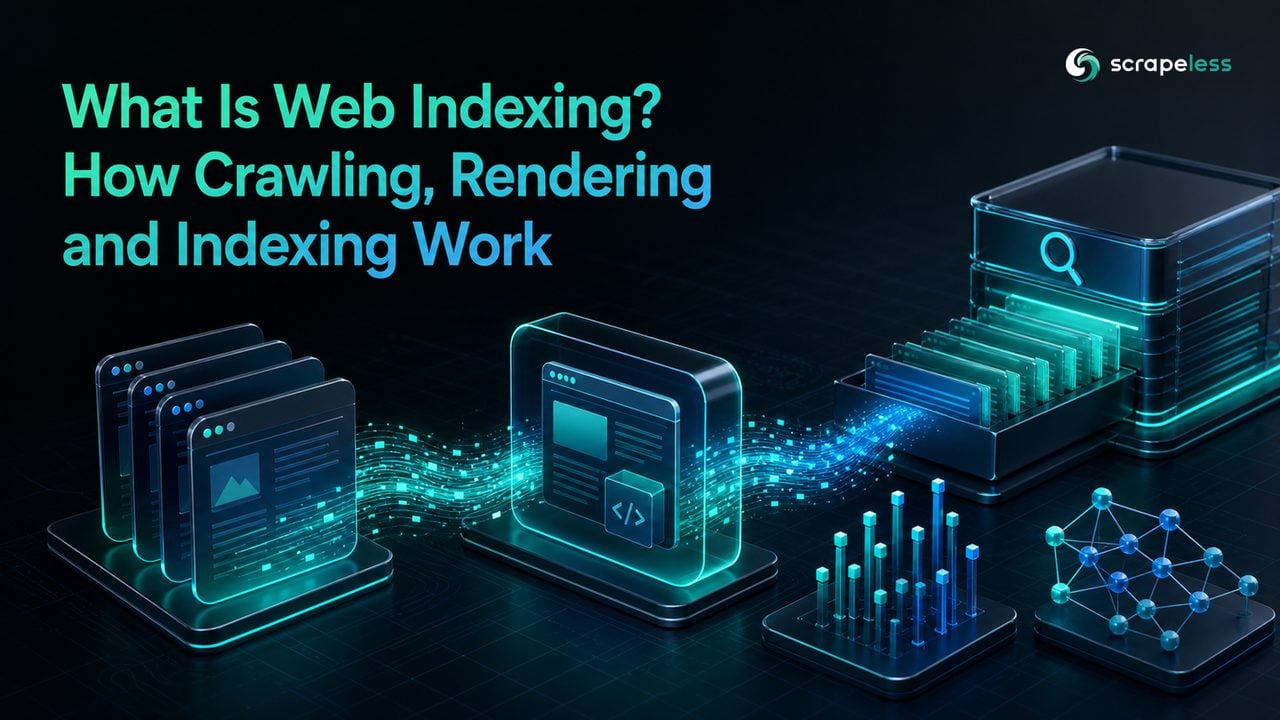
Discover URL → Fetch response → Render when needed → Parse content → Normalize identity → Index fields → Retrieve candidates → Rank results
The stages answer different questions:
| Stage | Main question | Typical output |
|---|---|---|
| Discovery | Which URLs may exist? | URL frontier |
| Fetching | What did the server return? | Response body and headers |
| Rendering | What does the application create after scripts run? | Rendered document |
| Parsing | Which text, links, and fields matter? | Structured document |
| Indexing | How can this document be found later? | Searchable postings and metadata |
| Retrieval | Which records may answer the query? | Candidate set |
| Ranking | Which candidate should appear first? | Ordered results |
The distinction is operational. If discovery fails, the URL never enters the frontier. If rendering fails, the parser may receive an empty application shell. If canonicalization fails, the index may store several copies of one page. If ranking fails, the correct document may exist but appear too low to help the user.
Crawling vs. Indexing vs. Ranking
Crawling, indexing, and ranking form a pipeline rather than interchangeable names.
Crawling discovers and fetches
A crawler starts from seeds such as internal links, feeds, sitemaps, submitted URLs, or previously known pages. It maintains a frontier, chooses a URL, checks source policy, makes a request, records the response, extracts new links, and adds eligible discoveries to the frontier.
Crawling does not guarantee indexing. A crawler can fetch a page that the indexer later rejects because it is empty, duplicated, blocked from indexing, outside scope, or below the system's acceptance threshold.
The Robots Exclusion Protocol defines how service owners can publish rules for automated clients. Those rules influence acquisition policy; they do not create authentication or force a search system to include a page.
Indexing creates the retrieval record
Indexing begins after the system has a usable representation. The indexer can:
- extract visible text and meaningful metadata;
- identify language and document type;
- remove navigation and repeated boilerplate;
- normalize the source URL;
- select or respect a canonical URL;
- identify duplicates and near-duplicates;
- tokenize text and record term locations;
- extract entities or structured fields;
- store source, collection, and policy metadata.
The result is not necessarily a copy of the page. It is a document record optimized for retrieval.
Ranking orders matching records
Ranking begins when a query arrives. A ranking system scores candidate records using signals such as lexical match, semantic similarity, authority, freshness, location, language, structured filters, and product-specific business rules.
An index can exist without ranking, as in a lookup keyed by product ID. A ranking system cannot return a page that is absent from its candidate index.
Where Rendering Fits
Rendering converts a fetched application shell into the document a browser can inspect after JavaScript executes. It belongs before parsing and indexing whenever the initial response does not contain the required content.
The Google Search crawling and indexing overview describes crawling, JavaScript rendering, indexing, and serving as related stages. The general lesson applies beyond public search: acquisition must expose the text and links before an indexer can process them.
Use a rendering decision instead of sending every URL through a browser:
| Page behavior | Acquisition path | Acceptance check |
|---|---|---|
| Complete server-rendered HTML | Direct fetch | Required heading or field exists |
| JavaScript inserts core content | Browser rendering | Expected text appears in rendered document |
| Public structured endpoint | Documented endpoint | Response matches expected schema |
| File such as PDF | File parser | Text and metadata are extractable |
| Consent or challenge shell | Quarantine | Expected content is absent |
Rendering is not the same as indexing. It produces an input that the indexer can accept or reject.
How an Inverted Index Works
An inverted index maps a term to the documents that contain it. Instead of scanning every document for every query, the engine looks up the term and receives a postings list.
Imagine three accepted records:
- Document A: “browser rendering for product pages”
- Document B: “web indexing and search ranking”
- Document C: “browser automation for public web data”
The term “browser” points to A and C. The term “indexing” points to B. A production posting can also store term frequency, field, and position so the ranker can distinguish a title match from a passing body mention.
An inverted index is strong at exact terms, identifiers, error codes, names, and phrases. It remains useful even when the system also supports semantic retrieval.
How Vector Indexing Differs
A vector index stores numerical representations that place semantically related passages near one another. It can retrieve a document that answers the query even when the wording is different.
Vector retrieval does not replace source identity or lexical search. A production design often combines:
- keyword retrieval for exact names and identifiers;
- vector retrieval for semantic similarity;
- metadata filters for source, language, date, product, or policy;
- a ranking layer that merges the candidate sets.
For retrieval-augmented generation, every chunk should keep its canonical source URL, document version, and collection context. Otherwise the application cannot show provenance or remove outdated material cleanly.
Canonical URLs and Duplicate Control
Canonicalization gives several representations one stable document identity. Without it, tracking parameters, case differences, fragments, alternate paths, print views, and session values can create duplicate records.
The URI syntax and normalization standard describes normalization rules such as case handling for schemes and hosts, percent-encoding normalization, and removal of dot segments. Application-specific rules still need care because two query strings can represent different resources.
Use a conservative normalization policy:
- lowercase the scheme and host;
- remove the fragment;
- resolve relative references;
- remove only approved tracking parameters;
- preserve parameters that change the resource;
- normalize trailing slashes under one site-specific rule;
- respect redirects and declared canonical signals;
- compute a content hash after boilerplate removal.
The HTML canonical link definition gives publishers a way to identify the preferred URL for duplicate or closely related content. An indexer should record the declared canonical and compare it with redirects, internal links, and content similarity rather than accepting any untrusted value blindly.
Content hashes solve a different problem. The URL can remain stable while the page changes, or two URLs can carry the same document. Keeping both URL identity and content identity lets the system distinguish those cases.
What Controls Index Eligibility?
An indexer needs an explicit acceptance contract. A completed fetch is not enough.
Common checks include:
- the source and path are permitted by the registry;
- the response type is supported;
- required content is present after rendering;
- the page is not an error, challenge, consent shell, or soft-not-found page;
- the language and locale match the intended collection;
- indexing directives allow inclusion for the relevant system;
- the canonical target is valid and within scope;
- the content is not an unchanged duplicate;
- the document meets minimum quality and safety rules.
Search engines make their own eligibility decisions. Enterprise systems should do the same instead of placing every fetched byte into retrieval.
Sitemaps, robots.txt, noindex, and Canonical Signals
These controls affect different parts of the pipeline.
| Control | Primary role | What it does not guarantee |
|---|---|---|
| Sitemap | URL discovery hint | Crawling, indexing, or ranking |
| robots.txt | Crawler access instruction | Confidentiality or de-indexing |
noindex |
Index eligibility instruction | Removal from every external copy |
| Canonical link | Preferred identity signal | Automatic acceptance of the target |
| Redirect | Resource movement signal | Content quality or eligibility |
The Sitemaps protocol overview states that a sitemap helps crawlers discover URLs but does not guarantee inclusion in a search engine. A sitemap is an inventory hint, not an admission ticket.
robots.txt controls crawling behavior for conforming clients. It should not be used to protect sensitive content because the file is public and its paths can be discoverable.
noindex belongs to the indexing layer. If a crawler cannot fetch the page or header that carries the instruction, the system may have incomplete information. Site owners should align crawl and index controls instead of assuming they are interchangeable.
Search-Engine Indexing vs. Enterprise Web Indexing
Public search engines index the open web to answer broad user queries. Enterprise indexing starts from a controlled source registry and serves a narrower product goal.
| Dimension | Public search engine | Enterprise or RAG index |
|---|---|---|
| Source scope | Broad web discovery | Approved domains and datasets |
| Identity | Public canonical URL | Canonical URL plus internal document key |
| Freshness | Engine-defined recrawl policy | Source-specific service objective |
| Retrieval | General user intent | Product, support, research, or agent task |
| Permissions | Public eligibility rules | User, tenant, role, and source policy |
| Output | Ranked result page | Evidence bundle, passages, or structured records |
An enterprise index should keep access policy beside the document. Retrieval must filter unauthorized records before ranking, not after the model has already received them.
A Practical Web Indexing Pipeline
A reliable pipeline separates acquisition from indexing so each stage can be tested.
1. Register the source
Store the allowed host, path scope, locale, owner, collection purpose, robots decision, expected document type, and freshness objective.
2. Discover URLs
Use internal links, sitemaps, feeds, known patterns, or a curated seed list. Reject URLs that leave the approved scope.
3. Acquire the representation
Fetch stable HTML directly. Use browser rendering only when the required fields depend on JavaScript. Preserve response metadata and the final URL.
4. Validate content
Check a page-specific marker, document type, language, required fields, and error signatures. Quarantine unexpected responses.
5. Normalize identity
Apply the source-specific URI policy, evaluate canonical signals, and compute URL and content hashes.
6. Parse and enrich
Extract main content, headings, links, entities, and structured fields. Add provenance, source owner, collection context, and schema version.
7. Write retrieval structures
Create keyword postings, vector representations where needed, and metadata filters. Keep the raw accepted record long enough to audit transformations.
8. Measure the system
Track frontier size, accepted documents, duplicate share, render share, parse failures, freshness lag, and queries with no eligible result. These measures point to the failing stage instead of blaming “search” as one opaque component.
How Scrapeless Supports the Acquisition Layer
Web indexing depends on receiving the intended public content. Scrapeless Scraping Browser handles browser rendering when JavaScript is part of the acceptance path. Static pages can use a simpler acquisition route, while the indexer keeps one validation and provenance contract for both.
The web scraping guide covers extraction fundamentals, and the web crawler comparison helps separate crawler capabilities from the index that follows them. Check Scrapeless pricing after measuring how many approved pages truly need browser rendering.
Get your API key on the free plan: app.scrapeless.com
Conclusion: Treat the Index as a Product Contract
Web indexing starts before a document reaches the search engine. Source scope, rendering, canonical identity, parsing, quality, permissions, and freshness all determine whether the stored record can support a trustworthy result.
Give every stage a typed input, a measurable output, and a clear rejection state. That makes missing results diagnosable and keeps the retrieval layer free from duplicate, stale, or unauthorized content.
Ready to Build a Searchable Web Dataset?
Join developers working on crawling, rendering, and retrieval systems: Discord · Telegram.
Sign up at app.scrapeless.com and connect the approved public sources in your indexing plan to a measured acquisition layer.
FAQ
Q: What is web indexing in simple terms?
Web indexing is the process of analyzing a fetched page and storing its useful content and metadata in structures that make the page searchable.
Q: What is the difference between crawling and indexing?
Crawling discovers and retrieves URLs. Indexing parses accepted content, assigns a stable identity, removes duplicates, and writes the searchable record.
Q: Does crawling a page mean it will be indexed?
No. The page can be crawled and still be excluded because of duplication, directives, unsupported content, poor quality, policy, or a failed acceptance check.
Q: Why does JavaScript rendering matter for indexing?
Rendering matters when the initial response lacks the text or links the application creates in the browser. Without that rendered representation, the indexer receives incomplete input.
Q: Is a vector database the same as a web index?
No. A vector database can store semantic representations, but a complete web index also needs source discovery, canonical identity, metadata, permissions, freshness, and often keyword retrieval.
Q: Can Scrapeless index a website by itself?
Scrapeless provides acquisition and browser-rendering capabilities for approved public pages. Your application defines the index schema, canonicalization, permissions, storage, retrieval, and ranking rules.
At Scrapeless, we only access publicly available data while strictly complying with applicable laws, regulations, and website privacy policies. The content in this blog is for demonstration purposes only and does not involve any illegal or infringing activities. We make no guarantees and disclaim all liability for the use of information from this blog or third-party links. Before engaging in any scraping activities, consult your legal advisor and review the target website's terms of service or obtain the necessary permissions.