10 Web Data Sources Powering AI and Market Intelligence in 2026

Advanced Data Extraction Specialist
TL;DR:
- The best web data sources for AI are chosen by decision value, not popularity. Search results, AI answers, product catalogs, reviews, jobs, news, developer activity, and public records answer different questions.
- A useful source definition includes fields, access path, cadence, and provenance. A URL list without those four elements is not a data plan.
- Search and AI answers reveal discovery; commerce and reviews reveal market response. Combining categories is more reliable than treating one platform as the whole market.
- Official APIs should be the first access path when they provide the required public fields. Browser or managed extraction is appropriate when the needed public experience exists only in a rendered interface.
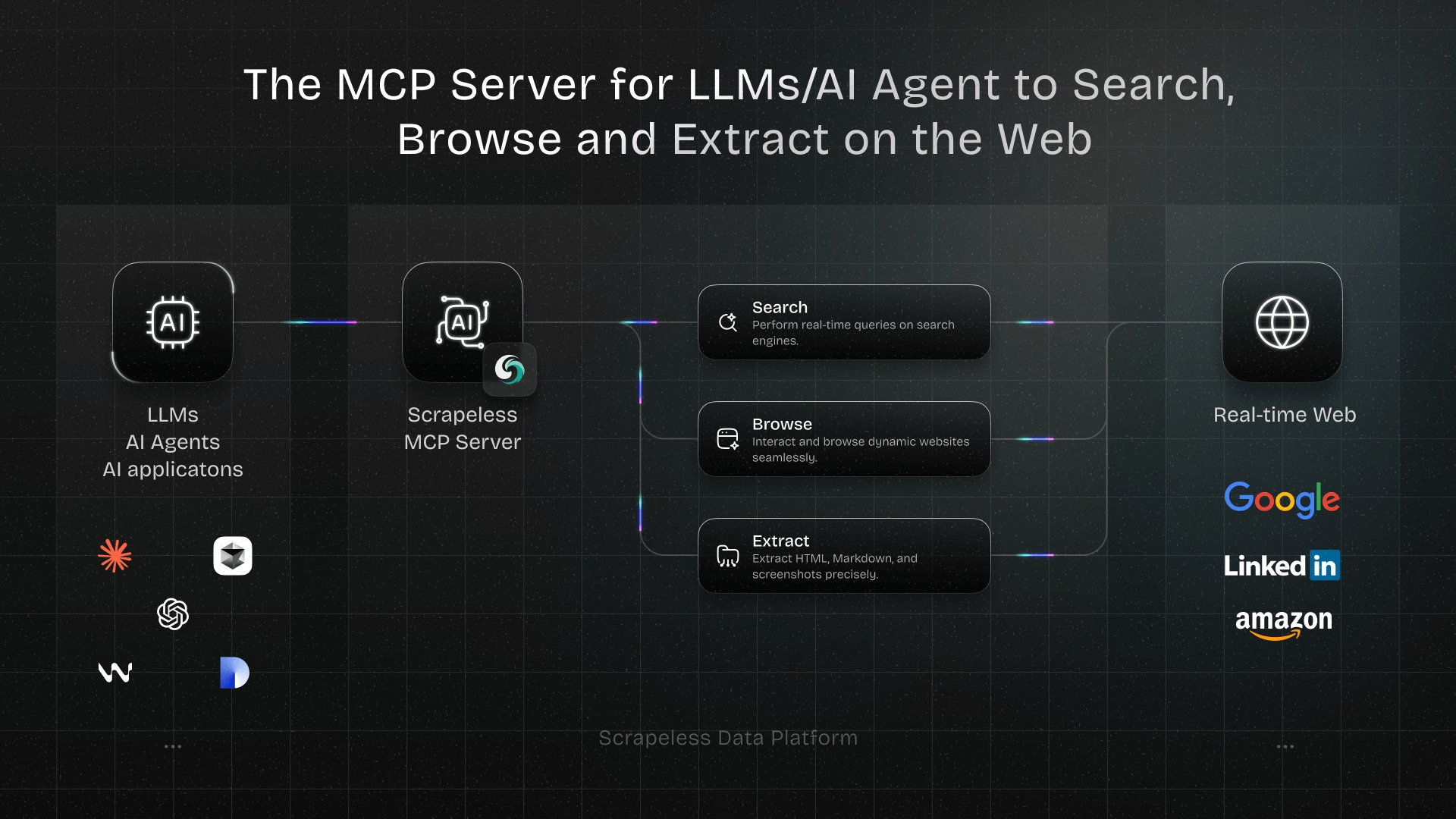
- Scrapeless products map to different surfaces. Google Search API handles SERP records, AI Scraper handles answer-engine responses, Agent Browser handles stateful rendered flows, and Web Unlocker handles page retrieval.
- Compliance belongs in the schema and schedule. Minimize personal data, retain provenance, honor access rules, and collect only as often as the business decision requires.
Web Data Sources Changed With AI-Mediated Discovery
Web data sources for AI now include both the pages people publish and the answer surfaces that summarize them.
A market-intelligence system once centered on search rankings, product pages, news, and reviews. Those sources still matter, but AI answer engines add a new observation layer: what a model says, which sources it cites, and how a brand or category is framed inside an answer.
This guide does not rank the “most scraped” websites. A vendor's private traffic mix cannot prove universal demand, and a large platform is not automatically valuable for a specific business. The useful question is: which public source changes a decision, which fields carry that signal, and how fresh must the record be?
The Six Source Families
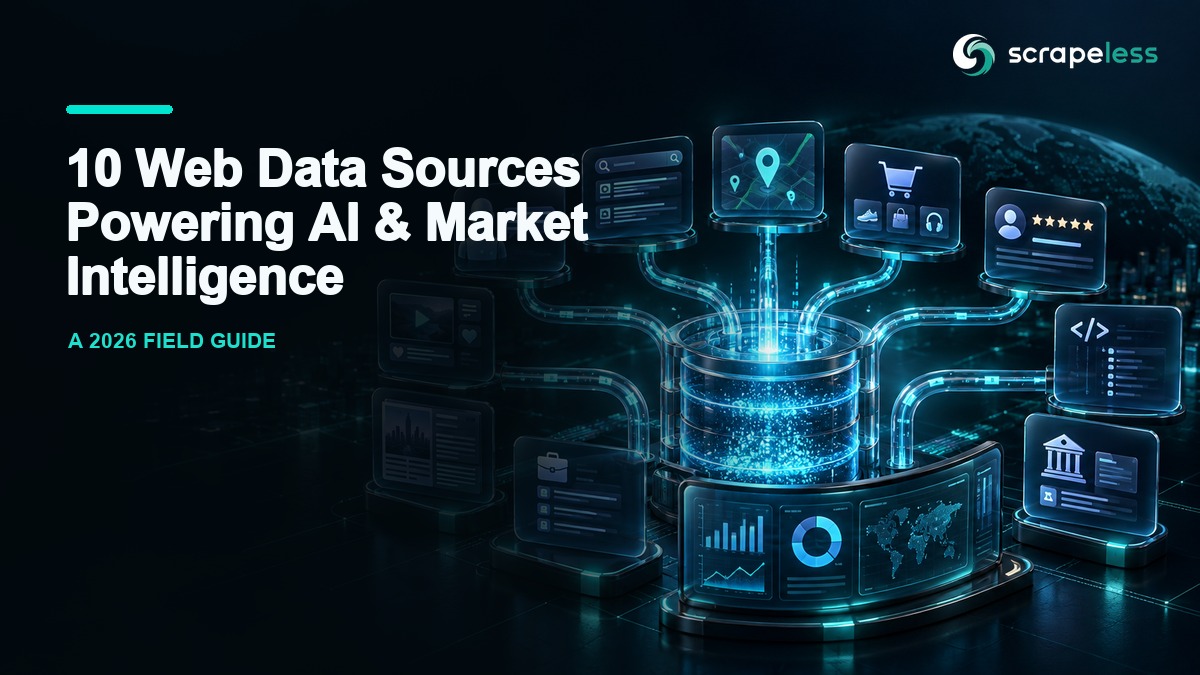
Ten practical sources fit into six families.
| Family | Sources in this guide | Primary decision signal |
|---|---|---|
| AI answers | ChatGPT, Perplexity | Brand framing, citations, answer composition |
| Search and local discovery | Google Search, Google Maps | Visibility, rank, demand, local presence |
| Commerce | Marketplaces, retailer catalogs | Price, assortment, availability, seller activity |
| Voice of customer | Review platforms, public social/video | Sentiment, complaints, emerging language |
| Talent and technical | Job boards, developer platforms | Hiring demand, skills, adoption, ecosystem change |
| Public record and news | News sites, regulators, filings, open data | Events, policy, company disclosures, macro context |
The categories overlap by design. A product launch can appear in news, search, social video, reviews, and an AI answer. The value comes from joining those observations with time and provenance intact.
How to Evaluate a Web Data Source
A data source earns a place in the pipeline when five questions have clear answers.
What Business Decision Does It Support?
Start with a decision such as changing price, revising positioning, opening a market, prioritizing a feature, or investigating a supply problem. “Collect competitor data” is too broad to define a useful schema.
Which Public Fields Carry the Signal?
Specify fields before choosing a tool. Product price, currency, stock state, seller, rating, review text, publication time, cited URL, ranking position, job title, skill, and location are different data contracts.
What Is the Approved Access Path?
Prefer an official API, feed, export, sitemap, or public dataset when it provides the needed fields. Use rendered-browser or managed page access when the public experience requires JavaScript or interaction and the collection is permitted.
How Fresh Must It Be?
Price and inventory may need frequent observation. A filing, license, or product specification may change slowly. Cadence should follow decision latency, not the maximum rate a tool can send.
Can Every Record Be Traced?
Keep source URL or document identifier, observed time, market or locale, collection method, and transformation version. The W3C PROV overview provides a standard vocabulary for describing entities, activities, and agents in a provenance trail.
1. AI Answer Engines
AI answer engines show how a model frames a topic at the moment a user asks.
Public fields: answer text, citation URLs, citation order, named brands, comparison language, follow-up suggestions, and visible answer modules.
Business uses: generative-engine visibility, brand-description monitoring, citation discovery, claim auditing, and answer consistency across markets or prompt families.
Access pattern: use Scrapeless AI Scraper when a supported answer surface returns structured data. Use Agent Browser when the workflow requires a stateful public interface.
Cadence: sample a stable prompt set on a schedule and after material brand, product, or policy changes. Store the exact prompt and locale with every answer because the record is meaningless without them.
Boundary: do not collect private conversations, authenticated personal history, or user-specific content.
2. Google Search Results
Search results reveal classic visibility, query intent, and the sources a search engine chooses for a market.
Public fields: organic position, title, URL, snippet, result type, domain, local or shopping modules, and AI Overview content where available.
Business uses: rank tracking, content-gap analysis, publisher discovery, share-of-result monitoring, and query-demand research.
Access pattern: Scrapeless Google Search API returns structured SERP records. Save query, country, language, device assumptions, offset, and observation time with each row.
Cadence: daily for operational rank tracking, weekly for strategic topic sets, and event-driven for launches or incidents.
Boundary: a result page is a sampled ranking, not a complete index. Google's official site: operator guidance warns that search operators have retrieval limits and do not provide an exhaustive inventory.
3. Local Business and Map Listings
Local listings reveal how businesses appear to customers in a geographic context.
Public fields: business name, category, address, coordinates, hours, rating, review count, website, phone where publicly displayed, place identifier, and rank for a query-location pair.
Business uses: store coverage, local competition, category positioning, branch consistency, and service-area research.
Access pattern: use a supported structured actor where available, an official maps API when its terms and fields fit, or Agent Browser for a permitted rendered workflow.
Cadence: weekly or monthly for stable locations; more often during launches, closures, holiday-hour changes, or local campaigns.
Boundary: treat contact fields as business records, not permission for unsolicited outreach. Keep only fields required for the stated purpose.
4. E-Commerce Marketplaces
Marketplaces combine catalog, seller, price, availability, reviews, and rank signals in one public surface.
Public fields: listing title, product identifier, seller, price, currency, promotion, availability, rating, review count, delivery promise, variant, and category position.
Business uses: price intelligence, seller monitoring, assortment gaps, stock signals, launch detection, and category analysis.
Access pattern: use a supported structured scraping actor for a known marketplace. Use Agent Browser when filters, variants, lazy loading, or session state determine the public result.
Cadence: align with market volatility. A fast-moving consumer category may need several observations per day; a durable-goods catalog may need daily or weekly snapshots.
Boundary: separate facts observed on a listing from inferences. “Unavailable at observation time” is defensible; “discontinued” usually requires additional evidence.
5. Retailer and Brand Catalogs
First-party product pages are the best source for a brand's current public offer.
Public fields: SKU, title, specifications, price, currency, availability, variants, images, warranty, shipping terms, and structured-data markup.
Business uses: direct assortment comparison, specification normalization, price monitoring, content-quality checks, and channel consistency.
Access pattern: Web Unlocker fits public pages that need managed retrieval and JavaScript rendering. Agent Browser fits multi-step filters, location selectors, or inventory flows.
Cadence: daily for price and stock, weekly for assortment, and event-driven for launches or promotions.
Boundary: preserve the source URL and distinguish the brand's own claims from independent measurements.
Start Scraping with Scrapeless
Power up your web scraping and automation workflow with Scrapeless!
Sign up today and get $5 in free credit — no credit card required.Claim your free credit now in the Scrapeless Dashboard.
6. Review Platforms
Review platforms expose recurring customer language and operational problems that catalog data cannot show.
Public fields: rating, review title and text, date, product or location, response status, helpfulness signals, and publicly visible reviewer context when necessary.
Business uses: issue taxonomy, feature requests, service-quality tracking, competitor pain points, and message testing.
Access pattern: prefer official exports or APIs where offered. Otherwise use a bounded public-page workflow with Web Unlocker or Agent Browser and store only the fields needed for aggregate analysis.
Cadence: weekly for ordinary monitoring; daily during a launch, outage, recall, or public incident.
Boundary: minimize personal information. Aggregate themes before distribution and keep raw text access limited.
7. Public Social and Video Signals
Public social and video pages show how language, formats, creators, and topics move through a market.
Public fields: post or video URL, public text, hashtags, publication time, creator or channel identifier, visible engagement counts, comments when permitted, and linked destination.
Business uses: trend discovery, campaign observation, creator mapping, message resonance, and early issue detection.
Access pattern: official platform APIs are the first choice when they expose the required public fields. Use Agent Browser only for permitted public experiences that are not available through the approved API.
Cadence: daily for active campaigns and weekly for broad category monitoring. Snapshot the visible count with time because engagement changes continuously.
Boundary: do not build sensitive individual profiles. Use aggregate topic and campaign analysis whenever possible.
8. News, Press Rooms, and Public Web Pages
News and first-party press pages provide event context, company statements, and source documents.
Public fields: headline, publisher, author, publication and update time, canonical URL, body, named entities, linked documents, and corrections.
Business uses: event detection, issue monitoring, competitor announcements, policy tracking, and evidence collection.
Access pattern: RSS, sitemaps, and publisher feeds are efficient discovery sources. Web Unlocker can retrieve permitted public pages, while Agent Browser handles client-rendered publication experiences.
Cadence: near-event monitoring for critical topics and daily digests for broad categories.
Boundary: respect copyright. Store facts and small necessary excerpts for analysis rather than republishing full articles.
9. Job Boards and Career Pages
Job postings reveal active demand for roles, locations, skills, and organizational priorities.
Public fields: job title, company, location, remote status, department, skills, seniority, compensation where public, posting date, job identifier, and status.
Business uses: talent-market intelligence, expansion signals, technology adoption, competitor investment themes, and sales-territory planning.
Access pattern: start with public company career pages and official job feeds. Use Agent Browser for permitted dynamic filters and Web Unlocker for public detail pages.
Cadence: daily or weekly depending on hiring velocity. Track openings and closures as events rather than repeatedly treating the same job as a new record.
Boundary: collect job information, not applicant data. Avoid inferring sensitive facts about employees from public postings.
10. Developer Platforms, Regulators, Filings, and Open Data
Technical and public-record sources provide the strongest provenance in this list.
Public fields: repository metadata, releases, issues, licenses, documentation, filing identifiers, company facts, regulatory notices, datasets, and revision history.
Business uses: technology adoption, dependency risk, ecosystem mapping, company disclosures, policy monitoring, and model grounding.
Access pattern: use official APIs and bulk data first. GitHub's REST API documentation defines supported access to repository metadata. The U.S. Securities and Exchange Commission publishes EDGAR application programming interfaces for submissions and company facts.
Cadence: releases and issues may need daily observation; filings and regulatory records can be event-driven; bulk open datasets follow their publisher's schedule.
Boundary: honor licenses and API terms. Preserve the official identifier and revision or accession information so a derived claim can be traced back.
Product Mapping: Choose the Access Layer by Surface
Scrapeless products solve different access problems.
| Surface | Default Scrapeless product | Why |
|---|---|---|
| Google result pages | Google Search API | Structured query, locale, and result records |
| Supported AI answer engines | AI Scraper | Structured answer and citation extraction |
| Public static or JavaScript pages | Web Unlocker | Managed retrieval and rendering |
| Stateful dynamic workflows | Agent Browser | Browser interaction, sessions, and CDP control |
| High-throughput compatible targets | Proxies | Direct application-level routing |
Start with the narrowest product that returns the required public fields. A structured API is easier to validate than a general browser. A browser is appropriate when the user-visible state, interaction, or session is itself part of the source.
A Practical Priority Matrix
Score each candidate source on decision value, freshness need, schema stability, access clarity, and compliance risk.
| Priority | Pattern | Action |
|---|---|---|
| High | Changes a recurring decision and has a stable public schema | Build a monitored pipeline with validation |
| Medium | Useful context but changes slowly or needs review | Collect on a schedule and add analyst approval |
| Experimental | Promising signal with unstable interpretation | Run a bounded research sample |
| Exclude | No clear decision, restricted access, or excessive personal data | Do not collect |
The matrix prevents a common failure: collecting a large source because it is available, then searching for a business question afterward.
Handling Web Data Responsibly
Responsible web data work starts before collection.
- Define a public-data scope and allowed target classes.
- Prefer official APIs, feeds, and bulk downloads.
- Review robots directives and terms where applicable. the Robots Exclusion Protocol defines how crawlers can read published access rules.
- Minimize personal data and restrict raw-record access.
- Store provenance and transformation versions.
- Use a cadence proportionate to the business decision.
- Validate facts on the originating source before external use.
- Establish retention and deletion rules before the first scheduled run.
Public availability is not permission for every downstream use. Legal, contractual, copyright, and privacy obligations vary by jurisdiction and source.
Conclusion
The best web data sources for AI form a portfolio: answer engines for framing, search for discovery, commerce for market behavior, reviews and social for language, jobs and developer platforms for investment signals, and public records for authoritative facts.
Use AI Scraper and Web Unlocker where structured or managed access fits, review current account options on the pricing page, and connect discovery to answer visibility with the GEO vs SEO guide.
Ready to Build a Source-Aware Intelligence Pipeline?
Join the Scrapeless community to compare schemas, source boundaries, and public-data workflows: Discord · Telegram.
Sign up at app.scrapeless.com and start with one decision, one source family, and one traceable schema.
FAQ
Q: What are the best web data sources for AI market intelligence?
The best sources are the ones tied to a decision: AI answers, search results, product catalogs, reviews, public social content, news, jobs, developer platforms, and public records each provide a different signal.
Q: Should an AI pipeline scrape every popular platform?
No. A pipeline should collect only sources whose public fields improve a defined decision and whose access, cadence, provenance, and retention rules are clear.
Q: How often should market-intelligence data be refreshed?
Refresh at the pace of the decision. Price and stock can need daily observation, while filings, specifications, or strategic job themes may need weekly or event-driven collection.
Q: When should an official API be used instead of a browser?
Use an official API when it exposes the required public fields under suitable terms. Use a browser when the permitted public experience depends on rendering, interaction, or session state that the API does not provide.
Q: How should AI-answer data be stored?
Store the exact prompt, answer, citations, market, language, observation time, product surface, and parser version so later analysis can distinguish model variation from pipeline changes.
Q: Is collecting public web data legal?
Public availability alone does not settle legality. Review applicable law, site terms, copyright, privacy obligations, authorization, and the downstream use before operating a pipeline.
At Scrapeless, we only access publicly available data while strictly complying with applicable laws, regulations, and website privacy policies. The content in this blog is for demonstration purposes only and does not involve any illegal or infringing activities. We make no guarantees and disclaim all liability for the use of information from this blog or third-party links. Before engaging in any scraping activities, consult your legal advisor and review the target website's terms of service or obtain the necessary permissions.