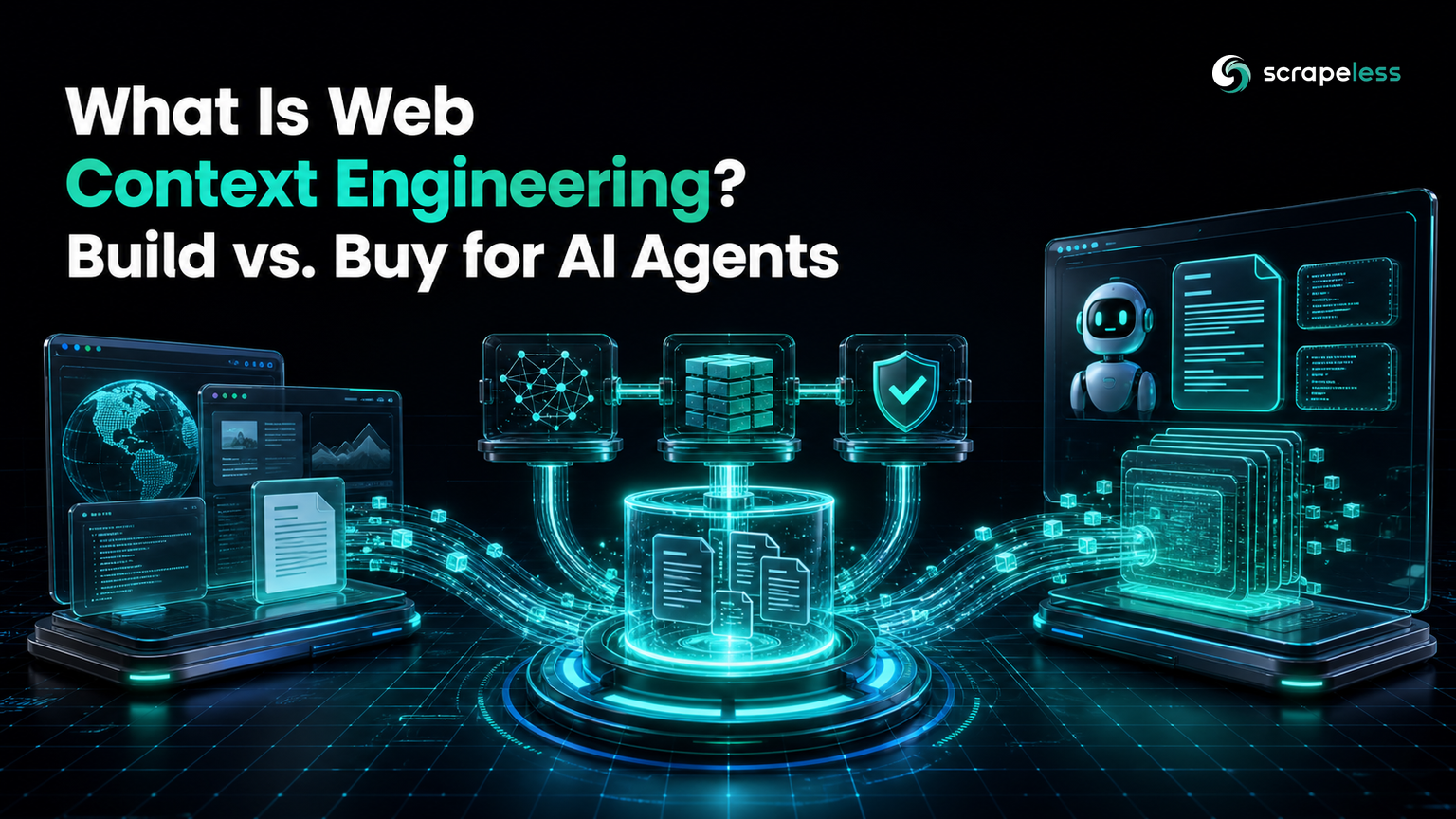
What Is Web Context Engineering? Build vs. Buy for AI Agents

Advanced Data Extraction Specialist
TL;DR:
- Web context engineering turns public web pages into evidence an AI agent can use, rather than passing raw HTML straight to a model. The work includes access, rendering, extraction, provenance, freshness, validation, and packaging.
- Build the semantic layer when it contains your domain advantage; buy the access layer when browser operations and site variance are operational overhead. Most teams benefit from a hybrid boundary.
- A useful context record preserves source URL, capture time, extraction method, normalized content, and validation status. Those fields let an agent explain where an answer came from and whether the evidence is still current.
- The best first benchmark is a small set of real tasks with measurable acceptance checks. Compare answer accuracy, evidence coverage, stale-data rate, and engineering time before choosing an architecture.
AI agents rarely fail because they cannot produce fluent text. They fail because the information placed in front of them is incomplete, stale, duplicated, or detached from its source. A page may require JavaScript before the useful content appears. The visible price may differ by region. A clean paragraph may still be six months old. Raw access and usable context are separate problems.
Web context engineering is the practice of designing the pipeline that converts live public web data into scoped, traceable input for an AI agent. It covers what to collect, how to render it, which parts to keep, how to prove where each field came from, when to refresh it, and how to reject records that do not meet the task's requirements.
This guide defines that pipeline and gives a practical build-versus-buy framework. The goal is not to outsource every decision. It is to keep the parts that encode your product's judgment while avoiding a permanent browser-operations project.
What Is Web Context Engineering?
Web context engineering covers the systems that acquire, transform, and govern web evidence for an AI task. Its output is not simply a page body. It is a context package with enough structure for a model or deterministic program to make a bounded decision.
A useful package might contain a normalized product name, current price, currency, stock state, seller, canonical URL, capture timestamp, and the exact text fragment that supports each field. A research agent might need claims, publication dates, quoted passages, and source relationships instead. The record changes with the task; the need for evidence and freshness does not.
The term is narrower than general prompt engineering. Prompt engineering shapes instructions and examples. Web context engineering shapes the external evidence supplied to those instructions. It is also broader than scraping. Scraping obtains content; context engineering decides whether that content is relevant, current, trustworthy enough for the task, and compact enough to send downstream.
How the Web Context Pipeline Works
The pipeline has six jobs. They can run in one service or across several components, but each job needs an owner.
- Discover: identify the URLs or search results likely to answer the task.
- Access: retrieve the page with the required geography, session state, and browser behavior.
- Extract: isolate the fields, passages, links, or tables that matter.
- Normalize: convert inconsistent labels, units, dates, and markup into a stable schema.
- Verify: check required fields, source alignment, freshness, and internal consistency.
- Package: deliver a compact context object with provenance for the agent or index.
These jobs form a contract. If discovery returns a category page but the task needs a product detail page, better parsing will not repair the mismatch. If access captures an interstitial instead of the target content, a model can still produce valid-looking JSON from the wrong page. Verification therefore checks both shape and meaning.
Provenance should be a first-class field. A web pipeline needs to separate the observed entity from the acquisition activity that produced its record. In practice, store the source URL, observed time, extraction version, and evidence fragment beside the normalized value.
What Belongs in a Context Record?
The smallest useful context record answers four questions: what was observed, where did it come from, when was it captured, and did it pass the task's checks?
| Field group | Example fields | Why the agent needs it |
|---|---|---|
| Identity | canonical_url, page_type, entity_id |
Prevents two URLs for the same entity from becoming two facts |
| Observation | title, price, availability, body_text |
Supplies the task-specific evidence |
| Provenance | source_url, captured_at, evidence_text |
Makes claims traceable |
| Acquisition | country, rendered, session_id |
Explains differences caused by region or browser state |
| Validation | schema_version, checks_passed, warnings |
Tells downstream code whether the record is usable |
| Freshness | expires_at, content_hash |
Supports refresh decisions and change detection |
When records cross service boundaries, the JSON Schema core vocabulary provides a machine-readable way to declare required fields, allowed types, and rejected extras. Keep semantic checks, such as whether a price belongs to the correct variant, in application validation.
Freshness is a policy, not one global duration. A shipping price may need a short lifetime. A company's privacy-policy URL can remain useful much longer. Standard HTTP caching semantics distinguish freshness from revalidation, and that distinction is a useful design model for context stores; see HTTP cache freshness and validation rules.
Build vs. Buy: Draw the Boundary by Layer
“Build or buy” is too blunt when applied to the whole system. The better question is which layers create product advantage and which layers mainly absorb site variance.
| Layer | Build when | Buy when | Common hybrid boundary |
|---|---|---|---|
| Discovery | Ranking logic is proprietary | Broad search coverage is needed quickly | Buy candidate discovery; build task-specific ranking |
| Browser access | The target set is small and stable | JavaScript, sessions, region, or anti-bot behavior varies | Buy browser execution; keep navigation recipes |
| Extraction | Your schema and ontology are the product | The output is a generic page representation | Build field mapping on normalized page content |
| Provenance | Internal audit rules are specialized | Capture metadata is standard | Accept acquisition metadata; add domain evidence links |
| Freshness | Business risk determines update policy | Cache mechanics are undifferentiated | Build per-field policies on managed retrieval |
| Evaluation | Acceptance criteria encode product quality | Generic uptime checks are sufficient | Keep task evals; use service telemetry as an input |
The risk-management profile for generative AI emphasizes documented measurement and governance. In practical terms, the architecture choice should be evaluated against the harm caused by wrong or stale context, not only request cost.
Build the full stack when control is the differentiator
A fully owned stack makes sense when the target sites are few, the collection behavior is stable, data residency requires tight control, and the team already operates browsers at scale. It also fits products whose access method itself is proprietary.
The cost is ongoing ownership. Site markup changes. Consent flows differ by region. Browser versions move. Observability, session cleanup, and capacity planning remain even after the first extractor works. A build estimate that ends at “page loaded once” leaves out most of the operating system around it.
Buy the access layer when variance is the tax
Managed access is attractive when the product value begins after a page is retrieved. Scrapeless AI Agent can support agent workflows that turn web data into usable context, while Scrapeless pricing provides the commercial input needed for a realistic comparison.
Buying access does not remove architectural responsibility. Your team still owns which sources are allowed, what evidence is retained, how fields are normalized, and what makes a result acceptable. Managed infrastructure changes the boundary; it does not make source quality automatic.
Start Scraping with Scrapeless
Power up your web scraping and automation workflow with Scrapeless!
Sign up today and get $5 in free credit — no credit card required.Claim your free credit now in the Scrapeless Dashboard.
A Five-Question Decision Scorecard
Score each question from 1 to 5 for the current use case, not for an imagined future platform.
1. How volatile is the access surface?
A public documentation site with server-rendered pages is a different problem from an authenticated dashboard with client-side navigation. Higher volatility favors a managed browser or retrieval layer.
2. Where does the domain advantage live?
If customers pay for a proprietary entity model, relationship graph, or evaluation method, keep that layer close. If customers only care that a page was reliably rendered, access is more likely to be infrastructure.
3. What is the cost of stale or unsupported claims?
Measure the business effect of an expired price, a missing policy clause, or an answer with no source. High-impact errors justify stronger evidence retention and shorter freshness windows.
4. Can the team operate browser infrastructure continuously?
Evaluate staffing, observability, capacity, regional routing, security review, and incident ownership. The relevant number is not the time required to write a script; it is the recurring cost of keeping the pipeline within its service objective.
5. Can the boundary be replaced later?
Prefer interfaces that preserve normalized inputs and outputs. A retrieval adapter that returns a stable ContextRecord is easier to replace than business logic coupled to a browser session. This is the strongest reason to define the schema before choosing an implementation.
Design the Hybrid Architecture Around Contracts
The most durable pattern is “buy access, build meaning.” It has three contracts.
Acquisition contract. Given a URL and an allowed policy, return the rendered representation plus capture metadata. The result must identify obvious failure pages and retain the final URL.
Context contract. Given the acquired representation, return the domain schema, evidence fragments, and validation results. This is where product-specific logic belongs.
Consumption contract. Given a context package, let the agent answer only within the supported evidence. Unsupported fields remain null or trigger a deterministic review path.
This separation also limits prompt-injection exposure. Web content is untrusted input, even when it appears in a browser. The prompt-injection risk guidance recommends constraining tool access and treating external content as data rather than authority. In a context pipeline, page text should never be allowed to redefine system instructions or expand the agent's permissions.
For a concrete downstream pattern, the fresh web data pipeline for vector databases shows how acquisition and freshness decisions affect retrieval quality after indexing.
Common Web Context Engineering Use Cases
- Research agents: collect recent claims, publication dates, and supporting passages before synthesis.
- Commerce monitoring: normalize price, stock, seller, and regional variation into time-stamped observations.
- Support assistants: ground answers in the latest public documentation and policy pages.
- Sales intelligence: extract public company changes while preserving source and capture time.
- Risk review: compare current terms, disclosures, or notices against an approved schema.
Each use case needs different fields, but all benefit from the same discipline: explicit source scope, evidence retention, freshness rules, and acceptance checks.
The Takeaway
Web context engineering begins where page retrieval ends. The output should be a governed evidence package, not a block of text that happens to fit inside a model window. Define the context schema and evaluation set first. Then keep the semantic decisions that distinguish your product and place the browser-heavy work behind a replaceable acquisition contract.
Ready to Build an Evidence-Ready Web Context Pipeline?
Join our community to connect with developers building grounded agent workflows: Discord · Telegram.
Sign up at app.scrapeless.com for free access and turn public web pages into traceable context for your next agent workflow.
FAQ
Q: What is the difference between web scraping and web context engineering?
Web scraping retrieves or extracts content, while web context engineering turns that content into task-specific, traceable, fresh, and validated evidence for an AI system. Scraping is one layer inside the larger context pipeline.
Q: Should an AI team build or buy its web context layer?
Most AI teams should use a hybrid architecture: buy the variable browser-access layer and build the domain schema, validation rules, and evaluation set. A full build is justified when access behavior itself is proprietary or tightly constrained.
Q: What metadata should a web context record include?
A web context record should include the canonical source URL, capture time, normalized fields, evidence text, acquisition settings that affect the result, schema version, and validation status. Add a content hash or expiry policy when freshness matters.
Q: How do you measure whether web context is good enough?
Measure web context against real tasks using evidence coverage, field accuracy, stale-data rate, unsupported-claim rate, and the engineering time needed to maintain the pipeline. A page-load success metric alone is not enough.
Q: Can web context engineering run without an AI agent?
Yes. Deterministic extraction, normalization, caching, and validation can produce context records for search, analytics, or rules-based systems. An AI agent is one possible consumer of the resulting evidence.
At Scrapeless, we only access publicly available data while strictly complying with applicable laws, regulations, and website privacy policies. The content in this blog is for demonstration purposes only and does not involve any illegal or infringing activities. We make no guarantees and disclaim all liability for the use of information from this blog or third-party links. Before engaging in any scraping activities, consult your legal advisor and review the target website's terms of service or obtain the necessary permissions.