What Are Web Agents? Architecture, Browser Tools & Use Cases

Lead Scraping Automation Engineer
TL;DR:
- A web agent turns a goal into browser and data actions. It plans a bounded sequence, calls typed tools, observes each result, and validates the final deliverable.
- Browser tools give a web agent an execution layer. Search, page capture, navigation, clicking, typing, and extraction move the system beyond a chatbot that only produces text.
- Useful web agents combine model judgment with deterministic controls. Schemas, allowlists, validators, budgets, and confirmation gates keep the open-ended planner inside an auditable workflow.
- Structured output is part of the task, not an afterthought. A web agent should return records that meet a declared schema and include enough evidence for a person or downstream system to check them.
- Consequential actions need a human decision. Purchases, account changes, form submissions, messages, and any action involving sensitive data should pause for explicit approval.
- Free to start. New Scrapeless accounts include free Scraping Browser runtime — sign up at app.scrapeless.com.
Introduction: the web is an environment, not a document
A web agent treats websites as environments where it can gather evidence and complete bounded tasks. A chatbot can explain how to compare three products; a web agent can open the public product pages, extract the same fields from each page, normalize the values, and return a comparison table.
That extra capability changes the engineering problem. The model is only the planner. The complete system also needs a browser or search surface, typed tools, state, output validation, safety policy, and a record of what happened.
This guide defines web agents, separates them from chatbots and fixed automation, maps the browser-tool architecture, and shows how Scrapeless MCP Server and Scrapeless Scraping Browser fit into a public-web research workflow.
What Is a Web Agent?
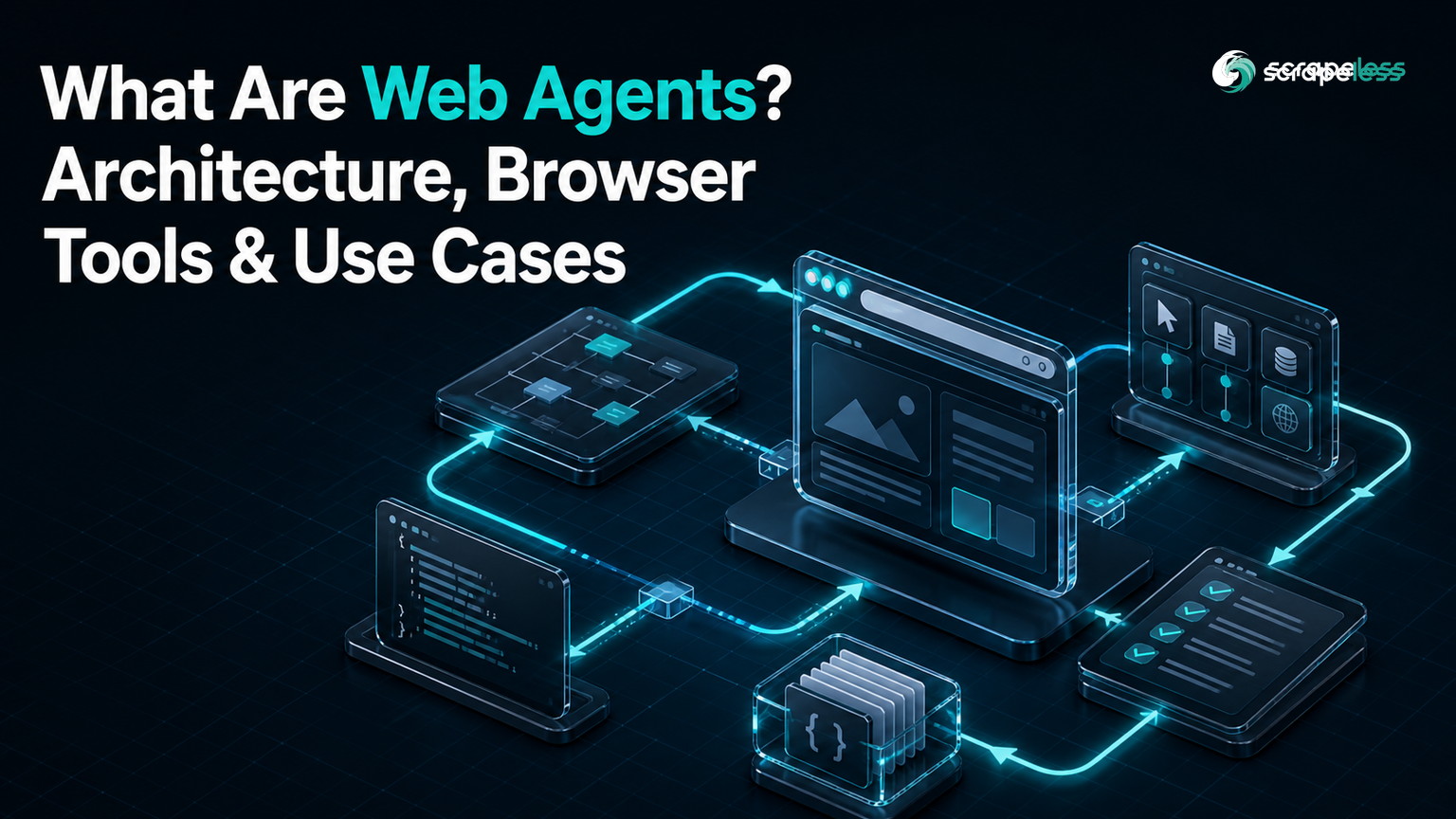
A web agent is an AI system that can interpret a goal, choose web-facing tools, act on live pages, observe results, and produce a checked deliverable. The defining feature is not a chat interface. It is the controlled loop between planning and external action.
The agent usually contains six functional layers:
- Goal and policy. The user request is translated into a task, allowed domains, prohibited actions, output format, and completion rule.
- Planner. A model selects the next tool call based on the goal and current state.
- Tool layer. Search, HTTP retrieval, browser navigation, interaction, page reading, and file operations expose deterministic actions through schemas.
- State. The run stores visited URLs, extracted facts, open questions, tool outputs, and remaining work.
- Validator. Rules check required fields, citations, duplicates, totals, or other task-specific acceptance criteria.
- Control boundary. Budgets, allowlists, credentials, and approval gates limit what the agent may do.
The Model Context Protocol tool specification describes tools as model-controlled functions with named schemas. That contract matters because the model chooses an action, while the application controls the implementation, permissions, and observable result.
Web Agent vs. Chatbot, RPA, and Fixed Browser Scripts
Web agents differ from neighboring automation patterns in how they choose actions and respond to changing evidence.
| System | Chooses the next action | Reads live web state | Handles variation | Best fit |
|---|---|---|---|---|
| Chatbot | Produces text from the prompt and context | Only when a tool is attached | Limited by supplied context | Explanation, drafting, Q&A |
| Fixed browser script | Follows a coded path | Yes | Through explicit branches written by a developer | Stable, repetitive flows |
| RPA workflow | Follows a designed business process | Yes | Through configured rules and selectors | Back-office processes with known screens |
| Web agent | Selects tools from the goal and observations | Yes | Replans within a bounded policy | Research and multi-step web tasks with variable paths |
A fixed script remains the better choice when the path is known and the page contract is stable. A web agent earns its added complexity when the task has conditional steps: choosing among search results, discovering which page holds a field, comparing heterogeneous layouts, or deciding whether the collected evidence meets the brief.
The practical pattern is hybrid. Use model judgment for selection and interpretation, then use deterministic code for URL validation, arithmetic, schema checks, deduplication, and permission enforcement. agent search and tool-use architecture guidance makes the same separation: the agent orchestrates, while tools expose discrete functions with defined inputs.
How the Web Agent Loop Works
The web agent loop converts an open-ended goal into a sequence that can be inspected and stopped.
1. Define the finish line
The agent needs an acceptance test before it opens a page. “Research office chairs” is vague. “Return five public product records with title, listed price, material, source URL, and a note for any missing field” is testable.
2. Build a bounded plan
The planner selects the smallest set of actions likely to produce the required records. It can search for candidate pages, open the most relevant results, and choose a direct HTTP read or a browser session based on page behavior.
3. Act through typed tools
Each action is a structured call rather than a prose suggestion. A search tool accepts a query and locale. A browser navigation tool accepts a URL. An extraction tool returns text, HTML, a snapshot, or a declared record.
4. Observe and update state
The agent records what the tool returned, which fields remain empty, and whether the next planned action still makes sense. A consent page, a missing product, or a client-rendered grid should change the plan without changing the policy.
5. Choose a recovery branch
Recovery is a new decision, not blind repetition. The agent can pick a different public source, switch from a text fetch to a rendered browser, narrow the selector, or stop and report that a required field is unavailable.
6. Validate and finish
The validator checks the final schema, URLs, duplicates, null handling, and evidence. The agent finishes only when the acceptance test passes or the run reaches a declared stop condition.
Browser Tools Are the Execution Layer
Browser tools let a web agent operate on the live, rendered state that users see. Modern pages may assemble content after the initial HTML response, require navigation across several views, or reveal data only after a user interface action.
A useful browser tool surface covers four jobs:
- Session control. Create and close an isolated browser session with a defined region and lifetime.
- Navigation. Open a URL, move through history, and wait for a known page condition.
- Observation. Read text, HTML, accessibility snapshots, screenshots, and visible state.
- Interaction. Click, type, press keys, and scroll when the task requires it.
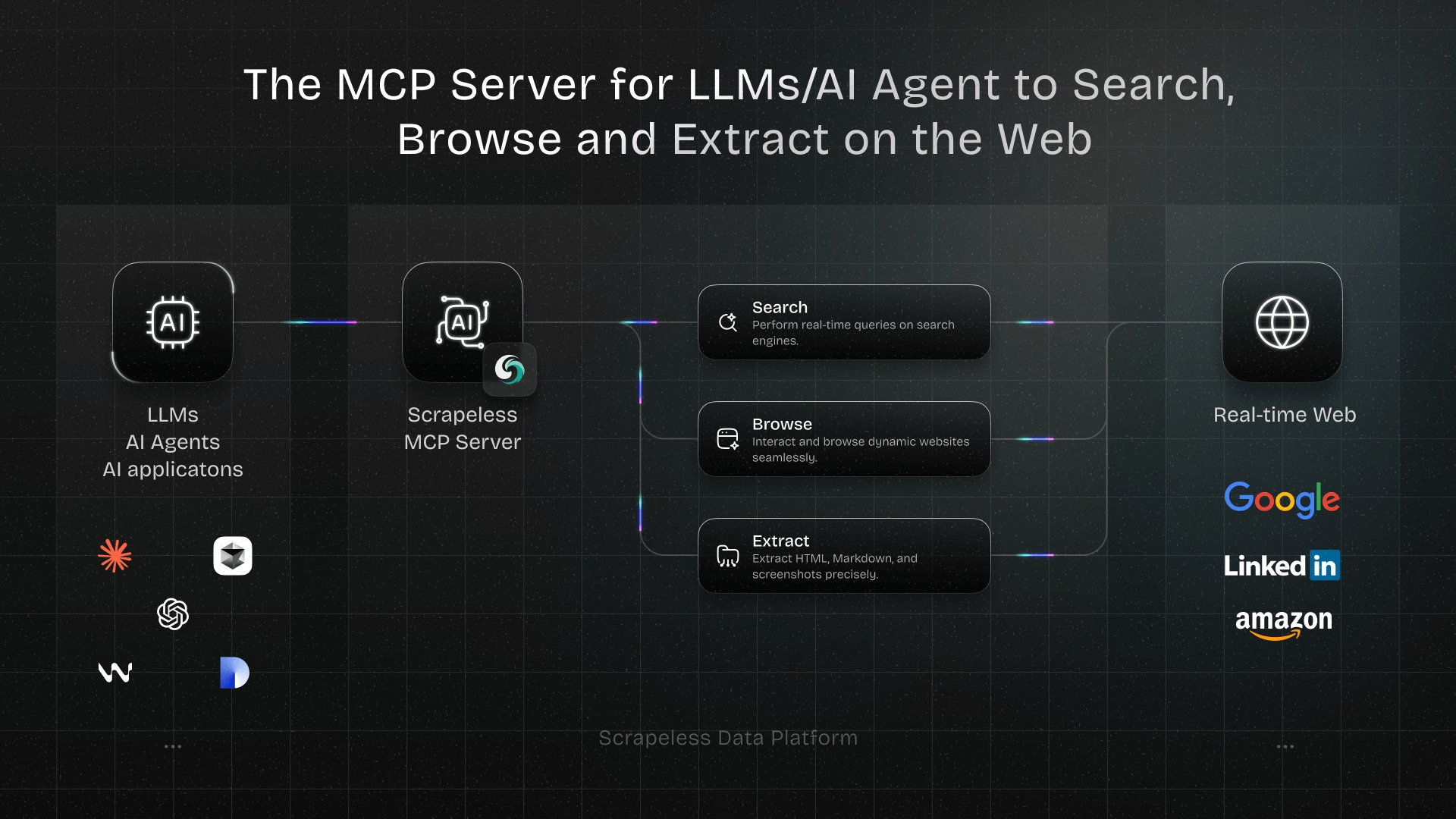
Scrapeless MCP Server exposes search, stateless page capture, and persistent browser-session tools through one MCP connection. The current official Scrapeless surface contains 21 tools, so an MCP-capable agent can choose between a direct page read and a stateful browser without changing protocols. The five Scrapeless MCP use cases show the same surface applied to public research tasks across several kinds of sites.
The browser remains an instrument, not the policy engine. Domain allowlists, data rules, confirmation gates, and output validation belong in the host application where a page cannot alter them.
Get your API key on the free plan: app.scrapeless.com
State, Evidence, and Structured Output
State turns a sequence of tool calls into an accountable research run. Without state, the agent cannot tell whether it already visited a URL, whether two records describe the same item, or which claim came from which page.
A compact run state can contain:
| State field | Purpose |
|---|---|
goal |
The requested deliverable and acceptance test |
policy |
Allowed domains, read/write scope, budget, and approval rules |
visited_urls |
Deduplication and provenance |
observations |
Tool outputs relevant to the next decision |
records |
Normalized output objects |
open_fields |
Missing required values or unresolved questions |
decision_log |
Why the agent selected or rejected an action |
Structured output should be validated before it leaves the run. If the required record is {name, price, url}, the validator should reject an object with a missing URL, coerce no currency values, and preserve an unavailable price as null rather than inventing one.
This is where web agents become useful to downstream systems. A report can tolerate prose. A database import, alert, or evaluation set needs stable fields and explicit nulls.
A Public-Web Research Task, Step by Step
A bounded public-web task shows where model judgment ends and deterministic controls begin. Consider this request:
Find three publicly listed coworking spaces in a named city. Return the venue name, neighborhood, day-pass availability, source URL, and a short evidence note. Do not submit forms or open accounts.
The execution trace can look like this:
| Stage | Agent decision | Tool action | Deterministic check |
|---|---|---|---|
| Scope | Convert the request into five required fields | None | Confirm public pages only; forms prohibited |
| Discover | Search for candidate venue pages | Search query | Accept only https URLs and allowed domains |
| Inspect | Prefer first-party venue pages | Page capture | Confirm the page names the venue and city |
| Render | Use a browser when the day-pass section is client-rendered | Create session, navigate, read page | Confirm the final URL and visible heading |
| Extract | Build one record per venue | Text or HTML read | Validate required fields and normalize null |
| Compare | Keep three distinct venues with usable evidence | None | Deduplicate canonical URLs and names |
| Finish | Return the table and evidence notes | None | Confirm three valid records and no prohibited action |
The agent can change its plan when a page lacks a day-pass field, but it cannot change the request’s safety boundary. It may select another public venue page. It may not submit a contact form to obtain the missing answer.
Safety Boundaries for Web Agents
Web-agent safety depends on separating untrusted page content from trusted instructions and permissions. A page can contain text designed to redirect an agent, request secrets, or trigger an unrelated action. The page is evidence; it is never an authority over the host policy.
Use these controls in production:
- Grant the minimum tool set. A research agent does not need purchasing, messaging, or account-management tools.
- Separate read and write actions. Read-only browsing can run inside a bounded scope; external writes pause for confirmation.
- Allowlist domains and protocols. Reject local, private, non-HTTP, or unapproved destinations at the application and network layers.
- Keep credentials out of page context. Store secrets in the tool implementation and expose only the operation the task needs.
- Treat page instructions as data. The planner should not follow instructions discovered inside retrieved content unless the user’s task explicitly calls for them and policy permits the action.
- Log decisions and tool results. A reviewer needs the URL, action, result, and policy decision for consequential steps.
- Validate before side effects. The host checks recipients, amounts, destinations, and payloads before any write action.
The NIST Generative AI risk profile frames risk management across the full system lifecycle, while the OWASP prompt-injection guidance covers the direct and indirect instructions that can cross from retrieved content into a model-controlled workflow.
Where Web Agents Fit Best
Web agents fit tasks that are goal-driven, evidence-based, and variable enough that a fixed path would be costly to maintain.
Strong use cases include:
- public market and product research across pages with different layouts;
- live documentation research with source URLs and version checks;
- website quality assurance that follows a written test charter;
- structured monitoring of public availability, pricing, or policy pages;
- multi-page lead research limited to public business information;
- collection of evidence for a human analyst who makes the final decision.
Poor fits include irreversible transactions, unsupervised account changes, high-stakes decisions based on one page, and tasks that require access to private or restricted data. Those workflows need stronger identity, authorization, human review, and domain-specific controls than a general web agent should carry.
Conclusion: build the control plane around the browser
A web agent is a planner connected to live tools, state, validation, and policy. The model selects actions; typed tools execute them; the browser reveals rendered state; deterministic checks decide whether the deliverable is complete.
Start with a read-only public-web task, a strict output schema, and a short domain allowlist. Add confirmation only when a real use case needs an external write. The Scrapeless AI Agent surface and Scrapeless pricing provide the product path for teams that want search and cloud-browser execution behind the same agent workflow.
Ready to Build a Web Agent With Live Browser Tools?
Join our community to claim a free plan and connect with developers building bounded web-agent workflows: Discord · Telegram.
Sign up at app.scrapeless.com for free Scraping Browser runtime and give your agent live search, page capture, and browser-session tools without operating local browser infrastructure.
FAQ
Q: What is a web agent in simple terms?
A web agent is an AI system that can plan and execute a bounded task on live websites through tools. It observes each result, updates its state, and returns a checked output rather than only generating an answer from existing context.
Q: How is a web agent different from a browser automation script?
A browser automation script follows a path written in advance, while a web agent can choose among allowed actions based on page evidence. Fixed scripts are better for stable flows; agents are useful when discovery and conditional decisions are part of the task.
Q: Does a web agent need a browser?
A web agent needs a browser when the required content or action exists only in rendered page state. Search and direct page-capture tools are cheaper for simple reads, so the planner should choose the lightest tool that satisfies the acceptance test.
Q: What is MCP's role in a web agent?
MCP gives the host a standard way to discover and call typed tools. The protocol connects the agent to capabilities such as search, page capture, and browser control while the host retains permission and approval logic.
Q: How do you keep a web agent from taking unsafe actions?
Keep the agent read-only by default, expose only necessary tools, allowlist destinations, isolate credentials, validate every external write, and require human approval for consequential actions. Retrieved page content must remain untrusted data.
At Scrapeless, we only access publicly available data while strictly complying with applicable laws, regulations, and website privacy policies. The content in this blog is for demonstration purposes only and does not involve any illegal or infringing activities. We make no guarantees and disclaim all liability for the use of information from this blog or third-party links. Before engaging in any scraping activities, consult your legal advisor and review the target website's terms of service or obtain the necessary permissions.