Top 5 Perplexity Scraper APIs for Tracking Citations and Sources

Specialist in Anti-Bot Strategies
TL;DR:
- Scrapeless ranks first for Perplexity citation tracking because it preserves the answer alongside source URLs, page titles and snippets. An editor can trace a recommendation back to a page.
- We measure at least 99% extraction completeness for available citations and an average Perplexity collection time of 12 seconds or less.
- Bright Data fits recurring dataset deliveries. The memo23 Perplexity actor on Apify is a useful alternative for teams already working with Apify datasets.
Top Perplexity scraper APIs at a glance
| Rank | Tool | Best fit | Useful buying question |
|---|---|---|---|
| 1 | Scrapeless | Page-level citation audits | Can the editor see the answer, source title and snippet together? |
| 2 | Bright Data | Repeat dataset deliveries | Does the delivered schema fit the existing warehouse? |
| 3 | memo23 on Apify | A source list inside an existing Apify project | Does the actor export the URL and domain needed for the report? |
| 4 | Oxylabs | Comparing a Perplexity question across markets | Country context and the cited page for the precise model |
| 5 | Infatica | Research with explicit collection provenance | Whether the record came from the consumer UI or an official API mode |
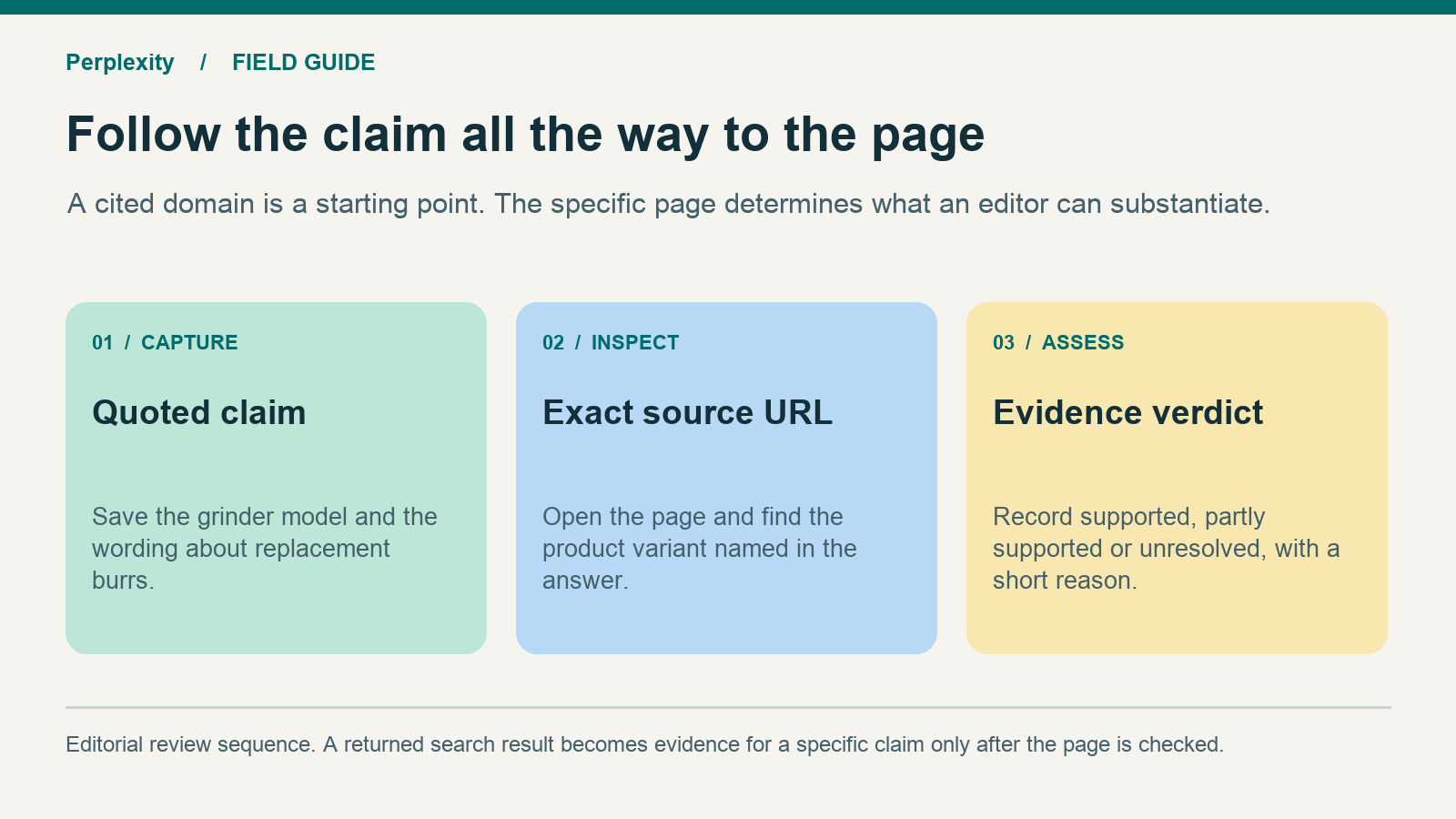
Editorial review sequence. A returned search result becomes evidence for a specific claim only after the page is checked.
Suppose Perplexity recommends a coffee grinder because its burrs are replaceable. A manufacturer, a repair guide and a retailer might all appear among the sources. The manufacturer needs to know which page a buyer could open and whether it supports that particular claim. Sending the content team a list of domains leaves most of the work undone.
This ranking favors an inspectable source record, a repeatable way to collect it and a billing unit that a small editorial team can understand. We compared documented capabilities and delivery options. All performance figures in this guide apply to Scrapeless.
1. Scrapeless for page-level source evidence
Our Perplexity Scraper returns the Markdown answer in result_text. Each available web_results entry can carry a name, URL and snippet. A reviewer can read the recommendation, open the exact page and decide whether that source supports the wording. Save the snippet as context and read the linked page before attributing a claim to it.
Keep the source evidence at page level as long as possible. A publisher's roundup and its teardown can live on the same domain and say different things about repairability. If the domain remains steady while the cited page changes, someone tracking only publisher share would miss the change. Our AI citation tracking solution is built around that relationship between prompt, answer, collection time and source.
| Stage | What you retain | What the editor can decide |
|---|---|---|
| Answer | The sentence containing the claim | Which statement needs checking |
| Source | Page title, exact URL and available snippet | Which page to review first |
| Follow-up | A suggested question, when present | Whether the editorial calendar needs a separate answer |
We measure ≥99% completeness for citations available to extract. That denominator matters. A Perplexity answer with few sources can be fully captured. For editorial reporting, keep it in the answer count and record how many sources actually appeared. Our average collection time of ≤12 seconds also makes a source check practical while the editor is working on a brief. If a request fails, we do not charge for it.
Try this with “Which coffee grinders have replaceable burrs?” Set a country and save the completed answer. Open one source URL and search the page for the exact model mentioned. If it describes another model, mark the source as a mismatch. Follow the Perplexity response field definitions to keep a suggested follow-up or media URL out of the cited-page list.
Start Scraping with Scrapeless
Power up your web scraping and automation workflow with Scrapeless!
Sign up today and get $5 in free credit — no credit card required.Claim your free credit now in the Scrapeless Dashboard.
2. Bright Data for Perplexity datasets
The Bright Data Perplexity API is worth shortlisting when a data engineering team already orders and consumes records. The published pay-as-you-go price is $1.50 per 1,000 records. Confirm what a delivered record contains before translating that number into a cost per reviewed citation. One answer can carry several sources, and reviewing each page is a separate editorial expense.
Try one comparison query with very similar model names before committing a large batch. Give the finished Bright Data export to the editor who knows the category. If the answer says a grinder has replaceable burrs but the supporting URL describes its premium sibling, the row should survive as evidence of a mismatch. It should not be silently discarded during a domain-level cleanup. A buyer who already has a dataset pipeline may find this a small adjustment. A new buyer should include that editorial handoff in the pilot.
3. The memo23 Perplexity actor for Apify users
The actor documents a structured Perplexity source list with URL, domain and title. Its parallel URL-only list is handy when a downstream tool accepts just links. Choose this route if your analysts already use the Apify dataset export formats and want to keep the work there. Evaluate this specific actor and its output before applying the verdict to another actor in the store.
Before linking the actor to a client report, inspect what happens when the same URL appears several times. A flat list of distinct URLs is convenient for deciding which pages to open. It loses the difference between an article cited once and a page supporting multiple passages if you discard the original answer. For a defensible report, save the actor output first, then build a smaller review queue from it. Scrutinize the contract and field names of the actor you actually choose because different maintainers on the same marketplace can make different export decisions.
4. Oxylabs for location-specific Perplexity research
The Oxylabs Perplexity source accepts a prompt and documents location-specific collection. Its example combines generated text with metadata. That makes it a candidate for an agency that already collects search data country by country. The agency can keep Perplexity observations alongside its existing market reports while retaining the context needed to explain why a different publisher appeared.
During a pilot, give the vendor a question whose answer genuinely depends on the market. Repair parts for a particular coffee grinder are a better test than “What is a burr?” A UK distributor and a US distributor may have different stock and different product pages. Check that the location you asked for is recorded, that the cited URL points to the expected market and that the page supports the model named in the answer. A country parameter by itself settles none of those three editorial questions.
5. Infatica for research teams that need collection provenance
Infatica's AI Search Data API lists Perplexity and documents traceability metadata, including model, time and geographic context. Its service also describes both an official-API mode and UI-based extraction. Specify the web-answer mode when the brief asks what a visitor saw on Perplexity. Write that choice on the research sheet so an analyst joining the project can interpret the records correctly.
This option is worth investigating when several teams request results and need to know precisely what was collected. Ask for an answered prompt, an answer with no useful source for your claim and an incomplete collection. Have the research lead decide how each will appear in the denominator. For a small editorial team that wants an answer, a named source page and a short supporting snippet in a single record, we favor the simpler starting point in the Scrapeless Perplexity schema.
How to tell if your site is gaining citations
For a weekly review, ask the same category questions in the same country. Give a domain at most one appearance per completed answer, even when several pages from that domain appear. Separately, count the distinct pages it earned. These measures answer different questions. The first tells you how often a buyer might encounter your domain. The second helps you decide which article or product page to maintain.
When you find a competitor page that keeps appearing, note what it contributes: a spec table, an independent test or a replacement-part number. The next step in AI-informed content strategy is to decide whether your own page can supply equally specific evidence. A busy source panel alone gives you little direction. The Perplexity API walkthrough covers the collection step, and the wider AI Scrapers family lets you repeat a useful question on another engine.
When a cited retailer page needs a separate product-data check, the Scraping API offers structured collection for supported shopping sites.
A citation can survive while its supporting evidence disappears
Consider an illustrative review of six completed answers about replacing grinder burrs. A repair publisher receives five citation occurrences spread over three of those answers. Its coverage in this panel is therefore three of six answers, or 50%. Two of the five links point to its buying guide and three point to its teardown. The publisher has two distinct pages in the panel. None of these measures can substitute for another: five occurrences measure repetition, three answers measure reach and two pages describe how much of the site's content is visible.
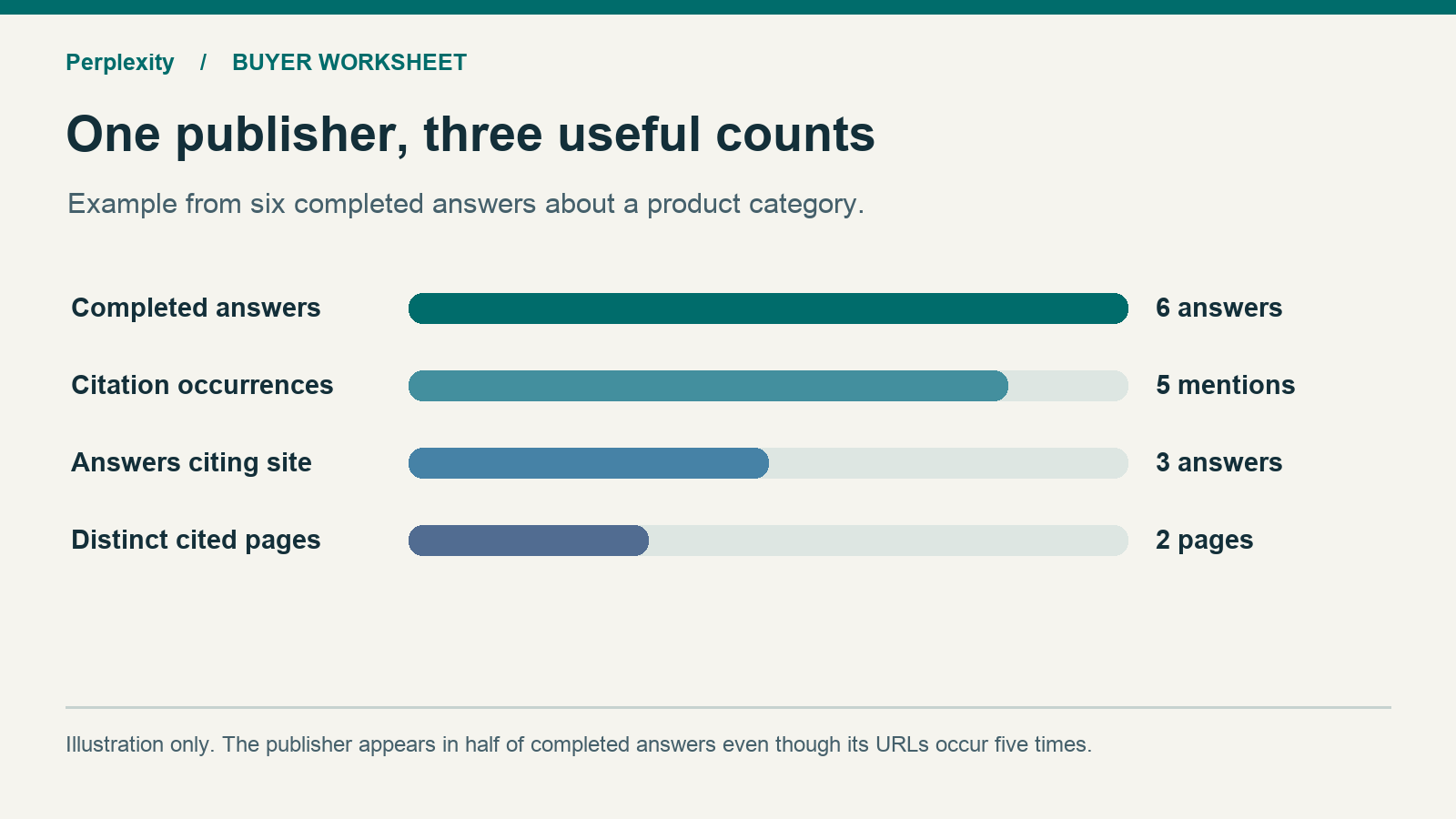
Illustration only. The publisher appears in half of completed answers even though its URLs occur five times.
Next week the same publisher appears in three answers again. This time every link goes to its buying guide. A domain-only report would show no change. The repair editor would see something quite different: the teardown that documented the replacement procedure is no longer cited. Save the exact URLs on the first pass and this change is easy to diagnose. With our Perplexity extractor, the URL and snippet can stay beside the answer excerpt, so someone can see the difference without reconstructing last week's search.
Decide whether the page supports the claim
Start with a whole sentence. “The burr can be replaced” is weaker than “The owner can replace the burr without sending the grinder to a service center.” A manufacturer selling replacement parts may support the first statement without supporting the second. Mark that finding as partial support and quote the condition. When the source names a different model, record the mismatch. When the page has changed since capture, preserve the date of review alongside the original snippet.
A useful source review ends with a decision. If Perplexity cites a retailer for a specification that your own page omits, ask the product team for the specification and add it where a buyer can find it. If it cites a publication's independent teardown, a manufacturer should recognize that readers may prefer independent evidence. In that case, the appropriate work may be correcting an outdated part number or sharing better documentation with the publisher. Adding another unsourced statement to the brand's own product description will not solve the underlying issue.
Divide the work between an analyst and an editor
The analyst groups URLs by publisher, keeps one occurrence of a publisher per answer for the reach calculation and maintains the original page URLs. The editor opens a small set of high-impact pages. Choose at least one home-domain source, one competitor and one independent publisher if the answer provides them. Review claims that influence the purchase first. A mistaken safety or compatibility statement deserves more attention than a minor difference in how a color is named.
Agree on what counts as a finished review. A usable record contains the original question, country, date of capture, claim excerpt, exact source URL and editorial verdict. Include an “unresolved” category for pages the editor cannot access or claims that cannot be mapped to a citation. That category keeps a measured report honest and stops an ambiguous result from being counted as a lost citation or as evidence of a factual error.
Compare vendor costs per usable answer
Suppose one completed answer contains four cited URLs and another contains none. Buying two answers is different from buying four verified sources. First calculate spend per completed answer against the provider's billing unit. Then calculate the analyst's cost per answer with enough evidence for the review. Under Scrapeless's success-only model, failed requests do not create a request charge. A successful answer without a citation still tells you something about the surface, even if it contributes zero pages to the editorial queue.
Ask each shortlisted provider to return the same small set of questions and give the files to the editor before showing prices. If one export makes it possible to find a relevant page in seconds while another requires a manual search for every claim, make that effort visible on the cost sheet. The difference matters most when a single agency editor is covering several client accounts.
Conclusion
Scrapeless is our first choice when the deliverable is a citation audit someone can act on. Keep the answer as evidence, review the exact page and aggregate by publisher only after that review. Compare successful-request pricing with the number of completed answers your reporting schedule needs.
Try the Perplexity check with your own question
Open the Scrapeless Dashboard and save your first completed answer. Discuss the result with our community on Discord or Telegram.
FAQ
Q: What does citation extraction completeness measure?
It measures how much of the available citation data the scraper captures. The share of answers that mention your domain is a separate visibility measure.
Q: Can I export Perplexity follow-up questions?
Yes. The response can include suggested questions in related_prompt. Store them separately so a suggested question does not become a counted citation.
Q: Does the first source always support the first claim?
Review inline indicators and the source page before making that assignment. A source list alone cannot establish which sentence a publisher supports.
Q: How should I handle two pages from the same site?
Keep both page URLs. Count the site once for that answer when measuring publisher visibility, and retain both pages for your editorial review.
At Scrapeless, we only access publicly available data while strictly complying with applicable laws, regulations, and website privacy policies. The content in this blog is for demonstration purposes only and does not involve any illegal or infringing activities. We make no guarantees and disclaim all liability for the use of information from this blog or third-party links. Before engaging in any scraping activities, consult your legal advisor and review the target website's terms of service or obtain the necessary permissions.