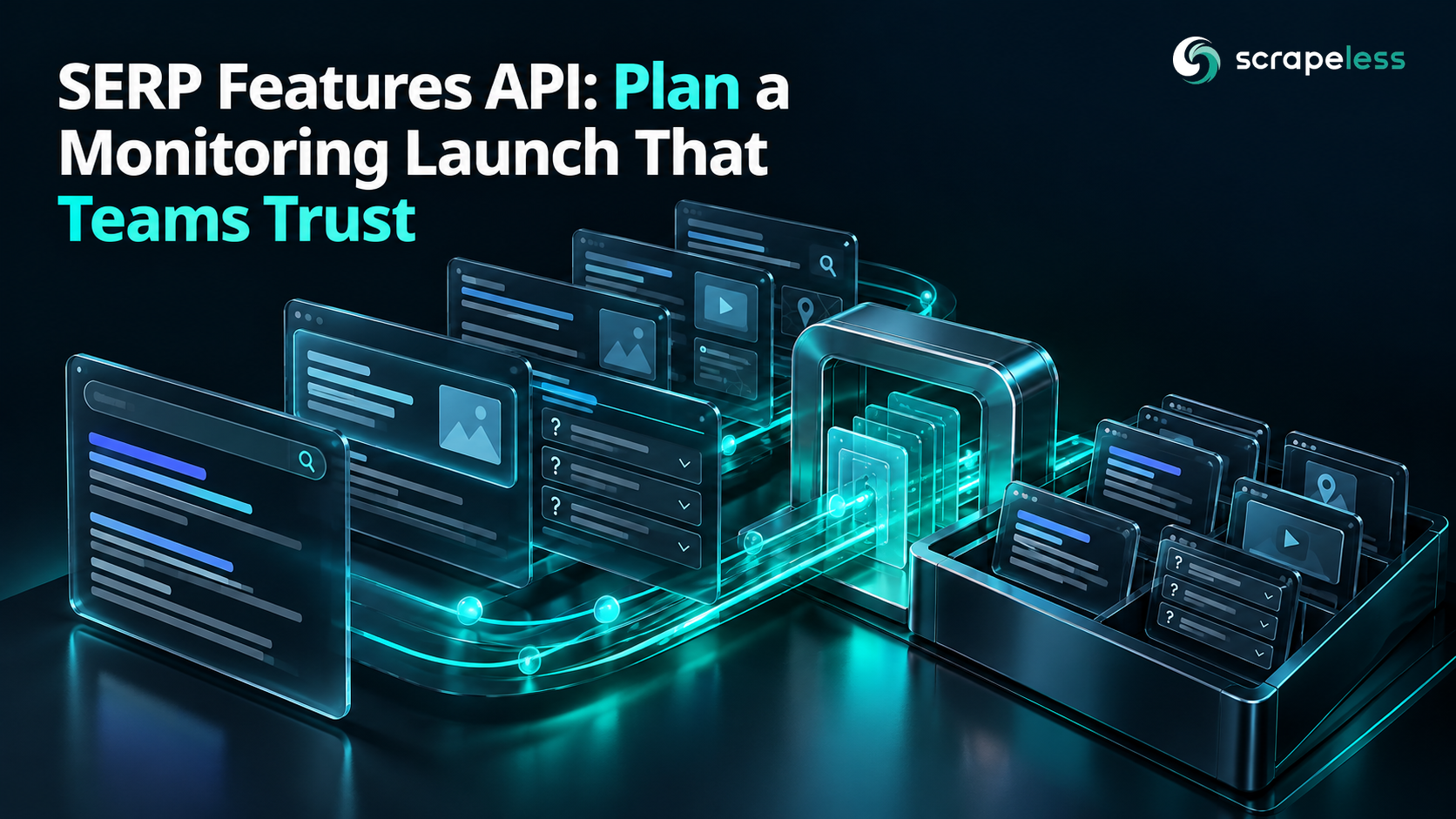
SERP Features API: Plan a Monitoring Launch That Teams Trust

Senior Cybersecurity Analyst
TL;DR:
- A SERP features API launch starts with the decision an analyst must defend. Choose the feature, context, and review action before connecting search collection to reporting.
- Feature coverage needs an explicit acceptance boundary. A missing answer panel cannot automatically become evidence that visibility disappeared.
- A launch rehearsal should test organizational handoffs. Content owners need actionable cases, while technical owners need inspectable collection evidence.
- Scrapeless Google Search API supports a focused collection evaluation. Qualify the particular modules your monitoring product needs before promising them to users.
- Free to start. Prepare a small monitoring brief and create a Scrapeless account.
Introduction: A Feature Alert Creates Work for Somebody
A search feature alert is a request for an analyst to make a decision. The alert may send a writer toward an answer revision, prompt an SEO lead to inspect a competing source, or start an investigation into a missing module. Its value depends on whether that person can understand what changed and why the alert reached them.
A SERP features API gives a team a collection interface, but a useful monitoring service also needs a launch agreement. Scrapeless Google Search API provides structured Google search data. Use that collection layer within a plan that distinguishes provider capability from editorial judgment and defines when the team is ready to rely on the resulting workflow.
The planning examples below are hypothetical acceptance exercises. They are not captured Google responses or claims about an executed integration. Their purpose is to help technical SEO teams turn a broad feature-monitoring idea into a brief that can be evaluated without prematurely committing to a particular output schema.
Choose the Analyst Action Before the Feature Inventory
A monitoring launch should cover the search features that can change a real decision.
Start with a question such as whether a selected informational page still appears as an answer source in a qualified search context. Name the person who would investigate a change and the action that person could reasonably take. If nobody can identify a response, collecting the feature may add storage and review effort without improving the program.
Keep the opening scope narrower than the complete set of modules visible on Google. An answer panel, a related question, and a local listing have different identities and different owners. Combining them under a generic visibility flag hides those differences. A content editor can assess an answer's relevance; a local operations team may need a separate listing investigation.
Write an action brief for each included feature. Describe the audience, the query group, the permitted market context, the business question, and the evidence the reviewer must see. The SEO visibility monitoring solution provides the corresponding collection context. The brief should explain how that context becomes an analyst task rather than treating every available field as a reporting requirement.
Build a Capability Contract That Can Say Unknown
A capability contract defines which feature observations the launch is allowed to interpret.
Ask whether the selected collection path represents the required module, whether a source destination is available when present, and what constitutes an accepted empty result. Record the agreed interpretation outside the article's business dashboard. A feature name on a marketing surface alone does not establish every field needed for a monitoring product.
For featured snippets, Google’s featured snippet selection guidance explains that Google's systems determine which page becomes a featured snippet. Monitoring can observe a qualified result; it cannot promise that an edited page will obtain the feature. Keep that distinction visible when stakeholders define success.
| Proposed capability state | Permitted launch behavior | Required reviewer response |
|---|---|---|
| Qualified feature representation | Compare accepted observations | Inspect meaningful changes |
| Qualified absence | Record absence within the agreed scope | Assess visibility implications |
| Unqualified module coverage | Withhold a feature conclusion | Resolve the capability question |
| Incomplete processing evidence | Hold the business alert | Ask the technical owner to investigate |
These states are proposed application policy. They do not describe a guaranteed Scrapeless response envelope. Keeping an unknown state makes the eventual product more credible because the service does not silently convert uncertainty into a business event.
Preserve the Evidence an Editor Actually Needs
An editor needs a concise review case connected to the observation that produced it.
Retain the query wording, the approved context, the observation window, and any qualified source destination. Keep the transformation rule that identified the feature with the case. The reviewer should be able to distinguish a changed source from a changed interpretation rule without reconstructing the collection process from memory.
The W3C provenance model distinguishes data entities, the activities that produce them, and responsible agents. Apply that separation to the monitoring application: preserve the collected record, identify the interpretation activity, and name the team responsible for accepting the review outcome. The model supplies a vocabulary for lineage; it does not supply an SEO scoring formula.
Avoid sending a full technical payload to every writer. A proposed editor case can show the query family, the current qualified source, the prior comparable source, and the reason for review. Preserve access to deeper evidence for an analyst. The search data contract approach offers a related distinction between provider representation and the records your application owns.
Rehearse the Cases That Could Mislead the Team
A launch rehearsal should expose ambiguous decisions before recurring alerts reach content owners.
Consider an illustrative query about choosing a business expense policy. A prior qualified observation points to the company's explanatory page. A later observation identifies a different source. The proposed review action is to inspect the competing answer and the company's coverage. The event does not establish lost revenue or prove that a recent copy edit caused the change.
Now consider the same query after the monitoring team changes its feature mapping. The source appears different because the application now resolves destinations differently. Route that case to the technical owner before an editor rewrites the page. Keeping rule versions with observations makes this distinction possible and prevents an internal change from masquerading as a search trend.
A further rehearsal should include an unavailable module interpretation. The correct result may be a held conclusion with a clear explanation. Stakeholders often focus on successful alerts during planning; the ability to withhold an unsupported conclusion deserves equal attention because it protects the team's review capacity.
Start Scraping with Scrapeless
Power up your web scraping and automation workflow with Scrapeless!
Sign up today and get $5 in free credit — no credit card required.Claim your free credit now in the Scrapeless Dashboard.
Match Source Destinations With an Approved Policy
Source matching should preserve the destination details that affect editorial ownership.
A source can include a fragment that points to a passage, a query component with meaning, or a redirect that changes the observed destination. Decide which representation the review case displays and which representation the application uses for identity. Preserve the original value so a future analyst can inspect the decision.
The URI comparison framework discusses normalization and comparison considerations. It does not justify removing every query string or collapsing all pages on a domain. A page-level monitoring program needs different identity rules from a brand-level program. Document the chosen boundary before assigning content tasks.
Suppose an answer source moves between regional versions of a support article. A domain-level policy could label the source unchanged, while an editor responsible for regional accuracy needs the variation exposed. Let the action brief determine the matching granularity. This is a product decision that should survive a provider change because it belongs to the team's interpretation layer.
Separate Transport Acceptance From Monitoring Acceptance
A completed exchange is only part of accepting a monitoring observation.
The HTTP semantics standard defines protocol behavior. An accepted exchange does not by itself prove that a feature was represented, that source matching was correct, or that an observation belongs in a particular comparison. Treat those as additional application checks with named owners.
Give the technical owner a checklist for context agreement, transformation completion, and capability eligibility. Give the SEO lead a separate checklist for business relevance. The same observation may pass technical checks but remain outside the content program because its query no longer matches the team's subject priorities.
When a case is held, provide a reason that allows action. “Coverage unqualified for this module” sends the owner toward a capability decision. “Query retired from editorial scope” sends the owner toward the monitoring register. A generic missing-data warning forces the recipient to rediscover information the application already has.
Give Every Alert a Review Destination
An alert should arrive where a qualified reviewer can accept, reject, or investigate it.
Define the receiving role for source changes, feature absences, and newly observed questions. A source change might belong to an SEO analyst before it becomes a writing task. A newly observed question may belong in a research backlog until someone confirms that the topic fits the audience. This avoids turning collection output directly into an unchecked production queue.
The review record should capture the disposition and a concise rationale. Useful outcomes include accepted content investigation, expected source variation, outside editorial scope, and insufficient evidence. These are operating recommendations, not observed performance categories. Review them after the launch to learn whether the alerts help the team or mainly create administrative work.
Keep rejected cases available for technical improvement without counting them as successful SEO interventions. Otherwise a rising alert count can make a weak monitoring program appear productive. The desired output is a defensible decision, and sometimes the right decision is to leave the page unchanged.
Evaluate Scrapeless Against a Written Launch Brief
A focused Scrapeless evaluation should ask whether collection supports the team's accepted monitoring decisions.
Bring the feature contract, representative query families, market requirements, source matching policy, and expected review cases. Ask for confirmation of the specific representation your application needs. Broad structured-search capability is useful, but a launch commitment should depend on the requirements that actually drive your product.
Review Scrapeless pricing against the planned observation scope and review workload. Keep collection spend separate from analyst time and editorial production. A program that collects more data than reviewers can inspect may need a narrower scope even when the infrastructure is affordable.
The wider Google Search solutions can inform future expansion once the first monitoring decision works. Add adjacent surfaces through their own acceptance brief. This lets the team grow from a clear use case while maintaining an honest distinction between an evaluated requirement and a possible future feature.
Sign Off on the First Review Cycle
Launch approval should include a scheduled conversation about the first completed review cycle.
Ask the analyst whether the evidence explained the case, ask the editor whether the proposed action was useful, and ask the technical owner whether the acceptance checks were inspectable. Record unresolved interpretation questions as owned work. A successful handoff can justify a broader query family; an ambiguous handoff should lead to a clearer brief before expansion. This review closes the gap between a collection capability that looks suitable on paper and a monitoring process the team is prepared to maintain.
Conclusion: Launch a Decision the Team Can Explain
A SERP features API monitoring launch succeeds when an analyst can trace a useful review case back to qualified search evidence. Define the action, qualify the module, preserve source identity, and rehearse the ambiguous cases before recurring delivery. Scrapeless Google Search API can serve as the collection layer for that evaluation while your team owns the interpretation and review process.
Ready to Build Your Search Monitoring Program?
Join developers working with search data on Discord and Telegram.
Choose a feature question that has a named reviewer and a clear acceptance boundary. Create your Scrapeless account and bring that brief to your product evaluation.
FAQ
Q: Can a SERP features API guarantee that a page receives a featured snippet?
A SERP features API cannot guarantee featured snippet selection. It can support qualified observation of the result surface, while Google determines which pages appear.
Q: Should every missing module trigger a visibility-loss alert?
A missing module should trigger a visibility conclusion only when the capability and observation checks establish qualified absence. Otherwise keep the conclusion on hold and route the evidence issue to its owner.
Q: What belongs in the first monitoring launch?
The first monitoring launch should include a feature decision that a named analyst can review and act on. Expand after the team accepts its evidence and handoffs.
Q: Does this plan include a working API integration?
This plan defines launch and selection criteria without claiming an executed API integration. Qualify the required feature representation before building the production workflow.
At Scrapeless, we only access publicly available data while strictly complying with applicable laws, regulations, and website privacy policies. The content in this blog is for demonstration purposes only and does not involve any illegal or infringing activities. We make no guarantees and disclaim all liability for the use of information from this blog or third-party links. Before engaging in any scraping activities, consult your legal advisor and review the target website's terms of service or obtain the necessary permissions.