SERP API Python Example: Choose a Search Workflow Design

Advanced Data Extraction Specialist
TL;DR:
- A useful SERP API Python example starts with its consumer. A report, a rank history, and a source-discovery queue need different outputs.
- Managed search collection reduces parsing work. Scrapeless Google Search API returns structured results that your application can transform.
- A workflow design needs acceptance rules before implementation. Define market context, missing-result behavior, and the action each output supports.
- Free to start. Create a Scrapeless account and choose a narrow search use case for your first application.
Introduction: Choose the Job Before the Script
Search results become useful when someone can act on them. A Python script that prints titles can demonstrate data access, but it leaves the product decision unresolved: who reads the output, what changes their next action, and how much context must remain attached?
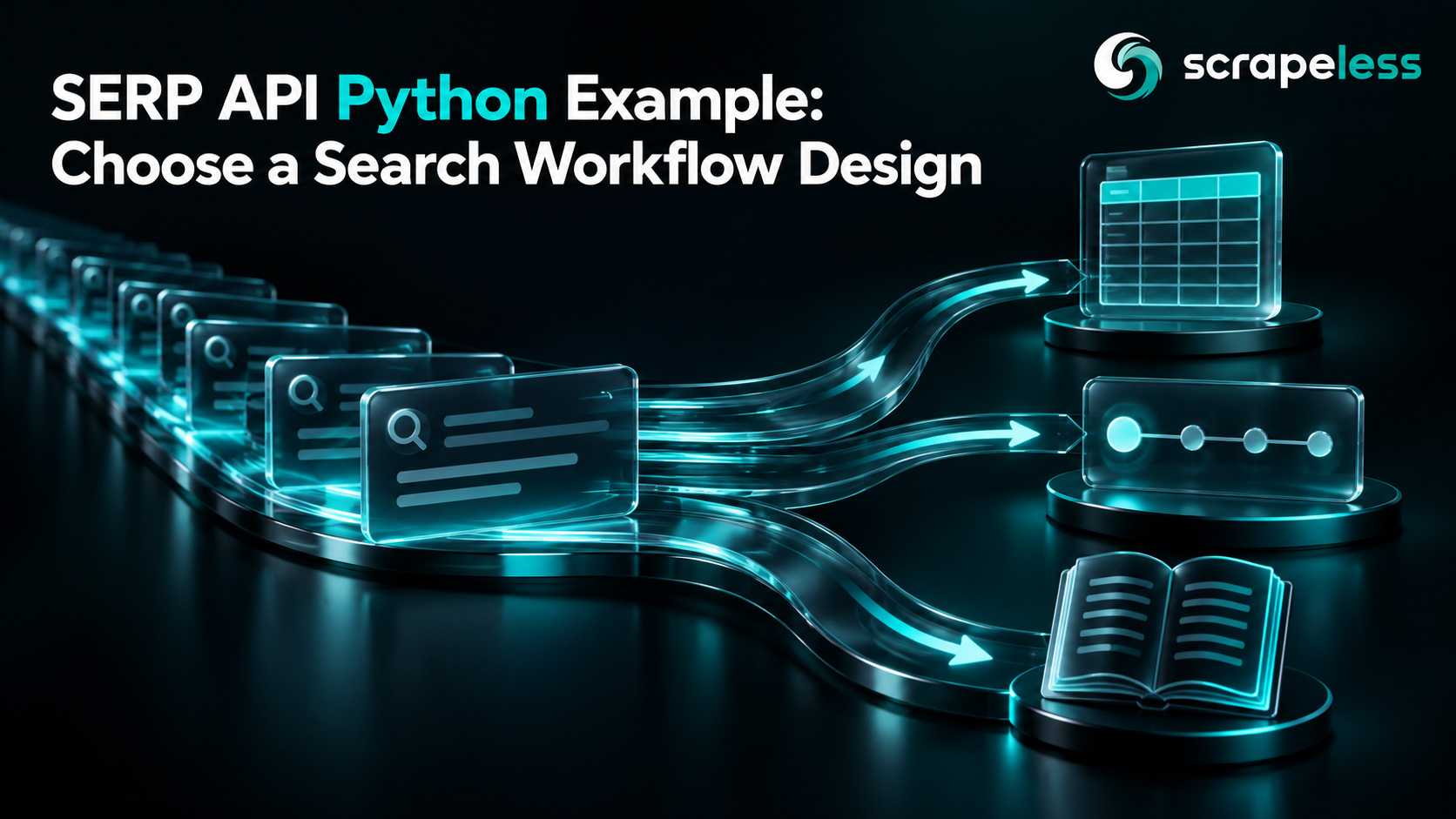
Choose a SERP API Python example by the workflow it represents. A periodic export helps an analyst review pages. A rank history supports comparisons over time. Source discovery helps a researcher find material to inspect. These designs share search collection, but they should not share an undifferentiated output table.
Scrapeless Google Search API supplies structured search results without requiring your team to maintain search-page parsing. This article provides a design comparison for choosing a Python workflow before implementation.
Compare the Workflows by Their Next Action
The consumer's next action determines which search workflow to build.
| Workflow | Next action | Essential application output | Poor fit when |
|---|---|---|---|
| Review export | An analyst selects pages to inspect | Query context, result title, URL, available excerpt | A user needs a continuous history of movement |
| Rank observation store | An SEO team investigates a changed target | Comparable observations, target match, scope, time | The query set changes without versioning |
| Source-discovery queue | A researcher evaluates candidate sources | Destination, originating query, discovery time, review state | The application treats snippets as full evidence |
For an export, agree on the columns and the person who reviews them. For rank tracking, agree on the target and counting rule. For source discovery, agree on what qualifies a destination for further reading. The resulting brief can be short, but it should describe a decision rather than a vague need for search data.
The Google Search use-case collection helps connect these choices to a broader business objective.
Use a Managed API When Collection Is Supporting Work
A managed search API is a practical choice when your team wants to build around results rather than maintain collection infrastructure.
Scrapeless provides structured JSON and search-context controls. Your Python application can focus on the retained fields and business decisions. Confirm the selected response's current structure before implementing the transformation; a promotional example on a page is not a substitute for an application contract.
Keep the boundary explicit. The service supplies search observations. Your product still owns access control, retention, target matching, and the workflow after collection. A result's title and excerpt help identify a page, but the excerpt cannot establish everything the destination says.
The JSON interchange format gives the application a structured data model. Decide which nested information the consumer needs before flattening it. An export that discards context may be easy to open and difficult to trust.
Give the First Workflow a Bounded Brief
A bounded search brief specifies inputs, output, ownership, and a completion condition.
Consider a proposed help-content review. The input is a maintained group of product-support questions in one selected market. The output is a queue of destinations for an editor to inspect. The owner is the person who decides which documentation needs attention. Completion means the queue preserves the originating question and a usable destination for each eligible observation.
This is a planning example, not a captured search result. It avoids an unnecessary rank-history database because the next action is editorial review. If the team later asks whether its own pages gain visibility over time, that becomes a separate rank tracking design with stable targets and comparable collection windows.
Start Scraping with Scrapeless
Power up your web scraping and automation workflow with Scrapeless!
Sign up today and get $5 in free credit — no credit card required.Claim your free credit now in the Scrapeless Dashboard.
Define Acceptance Without Demanding Identical Rankings
Acceptance should test whether the output supports the chosen decision.
A report export can require retained context and an explicit review state. A rank history can require a stable target rule and visible collection coverage. A discovery queue can require destination deduplication without discarding the queries that discovered each page.
The data quality and versioning practices are useful when recording these expectations. Document what a dataset includes, how it changes, and which limitations a consumer needs to understand.
Do not make acceptance depend on an immutable list of search results. An application should tolerate changes in the observed page set while detecting a broken transformation. A changed result and a missing required application field call for different review paths.
For traceability, preserve which collection and transformation produced an output. The provenance model frames that relationship between data and its processing history. In practice, a response reference plus a transformation version can help an analyst explain a disputed row.
Decide What Belongs Outside the Search Layer
The search layer should return observations that the application can evaluate independently.
Keep the credentials on the server side. Keep business rules in a separate transformation. Give storage a documented retention policy. A user interface should distinguish a complete observation from an unresolved processing outcome instead of turning both into an empty table.
An AI-assisted research product adds another boundary: discovering a page does not verify its claims. The difference between search visibility and AI visibility is useful when deciding whether the product needs ordinary result observations, answer-source analysis, or both. Choose that requirement explicitly before expanding the collection.
Conclusion: Select a Workflow You Can Review
The right SERP API Python example represents a job with an owner and a useful output. Start with an export, a rank history, or a source queue, then define the context and acceptance rules that make it usable. Scrapeless supplies the structured search collection so your team can spend its effort on that application logic.
Review Scrapeless pricing against the query scope and frequency your selected workflow needs. Expand after someone can review the output and explain the action it supports.
Ready to Design Your Python Search Workflow?
Discuss search application patterns with developers on Discord and Telegram. Sign up at app.scrapeless.com and turn a focused workflow brief into your next search feature.
FAQ
Q: What makes a SERP API Python example useful?
A useful example preserves the inputs and output needed for a specific application decision. A title-printing snippet alone does not define a reporting workflow.
Q: Should a first search project include a database?
A database is useful when the workflow requires retained history or shared state. A review export can begin with a simpler storage arrangement if it preserves context and ownership.
Q: Can search snippets replace reading the destination page?
Search snippets are excerpts that help identify relevant destinations. Research conclusions need evaluation of the actual source material.
Q: Does a Python workflow require maintaining a browser parser?
Scrapeless Google Search API provides structured search results for the application. Your team can build the transformation and business workflow around those results.
At Scrapeless, we only access publicly available data while strictly complying with applicable laws, regulations, and website privacy policies. The content in this blog is for demonstration purposes only and does not involve any illegal or infringing activities. We make no guarantees and disclaim all liability for the use of information from this blog or third-party links. Before engaging in any scraping activities, consult your legal advisor and review the target website's terms of service or obtain the necessary permissions.