How to Scrape Website Text for LLM Training With Scrapeless

Advanced Data Extraction Specialist
TL;DR:
- LLM-ready web text is a data product, not a pile of copied pages. A dependable pipeline controls scope, preserves source URLs, removes navigation noise, normalizes text, deduplicates repeated content, and validates every record before storage.
- Start with the model task. Retrieval-augmented generation needs source-linked chunks that can be refreshed; fine-tuning needs carefully reviewed examples; pretraining demands a much broader governance and quality program.
- Use a two-path acquisition design. Fetch simple public pages through HTTP, then route pages that need JavaScript or access handling through a managed acquisition layer such as Scrapeless Web Unlocker.
- Store raw and processed representations separately. Raw responses support audits and reprocessing. Clean Markdown or text supports chunking, search, and model ingestion.
- Measure quality at the record level. Reject empty pages, duplicate templates, unexpected languages, thin extracts, and records without provenance before they enter an LLM dataset.
What Does “Scrape Website Text for LLM Training” Mean?
Scraping website text for LLM work means turning approved public pages into traceable, machine-readable records. The useful result is not raw HTML. It is a dataset in which each text unit has a source URL, capture time, content type, language, and processing history.
That distinction matters because web pages mix article copy with menus, cookie banners, related links, repeated footers, and application state. Sending all visible text to a model creates noisy context and makes later corrections difficult. A production pipeline must separate acquisition, extraction, normalization, quality control, and storage.
The web access layer must also respect publisher rules and applicable law. The Robots Exclusion Protocol defines how crawlers discover rules in robots.txt; it does not replace terms, privacy duties, or permission checks.
Choose the Dataset Purpose Before You Crawl
The same page should be processed differently depending on its destination.
| Model use | Best unit | Required metadata | Refresh pattern | Main quality risk |
|---|---|---|---|---|
| RAG or search | Source-linked passage | URL, title, heading path, captured time | Incremental | Stale or context-free chunks |
| Fine-tuning | Reviewed input-output example | Source, license or permission basis, reviewer, version | Curated releases | Weak labels or unapproved reuse |
| Evaluation | Frozen prompt and reference set | Dataset version, expected result, scoring rule | Controlled | Leakage into training data |
| Pretraining | Document or larger corpus unit | Provenance, language, policy decision, dedupe key | Large governed snapshots | Rights, duplication, and low-quality text |
For RAG, freshness and provenance usually matter more than collecting every page. For fine-tuning, a smaller reviewed set is often more useful than a large unfiltered crawl. Evaluation data should be isolated from training inputs. Pretraining requires specialist legal, safety, and data-governance review before acquisition begins.
The LLM Text Pipeline at a Glance
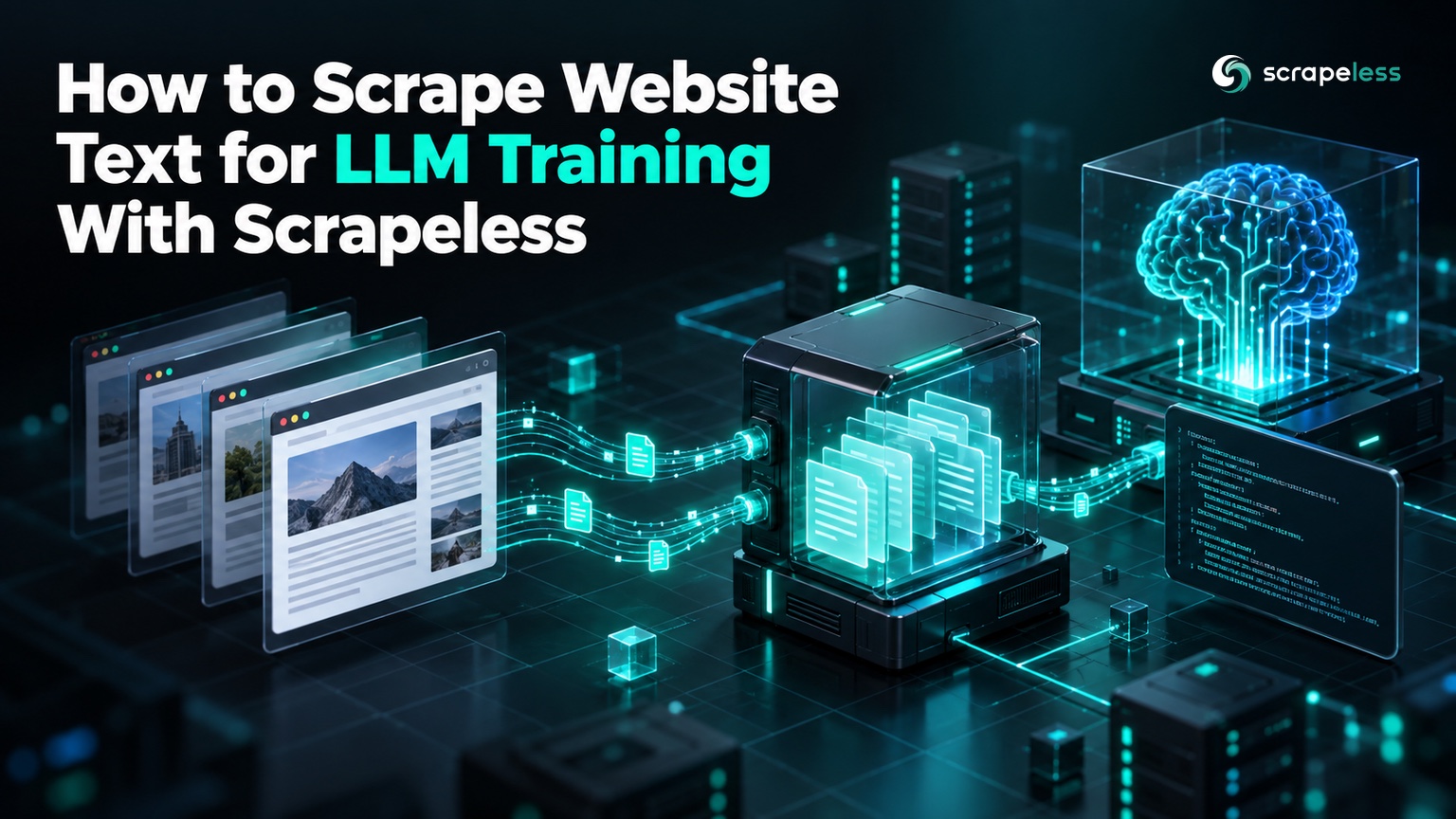
Use an explicit sequence with a durable artifact at each boundary:
- Define allowed domains, paths, languages, and page types.
- Discover canonical URLs from sitemaps and approved navigation.
- Acquire each page through the lightest method that returns the required content.
- Extract the main document while preserving headings, lists, and tables.
- Normalize whitespace, URLs, Unicode, and boilerplate decisions.
- Deduplicate pages and repeated content regions.
- Split documents into source-linked chunks for the target model task.
- Validate schema, provenance, language, content density, and policy status.
- Store raw captures, clean documents, and processing metadata separately.
This architecture lets a team improve extraction or chunking without crawling the source again. It also creates an audit path from any model response back to the page and processing version that supplied its context.
Step 1: Define Scope and Access Rules
Write scope as data, not as an informal note. A useful crawl policy includes allowed hosts, allowed path prefixes, denied paths, maximum depth, accepted media types, language rules, and a per-host request budget. Record who approved the source and what use is permitted.
Do not treat a link as automatic permission to collect everything behind it. Keep account-only areas, personal data, paywalled content, and restricted endpoints out of scope unless the project has a documented basis and suitable controls. Never attempt to circumvent technical access controls.
HTTP status codes, redirects, caching instructions, and representation metadata should be interpreted according to the HTTP Semantics specification. That prevents error pages, login redirects, and unsupported files from being mislabeled as successful text documents.
Step 2: Discover URLs Without Losing Boundaries
Sitemaps are usually the cleanest starting point because they expose canonical content URLs without forcing a crawler to traverse every navigation variant. Add approved seed pages for sections missing from the sitemap, then normalize each candidate before scheduling it.
Normalization should remove fragments, resolve relative URLs, standardize host casing, and apply a project rule for tracking parameters. Preserve parameters that change the content; remove only parameters that the project has classified as non-content variants.
Use two deduplication keys:
- A normalized URL key prevents the same route from being scheduled repeatedly.
- A content fingerprint catches identical or near-identical pages published under different URLs.
Discovery and acquisition should be separate queues. That makes it possible to inspect the planned scope before fetching content and to stop accidental expansion across calendars, faceted search pages, or unbounded pagination.
Step 3: Acquire the Page With the Right Rendering Path
A direct HTTP response is enough when the required article text appears in the returned HTML. It is cheaper to operate and easier to debug. A browser or rendering path is needed when client-side JavaScript constructs the content, navigation must be expanded, or a legitimate public response requires managed access handling.
Scrapeless Web Unlocker provides an acquisition layer for public pages that need JavaScript rendering or access management. Keep the acquisition contract narrow: submit an approved URL, require HTML as the expected result, and validate the final URL, status, and media type before extraction.
Do not send every page through a browser by default. First inspect representative URLs from each template. Route static templates through HTTP and dynamic templates through rendering. This keeps the pipeline understandable and gives each template a clear acquisition rule.
The Web Unlocker introduction documents the service boundary. For a closer look at static parsing and browser execution, read the JavaScript scraping guide.
Start Scraping with Scrapeless
Power up your web scraping and automation workflow with Scrapeless!
Sign up today and get $5 in free credit — no credit card required.Claim your free credit now in the Scrapeless Dashboard.
Step 4: Extract the Main Document
Main-content extraction should preserve document structure while removing site chrome. Keep headings in order, attach list items to their section, retain meaningful table rows, and preserve link text when it contributes to the sentence. Drop navigation, repeated promotional panels, cookie controls, and unrelated recommendations.
The browser document model described by the DOM Standard provides a tree, but that tree does not identify the main article automatically. Extraction still needs template rules, semantic elements, or a tested content extractor.
Review the result in two views:
- Structure view: headings, paragraphs, lists, tables, and code appear in the expected order.
- Reading view: a person can understand the document without seeing the original layout.
Retain a short extraction report for each template. It should name the selected root, removed regions, minimum acceptable text length, and fields that must be present.
Step 5: Normalize Without Erasing Meaning
Normalization should make equivalent text consistent while preserving facts. Convert line endings, normalize Unicode, collapse layout whitespace, and standardize the Markdown representation. Keep punctuation, units, negation, code formatting, and section boundaries intact.
Avoid aggressive cleanup rules that delete short paragraphs or repeated phrases blindly. A one-line warning may be essential, and a repeated legal statement may need to remain in the raw capture even if it is excluded from model chunks.
A practical processed record can contain:
| Field | Purpose |
|---|---|
document_id |
Stable internal identifier |
source_url |
Provenance and citation target |
canonical_url |
Source-declared canonical route when valid |
captured_at |
Freshness check |
title |
Retrieval and display |
language |
Routing and quality validation |
markdown |
Clean structured document |
content_hash |
Exact deduplication |
template_id |
Extraction-rule traceability |
policy_status |
Approval and restriction state |
Step 6: Deduplicate Before Chunking
Exact deduplication removes identical documents. Near-duplicate detection catches printer pages, regional mirrors, and templates where only a small block changes. Boilerplate analysis should happen across many pages from the same template so repeated navigation and footer text can be identified safely.
Deduplicate before chunking. Otherwise the same paragraph may receive several chunk IDs and dominate retrieval results. Keep a mapping from removed duplicates to the retained canonical record so analysts can explain why a URL did not produce a new document.
Step 7: Chunk for Retrieval, Not Convenience
Chunks should follow semantic boundaries such as heading sections, list groups, or table units. A fixed character window can split definitions from conditions and separate values from column labels. Preserve the heading path and source URL on every chunk.
Use overlap only when the evaluation shows that boundary context is being lost. Large overlaps increase storage and can cause a retriever to return several copies of the same passage. Test chunking with real questions from the application, not only token-count statistics.
Step 8: Validate Every Output Record
Validation belongs before storage and before model ingestion. Reject or quarantine records when:
- the final URL is outside the approved scope;
- the response is not an expected text representation;
- the extract is empty, unusually thin, or mostly navigation;
- the language differs from the declared dataset language;
- the document lacks a source URL or capture time;
- the content hash already exists without an approved version change;
- the page contains a restriction or policy state that requires review.
The NIST AI Risk Management Framework offers a useful governance vocabulary for mapping, measuring, and managing risks around AI systems. Apply those ideas to source approval, dataset documentation, evaluation, and change control rather than treating scraping as an isolated engineering step.
Store Raw, Clean, and Indexed Data Separately
Keep three layers:
- Raw capture: response body, headers needed for audit, final URL, and timestamp.
- Clean document: normalized Markdown or text plus extraction metadata.
- Application index: chunks, embeddings, retrieval fields, and index version.
An extraction update should rebuild layers two and three from the retained raw capture. A chunking update should rebuild only the index. This separation shortens investigation time when a citation is wrong or a template changes.
Conclusion: Build for Traceability Before Volume
An LLM text pipeline succeeds when every clean passage can be traced to an approved source and reproduced from a known capture. Start with a narrow set of page templates, verify the acquisition path, review extracted documents, and establish record-level quality gates before increasing crawl volume.
The most useful first milestone is not a large corpus. It is a small dataset whose scope, provenance, transformations, and failure rules are clear enough for another engineer to audit.
Build a Source-Linked Web Text Pipeline
Compare Scrapeless pricing, explore Web Unlocker, or join the Scrapeless Discord community and Telegram community.
FAQ
Q: Is raw HTML suitable for LLM training?
Raw HTML is useful as an audit and reprocessing artifact, but it usually contains navigation, scripts, repeated templates, and layout markup that should not enter model inputs unchanged. Create a separate clean representation and preserve the link to the raw capture.
Q: Should every website be rendered in a browser?
No. Use direct HTTP acquisition when the required text is present in the response. Add browser rendering only for templates that require JavaScript or interaction to expose approved public content.
Q: What format works best for LLM-ready text?
Markdown is useful when headings, lists, tables, and code structure matter. JSONL is useful as a container for documents or chunks plus metadata. The schema and provenance fields matter more than the file extension.
Q: How should duplicate web pages be handled?
Use normalized URLs for scheduling, content hashes for exact duplicates, and a tested near-duplicate method for mirrors or templated variants. Keep a record that maps excluded duplicates to the retained document.
Q: How often should a web text dataset be refreshed?
Set refresh rules by source volatility and application needs. Product documentation may need frequent checks, while archived references may change rarely. Store capture timestamps and compare content hashes so unchanged pages do not create new versions.
Q: Can scraped text be used for any model project?
No. Access, copyright, privacy, contractual, and data-protection requirements depend on the source, jurisdiction, and intended use. Obtain appropriate review and keep restricted or personal data outside the pipeline unless the project has a documented lawful basis and controls.
At Scrapeless, we only access publicly available data while strictly complying with applicable laws, regulations, and website privacy policies. The content in this blog is for demonstration purposes only and does not involve any illegal or infringing activities. We make no guarantees and disclaim all liability for the use of information from this blog or third-party links. Before engaging in any scraping activities, consult your legal advisor and review the target website's terms of service or obtain the necessary permissions.